
五个必须

Search documents
定信心用好优势 不断巩固拓展经济稳中向好势头
Xin Hua She· 2025-12-16 00:54
Core Viewpoint - The recent Central Economic Work Conference outlines the economic work for 2025 and 2026, emphasizing the need to maintain confidence, leverage advantages, and address challenges to ensure a stable and improving economic momentum [1][2]. Economic Performance and Goals - The major expected goals for economic and social development in 2025 are on track to be achieved, with a projected GDP growth of around 5% year-on-year, positioning China as the largest engine of global economic growth [2][3]. - The "14th Five-Year Plan" is nearing completion, with 20 key indicators expected to be met, showcasing resilience and vitality in the face of challenges such as the pandemic [2][3]. Key Insights from the "Five Musts" - The conference highlighted five essential principles for economic work: 1. Fully explore economic potential by expanding consumption, investment, and fostering innovation [3]. 2. Combine policy support with reform and innovation to address intertwined economic issues [3]. 3. Balance deregulation with effective governance to enhance productivity while maintaining market order [4]. 4. Integrate investments in physical and human capital to promote overall development and welfare [4]. 5. Strengthen internal capabilities to face external challenges and enhance self-reliance in the economy [4]. Economic Work for 2026 - The economic work for 2026 will focus on stability and quality improvement, with an emphasis on maintaining employment and price stability, and promoting synchronized growth of residents' income and the economy [5][6]. - A proactive fiscal policy will be implemented, ensuring sustainable fiscal practices while optimizing expenditure structures to support strategic national initiatives [5][6]. Eight Key Tasks for Economic Work - The conference identified eight key tasks for economic work in 2026: 1. Prioritize domestic demand and build a strong domestic market. 2. Accelerate innovation-driven growth. 3. Enhance reform efforts to boost high-quality development. 4. Promote open cooperation in various fields. 5. Foster coordinated development between urban and rural areas. 6. Lead with dual carbon goals for comprehensive green transformation. 7. Focus on improving people's livelihoods. 8. Safeguard against risks in key areas [7][8]. Employment and Risk Management - Employment is highlighted as a fundamental aspect of people's livelihoods, with a focus on stabilizing job opportunities for key groups such as graduates and migrant workers [8]. - Measures will be taken to stabilize the real estate market and manage local government debt risks, ensuring that systemic risks are avoided [8][9].
目标积极务实,政策提质增效,内需主导强化——2025年中央经济工作会议解读
Sou Hu Cai Jing· 2025-12-15 03:58
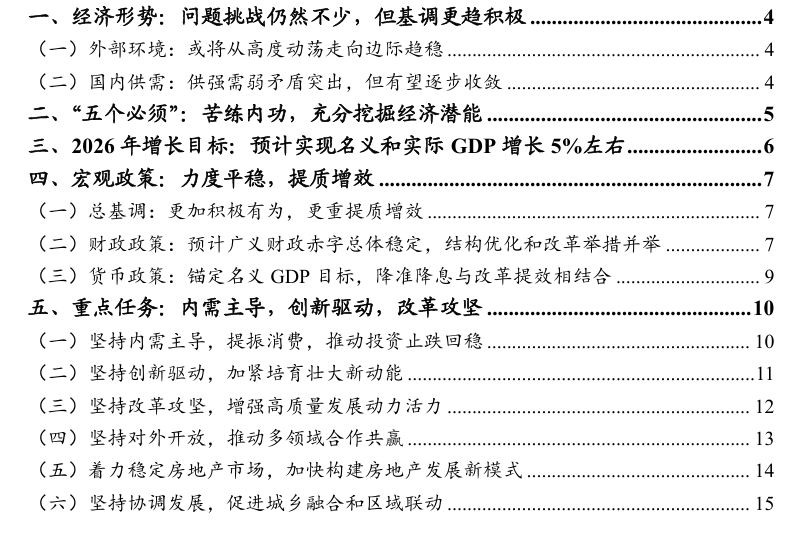
Economic Situation - The economic situation is characterized by persistent challenges, but the overall tone is becoming more positive. The external environment is expected to stabilize marginally, while domestic supply-demand imbalances are highlighted as significant issues [2][10][14]. Five Musts - The meeting outlined "Five Musts" to enhance economic potential, emphasizing the need for internal strengthening to address external challenges, and the importance of policy support and reform innovation [2][16][17]. 2026 Growth Target - The nominal and real GDP growth target for 2026 is set at around 5%. This target aligns with the need for a good start to the 14th Five-Year Plan and is slightly above the lower limit of the expected growth for the next decade [3][18][19]. Macro Policy - The macro policy framework is shifting from "promoting stability through growth" to "enhancing quality and efficiency," indicating a focus on structural optimization and effectiveness rather than just scale and intensity [4][22][25]. Fiscal Policy - The fiscal policy is expected to maintain a broad deficit rate of around 4%, with a focus on optimizing the expenditure structure and increasing investment in social welfare [4][26][28][29]. Monetary Policy - The monetary policy will continue to be moderately loose, with expectations for one rate cut and one reserve requirement ratio reduction in 2026. The focus will be on stabilizing nominal GDP and supporting key sectors [4][32][33][36]. Key Tasks - The emphasis is on domestic demand, innovation-driven growth, and reform efforts. Specific strategies include boosting consumption, stabilizing investment, and enhancing innovation capabilities [5][38][45]. Domestic Demand - The strategy prioritizes domestic demand, with a focus on increasing consumer income and optimizing supply. Retail sales growth is projected to recover to around 4.5% in 2026 [5][38][43]. Innovation - Innovation is positioned as a key task, with plans to strengthen the integration of education, technology, and talent development, and to establish major international technology innovation centers [5][45][46]. Reform - Key reforms will target the elimination of "involution" in competition, the clearing of overdue corporate debts, and the enhancement of the financial supply-side structure to support high-quality development [5][52][53][54]. Opening Up - The commitment to opening up remains strong, with a focus on expanding institutional openness and optimizing the business environment for foreign investment [5][55][56].

“五个必须”彰显战略定力与转型决心
Jin Rong Shi Bao· 2025-12-15 02:52
Group 1 - The core viewpoint emphasizes the "Five Musts" proposed by General Secretary Xi Jinping during the Central Economic Work Conference, which serve as a guiding framework for economic work in the new era [1] - The first must is to fully tap into economic potential, recognizing that while China has a vast market advantage, there are still untapped potentials that need to be addressed, particularly in expanding consumption and investment [2] - The second must is to combine policy support with reform and innovation, highlighting the importance of macro policies and structural reforms to ensure stable economic development [2] Group 2 - The third must focuses on balancing the roles of the market and government, advocating for a collaborative approach that avoids both excessive regulation and complete laissez-faire [3] - The fourth must stresses the importance of combining investments in physical assets with investments in human capital, indicating a shift towards prioritizing education, employment, and social welfare in policy decisions [3] - The fifth must is about strengthening internal capabilities to face external challenges, emphasizing the need for sustained domestic demand and risk management in key sectors [4] Group 3 - The conference also conveyed a clear message regarding macroeconomic policy stability, indicating that there will be no abrupt changes or reductions in policy support as the country embarks on the new "15th Five-Year Plan" [4] - The emphasis on "long-termism" reflects a commitment to maintaining resilience in economic development despite external uncertainties, reinforcing the strategic determination to continue with established plans [5]
结合实际,领会做好新形势下经济工作的规律性认识——论学习贯彻中央经济工作会议精神
Ren Min Ri Bao· 2025-12-15 01:37
Core Viewpoint - The article emphasizes the importance of understanding and applying economic laws as a key experience for governance, highlighting five essential principles for economic work during the 14th Five-Year Plan period, which are aimed at achieving effective economic and social development in the new context [1][4]. Group 1: Economic Potential and Policy Support - Fully tapping into economic potential involves leveraging advantages such as a complete industrial system and a large market scale to convert potential into driving force [2]. - The necessity of combining policy support with reform and innovation is underscored, aiming to address both old problems and new challenges while enhancing the macroeconomic governance system [3][4]. - The implementation of proactive macro policies is crucial, focusing on enhancing the foresight, targeting, and coordination of policies to stabilize and improve economic performance [4]. Group 2: Reform and Innovation - The article discusses the importance of reform measures that have been effective in releasing market vitality, such as the establishment of a unified national market and the introduction of new laws to support the private economy [3]. - It highlights the need for comprehensive policy measures to address intertwined cyclical, structural, and institutional issues in the economy, advocating for a balance between macro policy adjustments and deepening reforms [3][4]. - Specific tasks for reform and innovation are outlined, including fostering new growth drivers and enhancing the dynamism of high-quality development [4]. Group 3: Strategic Importance of the 14th Five-Year Plan - The 14th Five-Year Plan period is identified as a critical time for laying the foundation for socialist modernization and achieving significant breakthroughs in strategic tasks related to Chinese-style modernization [4]. - The article stresses that understanding the "five musts" and applying them in practice will lead to a good start for the 14th Five-Year Plan, enhancing the country's resilience, competitiveness, and sustainable development [4].
今日视点:“五个必须”定方向 政策协同稳大局
Xin Lang Cai Jing· 2025-12-14 23:05
Core Viewpoint - The Central Economic Work Conference held on December 10-11 in Beijing serves as a critical juncture for China's economic development, providing a roadmap for the 14th Five-Year Plan's conclusion and the 15th Five-Year Plan's initiation, amidst complex external environments and domestic economic transitions [1][6]. Economic Performance - China's economy has shown resilience against external uncertainties and internal transformation pressures, with major development goals expected to be met by the end of 2025. Key indicators include a 7.2% growth in high-tech manufacturing and a 6.7% increase in digital product manufacturing in October [7][8]. - Domestic demand has maintained a high contribution rate to economic growth, and energy consumption per unit of GDP has continued to decline, laying a solid foundation for the upcoming 15th Five-Year Plan [7][8]. Challenges and Opportunities - Despite positive performance, challenges remain, including insufficient global economic growth, frequent geopolitical conflicts, and internal supply-demand imbalances. However, China's large market size, complete industrial system, and rich human resources provide strong support for long-term economic stability [2][8]. Policy Directions - The conference emphasized a macro policy framework focused on "stability while seeking progress and improving quality." Fiscal policy is set to be more proactive, while monetary policy will aim for moderate flexibility and efficiency [4][9]. - Eight key tasks were outlined for the upcoming year, including prioritizing domestic demand, driving innovation, enhancing high-quality development, promoting open cooperation, and ensuring social welfare [4][9]. Capital Market Reforms - The capital market is recognized as a core hub for serving the real economy, with a commitment to deepening comprehensive reforms in investment and financing. This includes the introduction of new measures such as a refinancing framework and further reforms in the ChiNext market [5][10]. Systematic Approach - The conference's directives reflect a systematic and long-term perspective, emphasizing the need for coordinated efforts across various regions and departments to implement policies effectively, thereby fostering economic growth and addressing development challenges [6][11].
“五个必须”定方向 政策协同稳大局
Zheng Quan Ri Bao· 2025-12-14 16:13
Core Viewpoint - The Central Economic Work Conference held on December 10-11 in Beijing aims to set the direction for economic development during the 14th Five-Year Plan's conclusion and the 15th Five-Year Plan's initiation, providing a "construction blueprint" for high-quality development amidst complex external and internal challenges [1][2]. Group 1: Economic Performance and Challenges - China's economy has shown resilience against external uncertainties and internal transformation pressures, with key development goals expected to be met, and significant progress in modern industrial system construction [1]. - In October, the value added of high-tech manufacturing and digital product manufacturing increased by 7.2% and 6.7% respectively, indicating ongoing industrial structure optimization [1]. - Despite these achievements, challenges remain, including insufficient global economic growth, frequent geopolitical conflicts, and internal supply-demand imbalances [2]. Group 2: Policy Directions and Action Plans - The conference emphasized a macro policy framework focused on "seeking progress while maintaining stability" and "improving quality and efficiency," with fiscal policy being "more proactive" and monetary policy aiming for "moderate easing" [4]. - Eight key tasks for economic work in the coming year were outlined, including promoting domestic demand, driving innovation, enhancing high-quality development, and ensuring risk management in key areas [4]. - The "Five Musts" proposed during the conference serve as a guide for future economic actions, emphasizing the need to leverage China's large market and complete industrial system, and to combine investment in physical and human capital [3]. Group 3: Capital Market Reforms - The capital market is recognized as a core hub for serving the real economy, with a focus on "continuously deepening comprehensive reforms in capital market investment and financing" [5]. - Past reforms, such as the "1+6" policy for the Sci-Tech Innovation Board, have laid the groundwork for future initiatives, including the introduction of a refinancing framework and further reforms in the Growth Enterprise Market [5]. - The emphasis on systemic thinking and long-term planning in the conference's directives aims to ensure that various policies work in concert to stimulate economic growth and address development challenges [6].
习言道丨中央这个提法,大有深意
Zhong Guo Xin Wen Wang· 2025-12-14 13:09
Core Viewpoint - The Central Economic Work Conference emphasizes the importance of adhering to established rules in economic governance, highlighting the need for a correct view of performance and practical actions to achieve results for the people [2][3]. Group 1: Economic Strategy and Principles - The concept of "acting according to rules" reflects the practical approach of the Communist Party of China and is a principle repeatedly stressed by General Secretary Xi Jinping [3]. - The conference outlines five essential strategies: fully tapping economic potential, balancing policy support with reform innovation, ensuring both flexibility and regulation, integrating investments in goods and people, and strengthening internal capabilities to face external challenges [5]. Group 2: Problem Awareness and Policy Measures - There is a growing recognition of the regularities in economic work, which is crucial for understanding the current situation and planning future actions [6]. - The conference identifies ongoing issues and new challenges in China's economic development, emphasizing the need for a problem-oriented approach to address both external and internal complexities [7]. - A series of policy measures are proposed, including removing unreasonable restrictions in consumption, addressing "involution" in competition, improving flood control infrastructure in northern regions, and stabilizing birth rates, aimed at both immediate and long-term development [8]. Group 3: Implementation and Local Adaptation - The emphasis on "acting according to rules" ultimately focuses on practical actions and results [9]. - The Central Political Bureau meeting stresses the importance of adapting economic work to local conditions and encourages proactive and innovative approaches to implement central decisions effectively [9]. - The ability to understand and utilize economic regularities is essential for China's economic advancement [12].
奋力实现“十五五”良好开局——中央经济工作会议精神引发热烈反响
Yang Guang Wang· 2025-12-14 06:00
Core Insights - The central theme of the news is the emphasis on the importance of the "Five Musts" proposed during the Central Economic Work Conference, which aims to guide economic work in the new situation and ensure a good start for the 14th Five-Year Plan [2][3] Group 1: Economic Policy and Strategy - The "Five Musts" include fully tapping economic potential, combining policy support with reform and innovation, ensuring both flexibility and regulation, integrating investment in physical assets and human capital, and focusing on internal capabilities to face external challenges [2][3] - The National Development and Reform Commission plans to implement the "Five Musts" into practical outcomes, focusing on stabilizing employment, enterprises, markets, and expectations to achieve qualitative and reasonable quantitative economic growth [2][3] - The banking and insurance sectors are expected to align with macro policy directions, utilizing counter-cyclical and cross-cyclical adjustments to enhance macroeconomic governance effectiveness [2][3] Group 2: Industrial and Financial Development - The Ministry of Industry and Information Technology aims to accelerate the construction of a modern industrial system centered on advanced manufacturing, reinforcing the industrial sector's role in stabilizing the macroeconomic environment [3] - The People's Bank of China will implement more proactive macro policies, focusing on financial supply-side structural reforms and optimizing funding structures to support key areas such as expanding domestic demand and technological innovation [3] - The Ministry of Commerce is committed to enhancing foreign trade quality and efficiency, leveraging China's large market to create more development opportunities for countries worldwide [3] Group 3: Resource Management and Environmental Protection - The Ministry of Natural Resources will focus on innovative land and space planning, improving resource allocation efficiency, and promoting integrated protection and systematic governance of natural resources to ensure a strong start for the 14th Five-Year Plan [4]
晶采观察丨180秒!从“五个必须”读懂明年经济怎么干
Yang Guang Wang· 2025-12-14 02:47
Core Insights - The central theme of the news is the strategic direction for China's economy in 2026, emphasizing the need to navigate complex domestic and international challenges while maintaining long-term growth potential [1][2]. Economic Situation Analysis - The meeting highlighted persistent old issues and new challenges in China's economic development, with deepening external environmental changes and prominent contradictions between strong supply and weak demand [1]. - The overall assessment indicates that despite these challenges, the fundamental conditions and trends supporting long-term economic growth remain unchanged [1]. Key Strategic Directions - The "Five Musts" are introduced as essential principles for economic work in 2026, which align with eight key tasks aimed at stimulating domestic demand and fostering innovation [2][3]. Must 1: Unlock Economic Potential - Emphasizes the importance of activating "incremental space" within the economy to create new opportunities and benefits, particularly through policies that support domestic demand and emerging industries [2]. Must 2: Policy Support and Reform Innovation - Highlights the dual approach of providing market support through subsidies and loans while fostering innovation to enhance product quality and affordability, particularly in sectors like new energy vehicles and smart home technology [2]. Must 3: Balance Between Flexibility and Regulation - Stresses the need for a dynamic market environment that encourages consumer choice while ensuring regulatory measures to maintain market order and prevent disruptions [2]. Must 4: Investment in Infrastructure and Human Capital - Advocates for increased investment in both physical infrastructure and human development, aiming to enhance living standards and educational equity, thereby boosting overall productivity [3]. Must 5: Strengthening Internal Capabilities - Focuses on the importance of solidifying domestic foundations and enhancing core competencies to effectively respond to external challenges, ensuring resilience in supply chains and industries [3]. Conclusion - The "Five Musts" are interconnected and aim to build confidence, leverage advantages, and address challenges, ultimately ensuring that economic growth benefits all citizens [3].
牢牢把握“五个必须”的规律性认识——二论学习贯彻中央经济工作会议精神
Xin Hua Wang· 2025-12-14 01:29
Group 1 - The core viewpoint of the article emphasizes the "Five Musts" proposed at the Central Economic Work Conference, which are essential for guiding economic work in the new situation [1][2] - The "Five Musts" include fully tapping economic potential, combining policy support with reform and innovation, balancing market freedom with effective regulation, integrating investment in physical and human capital, and honing internal capabilities to face external challenges [1][2][3] Group 2 - The article highlights China's advantages as a large-scale economy, including a population of over 1.4 billion, being the world's largest manufacturing country, and the second-largest consumer market, which are crucial for driving high-quality economic development [3][4] - It stresses the importance of expanding domestic demand as a strategic foundation, boosting consumption, and increasing effective investment while removing barriers to a unified national market [3][4] - The need for a dual approach of policy support and reform innovation is emphasized, focusing on macroeconomic governance and key reforms in various sectors to enhance economic vitality and drive high-quality growth [4][5] Group 3 - The article discusses the necessity of allowing market mechanisms to play a decisive role in resource allocation while ensuring effective government regulation to create a fair competitive environment [5][6] - It points out that investment in physical assets is vital for economic growth, while investment in human capital is essential for driving innovation and demand, thus creating a virtuous cycle of economic development and improvement in living standards [6][7] Group 4 - The article concludes that internal factors are crucial for development, and emphasizes the importance of maintaining strategic focus and confidence in achieving high-quality development amidst external uncertainties [7]