产业科技创新

Search documents
“感知无锡”调研行 | 触摸产业发展脉搏 助力产业科技创新高地建设
Xin Hua Cai Jing· 2025-11-04 04:53
Core Insights - The event "Technology Meets Industrial Innovation" was held in Wuxi, Jiangsu Province, focusing on the integration of technological and industrial innovation to enhance Wuxi's status as a leading innovation hub in China [1][2] Group 1: Event Overview - The event was organized by Xinhua News Agency and the Wuxi Municipal Propaganda Department, gathering over thirty participants to explore Wuxi's latest practices in technology and industrial innovation [1] - A roundtable discussion was held to address the theme of building a first-class, internationally influential industrial technology innovation hub during the 14th Five-Year Plan period [2] Group 2: Government and Institutional Participation - Participating government departments included the Wuxi Municipal Propaganda Department, Development and Reform Commission, Education Bureau, Science and Technology Bureau, and Industrial and Information Technology Bureau [3] - New research institutions involved were Shanghai Jiao Tong University Wuxi Photonic Chip Research Institute, Wuxi Special Food and Nutrition Health Research Institute, and others [3] Group 3: Industrial Development Focus - Wuxi aims to create a high-quality innovation ecosystem by focusing on five key areas: cultivating high-level innovative enterprises, building high-capacity platforms, conducting high-level technological research, establishing efficient transformation systems, and fostering a high-quality innovation environment [4] - The city has established itself as a leader in technology contribution rates in Jiangsu, with a focus on modern industrial clusters and future industry development [2][4] Group 4: Expert Insights - Experts highlighted Wuxi as a model for the integration of industrial, innovation, talent, capital, and policy chains, emphasizing the importance of aligning with national strategies and nurturing an innovation-driven ecosystem [5] - The city has a strong foundation in integrated circuits and the Internet of Things, with recommendations to enhance its capabilities in artificial intelligence and IoT for future industry development [5] Group 5: IoT Industry Development - Wuxi has become a national leader in the Internet of Things (IoT), with a reported revenue exceeding 250 billion yuan in the sector [7] - The World Internet of Things Expo was held during the event, showcasing significant advancements in IoT and its integration with artificial intelligence [6][7] Group 6: Media Participation - The event attracted various media outlets, including Xinhua Daily Telegraph, Securities Times, and several financial self-media platforms, to report on Wuxi's innovation practices [8]
江海奔流,“苏”写新篇——从“苏超”现象探寻江苏高质量发展动能
Zhong Guo Zheng Quan Bao· 2025-10-15 00:03
Core Insights - Jiangsu's economy demonstrates robust growth, with a projected GDP of 13.7 trillion yuan in 2024, leading the nation in growth increment [3] - The province's manufacturing sector is significant, contributing approximately 14% to the national manufacturing value added [3] - Jiangsu's industrial structure is evolving, with strategic emerging industries accounting for 41.8% of the industrial output in 2024, and high-tech industries surpassing 50% for the first time [3] Economic Strength - Jiangsu's GDP growth rate is projected to be the highest in the country, with a manufacturing value added of 4.66 trillion yuan [3] - The province's industrial output saw a year-on-year increase of 7.4% in the first half of the year, outpacing the national average by 1 percentage point [3] - The number of core enterprises in future industries exceeds 3,100, with a revenue scale surpassing 750 billion yuan [3] Regional Characteristics - Jiangsu has cultivated 14 national advanced manufacturing clusters, the highest in the country, promoting balanced regional development [5] - The income disparity between southern and northern Jiangsu has narrowed significantly, with per capita GDP and disposable income ratios decreasing to 1.86 and 1.80, respectively [5] Industrial Diversity - Jiangsu's manufacturing sector encompasses 31 major categories and over 500 subcategories, making it one of the most diverse in the nation [7] - The province is developing a "1650" industrial system, focusing on 16 advanced manufacturing clusters and 50 industrial chains [7] Innovation and Transformation - Traditional industries in Jiangsu are undergoing digital transformation, with over 56,000 projects implemented since 2022 [9] - The province leads the nation in the integration of digital and intelligent manufacturing, with a CNC rate of 70.1% for key processes [9] Private Sector Dynamics - Private enterprises are pivotal in driving new productive forces in Jiangsu, with significant investments in R&D despite long payback periods [10] - The government is fostering a supportive environment for private businesses, encouraging investment across various sectors [11] Government Support - Jiangsu's government is strategically planning the development of industries, facilitating supply-demand matching and optimizing services [13] - The province has launched a strategic emerging industry fund to enhance financing channels for innovative sectors [17] Global and Domestic Market Expansion - Jiangsu companies are increasingly focusing on international markets, with notable export growth and overseas production bases being established [15][16] - Domestic market potential is also being tapped, with companies like Tiangong International targeting high-end precision tools [16] Financial Ecosystem - Jiangsu has developed a multi-tiered capital market, supporting technology and industry innovation through various financing mechanisms [17] - The establishment of a strategic emerging industry fund aims to connect industry capital with financial resources, enhancing support for innovative enterprises [17]
江海奔流,“苏”写新篇
Zhong Guo Zheng Quan Bao· 2025-10-14 20:17
Economic Overview - Jiangsu province accounts for 1% of China's land area, 6% of the population, and generates over 10% of the national GDP, maintaining the second-largest GDP in the country for several years [1][2] - The manufacturing sector in Jiangsu contributes approximately 14% to the national total, with an industrial output value of 4.66 trillion yuan [2][3] - In 2024, Jiangsu's GDP is projected to reach 13.7 trillion yuan, marking the highest growth increment in the country [2] Industrial Structure - The proportion of strategic emerging industries in Jiangsu's industrial output is expected to reach 41.8% in 2024, with high-tech industries surpassing 50% for the first time [2][3] - Jiangsu has cultivated 14 national advanced manufacturing clusters, the highest in the country, with a balanced development across all 13 prefecture-level cities [3][4] Innovation and Transformation - Traditional industries in Jiangsu are undergoing digital transformation, with over 56,000 digital projects implemented, achieving a 70.1% CNC rate in key processes [6][7] - The province has initiated a "1650" industrial system, focusing on 16 advanced manufacturing clusters and 50 industrial chains [4][6] Private Sector and Government Support - Private enterprises are crucial for Jiangsu's economic dynamism, with policies aimed at fostering a supportive environment for private investment [7][8] - The government is enhancing financial support for technology and industry, with a strategic fund of 500 billion yuan launched to boost emerging industries [12][13] Export and Market Expansion - Jiangsu companies are increasingly focusing on international markets, with significant export growth reported, such as a 13.3% increase in export revenue for a local pharmaceutical company [11] - Many firms are also exploring domestic market opportunities, particularly in high-demand sectors like precision tools [11] Future Challenges and Goals - Jiangsu recognizes the need to address challenges such as insufficient domestic demand and external pressures, while continuing to push for breakthroughs in key technologies [13]



石化行业未来两年稳增长目标锁定
中国能源报· 2025-10-13 03:35
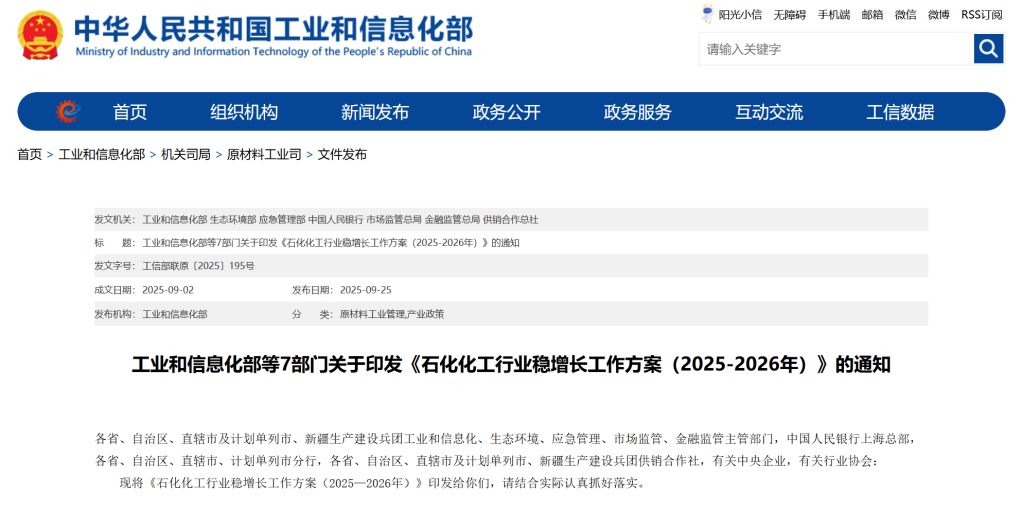
Core Viewpoint - The article discusses the "Stabilization and Growth Work Plan for the Petrochemical Industry (2025-2026)" issued by seven government departments, aiming for an average annual growth of over 5% in the industry's added value through various measures such as technological innovation, investment optimization, and demand expansion [3][4]. Group 1: Industry Overview - The petrochemical industry is a crucial sector for the national economy, accounting for 14.9% of industrial added value in 2024, with a growth rate of 6.6% [3]. - The industry faces significant structural contradictions, including intensified competition in basic organic raw materials, insufficient supply of high-end fine chemicals, and slowing domestic demand [3][4]. Group 2: Policy Objectives - The plan aims to balance growth and transformation by fostering new growth drivers while updating old ones, enhancing supply quality, and expanding both domestic and international demand [4]. - Key tasks include strengthening technological innovation and effective supply capabilities, controlling new refining capacity, and promoting the upgrade of old facilities [6]. Group 3: Implementation Measures - Specific measures include the implementation of "AI + Petrochemical" initiatives, promoting high-end, green, and digital transformation within the industry [6]. - The plan emphasizes the evaluation of chemical park competitiveness and intelligence levels, guiding parks to focus on strengthening industrial chains and enhancing regional economic growth [6]. Group 4: Market Implications - The plan signals a shift towards refined regulatory policies, moving from scale expansion to quality and efficiency improvements, with a focus on developing high-end products like electronic chemicals and high-performance materials [8]. - The impact on the futures market for petrochemical products will be differentiated, with a shift in trading logic towards a deeper integration of policy and industry [8]. Group 5: Future Outlook - The industry is expected to undergo a new round of value reassessment, breaking through long-standing structural contradictions and moving towards greener, smarter, and more efficient development [9].

江苏发布住房城乡建设领域技术图谱 122项重点技术破解行业转型难题
Jiang Nan Shi Bao· 2025-09-29 07:25
Core Viewpoint - Jiangsu Province has officially released the "Technical Map of Housing and Urban-Rural Construction" to address industry transformation challenges and promote high-quality development in the sector [2] Group 1: Industry Transformation and Development Needs - The technical map aims to tackle the difficulties of industry transformation and enhance the quality of housing and urban-rural construction in Jiangsu [2] - Since the 14th Five-Year Plan, Jiangsu's housing and urban-rural construction system has achieved significant technological innovation, winning 2 national and 36 provincial science and technology progress awards, and adding 150 high-tech enterprises [2] - The urbanization rate in Jiangsu has reached 75.5%, indicating a shift from large-scale construction to renovation and reconstruction of older buildings [2] Group 2: Focus Areas and Key Technologies - The technical map identifies 122 key technologies across three main areas: high-quality buildings, smart construction, and resilient smart cities [3] - In the high-quality building sector, 46 technologies are categorized into 14 subcategories, including smart home technologies that enhance user interaction through AI and IoT [3] - The smart construction sector includes 23 technologies focused on BIM and construction robotics, which help alleviate labor shortages due to an aging workforce [3] - The resilient smart city area features 53 technologies, such as smart flood control systems that utilize IoT and AI for efficient emergency response [3] Group 3: Features of the Technical Map - The technical map emphasizes a comprehensive overview of the entire industry, covering real estate and construction, and utilizes various presentation formats like mind maps [4] - It targets high-potential technologies for the next 5-10 years, integrating emerging technologies like AI and big data [4] - The map also considers industry development by analyzing technology applications alongside industry scale and leading enterprises [4] Group 4: Implementation and Future Development - Jiangsu plans to promote the technical map's implementation by focusing on key technology research, aiding enterprise innovation, and supporting local industry development [5] - The government will assist educational and research institutions in determining research directions and help enterprises select suitable technology paths [5] - There will be an emphasis on collaborative innovation among industry, academia, and research to enhance the overall technological landscape in housing and urban-rural construction [5]
八部门,重磅发布!
Di Yi Cai Jing· 2025-09-29 01:47
Core Viewpoint - A new round of growth stabilization plans for the non-ferrous metal industry is being implemented, focusing on enhancing resource security, optimizing supply, promoting transformation, expanding consumption, and strengthening cooperation [3][4]. Group 1: Industry Overview - The Ministry of Industry and Information Technology (MIIT) and seven other departments released the "Non-Ferrous Metal Industry Growth Stabilization Work Plan (2025-2026)" to address new challenges in the industry [3][4]. - The non-ferrous metal industry is crucial, being the largest producer and consumer globally, with a significant contribution to strategic emerging industries like aerospace and new energy [5]. Group 2: Economic Performance - In 2024, the added value of the non-ferrous metal industry is expected to grow by 8.9%, outperforming the industrial average by 3.1 percentage points [5]. - From January to June this year, the production of ten non-ferrous metals reached 4,032 million tons, a year-on-year increase of 2.9%, with revenue of 4.8 trillion yuan and profit of 217.85 billion yuan, reflecting a growth of 14.9% and 15.0% respectively [5]. Group 3: Future Goals - The work plan sets a target for the non-ferrous metal industry's added value to grow by about 5% annually and production to increase by approximately 1.5% annually from 2025 to 2026 [6]. - The plan emphasizes the importance of aligning with national economic goals and enhancing the industry's resilience and safety in response to external uncertainties [4][6]. Group 4: Resource Utilization and Innovation - The plan includes initiatives for efficient resource utilization, such as implementing a new round of mineral exploration strategies and enhancing the recycling of waste metals [7]. - There is a focus on technological innovation, aiming to develop high-quality materials and improve product quality through advanced manufacturing processes [7][8].
增加值年均增长5%左右 有色金属行业处于高质量发展关键时期
Yang Shi Xin Wen· 2025-09-28 08:09
Core Viewpoint - The Ministry of Industry and Information Technology, along with seven other departments, has issued a work plan for the non-ferrous metals industry, aiming for an average annual growth of around 5% in added value from 2025 to 2026 [1][2]. Group 1: Industry Growth and Economic Performance - The non-ferrous metals industry is positioned for high-quality development, with a focus on systematic solutions to existing problems [2]. - In the first half of this year, the production of ten non-ferrous metals reached 40.32 million tons, a year-on-year increase of 2.9% [2]. - The industry achieved an operating revenue of 4.8 trillion yuan and a profit of 217.85 billion yuan, reflecting year-on-year growth of 14.9% and 15.0%, respectively [2]. Group 2: Challenges Facing the Industry - The non-ferrous metals industry is currently facing deep-seated structural issues, including significant resource security pressures and high external procurement rates for certain strategic minerals [3]. - There is a lack of independent innovation capabilities, which affects the stable supply of high-end products [3]. - The international trade environment is complex, posing additional challenges [3]. Group 3: Strategic Measures Proposed in the Work Plan - The work plan emphasizes enhancing domestic exploration of strategic minerals and the utilization of recycled metals to improve resource self-sufficiency [5]. - It calls for breakthroughs in high-end material technology and acceleration of product application verification and iteration [5]. - The plan advocates for scientific capacity regulation to avoid low-level redundant construction and promotes green transformation and digitalization [5]. - It encourages the expansion of applications for bulk metals like aluminum and copper, as well as the cultivation of new consumption scenarios for rare metals [5]. - The work plan supports enterprises in addressing trade barriers and promotes the export of high-end products and technology standards [5]. Group 4: Overall Industry Development Quality - The industry aims to address resource constraints, insufficient innovation, and supply-demand imbalances through various measures to enhance development quality [6].
七部门发布:围绕新能源、低空经济、人形机器人等,拓展特种工程塑料、碳纤维及复材、电池材料等应用
DT新材料· 2025-09-26 16:05
Core Viewpoint - The article discusses the "Work Plan for Stable Growth in the Petrochemical Industry (2025-2026)" issued by the Ministry of Industry and Information Technology and six other departments, aiming for an annual growth of over 5% in the industry's added value during this period, with a focus on innovation, efficiency, demand expansion, and collaboration [2]. Group 1: Strengthening Technological Innovation - Enhance high-end supply by focusing on key industrial chains such as integrated circuits and new energy, supporting the development of electronic chemicals and high-performance materials through collaborative innovation [3]. - Ensure stable supply of fertilizers by optimizing production plans and establishing long-term contracts between raw material suppliers and fertilizer producers [3]. - Optimize pilot project management to enhance innovation development momentum by streamlining approval processes and reducing environmental assessment burdens for pilot projects [4]. Group 2: Expanding Effective Investment - Control major project construction scientifically, limiting new refining capacity and supporting the transformation of outdated facilities [5]. - Implement safety upgrades for aging facilities, establishing a standard system for evaluation and renovation, and ensuring the relocation of hazardous chemical production enterprises by the end of 2025 [5]. Group 3: Accelerating Digital and Green Transformation - Promote digital transformation in the petrochemical industry by establishing benchmarks and typical scenarios, and supporting enterprises in energy-saving and pollution reduction efforts [6]. - Develop standards for pollution reduction and carbon reduction, including guidelines for green hydrogen and digital transformation maturity assessments [7]. Group 4: Expanding Market Demand - Facilitate supply-demand matching by organizing product connection activities and promoting stable cooperation between production enterprises and downstream users [8]. - Explore new applications in emerging industries such as new energy and low-altitude economy, and promote the use of green products [8]. Group 5: Developing High-Quality Growth Engines - Build high-quality chemical parks and industrial clusters, focusing on safety and competitiveness evaluations, and enhancing collaboration with national economic development zones [9]. Group 6: Deepening Open Cooperation - Expand international cooperation by addressing changes in the international trade environment and leveraging free trade agreements to enhance the export of petrochemical products [10].
石化化工行业稳增长方案落地 今明两年年均增长5%以上
Di Yi Cai Jing· 2025-09-26 15:03
Core Viewpoint - The new "Work Plan for Stable Growth in the Petrochemical Industry (2025-2026)" aims to address challenges and promote high-quality development in the petrochemical sector through innovation, efficiency improvement, demand expansion, and collaboration among various stakeholders [1][2]. Group 1: Industry Overview - The petrochemical industry is a crucial pillar of the national economy, with significant economic volume and high industrial correlation, impacting industrial stability and economic operation [1][5]. - China has become the world's largest producer and consumer of petrochemical products, with the industry's added value expected to account for 14.9% of industrial output in 2024, growing at a rate of 6.6%, which is 0.8 percentage points higher than the industrial average [1]. Group 2: Current Challenges - The industry faces intensified competition in basic organic raw materials, insufficient supply of high-end fine chemicals, slowing domestic demand growth, and increasing external uncertainties [2][5]. - Current domestic chemical product price indices, profit margins, and industry valuations are at low levels, while global demand for chemical products remains weak [2]. Group 3: Strategic Goals - The Work Plan sets a target for the petrochemical industry's added value to grow by over 5% annually from 2025 to 2026, with a focus on stabilizing economic benefits and enhancing technological innovation capabilities [2][7]. - Emphasis will be placed on improving the quality and safety of production, reducing pollution and carbon emissions, and transitioning chemical parks from standard construction to high-quality development [2][7]. Group 4: Key Initiatives - The plan includes supporting key product breakthroughs in electronic chemicals and high-end polyolefins, and promoting the upgrade of bulk products like coatings and pesticides [3][8]. - It aims to expand market demand by organizing supply-demand matching activities and exploring consumption potential in traditional sectors like construction and automotive, as well as emerging fields such as new energy and robotics [3][15]. Group 5: Investment and Policy Support - The plan calls for scientific control of major project construction, particularly in refining and ethylene production, and emphasizes the need for safety upgrades in aging facilities [11][12]. - It encourages the use of long-term special bonds and other policy channels to support technological innovation and equipment upgrades in the petrochemical sector [19].

利好来了!七部门集体发布
Zhong Guo Ji Jin Bao· 2025-09-26 12:43
Core Viewpoint - The Ministry of Industry and Information Technology, along with six other departments, has released the "Petrochemical Industry Stabilization and Growth Work Plan (2025-2026)" to promote stable operation and structural optimization of the petrochemical industry, which is crucial for the national economy [1][2]. Summary by Sections Industry Importance and Current Challenges - The petrochemical industry is a vital foundation and pillar of the national economy, characterized by a large economic scale and high industrial correlation. Current challenges include intensified competition in basic organic raw materials, insufficient supply of high-end fine chemicals, slowing domestic demand growth, and increasing external uncertainties [2][10]. Main Goals - The plan aims for an average annual growth of over 5% in the industry's added value from 2025 to 2026, stabilization of economic benefits, significant enhancement of technological innovation capabilities, continuous improvement in fine chemical extension, digital empowerment, and safety levels, as well as noticeable synergy in pollution reduction and carbon reduction [2][12]. Key Measures - **Strengthening Technological Innovation**: The plan emphasizes enhancing high-end supply, supporting key product breakthroughs in industries like integrated circuits and new energy, and promoting collaborative innovation [3][13]. - **Investment and Project Management**: It includes strict control over new refining capacity, guiding the planning of major petrochemical and modern coal chemical projects, and supporting the transformation of old facilities [4][17]. - **Fertilizer Production Assurance**: The plan optimizes management of key fertilizer production enterprises and ensures stable supply of essential raw materials [5][13]. - **Digital and Green Transformation**: It promotes the integration of artificial intelligence in the petrochemical sector and accelerates the construction of high-quality data sets [6][18]. - **Standardization**: The plan calls for the development of standards for high-end fine chemicals and quality traceability for key products [7][19]. Market Expansion and International Cooperation - The plan encourages the expansion of applications for new energy battery materials and special engineering plastics, while also promoting international cooperation to navigate changes in the global trade environment [8][22]. Organizational and Policy Support - The plan outlines the need for enhanced organizational support, policy backing, and monitoring to ensure the effective implementation of the stabilization and growth objectives [23][24][25].