人民币国际化

Search documents
支持和规范银行开展 人民币跨境同业融资业务
Jin Rong Shi Bao· 2026-02-27 00:48
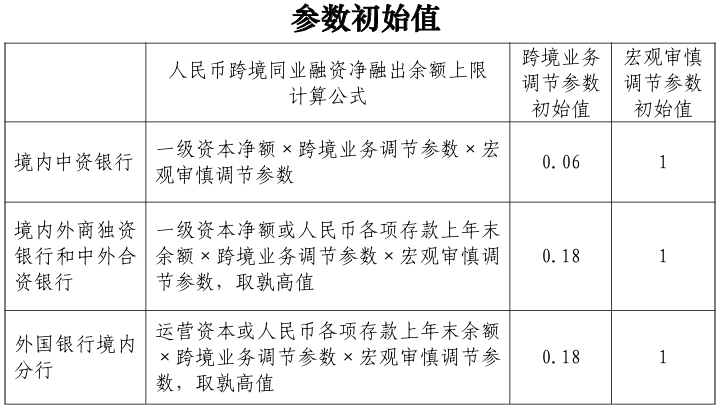
Core Viewpoint - The People's Bank of China (PBOC) has issued a notification to support and regulate the cross-border interbank financing business in Renminbi, aiming to enhance the internationalization of the Renminbi and improve the capital account openness [2][3]. Group 1: Background and Purpose - The notification is part of the broader strategy outlined in the 20th National Congress to promote Renminbi internationalization and develop the offshore market [2]. - Cross-border interbank financing includes various forms of financing such as account financing and bond repurchase, serving as a crucial channel for domestic banks to provide Renminbi liquidity to offshore markets [2]. Group 2: Key Contents of the Notification - The notification emphasizes the principle of "substance over form," covering all types of Renminbi cross-border interbank financing that involve substantial creditor-debtor relationships [3]. - It introduces a counter-cyclical adjustment mechanism linking the net outbound balance of cross-border interbank financing to the capital and funding strength of domestic banks [3]. - The notification supports domestic banks in conducting business in accordance with market demand and legal compliance, requiring them to have strong international settlement capabilities and robust risk management systems [3]. Group 3: Applicable Institutions - The notification applies to domestic banks legally established with international settlement capabilities, including Chinese banks, wholly foreign-owned banks, joint-venture banks, and foreign bank branches [4]. - Rural financial institutions are generally not allowed to engage in Renminbi cross-border interbank lending, although some qualified institutions may be permitted to do so [4]. Group 4: Limits on Net Outbound Balance - The notification sets an upper limit on the net outbound balance of Renminbi cross-border interbank financing, which is linked to the bank's capital or funding strength [5]. - For domestic Chinese banks, the upper limit is calculated as the net capital multiplied by cross-border business adjustment parameters and macro-prudential adjustment parameters [5]. - For foreign banks, the limit is based on either the net capital or the balance of Renminbi deposits at the end of the previous year, also adjusted by relevant parameters [5]. Group 5: Business Planning and Management - Banks are required to ensure that their net outbound balance does not exceed the established limits and must report relevant information to the Renminbi Cross-Border Payment Information Management System [6][7]. - Certain types of financing, such as those based on genuine trade financing or those involving Renminbi clearing banks, are excluded from the net outbound balance calculation [6][7]. Group 6: Integration with Existing Policies - The notification aims to integrate various Renminbi cross-border interbank financing activities without creating new business types, maintaining compliance with existing regulations [8]. - The PBOC plans to continuously refine policies and optimize business guidelines based on practical experiences [8]. Group 7: Impact of the Notification - The implementation of the notification is expected to enhance the rules and transparency of Renminbi cross-border interbank financing, facilitating stable offshore Renminbi liquidity [9]. - It allows banks to flexibly adjust their business structures within an overall net outbound balance limit, promoting a risk-neutral approach [9].
央行新规:支持银行向人民币离岸市场提供流动性
Sou Hu Cai Jing· 2026-02-27 00:23
央行规范人民币跨境同业融资业务 支持银行向人民币离岸市场提供流动性 2月26日,中国人民银行发布《关于银行业金融机构人民币跨境同业融资业务有关事宜的通知》(下称 《通知》),支持境内银行业金融机构与境外机构规范开展人民币跨境同业融资业务。央行称,将稳步 推进《通知》实施,发挥跨境同业融资业务服务实体经济、促进人民币离岸市场健康发展的积极作用。 业内专家表示,《通知》有望起到一举多得的积极作用:支持银行向人民币离岸市场提供流动性,将充 分满足海外人民币资金需求,推进人民币国际化,支持人民币离岸市场发展;有助于进一步激发海外人 民币融资需求,进而带动跨境贸易和投资人民币使用;有利于完善跨境资金双向流动宏观审慎管理。 《通知》主要包括三个方面的内容:按业务实质确定《通知》覆盖范围;引入逆周期调节机制;支持境 内银行顺应市场需求、依法合规开展业务。 按照"实质重于形式"的原则,《通知》将境内银行与境外机构之间存在实质债权债务关系的人民币资金 融通业务纳入覆盖范围。 "《通知》实现了对各类业务的全覆盖。"业内专家表示,《通知》改变了以往按业务品种分别制定规则 的模式,能更好适应人民币跨境同业融资业务创新需求。《通知》既 ...
推进人民币国际化 央行发文支持人民币跨境同业融资业务
Xin Lang Cai Jing· 2026-02-26 19:41
具体来看,《通知》实现对各类业务的全覆盖。明确按照"实质重于形式"的原则,将境内银行与境外机 构之间存在实质债权债务关系的人民币资金融通业务纳入《通知》覆盖范围,能涵盖人民币跨境同业融 资现有各类业务,未来推出相同性质业务也适用此《通知》。 与此同时,《通知》支持银行自主展业。《通知》提高了管理的透明度,明确允许境内银行可在净融出 上限内,灵活摆布各项业务结构,自主开展各类人民币跨境同业融资,这一规定较以往每项业务分别设 置上限的管理模式更加系统,减少了银行展业顾虑,客观上提升了业务开展空间,增强了拓展业务的积 极性。更为重要的是,银行自主性的提升有利于为境外提供更为稳定的人民币流动性,从而更好促进离 岸市场人民币供求平衡。 《通知》还引导金融机构树立风险中性的理念。《通知》沿用了全口径跨境融资宏观审慎管理的模式, 按照有多大资本、多强资金能力做多大业务的原则,将境内银行净融出余额上限与其一级资本净额相挂 钩(境内外资银行还可选择与其上年人民币存款余额相挂钩),有助于引导金融机构树立风险中性的理 念。 最后,《通知》对跨境资金流动整体引入逆周期调节机制。《通知》统一了银行业金融机构人民币跨境 同业融资净融出的 ...
央行规范人民币跨境同业融资业务 支持银行向人民币离岸市场提供流动性
Shang Hai Zheng Quan Bao· 2026-02-26 17:56
2月26日,中国人民银行发布《关于银行业金融机构人民币跨境同业融资业务有关事宜的通知》(下称 《通知》),支持境内银行业金融机构与境外机构规范开展人民币跨境同业融资业务。央行称,将稳步 推进《通知》实施,发挥跨境同业融资业务服务实体经济、促进人民币离岸市场健康发展的积极作用。 在支持境内银行依法合规开展业务方面,《通知》明确,展业银行应具备较强的国际结算业务能力,建 立健全风险管理和内控机制,由银行总行或外国银行境内分行(境内管理行)归口管理。 "《通知》允许境内银行在净融出上限内,灵活摆布各项业务结构,自主开展各类人民币跨境同业融 资,这一规定减少了银行展业顾虑,客观上提升了业务开展空间,有利于增强银行拓展业务的积极性。 更重要的是,银行自主性的提升,有利于为境外提供更为稳定的人民币流动性,从而更好促进离岸市场 人民币供求平衡。"业内专家表示。 央行有关负责人称,《通知》实施后,人民币跨境同业融资管理的规则性、透明度将明显提升,有利于 离岸人民币流动性供给的畅通和稳定。《通知》的管理逻辑同此前出台的境外贷款、境外放款等措施一 脉相承,是对全口径跨境融资宏观审慎管理的有效补充。 "《通知》实现了对各类业务的全 ...
【金融街发布】中国人民银行:进一步支持境内银行业金融机构与境外机构开展人民币跨境同业融资业务
Xin Hua Cai Jing· 2026-02-26 14:33
新华财经北京2月26日电为深入贯彻落实党的二十届四中全会精神,提升资本项目开放水平,发展人民 币离岸市场,完善跨境资本流动宏观审慎管理,2026年2月26日,中国人民银行发布《关于银行业金融 机构人民币跨境同业融资业务有关事宜的通知》(以下简称《通知》),支持境内银行业金融机构与境 外机构规范开展人民币跨境同业融资业务。《通知》自发布之日起实施。 《通知》覆盖人民币跨境同业融资各类业务,将银行业金融机构人民币跨境同业融资净融出余额与其资 本水平、资金实力挂钩,促进合理开展业务。设置宏观审慎管理相关参数,根据市场形势进行逆周期调 节。相关参数设定充分考虑了市场需求与银行业金融机构经营情况,有利于为人民币离岸市场提供稳定 的流动性,推动人民币跨境使用。 《通知》提出,支持境内银行顺应市场需求,按照依法合规、风险可控的原则开展人民币跨境同业融资 业务。境内中资银行、外商独资银行、中外合资银行开展相关业务应由银行总行统一管理,并按照实质 重于形式的原则,将全部人民币跨境同业融资业务纳入管理范围,建立健全风险管理和内部控制机制。 境内银行向境外机构净融出人民币资金余额不得超过人民币跨境同业融资净融出余额上限。境内银行应 ...

央行发文!支持境内银行开展人民币跨境同业融资业务
Sou Hu Cai Jing· 2026-02-26 14:06
境内中资银行、外商独资银行、中外合资银行开展相关业务应由银行总行统一管理,并按照实质重于形 式的原则,将全部人民币跨境同业融资业务纳入管理范围,建立健全风险管理和内部控制机制。 境内银行向境外机构净融出人民币资金余额不得超过人民币跨境同业融资净融出余额上限。 【大河财立方消息】2月26日,中国人民银行发布《关于银行业金融机构人民币跨境同业融资业务有关 事宜的通知》,支持境内银行业金融机构与境外机构规范开展人民币跨境同业融资业务。 《通知》覆盖人民币跨境同业融资各类业务,将银行业金融机构人民币跨境同业融资净融出余额与其资 本水平、资金实力挂钩,促进合理开展业务。设置宏观审慎管理相关参数,根据市场形势进行逆周期调 节。相关参数设定充分考虑了市场需求与银行业金融机构经营情况,有利于为人民币离岸市场提供稳定 的流动性,推动人民币跨境使用。 《通知》提到,支持境内银行顺应市场需求,按照依法合规、风险可控的原则开展人民币跨境同业融资 业务。 境内银行应建立内部预警提示工作机制,当人民币跨境同业融资净融出余额达到上限的80%时,应对有 关业务负责部门进行预警提示。 下一步,中国人民银行将稳步推进《通知》落地实施,切实发挥跨 ...

人民币强势升破6.9,世界防止美元突然崩溃,3个财富逻辑变了
Sou Hu Cai Jing· 2026-02-26 13:09
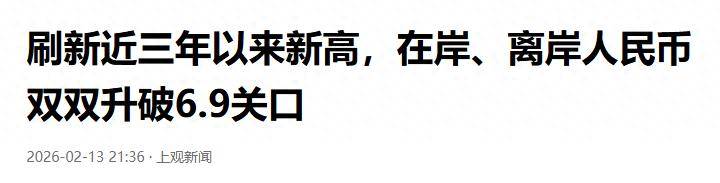
2月12日,人民币汇率延续强势行情,在岸、离岸人民币对美元汇率盘中双双升破6.9关口,创下近三年以来新高,春节人民币强势升值至6.89区间,这不 是"涨点汇率"那么简单,这是全球资金在提前排队改门票。 更有意思的是,外部环境并没那么"配合"。 过去我们理解人民币波动,有一套熟悉的解释。 比如美元走弱,比如国内经济数据改善,比如春节前企业集中结汇。 但这一次,很多理由看上去都对,却都不够"致命"。 关键在于,人民币这波升值的速度太像"攻城拔寨"。 短短一个多月,从年初7.0上方一路走强,升值幅度超过1.2%。这种力度,不是靠一两笔结汇能推出来的。 一个是沙特、俄罗斯、伊朗、委内瑞拉等的石油开始更"无顾忌"地用人民币结算。另一个更关键,是铁矿石这种长期被美元体系牢牢按住的品类也在松动。 美元指数不是一路下跌,而是从一月底95左右的低位反弹回到97上方。日元也从159附近回到155左右。 美元在反弹,人民币还在走强。 你告诉我这是"别人不行了所以我们行",我是不信的。 我更愿意下一个判断,这是人民币的使用场景和交易规则在变,背后那盘棋比汇率本身大得多。 有三个变化,它们合起来,才是"人民币强势"的底层推力,也是未来 ...
许正宇:将透过“促改革、增容量”等四大措施赋能 巩固香港国际金融中心优势
智通财经网· 2026-02-26 11:22
Core Viewpoint - The Hong Kong government aims to enhance its status as an international financial center through four main themes: "Promote Reform," "Expand Infrastructure," "Increase Capacity," and "Build Connectivity," aligning with the national "14th Five-Year Plan" to drive economic development [1]. Group 1: Promote Reform - The Hong Kong Stock Exchange (HKEX) has implemented measures to ensure market liquidity, generating approximately HKD 2.5 billion in stamp duty revenue during adverse weather conditions [2]. - HKEX plans to consult on revising listing requirements for companies with dual-class shares and facilitate secondary listings for overseas issuers [2]. - The Securities and Futures Commission (SFC) and HKEX will introduce a paperless securities market system and optimize the regulatory framework for listed companies [2]. Group 2: Expand Infrastructure - The Hong Kong Monetary Authority (HKMA) and HKEX are researching a one-stop multi-asset trading post-trade infrastructure to enhance collateral interoperability [4]. - The Central Moneymarkets Unit (CMU) aims to establish a digital asset platform by the end of the year to support the issuance and settlement of digital bonds [4]. - HKEX's comprehensive fund platform will expand its functionalities to include payment and settlement processes, improving market efficiency [4]. Group 3: Increase Capacity - The government has doubled the total quota for RMB business funding arrangements to RMB 200 billion [5]. - A third issuance of tokenized bonds amounting to HKD 10 billion has been completed, with plans for regular issuance and encouragement of more digital bond offerings [5]. - The asset and wealth management sector will benefit from optimized tax incentives, including the inclusion of digital assets and specific commodities as eligible investments for tax relief [5]. Group 4: Build Connectivity - The government supports the Asian Infrastructure Investment Bank (AIIB) in establishing an office in Hong Kong and will host the Asia-Pacific Economic Cooperation (APEC) Finance Ministers' Meeting [7]. - Hong Kong has signed 55 comprehensive double taxation agreements and will continue to expand its network of agreements [8].
交易结算将获税务优惠,香港国际黄金交易、定价中心“快进”
Di Yi Cai Jing Zi Xun· 2026-02-26 08:48
其一,香港黄金交易始终缺乏统一的中央清算机制,采用的是买卖双方双边清算模式。针对这一短板, 香港正加速与内地城市深化对接合作。1 月底,香港特区政府与上海黄金交易所签署合作协议,香港已 成立全资拥有的香港贵金属中央结算系统有限公司,上海黄金交易所将协助其建立黄金中央清算系统。 香港特区政府财经事务委员会最新政策简报显示,香港财库局已成立由政府全资拥有的公司作为清算系 统的管治机构。政府、金融监管机构和参与国际黄金市场的主要银行,将加入该公司董事会,参与制定 清算系统的管治架构和规则,充分吸纳市场意见。 其二,要成为真正的国际黄金交易中心,强大的基础设施是硬支撑。香港此前在黄金仓储方面存在短 板,无法满足未来大规模实物交割的需求。 香港特区政府财经事务及库务局局长许正宇透露,特区政府正积极支持香港机场管理局及金融机构建设 先进的黄金存储设施,目标是三年内将存储容量提升至2000吨以上。 将研究为在港进行黄金交易,以及及结算的合格机构提供税务优惠,协助成立行业协会、搭建培训体 系,推动香港建成国际黄金交易与定价中心。这是香港特区政府财政司司长陈茂波,在最新公布的2026 至2027财政年度政府财政预算案中,提到的 ...
人民币走强的新格局
Sou Hu Cai Jing· 2026-02-26 04:29
glB 文 | 人民币杂志 大河 图 | 微摄 2026 年春节假期后,人民币汇率迎来持续强势表现,在岸、离岸人民币兑美元汇率接连突破 6.87、6.85 关口,创下 2023 年 4 月以来新高,成为全球汇市的 亮眼看点。从 2025 年 12 月底升破 7.0 整数关口,到 2026 年 2 月以来中间价累计升值近 300 个基点,在岸、离岸汇率升值幅度超 1%,人民币汇率走出了一 轮兼具趋势性与结构性的升值行情。这并非短期市场情绪驱动的偶然波动,而是国内经济基本面韧性、外部货币格局调整、外汇市场供求优化共同作用的结 果,更标志着人民币汇率运行进入 "基本面支撑、双向波动、政策护航、功能升级" 的全新格局,其背后的驱动逻辑、市场特征与长期趋势,正成为观察中 国经济与全球货币体系演变的重要窗口。 强势行情:数据背后的汇率新高度 本轮人民币走强具有鲜明的趋势性与突破性特征,官方数据勾勒出清晰的升值轨迹,且汇率强势体现在中间价、在岸价、离岸价三大维度的同步上行,反映 出市场对人民币的共识性预期。2025 年 12 月底,人民币兑美元汇率成功升破 7.0 关口,结束了此前围绕该关口的震荡,2026 年开年即保持在 ...