出口退税政策

Search documents
【安泰科】单晶硅片周评-上下游僵持博弈 硅片价格持稳运行(2026年1月15日)
中国有色金属工业协会硅业分会· 2026-01-15 09:56
Core Viewpoint - The silicon wafer prices remain stable this week, with downstream battery prices continuing to rise, indicating a mixed market sentiment influenced by various factors [1][2]. Group 1: Silicon Wafer Prices - The average transaction price for N-type G10L monocrystalline silicon wafers (182*183.75mm/130μm) is 1.31 yuan per piece, unchanged from last week [1]. - The average transaction price for N-type G12R monocrystalline silicon wafers (182*210mm/130μm) is 1.42 yuan per piece, also stable compared to the previous week [1]. - The average transaction price for N-type G12 monocrystalline silicon wafers (210*210mm/130μm) is 1.66 yuan per piece, remaining flat week-on-week [1]. Group 2: Market Dynamics - The silicon wafer market is experiencing weak demand, with no significant price fluctuations due to multiple factors, including rising silver prices and weak terminal installation demand [2]. - The operating rates of silicon wafer manufacturers have continued to decline, with major companies operating at 50% and 48%, while integrated companies operate between 50%-70% [2]. - The upstream silicon material prices remain firm, providing some cost support, but the overall market sentiment is characterized by a standoff between upstream and downstream players [2]. Group 3: Future Outlook - Future market conditions may improve due to export tax rebate policies, which are expected to enhance overseas demand in the first quarter [2]. - Despite potential improvements, the overall terminal installation demand remains weak, and battery manufacturers are pushing for lower silicon wafer prices, suggesting a continued weak market trend in the short term [2].

甲醇日报:静待库存拐点-20260114
Guan Tong Qi Huo· 2026-01-14 11:13
Group 1: Report Industry Investment Rating - Not provided Group 2: Core Viewpoints of the Report - The methanol futures market maintains a slight oscillation, with support at the 60 - day moving average. There's a high possibility of a inventory inflection point in Q1 2026, and investors can focus on buying opportunities after price dips. Currently, methanol is undervalued. Although the overall rebound is limited by weak downstream demand, it is likely to rebound from low levels. Attention should be paid to the geopolitical situation in Iran [3][4] Group 3: Summary by Relevant Catalogs Fundamental Analysis - As of January 14, 2026, the total methanol port inventory in China was 1.4403 million tons, a decrease of 9,690 tons from the previous period. The inventory in East China decreased by 84,400 tons, and that in South China decreased by 12,500 tons. The significant reduction in port inventory was due to a small total unloading volume. The visible unloading of foreign vessels was 96,100 tons, and the non - visible unloading was 125,000 tons. In South China, the inventory in Guangdong decreased, while that in Fujian remained stable [1] Macroeconomic Analysis - The Ministry of Finance announced an adjustment to the export tax - rebate policy for products such as photovoltaic products. Starting from April 1, 2026, the VAT export tax - rebate for products including methanol will be cancelled [2] Futures and Spot Market Analysis - The futures market shows a slight oscillation, and the 60 - day moving average on the daily chart provides support. There's a high chance of an inventory inflection point in the first quarter. Investors can consider buying after price drops. Methanol is undervalued, and its rebound is restricted by weak downstream demand, but it may rebound from low levels. Attention should be paid to the geopolitical situation in Iran [3][4]
碳酸锂期货 突破17万元关口!
Zheng Quan Shi Bao Wang· 2026-01-13 13:11
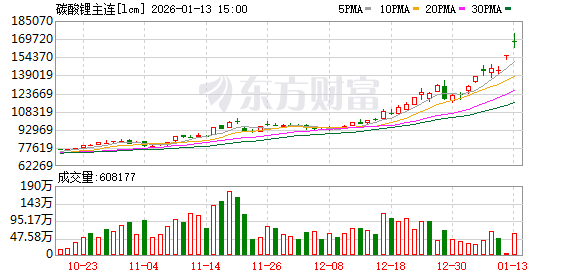
7月,江西、青海等地矿权审批问题引发供应担忧,叠加行业政策基调与下游需求回暖,价格强势反 弹。8月,江西某头部企业停产落地,推动价格冲高至阶段高点,现货价格接近8.4万元/吨。 10月起,碳酸锂下游旺季需求开始显现,市场延续去库状态,驱动价格再次开启上行。 11月至12月,需求保持旺盛,碳酸锂供需格局维持收紧状态,尽管现货市场呈现出价格高位运行后成交 活跃度受限的情况,但下游需求仍在某些价格运行阶段有所释放,且随着江西某矿山年内复产预期不断 减弱,支撑工碳价格不断冲击高位,并在年底突破12.4万元/吨。 "相较于2025年下半年的上涨行情,2026年开年至今,碳酸锂价格上涨还受到出口退税政策影响,中国 锂电企业即日起开始抢出口。在出口退税政策逐步退坡的影响下,2027年的海外部分需求将提前至2026 年。"上海钢联新能源事业部锂业分析师李攀表示,当前碳酸锂市场正处于"供应扰动叠加下游需求爆发 增长"的市场环境下。供应方面,市场主要受枧下窝矿区停产造成的供应扰动,需求则是动力端和储能 需求双重爆发造成的需求大幅增长以及出口退税政策调整导致的下游抢出口带来的需求增长。当下需求 增长带来的对价格的影响权重会更高一些 ...
碳酸锂期货,突破17万元关口!
Zheng Quan Shi Bao Wang· 2026-01-13 12:39
Core Viewpoint - The lithium carbonate market is experiencing significant price fluctuations driven by supply-demand dynamics, policy adjustments, and market expectations, with prices having doubled since October 2022 and showing a strong upward trend in early 2026 [1][4]. Price Trends - As of January 13, 2026, the main contract for lithium carbonate reached a peak of 170,000 yuan/ton before closing at 166,980 yuan/ton, marking a 7.44% increase [1]. - The price of lithium carbonate has increased from approximately 75,000 yuan/ton in October 2022 to over 166,000 yuan/ton in January 2026, representing a more than 100% increase [1]. - The spot price for battery-grade lithium carbonate rose from 124,350 yuan/ton on January 5, 2026, to 153,400 yuan/ton on January 12, 2026, a jump of 29,050 yuan/ton or 23.4% [1]. Supply and Demand Dynamics - In early 2025, pre-Spring Festival stocking demand drove industrial-grade lithium carbonate prices to nearly 75,000 yuan/ton, but prices fell to around 58,000 yuan/ton by late June due to decreased demand and increased supply [2]. - The second half of 2025 saw a price recovery due to supply concerns from mining rights approvals and increased downstream demand, with prices peaking near 84,000 yuan/ton in August [3]. - From October 2025 onwards, strong downstream demand during the peak season led to a tightening supply-demand balance, pushing prices above 124,000 yuan/ton by the end of the year [4]. Policy Impact - The export tax rebate policy is influencing the market, with Chinese lithium battery companies beginning to export aggressively in anticipation of reduced rebates, which is expected to shift some overseas demand from 2027 to 2026 [4][6]. - The export tax rebate is set to decrease from 9% before April 1, 2026, to 0% after January 1, 2027, which will impact pricing and demand dynamics in the lithium carbonate market [6]. Market Outlook - Analysts suggest that the current price increase is a result of multiple factors, including resilient demand during the off-season, policy changes, and supply-side news affecting market sentiment [5]. - The market is expected to face volatility due to simultaneous influences from upstream maintenance and traditional seasonal demand drops in early 2026, with potential inventory adjustments [5]. - Long-term, the industry may shift from price competition to value competition, necessitating technological upgrades and product enhancements to maintain competitiveness [7].
04合约处需求淡季 集运指数(欧线)轻仓试空
Jin Tou Wang· 2026-01-13 07:22
Core Viewpoint - The European shipping index futures experienced a sharp decline, with the main contract dropping to a low of 1210.3 points and closing at 1220.4 points, reflecting a decrease of 3.81% [1][2]. Group 1: Market Analysis - The SCFI European line index was reported at 1719 USD/TEU on January 9, marking a 1.7% increase from the previous period [2]. - Major shipping companies have adjusted their rates, with HPL reducing the large container rate by 300 USD to 2735 USD and CMA lowering it by 200 USD to 3893 USD [2]. - The geopolitical situation, particularly the submission of a candidate list by Hamas to Egypt for the future management of Gaza, is influencing market sentiment [2]. Group 2: Institutional Perspectives - Guangzhou Futures suggests that the shipping price is fluctuating due to capital speculation, recommending cautious operations [2]. - Guotai Junan Futures advises a light short position on the European shipping index, emphasizing the importance of monitoring opening guidance and the impact of export tax rebate policies on market dynamics [2]. - The analysis indicates that the shipping capacity before, during, and after the 2026 Chinese New Year shows varying growth rates, with post-holiday capacity growth significantly higher than pre-holiday levels [2].
PVC:出口扰动放大盘面波动 短期交易重点已非供需
Jin Tou Wang· 2026-01-13 02:11
【PVC现货】 国内PVC市场盘中大幅震荡,受周五晚间发布PVC取消出口退税影响,市场担忧远期出口竞争优势减 弱,盘中一度探低,今日市场黑色等产业盘面持续上涨推动成本支撑增强,叠加市场对政策前出口的预 期向好,午后市场止跌回涨,现货市场成交重心调整有限,华东地区电石法五型现货库提在4580-4680 元/吨,乙烯法僵持在4700-4900元/吨。 【PVC开工、库存】 开工:截止1月9日PVC粉整体开工负荷率为78.85%,环比上周77.34%提升1.51个百分点;其中电石法 PVC粉开工负荷率为80.23%,环比上周78.23%提升2个百分点;乙烯法PVC粉开工负荷率为75.69%,环 比上周75.28%提升0.41个百分点。周内检修企业较少,本周检修损失量下降;除此之外,部分前期降负 荷企业近期开工逐步提升。 库存:截至1月8日本周PVC社会库存统计环比增加3.48%至111.41万吨,环比节前增加4.72%,同比增加 40.98%;其中华东地区在106.04万吨,环比增加3.68%,同比增加40.69%;华南地区在5.37万吨,环比 减少0.26%,同比增加47.06%。 【PVC行情展望】 周一PVC ...
集运指数(欧线):关注开舱指引,04轻仓试空
Guo Tai Jun An Qi Huo· 2026-01-13 01:53
2026 年 1 月 13 日 集运指数(欧线):关注开舱指引;04 轻仓试空 郑玉洁 投资咨询从业资格号:Z0021502 zhengyujie@gtht.com 黄柳楠 投资咨询从业资格号:Z0015892 huangliunan@gtht.com 【基本面跟踪】 表 1:集运指数(欧线)基本面数据 | | 【基本面跟踪】 | | | | | | | | | --- | --- | --- | --- | --- | --- | --- | --- | --- | | 表 | 1:集运指数(欧线)基本面数据 | | | | | | | | | | | 昨日收盘价 | 日涨跌 | 昨日成交 | 昨日持仓 | | 持仓变动 昨日成交/持仓 | 前日成交/持仓 | | 期 货 | EC2602 | 1,748.0 | 1.03% | 16,668 | 13,344 | -4,359 | 1.25 | 0.64 | | | EC2604 | 1,280.8 | 11.30% | 64,695 | 37,092 | 8,071 | 1.74 | 0.47 | | | | 本 期 | | 2026/1/12 | | ...
光伏锂电出口退税归零 晶科能源出口占比超6成或受冲击最大
Xin Lang Cai Jing· 2026-01-12 09:49
电池产品的调整相对缓和,将从2026年4月1日起将退税率由9%下调至6%,并在2027年1月1日全面取 消。这一政策调整的背景是新能源行业面临的内外双重压力。 国内光伏与锂电池相关产品的全球产能占比已近绝对主导,光伏上游在全球产能中占比超95%、中游超 90%、组件超80%,锂电池则约占三分之二。 来源:新浪财经 财政部和国家税务总局日前宣布,光伏产品自2026年4月1日起,将全面取消增值税出口退税。这距离 2024年11月出口退税率从13%降至9%,仅一年有余。 根据中国光伏行业协会咨询专家的测算,仅2025年1-10月,中国光伏出口额为244.2亿美元,按9%的退 税率计算,涉及退税额约22亿美元(约153亿元人民币)。 中国光伏行业协会认为,部分企业在出口过程中,将出口退税额折算为对外议价空间,导致原本用于对 冲国内增值税负担的财政资金在议价环节被让渡给境外采购方。 政策调整对企业的影响程度,与其获得的出口退税额直接相关。在光伏组件四大厂商中,晶科能源2025 年上半年应收出口退税款期末账面价值达9.13亿元,位居首位。 天合光能2025年上半年应收增值税出口退税期初账面价值为0.21亿元,晶澳科技同期 ...

光伏、电池出口退税新政出台 对市场有何影响?
Qi Huo Ri Bao· 2026-01-12 00:54
Group 1 - The core viewpoint of the news is that the recent adjustment of export tax rebate policies for photovoltaic and battery products reflects the optimization and transformation of the government's support for the new energy industry, aiming to promote high-quality development in sectors like photovoltaics and lithium batteries [1][2][3] Group 2 - The announcement states that from April 1, 2026, the value-added tax export rebate for photovoltaic products will be completely canceled, marking the first time this has occurred since the policy was introduced in October 2013, where companies previously enjoyed up to a 50% rebate [2][3] - The China Photovoltaic Industry Association noted that the cancellation of export rebates is expected to help stabilize overseas market prices and reduce the risk of trade frictions, while also alleviating the financial burden on the state [3][5] - The adjustment in export tax rebates is seen as a policy to promote high-quality development in the industry, with a warning effect already observed from the previous reduction in rebate rates [3][5] Group 3 - The policy adjustment for battery products includes a phased reduction of the export rebate rate from 9% to 6% starting April 1, 2026, and a complete cancellation by January 1, 2027, aimed at guiding the industry away from mere scale expansion and towards enhancing product technology and value [5][6] - Major battery export companies include CATL, Guoxuan High-Tech, and others, with CATL reporting a domestic gross margin of 23% and an overseas margin of 29% in Q1 2025 [6] - The upcoming changes in export tax rebates may lead to a short-term surge in export orders as companies rush to fulfill shipments before the new rates take effect, potentially benefiting the demand for lithium carbonate [6][7]


光伏、电池出口退税新政出台,对市场有何影响?
Qi Huo Ri Bao· 2026-01-11 00:14
Core Viewpoint - The recent announcement by the Ministry of Finance and the State Taxation Administration regarding the adjustment of export tax rebate policies for photovoltaic and other products reflects the optimization and transformation of the country's support for the new energy industry, which will further promote high-quality development in the photovoltaic and lithium battery sectors [1] Photovoltaic Industry - The announcement states that from April 1, 2026, the value-added tax export rebate for photovoltaic products will be completely canceled, marking the first comprehensive cancellation since the industry was included in the export rebate policy in October 2013 [2] - The export rebate policy for the photovoltaic industry began in October 2013, allowing companies to enjoy a rebate rate of up to 50%. However, due to increasing competition, the rebate policy has been gradually optimized, with a previous reduction from 13% to 9% announced on November 15, 2024 [2] - The China Photovoltaic Industry Association noted that since 2024, the industry has faced fierce competition in overseas markets, leading to a "volume increase and price decrease" trend, where some companies engaged in low-price competition, effectively turning the export rebate into a subsidy for foreign buyers [2] - The cancellation of the export rebate is seen as a policy to promote high-quality development in the industry, with the adjustment expected to help stabilize export prices and reduce the risk of trade frictions [3] - The industry has begun to show signs of improvement, with upstream prices recovering to reasonable levels and downstream prices trending upward [3] Lithium Battery Industry - The announcement also includes a phased reduction in the export rebate for battery products, decreasing from 9% to 6% from April 1, 2026, and completely canceling it by January 1, 2027 [5] - The adjustment aims to guide the battery industry away from pure scale expansion and alleviate the pressure of homogenized competition, encouraging companies to enhance product technology and value [5] - Major battery exporters include companies like CATL and Guoxuan High-Tech, with CATL reporting a gross margin of 23% for domestic business and 29% for overseas business in the first quarter of 2025 [5] Short-term Market Dynamics - There is an expectation of a "rush to export" phenomenon in the short term as companies accelerate production and order fulfillment before the policy takes effect, potentially leading to a spike in export data [6] - The demand for lithium carbonate may see a short-term boost due to increased battery orders before the rebate cancellation, although the long-term impact may suppress demand due to increased costs [6] - Current inventory levels for lithium carbonate are rising, with a reported weekly inventory of approximately 110,000 tons as of January 8, indicating a shift towards marginal accumulation [6]