制造业采购经理人指数(PMI)

Search documents
土耳其10月通胀率降至32.87% 创近四年新低
Xin Hua Cai Jing· 2025-11-03 13:54
Core Insights - Turkey's Consumer Price Index (CPI) rose by 32.87% year-on-year in October, a decrease from 33.29% in September, marking the lowest level since November 2021 [1] - The manufacturing Purchasing Managers' Index (PMI) fell to 46.5 in October, indicating a continued contraction for the 19th consecutive month [1][2] Inflation and Price Changes - Food and non-alcoholic beverage prices increased by 34.87% - Housing prices rose by 50.96% - Clothing and footwear prices increased by 7.98% - Household equipment prices rose by 28.9% - Healthcare prices increased by 32.06% - Communication prices rose by 19.35% - Education prices surged by 65.69% - Prices in hotels, cafes, and restaurants increased by 33.78% - Miscellaneous goods and services prices rose by 30.13% - Transportation prices increased by 27.33% - Alcoholic beverages and tobacco prices rose by 27.56% - Cultural and entertainment prices increased by 25.32% [1] Economic Activity and Monetary Policy - Output is declining at a strong pace due to weak demand and slowing new orders, with both domestic and export markets showing low performance [2] - The Central Bank of Turkey lowered the benchmark interest rate by 100 basis points to 39.5% on October 23, marking the third rate cut since July [2] - The market anticipates that the policy rate will decrease to 37.5% by the end of 2025 [2]
捷豹路虎复工提振英国制造业
Zhong Guo Xin Wen Wang· 2025-11-03 13:19
Group 1 - The core point of the article highlights that Jaguar Land Rover's resumption of operations has significantly boosted the UK's manufacturing sector, leading to the highest manufacturing Purchasing Managers' Index (PMI) in nearly a year at 49.7 in October, up from 46.2 in September [1] - The recovery in manufacturing output is primarily driven by the production of intermediate goods, reflecting the positive impact of Jaguar Land Rover's phased production recovery on its supply chain [1] - Following a cyberattack in August 2025, Jaguar Land Rover's three UK factories were fully shut down, causing a drop in UK car production to the lowest level in 73 years in September; the gradual resumption of production is revitalizing thousands of related enterprises in the supply chain [1] Group 2 - Despite the improvement in October, the manufacturing PMI has been in contraction territory since October 2024, and the recovery is seen as a one-time rebound dependent on Jaguar Land Rover's reopening, with ongoing weak domestic and international market demand [2] - Manufacturers are closely monitoring the upcoming budget announcement by the UK Chancellor on November 26, amid concerns over potential tax risks and the impact of U.S. tariff policies [2] - In October, the number of jobs in the UK manufacturing sector continued to decline, but the decrease was the smallest in 12 months; input cost growth has also slowed to the lowest level of the year, providing a positive signal for the Bank of England regarding potential interest rate cuts [2]
“A系列”指数今日集体收涨,A500ETF易方达(159361)交投活跃,全天成交额约40亿元
Mei Ri Jing Ji Xin Wen· 2025-09-30 14:02
Core Viewpoint - The A-share indices collectively rose today, indicating a positive trend in the market, with significant trading activity in the A500 ETF, which reached a record high in scale [1]. Group 1: Market Performance - The CSI A500 index increased by 0.7% [1] - The CSI A100 index rose by 0.8% [1] - The CSI A50 index gained 0.6% [1] - The A500 ETF from E Fund (159361) had a trading volume of approximately 4 billion yuan [1] - The latest scale of this product exceeded 23 billion yuan, marking a historical high [1] Group 2: Manufacturing Sector Insights - The manufacturing Purchasing Managers' Index (PMI) for September rose by 0.4 percentage points to 49.8%, reaching a six-month high, indicating ongoing improvement in manufacturing sentiment [1] - The manufacturing production index stood at 51.9%, an increase of 1.1 percentage points from the previous month, also a six-month high [1] - The new orders index increased to 49.7%, up by 0.2 percentage points [1] - The new export orders index rose by 0.6 percentage points to 47.8% [1]
9月制造业PMI回升至49.8%,生产指数升至六个月高点
Sou Hu Cai Jing· 2025-09-30 02:21
Group 1 - The manufacturing PMI in China increased by 0.4 percentage points to 49.8% in September, indicating a slight recovery in manufacturing activity [1] - Factors contributing to this recovery include the easing of adverse weather conditions, the implementation of consumer loan interest subsidies, and the full rollout of the third batch of national subsidies for trade-in programs [1] - The production index rose to 51.9%, the highest in nearly six months, while the new orders index increased to 49.7% [1] Group 2 - Large enterprises reported a PMI of 51.0%, while medium and small enterprises had PMIs of 48.8% and 48.2%, respectively, indicating varying levels of manufacturing activity across different enterprise sizes [1] - The non-manufacturing PMI recorded a value of 50.0%, a decrease of 0.3 percentage points from the previous month, with the construction sector index at 49.3% and the services sector index at 50.1% [5] - Certain service industries, such as postal and telecommunications, showed strong activity with indices above 60.0%, while sectors like catering and real estate remained below the critical point [5] Group 3 - Economic forecasts suggest that the fourth quarter may see the implementation of new policy measures to support economic growth, including financial tools and potential monetary easing [2][4] - The National Development and Reform Commission is actively working on new policy financial tools, with a total scale of 500 billion yuan aimed at enhancing effective investment [4] - Proposed fiscal measures may include increasing support for equipment updates and extending special government bonds, which could significantly bolster the macroeconomic environment, particularly in manufacturing [5]

2025年9月德国制造业PMI初值
Jin Tou Wang· 2025-09-23 08:56
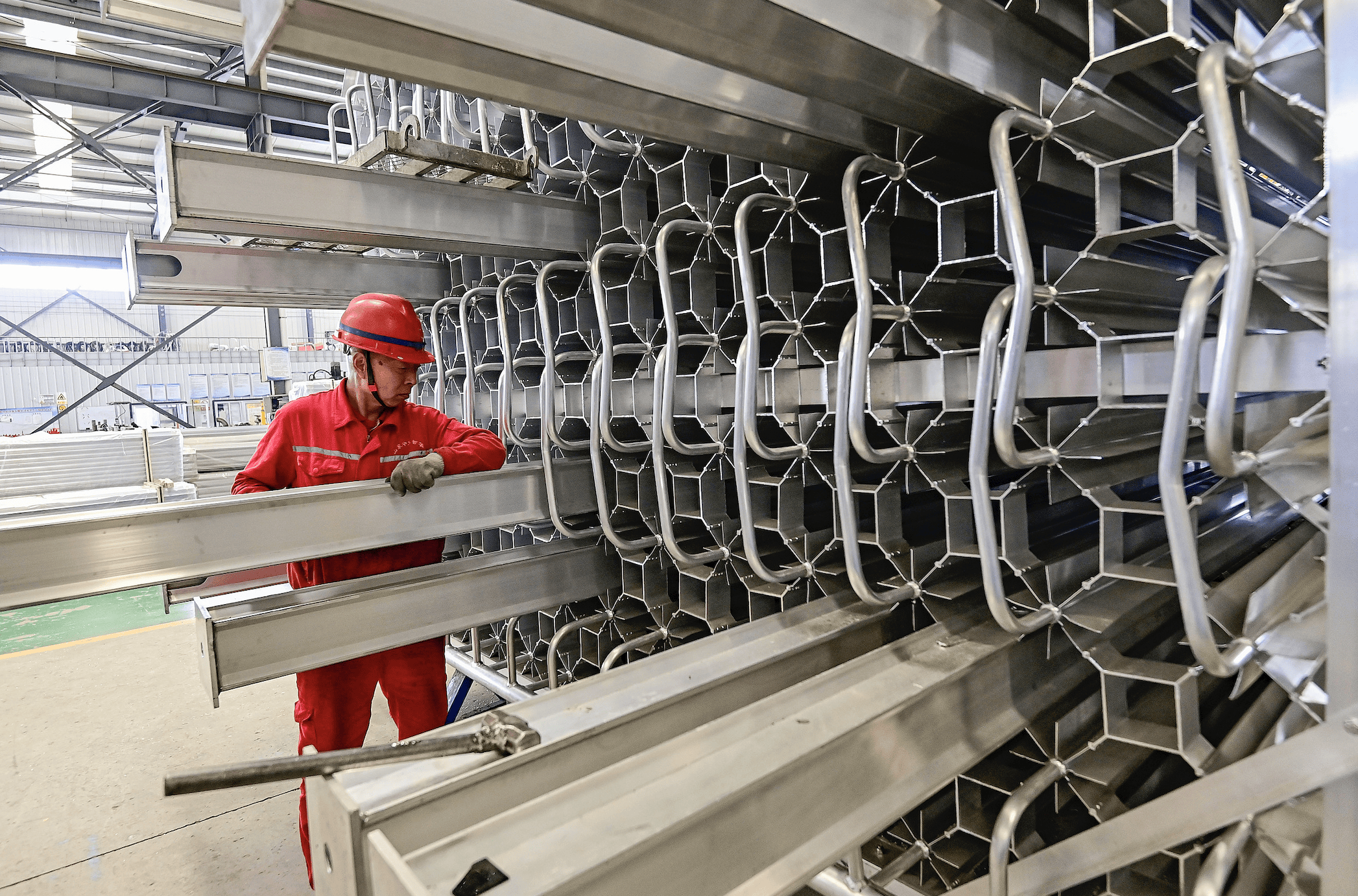
Core Insights - The preliminary Manufacturing Purchasing Manager Index (PMI) for Germany in September 2025 is reported at 48.5, which is below both the previous value of 49.8 and the forecasted value of 50, indicating a contraction in the manufacturing sector [1] Economic Data Summary - The PMI is a key economic indicator that reflects the business outlook of purchasing managers regarding the current operating environment [1] - The PMI has predictive capabilities for new orders and industrial production due to its real-time nature and leading characteristics of some components [1] - The data is published by S&P Global on a monthly basis, with the next release scheduled for October 24, 2025 [1] Market Impact - The reported PMI data is expected to have a negative impact on gold, silver, crude oil, and the euro [1]
需求疲软和关税压力导致越南制造业增长放缓
Shang Wu Bu Wang Zhan· 2025-09-05 03:26
Core Insights - The S&P Global report indicates that Vietnam's manufacturing sector continued to grow in August 2025, but the growth rate has slowed due to weak demand [1] - The PMI for August remained above the critical point of 50, indicating a slight improvement in manufacturing conditions for the second consecutive month, although it decreased from 52.4 in July to 50.4 in August, suggesting minimal improvement [1] - The report highlights a decrease in new orders in August, following a growth in July, with the decline attributed partly to U.S. tariff policies, which have led to a continuous drop in new export orders for ten consecutive months, with August's decline being significantly larger than the overall drop in new orders [1]
金属涨跌互现 期铜触及两个月最高,受助于美元回落【9月2日LME收盘】
Wen Hua Cai Jing· 2025-09-03 00:26
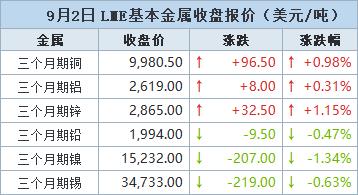
Core Viewpoint - LME copper prices reached a two-month high due to a decline in the dollar, positive economic data, and optimistic expectations for a rate cut in the U.S. [1] Group 1: Copper Market Performance - On September 2, LME three-month copper rose by $96.5, or 0.98%, closing at $9,980.5 per ton, with an intraday high of $10,009, the highest since July 3 [1][2] - The premium for copper imports in China, measured by the Yangshan copper premium, increased to $55 per ton, up from $29 on July 8, but still below the $100 level seen in May [4] - LME copper inventories are high, indicating weak demand outside of China, with spot copper trading at a discount of approximately $85 per ton compared to three-month copper [5][6] Group 2: Economic Indicators - The U.S. manufacturing sector contracted for the sixth consecutive month in August, with the ISM manufacturing PMI slightly rising to 48.7 from 48.0 in July, remaining below the neutral level of 50 [6] - The new orders index in the ISM survey rose to 51.4, indicating potential recovery after six months of contraction [7] - Market attention is focused on the upcoming Federal Reserve meeting on September 16-17, with expectations of a rate cut that could weaken the dollar and boost metal prices [7] Group 3: Other Base Metals Performance - LME three-month aluminum increased by $8, or 0.31%, closing at $2,619.0 per ton [2][8] - LME three-month zinc rose by $32.5, or 1.15%, closing at $2,865.0 per ton [2][8] - LME three-month lead decreased by $9.5, or 0.47%, closing at $1,994.0 per ton [2][9] - LME three-month nickel fell by $207, or 1.34%, closing at $15,232.0 per ton [2][10] - LME three-month tin dropped by $219, or 0.63%, closing at $34,733.0 per ton [2][8]
出口下滑,日本制造业持续萎缩
Huan Qiu Shi Bao· 2025-09-01 22:55
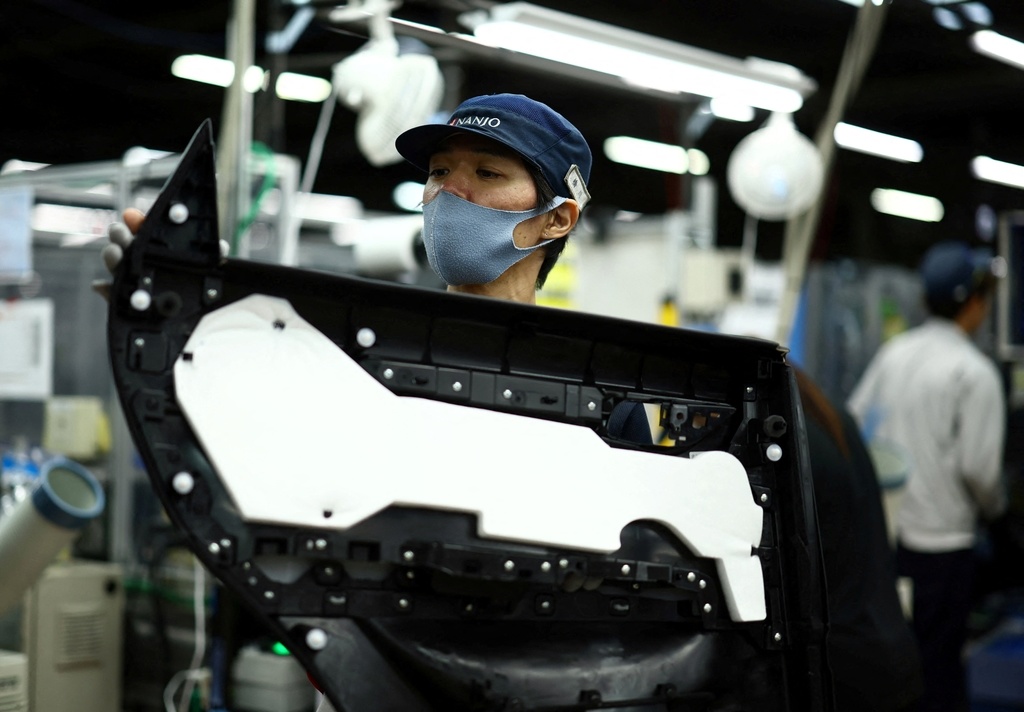
Group 1: Economic Impact of US Tariffs on Japan - Japan's manufacturing sector continues to shrink, with the August PMI at 49.7, indicating ongoing contraction as new orders decline, particularly in exports [2][3] - Japanese manufacturers' pre-tax profits dropped by 11.5% year-on-year in Q2, largely due to the impact of US tariffs on the automotive sector, which has led to reduced sales prices [3] - The Japanese government has revised its GDP growth forecast for FY2025 from 1.2% to 0.7%, reflecting the adverse effects of US tariff policies on the global economic outlook [9] Group 2: Trade Negotiation Challenges - Ongoing disputes over rice purchases have stalled further negotiations between Japan and the US, with Japan opposing US proposals that it views as interference in domestic affairs [6][7] - Communication issues between Japanese and US representatives have contributed to the current negotiation challenges, with Japan's chief negotiator having limited contact with key US officials [7] - The $550 billion investment mechanism within the Japan-US trade agreement has raised concerns that Japanese companies may prioritize investments in the US over domestic operations [5] Group 3: Future Economic Outlook - Short-term economic growth in Japan is expected to face pressure, with projections for Q3 growth slowing to 0.8% amid concerns over US tariffs and their impact on export profitability [9] - The potential for a decrease in US interest rates could further complicate Japan's economic situation, as it may lead to a narrowing interest rate differential that could squeeze export margins [9]
内外冲击叠加 英国制造业PMI五个月来首次下降
智通财经网· 2025-09-01 11:05
Group 1 - The UK manufacturing sector faced setbacks in August due to overseas trade tensions and domestic tax increases, leading to a decline in new orders [1] - The Manufacturing Purchasing Managers' Index (PMI) dropped from 48.0 in July to 47.0 in August, marking the first decline in five months and remaining in contraction territory for the 11th consecutive month [1] - Weak demand, global trade tariffs, and increased employer tax burdens contributed to a significant drop in new orders, with the fastest decline in four months [1][4] Group 2 - The confidence index among manufacturers slightly increased to a six-month high but remains below the long-term average [1] - Some employers anticipate stabilization in global market conditions, while others express concerns over potential tax increases and rising energy costs [2] - The ratio of new orders to finished goods inventory, an early indicator of future production changes, fell to its second-lowest level since October 2023 [3] Group 3 - The manufacturing sector has experienced continuous layoffs for ten months, raising concerns among Bank of England officials about a potential slowdown in the labor market [4] - Input price inflation reached its highest level since May, partly due to tax increases in April, although some cost increases have been passed on to customers [4] - Manufacturing accounts for approximately 9% of the UK's economic output, while the services sector showed accelerated expansion in August [4]
内需回暖提振,欧元区8月制造业PMI三年来首次升至荣枯线上方,德法强劲反弹
Hua Er Jie Jian Wen· 2025-09-01 09:11
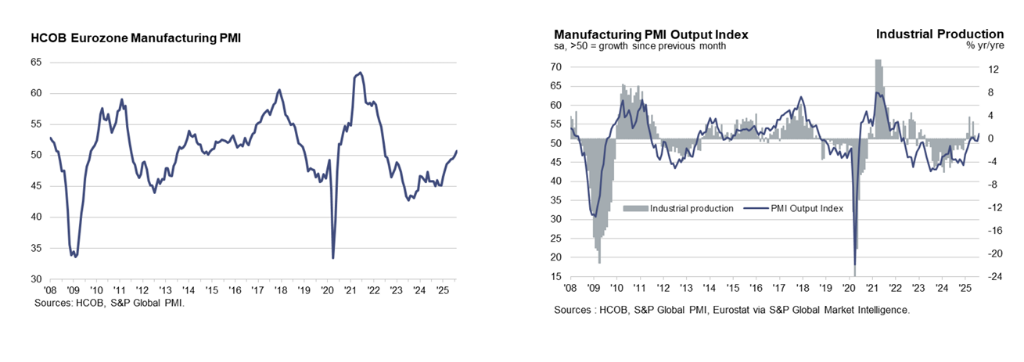
Core Insights - Eurozone manufacturing activity returned to expansion in August, with the PMI final value rising to 50.7, marking the highest level in over three years [1][2] - The recovery was primarily driven by strong internal demand, with factory output growth reaching its strongest level since March 2022 and new orders expanding at the fastest pace in nearly three and a half years [5][10] - Germany's manufacturing PMI rose from 49.1 in July to 49.8 in August, indicating significant resilience, while France's manufacturing PMI increased from 48.2 to 50.4, ending a two-and-a-half-year contraction [7][11] Eurozone Manufacturing Overview - The PMI for Eurozone manufacturing, compiled by Hamburg Commercial Bank (HCOB), increased to 50.7 in August, surpassing July's 49.8 and the initial estimate of 50.5, indicating growth above the 50 threshold [2] - Internal demand has effectively offset weak external demand, particularly amid US-EU trade tensions [5] Country-Specific Insights - Germany's manufacturing sector showed resilience, with the PMI reaching its highest level in over two years, although employment pressures and external demand challenges remain [7][10] - France's manufacturing sector returned to expansion for the first time in two and a half years, but faces challenges from domestic political instability and external trade issues [11][14] Economic Implications - The positive manufacturing data provides some breathing room for the European Central Bank as it weighs its next policy steps, despite ongoing inflation pressures and potential economic risks from US tariffs [1][5] - The recovery in manufacturing is uneven across the Eurozone, with Greece and Spain showing particularly strong performance, while broader economic uncertainties persist in France [5][14]