反向旅游

Search documents
北京号最精彩 | 秋日“赶集”天花板!地坛银杏文化节明日开逛
Bei Jing Ri Bao Ke Hu Duan· 2025-10-31 09:45
Group 1 - The autumn scenery in Beijing is highlighted, with various locations showcasing beautiful fall colors, such as the ginkgo trees in Ditan Park and the maple trees in Beifang [4][6][14][23] - The opening of the Xihui Leisure Park along the Tonghui River, covering an area of approximately 170,000 square meters, enhances the ecological landscape and provides green space for residents [16] - The completion of the Nanshan Ring Road Phase III, which spans 19.8 kilometers and includes 19 bridges and 2 tunnels, is expected to improve transportation and boost tourism in the Yanqing District [12] Group 2 - The "2025 National Drama Exhibition Season" will feature 35 performances, including 20 plays, from October 2023 to January 2026, promoting cultural engagement in Beijing [25] - The Shitai Expressway expansion project in Hebei Province has been completed, reducing travel time between Shijiazhuang and Taiyuan by approximately 20% [29]


反向旅游爆火背后,谁在支撑年轻人的山水梦?
Xin Jing Bao· 2025-10-29 02:39
Core Insights - The article highlights a shift in young people's travel motivations from conquering nature to self-indulgence and relaxation [1] - It discusses the emerging trend of "reverse tourism" as a popular escape from urban life [1] Group 1: Travel Trends - Young individuals are increasingly adopting "mountain therapy" as a new method to relieve stress [1] - The concept of "self-pampering" is becoming a key performance indicator (KPI) for travel among the youth [1] Group 2: Personal Experiences - Travelers are arriving at Qingcheng Mountain with various personal challenges, such as workplace anxiety and life uncertainties [1] - The article emphasizes the therapeutic benefits of nature, where individuals discover insights like the importance of not rushing through life [1]
宝藏“小城”成假期新宠“反向游”成假日经济新图景
Zhong Guo Qing Nian Bao· 2025-10-14 12:07
Core Insights - The trend of "reverse tourism" is gaining momentum, with significant increases in bookings for lesser-known destinations compared to popular tourist spots [1][2][9] - Young urban travelers are increasingly seeking out small towns and less commercialized locations for a more authentic and relaxing travel experience [3][4][6] Group 1: Booking Trends - Hotel bookings in over 30 county-level destinations have seen a year-on-year increase of over 100% [2] - During the National Day holiday, pre-order volumes for county tourism consumption increased by 51% compared to the previous year [1][2] - Specific destinations like Guangxi Jingxi and Guangdong Puning have experienced over 100% growth in tourism consumption pre-orders [1] Group 2: Traveler Preferences - Young travelers are prioritizing lesser-known destinations for their trips, valuing experiences that are not overcrowded and commercially overexploited [1][3] - The concept of "emotional value" is redefining holiday experiences, with travelers seeking genuine local interactions rather than just visiting famous landmarks [6][7] - A significant portion of travelers (43.6%) are specifically looking for local experiences that reflect the daily life of small towns [4] Group 3: Economic Impact - The rise of "reverse tourism" is contributing to a shift in travel patterns, with many opting for off-peak travel to enhance their experience and save costs [7][9] - The trend is also encouraging more people to explore local attractions, leading to increased tourism in nearby areas [9][10] - The demand for small towns is expected to continue growing, with 82.2% of respondents indicating plans for future small-town travel [7] Group 4: Infrastructure and Sustainability - The influx of tourists to small towns necessitates improvements in public services and leisure facilities to accommodate the growing demand [10][11] - Sustainable development strategies are essential for small towns to capitalize on the "reverse tourism" trend and maintain long-term appeal [11] - The focus should be on creating unique experiences that cater to the evolving preferences of travelers, ensuring that small towns can compete in the broader tourism market [11]
宝藏“小城”迎来“泼天富贵” “反向旅游”成假日经济“新图景”
Zhong Guo Qing Nian Bao· 2025-10-14 03:40
Core Insights - The rise of "reverse tourism" is reshaping travel preferences, with a significant increase in bookings for lesser-known destinations, particularly in county-level areas, reflecting a shift from crowded tourist spots to quieter, more authentic experiences [1][2][10] Group 1: Travel Trends - Hotel bookings in over 30 county-level destinations have seen a year-on-year increase of over 100% during the recent holiday period [2] - Popularity of small cities is growing, with travel orders for places like Enshi in Hubei and Yuncheng in Shanxi increasing by 300% and 57% respectively [3] - Young urban travelers are increasingly seeking unique experiences in small towns, with a notable rise in interest for destinations like Xinjiang's Uqia County, which saw a 114% growth in tourism [3][4] Group 2: Consumer Preferences - A significant portion of travelers prioritize "high cost-performance" in their travel plans, with budgets typically ranging from 2001 to 5000 yuan for small city trips [4] - Over 80% of users have given positive feedback on their experiences in small cities, with 82.2% indicating plans for future visits [8] - The trend of "reverse tourism" is not just a temporary fad but reflects a deeper exploration of travel's essence, focusing on emotional and experiential value [7][11] Group 3: Economic Impact - The shift towards small towns and lesser-known destinations is seen as an overflow from the thriving market of traditional tourist spots, creating a new dynamic in the tourism economy [10][11] - The demand for "reverse tourism" has led to increased interest in local experiences, with many travelers opting for off-peak travel to save costs and enhance their experiences [9][12] - The growth of small cities as travel destinations necessitates improvements in public services and infrastructure to sustain the influx of visitors [11][12]
“反向旅游”成假日经济“新图景”
Zhong Guo Qing Nian Bao· 2025-10-13 23:14
Core Insights - The trend of "reverse tourism" is gaining momentum, with significant increases in travel bookings to lesser-known destinations, reflecting a shift in consumer preferences towards less crowded and more authentic travel experiences [1][2][9] Group 1: Travel Trends - Hotel bookings in over 30 county-level destinations have seen a year-on-year increase of over 100%, indicating a strong demand for county tourism [2] - Popular small cities are emerging as new favorites during holidays, with notable increases in travel orders, such as a 300% rise in bookings for Enshi, Hubei, and a 57% increase for Yuncheng, Shanxi [3] - The concept of "reverse tourism" is not just a temporary trend but represents a deeper exploration of the essence of travel, focusing on emotional experiences rather than just sightseeing [6][10] Group 2: Consumer Preferences - Nearly half of respondents in a survey indicated that small cities offer high cost-performance ratios, with a budget range of 2001-5000 yuan being the mainstream choice for holiday travel [4] - 82.2% of respondents expressed plans for future trips to small cities, highlighting a growing interest in these destinations [7] - The search volume for hotels near morning markets has increased by 70%, indicating a preference for local experiences that reflect everyday life [4] Group 3: Economic Impact - The rise of "reverse tourism" has led to increased demand for off-peak travel, with many office workers opting for flexible holiday plans to avoid crowds [7][9] - Data shows that hotel costs can be reduced by 20% during certain periods, and flight prices can drop by over 30% after peak travel days [7] - The influx of tourists to small cities presents both opportunities and challenges, requiring improved public services and infrastructure to sustain growth [10][11]
中银晨会聚焦-20251013
Bank of China Securities· 2025-10-13 01:05
Core Insights - The report highlights a record high in domestic travel during the National Day and Mid-Autumn Festival holidays, with 888 million domestic trips taken, reflecting a year-on-year increase of 1.6% [6] - Despite the increase in travel volume, average spending per person has slightly decreased, indicating a trend of consumers being more cautious with their expenditures [6] - The cross-border travel market remains robust, with a significant increase in both outbound and inbound travel, suggesting a continued recovery in the tourism sector [9] Domestic Travel Performance - The total expenditure for domestic travel reached 809 billion CNY, with an average daily spending of 911.04 CNY, which is down 13% year-on-year [6] - Daily cross-regional travel reached over 300 million people, marking a historical high, with a year-on-year increase of 6.2% [6] - Popular tourist destinations saw significant visitor numbers, such as Changbai Mountain receiving 221,700 visitors and Jiuzhaigou receiving 305,700 visitors, reflecting a year-on-year increase of 24.39% [7] Trends in Tourism - There is a noticeable shift towards "deep experience travel," with long-distance and immersive travel becoming more popular, as evidenced by a 3 percentage point increase in long-distance travel orders compared to last year [8] - Events like music festivals and sports competitions are becoming key drivers in the cultural tourism market, significantly boosting local hotel bookings [8] - The report notes that the trend of "reverse tourism" is gaining traction, with tourists exploring non-traditional cities beyond major metropolitan areas [9] Cross-Border Travel Insights - During the holiday period, a total of 16.34 million people crossed borders, with an average of 2.043 million people per day, reflecting a year-on-year increase of 11.5% [9] - Outbound travel remains strong, particularly to East Asia and Southeast Asia, while European destinations are seeing a notable increase in bookings [9] - Inbound travel is also on the rise, with 751,000 foreign visitors during the holidays, of which 535,000 benefited from visa-free entry, marking increases of 19.8% and 46.8% respectively [9]
国庆中秋假期酒店平均入住率同比增长
Feng Huang Wang· 2025-10-11 01:50
Core Insights - The recent National Day and Mid-Autumn Festival holiday saw a significant increase in domestic travel, with 888 million trips taken, up 123 million from the previous year, and total spending reaching 809 billion CNY, an increase of 108 billion CNY [1][5] Group 1: Travel and Tourism Data - The travel service GMV on Fliggy increased by 48% year-on-year, with service users up by 30%, and hotel night stays surged by 78% compared to last year [1] - Jinjiang Hotels reported a 4% increase in average occupancy rate, with over 13 million guests served, a 30% increase year-on-year [2] - Huazhu Group's hotels hosted over 10.55 million guests, a 36% increase, with foreign guests up 75% [2] Group 2: Emerging Travel Trends - There is a growing trend of "reverse tourism," with younger travelers exploring less popular destinations, leading to high occupancy rates in lower-tier cities [3] - Cities like Jingdezhen saw a 60% increase in orders on Fliggy, with overall tourism orders up nearly 40% on Ctrip [4] - The demand for unique local experiences surged, with a 50% increase in tourists opting for extended stays of 7-8 days [4] Group 3: Market Outlook - The travel market is expected to maintain strong momentum, with predictions of increased travel activity continuing until October 12, driven by diverse consumer needs and quality offerings [5]
2025年国庆、中秋旅游数据点评:国内游出行半径扩大,跨境游双向升温
Bank of China Securities· 2025-10-10 09:12
Investment Rating - The industry is rated as "Outperform" with expectations of better performance compared to the benchmark index over the next 6-12 months [1][34]. Core Insights - The domestic tourism market saw record high travel numbers during the National Day and Mid-Autumn Festival holidays, with 888 million domestic trips and total spending of 809 billion CNY, reflecting a year-on-year increase of 1.0% in spending [7][19]. - Cross-border travel is experiencing a resurgence, with a significant increase in both inbound and outbound travel, indicating a recovery trend in the tourism sector [3][19]. - The report highlights a shift towards long-distance and immersive travel experiences, with deep travel orders increasing by 3 percentage points compared to last year [18][19]. Summary by Sections Investment Recommendations - Recommended companies include Lingnan Holdings, Changbai Mountain, and Huangshan Tourism for their strong operational performance and growth potential. Additionally, Jinjiang Hotels is favored due to the recovery in business travel and increased market share post-pandemic [3][26]. - The growth in cross-border travel is expected to boost airport duty-free sales, with new policies on city duty-free and outbound tax refunds contributing to incremental growth. Companies like China Duty Free Group and Wangfujing are recommended [3][26]. Domestic Travel Insights - The National Day and Mid-Autumn Festival holidays saw 888 million domestic trips, with daily average spending down by 13% to 911.04 CNY. The total expenditure reached 809 billion CNY, with a daily average increase of 1.0% [7][19]. - High travel volumes were recorded, with over 2.4 billion cross-regional movements, marking a historical high and a year-on-year increase of 6.2% [7][10]. Key Attractions and Events - Major tourist attractions maintained high visitor numbers, with Changbai Mountain receiving 221,700 visitors, and Jiuzhaigou welcoming 305,700 visitors, reflecting a year-on-year increase of 24.39% [14][20]. - Cultural events such as the "Thousand Years of Love" performances saw record attendance, with nearly 3 million visitors during the holiday period [20][21]. Cross-Border Travel Trends - A total of 16.34 million inbound and outbound travelers were recorded during the holidays, with a daily average of 2.04 million, representing an 11.5% year-on-year increase [19][21]. - Popular outbound destinations include East Asia and Southeast Asia, with significant growth in European travel orders [19][21].
超8000亿旅游花费背后,这届游客把钱花在哪儿?
Xin Jing Bao· 2025-10-10 06:30
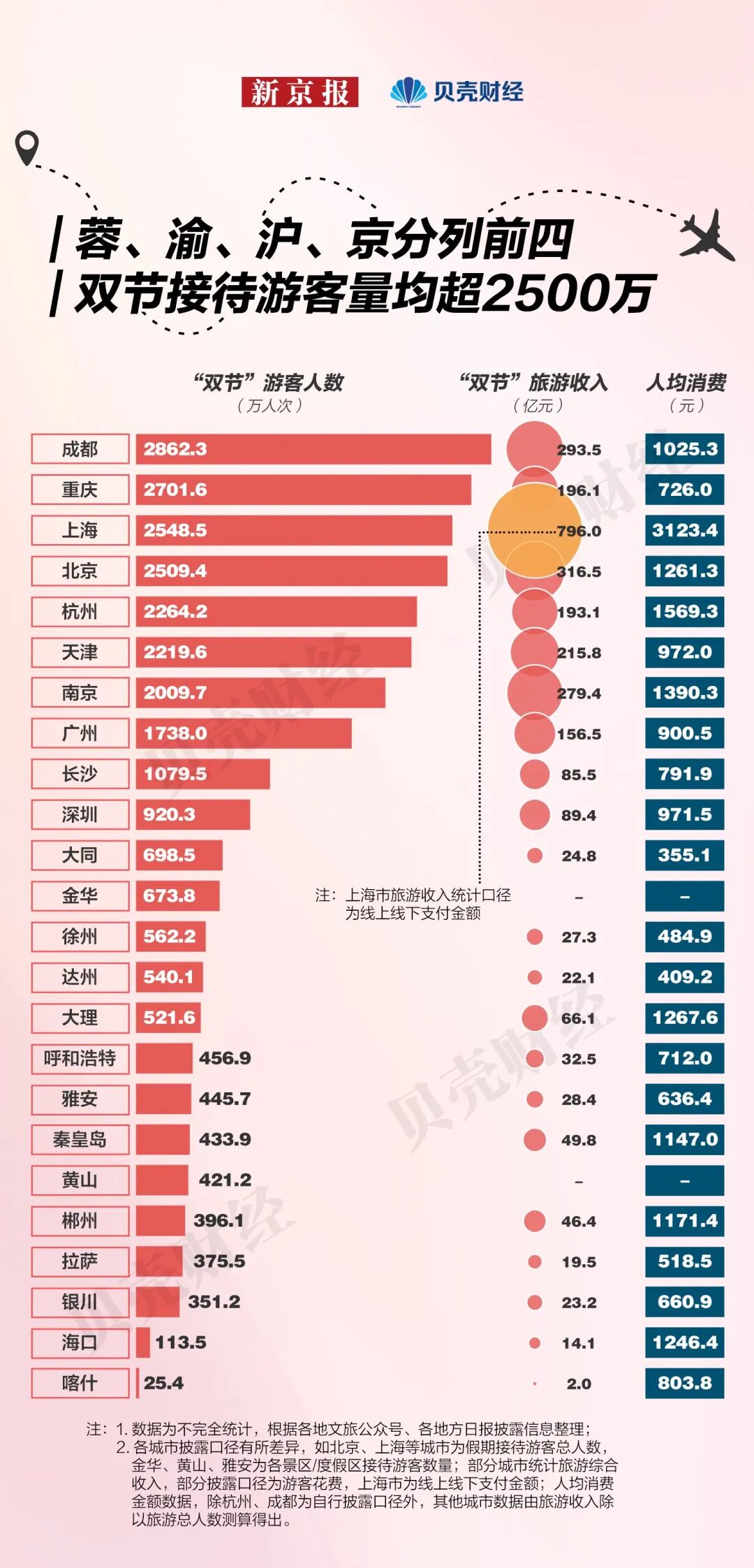
Core Insights - The "Super Golden Week" holiday saw a record 888 million domestic trips in China, with total tourism spending reaching 809 billion CNY, marking an increase of 1.23 million trips compared to the previous year [1][2]. Group 1: Travel Trends - The total cross-regional movement of people during the "Double Festival" period reached 2.433 billion, averaging 304 million daily, a 6.3% increase year-on-year, setting a historical high [2]. - Younger generations, particularly those born after 2000 and 1995, are becoming the main force in holiday travel, favoring less crowded destinations and new travel styles such as group tours and car rentals [2][7]. - There is a notable trend of "reverse tourism," where travelers seek out lesser-known attractions, with some destinations like Jingdezhen seeing a 60% increase in orders [2][10]. Group 2: International Tourism - Beijing welcomed 119,000 international visitors during the holiday, a 48% increase year-on-year, with spending reaching 1.23 billion CNY, up 54.1% [3]. - The booking volume for domestic flights by foreign passport holders increased by 33%, with cities like Datong and Lijiang experiencing significant surges in foreign tourist bookings [3][15]. Group 3: Popular Destinations - Major cities such as Chengdu, Chongqing, Shanghai, and Beijing received over 25 million visitors each during the holiday [2]. - The top ten attractions favored by the younger demographic include various theme parks and scenic spots across different provinces, indicating a shift in travel preferences [11][12]. Group 4: Emerging Travel Markets - The fastest-growing inbound tourism markets include Mongolia and the Netherlands, with booking volumes for flights from these countries increasing significantly [15][16]. - Cities like Datong and Lijiang saw extraordinary increases in flight bookings, with Datong experiencing a 700% rise [18].
数读“双节”|超8000亿旅游花费背后,这届游客把钱花在哪儿
Xin Jing Bao· 2025-10-10 05:49
Core Insights - The "Super Golden Week" holiday saw a record 888 million domestic trips in China, with total tourism spending reaching 809 billion yuan, marking an increase of 123 million trips compared to the previous year [1][2] - Major cities like Chengdu, Chongqing, Shanghai, and Beijing were the top destinations, each receiving over 25 million visitors [1] - The travel demographic has shifted towards younger generations, particularly those born after 2000 and 1995, who prefer less crowded, off-the-beaten-path destinations [1][2] Domestic Travel Trends - The total cross-regional movement of people during the holiday reached 2.433 billion, averaging 304 million daily, a 6.3% increase year-on-year [1] - Popular travel methods among younger travelers include group tours and chartered trips, reflecting a trend towards convenience and ease [2][13] - The rise of niche tourism, with destinations like Jingdezhen and Jiuzhaigou seeing significant increases in bookings, indicates a growing interest in less conventional travel experiences [2][13] International Visitor Insights - Beijing welcomed 119,000 international tourists during the holiday, a 48% increase, with spending reaching 1.23 billion yuan, up 54.1% [2] - There was a notable increase in flight bookings by foreign passport holders, with some cities experiencing over 700% growth in international bookings [2][19] - Emerging markets for inbound tourism include Mongolia and the Netherlands, with significant increases in flight reservations [15][17] Popular Destinations and Activities - The top ten attractions favored by younger travelers include various theme parks and scenic spots across China, such as Shenzhen's Ocean World and Beijing's Wildlife Park [9][12] - Events like music festivals and sports competitions have become popular, driving holiday consumption and hotel bookings [13] - The overall hotel booking volume saw substantial growth, with some regions reporting increases of up to 300% [13]