地缘局势

Search documents
休市前 欧线集运期价忽然“支棱”了一下
Qi Huo Ri Bao· 2026-02-14 03:04
Core Viewpoint - The recent surge in the European shipping index futures prices, exceeding 6%, is attributed to geopolitical tensions and short sellers exiting the market, despite no significant changes in the fundamentals [2]. Group 1: Market Dynamics - The increase in European shipping futures is primarily driven by geopolitical factors, particularly the ongoing conflict between the U.S. and Iran, which has heightened market volatility [2][4]. - Analysts note that the shipping companies have not yet implemented the previously announced price increases for March, indicating a potential disconnect between market expectations and actual pricing [2][4]. - The market is currently experiencing a seasonal downturn in shipping volumes post-Chinese New Year, which is expected to exert downward pressure on spot freight rates [3][4]. Group 2: Future Outlook - Analysts suggest that the upcoming months may see continued volatility in European shipping futures due to potential "black swan" events related to geopolitical and tariff policy changes, as well as adverse weather conditions affecting shipping schedules [3]. - The influx of new ships entering the market could lead to a more relaxed supply-demand balance, further pressuring freight rates in the medium to long term [3][4]. - The overall sentiment indicates that while there may be short-term support for freight rates due to anticipated economic improvements, the long-term outlook remains cautious due to the expected increase in shipping capacity and the resumption of operations in the Red Sea [4].
宏观经济周报:海外非农增长,国内通胀回升-20260213
BOHAI SECURITIES· 2026-02-13 08:51
Group 1: U.S. Economic Overview - U.S. retail sales unexpectedly stagnated in December 2025, with the control group retail sales showing a negative month-on-month growth, indicating high living costs suppressing consumption among low- and middle-income groups[1] - Non-farm employment rebounded unexpectedly, reversing the weak trend seen at the end of 2025, with private sector jobs supported mainly by education and healthcare, while financial and information sectors continued to decline due to AI substitution effects[1] - The unemployment rate decreased despite an increase in labor participation rate, with a slight rise in hourly wage growth, although the overall employment data may still be overestimated[1] Group 2: Domestic Economic Conditions - In January, the Consumer Price Index (CPI) month-on-month growth remained flat, with food prices slowing down but pork prices turning positive; core CPI continued to rise due to the upcoming Spring Festival[3] - Producer Price Index (PPI) showed an upward trend, with price changes in crude oil and non-ferrous metals causing a divergence in PPI growth across industries, while "anti-involution" policies positively impacted sectors like photovoltaics and lithium batteries[3] - Real estate transactions remained at a low point, with wholesale agricultural prices declining, and prices for steel and cement slightly decreasing, while upstream prices for coking coal and coking fell, and prices for non-ferrous metals and gold generally declined[3]
国泰君安期货商品研究晨报-能源化工-20260212
Guo Tai Jun An Qi Huo· 2026-02-12 06:53
1. Report Industry Investment Rating No relevant content provided. 2. Core Views of the Report - The report provides investment outlooks and strategies for various energy and chemical commodities, including PX, PTA, MEG, rubber, etc., suggesting investors to pay attention to position control before the Spring Festival due to potential geopolitical disturbances and market uncertainties [2][9][10]. - Different commodities show different trends, such as some being in a range - bound market, some having upward or downward pressure, and some being affected by factors like supply - demand changes, cost fluctuations, and geopolitical situations [2]. 3. Summary by Commodity PX, PTA, MEG - **PX**: A pre - holiday range - bound market with support at the bottom. The cost end is worried about potential supply risks due to unstable geopolitical situations, and the valuation is upward - revised. The fundamentals are weak in February, but the unilateral price is supported and runs strongly. Investors should manage positions [9]. - **PTA**: The downside space may be limited, and the monthly spread is bearish. Short positions can be taken when the processing fee is above 450. The terminal demand has different situations, and the polyester start - up rate is expected to change. Multiple sets of device maintenance plans boost the monthly spread. Investors should pay attention to the 5100 yuan/ton support level and manage positions [10]. - **MEG**: The inventory continues to rise, and the supply pressure is still high. The basis and monthly spread are in a reverse - set operation. The ethylene glycol start - up rate remains stable, but the demand side has large - scale shutdowns, resulting in large inventory accumulation pressure in February and difficult inventory digestion after the festival. Investors should manage positions [10]. Rubber - It is in a shock operation. The futures market has changes in closing prices, trading volumes, and positions. The spot market prices of some varieties have increased. The order situation of semi - steel tire and all - steel tire sample enterprises shows different trends [11][13]. Synthetic Rubber - It is in a pre - holiday shock operation. The futures market has changes in closing prices, trading volumes, and positions. The spot market prices of some varieties have increased, and the inventory of domestic butadiene rubber has increased [14][15]. LLDPE - The internal and external markets are close to a standstill, and the funds are risk - averse, showing a shock market. The raw material end crude oil price has fallen and stabilized, the ethylene monomer link is weak, and the downstream demand has different situations. The supply - side maintenance plan has decreased, and attention should be paid to the inventory accumulation during the festival and the destocking slope after the festival [17][18]. PP - The C3 raw material performs strongly, but the valuation repair is limited. The cost end of crude oil and propane prices continues to be strong, and the demand side has limited support. The PDH profit is at a low level, and attention should be paid to the marginal changes of PDH devices [20][21]. Caustic Soda - The cost is rising, and the valuation is being repaired. The previous short - selling logic of caustic soda profit may be challenged. The demand side is weak, and the supply - side reduction and load - reduction expectations are increasing after March. It is recommended to stop losses on short positions in the 03 contract before the Spring Festival and gradually build long positions in the 05 contract at low levels [25]. Pulp - It is in a shock operation. The market is in a state of waiting and seeing before the festival, with few spot quotations and stagnant downstream procurement. The supply - demand fundamentals have no actual changes during the holiday, and the price is expected to end stably. Attention should be paid to the changes in port inventory and the impact of the macro - market on the pulp market [31][32]. Glass - The original sheet price is stable. As the Spring Festival approaches, the downstream procurement volume decreases, and the float glass factory has no motivation to adjust prices. The market demand declines, and the overall trading is light [35][36]. Methanol - It is in a shock operation. The spot price shows a regional adjustment situation, and the port inventory has a small increase. In the short term, it is expected to fluctuate within a limited range. The macro - level is in the process of negotiation between Iran and the United States, and the fundamental driving force is neutral to downward. The upper and lower price limits are affected by factors such as MTO profit and coal - based cost [41][42]. Urea - It is in a pre - holiday shock with support. The support comes from the improvement of spot transactions driven by pre - holiday order collection and the strong expectation of agricultural spring plowing demand after the festival. The fundamental pressure level of the 05 contract is around 1830 yuan/ton, and the support level is around 1750 - 1760 yuan/ton [45][46]. Styrene - It is in a high - level shock. The absolute price is in a high - level shock with the withdrawal of funds. The styrene profit is at a high level in recent years, and attention should be paid to the restart progress of some devices after the festival and the opportunity of EB profit contraction and PX - EB [47][48]. Soda Ash - The spot market has little change. The domestic soda ash market is weakly stable, with stable device operation and high supply. The downstream demand procurement is basically completed before the holiday, and the trading is light. The price may remain weakly stable in the short term [50]. LPG and Propylene - **LPG**: Geopolitical disturbances still exist, and the fundamental driving force is downward. The futures market has price changes, and the spot market prices of some varieties have changes. The industrial chain start - up rate and shipping volume have different trends [52]. - **Propylene**: The spot price is stable, and the basis converges. The futures market has price changes, and the spot market prices of some varieties have changes [52]. PVC - It is in a weakly shock operation. The domestic spot market trading is dull, and the supply - demand is weak. The industry continues to accumulate inventory, and it is expected to be weakly shocked before the festival. The high - production and high - inventory structure is difficult to change, and the market may still trade delivery pressure and high forward premium [60][61]. Fuel Oil and Low - Sulfur Fuel Oil - **Fuel Oil**: The night - session price has risen, and it may turn to a relatively strong trend in the short term. - **Low - Sulfur Fuel Oil**: It mainly follows the upward trend, and the price difference between high - and low - sulfur in the external spot market is still at a low level [64]. Container Shipping Index (European Line) - It is in a shock market. The futures market has price and position changes. The spot market freight rate is stable before the festival. Geopolitical factors and shipping company policies have an impact on the market. Different contracts have different investment strategies [66][74][75]. Short - Fiber and Bottle Chip - **Short - Fiber**: It is in a short - term shock market, and investors are advised to reduce long positions when the price is high. The futures price fluctuates upward, the spot price is stable, and the downstream is mostly on holiday [77][78]. - **Bottle Chip**: It is in a short - term shock market, and investors are advised to reduce long positions when the price is high. The upstream polyester raw materials fluctuate upward, and the factory price is partially adjusted upward. The market trading atmosphere is average [77][78]. Offset Printing Paper - It is recommended to wait and see before the festival. The spot market price is stable, the scale paper mills are stably producing, some small and medium - sized paper mills are shut down, and the dealer's order - receiving situation is not good [80][81]. Pure Benzene - It is in a strong shock. The futures price has increased, the spot price has increased, and the port inventory has decreased slightly. Attention should be paid to the restart progress of some devices and the price trend [84][85].
油价成本支撑,节前现货交投清淡
Hua Tai Qi Huo· 2026-02-12 04:09
1. Report Industry Investment Rating - The report gives a mid - term cautious and bullish rating for PX/PTA/PF/PR, suggesting to control positions before the Spring Festival [3] 2. Core Viewpoints - Cost side: The market is still fluctuating around the Iran situation, and attention should be paid to the geopolitical situation. The PXN has significantly declined, and the floating price of PX remains weak. Although the short - term fundamentals are weak, the mid - term expectation is good [1] - TA: The spot processing fee of PTA has significantly declined, the supply - demand pattern has weakened, and the spot basis is weak. In the short term, the supply - demand situation is accumulating, but in the long - term, the processing fee is expected to improve [1] - Demand: The polyester operating rate is 78.2% (a 6.0% month - on - month decrease). The weaving load has accelerated its decline, and the polyester load has also dropped to a low level. The inventory has started to accumulate. The average monthly load in February is estimated to be 79% [2] - PF: The spot production profit is - 16 yuan/ton (a 42 - yuan/ton month - on - month decrease). The demand before the Spring Festival is weak, and the load is gradually declining [2] - PR: The spot processing fee of polyester bottle chips is 619 yuan/ton (a 42 - yuan/ton month - on - month decrease). The pre - holiday inventory reduction is smooth, and the processing fee has rebounded [2] 3. Summary by Related Catalogs Price and Basis - The report includes figures on TA and PX's main contract, basis, and inter - period spread trends, as well as PTA's East China spot basis and short - fiber basis [7][8][13] Upstream Profit and Spread - It shows figures on PX processing fee (PXN), PTA spot processing fee, South Korea's xylene isomerization profit, and South Korea's STDP selective disproportionation profit [15][19] International Spread and Import - Export Profit - Figures on toluene's US - Asia spread, toluene's South Korea FOB - Japan naphtha CFR, and PTA's export profit are presented [21][23] Upstream PX and PTA Operation - The report provides figures on the operating rates of PTA in China, South Korea, and Taiwan, as well as the operating rates of PX in China and Asia [24][27][29] Social Inventory and Warehouse Receipts - Figures on PTA's weekly social inventory, PX's monthly social inventory, PTA's total warehouse receipts + forecast volume, and various warehouse receipt inventories are included [34][37][38] Downstream Polyester Load - It shows figures on the production and sales of filaments and short - fibers, polyester load, and the inventory days and profits of filament factories, as well as the operating rates of weaving, texturing, and dyeing in Jiangsu and Zhejiang [46][48][56] PF Detailed Data - Figures on the load of polyester staple fibers, factory equity inventory days, physical and equity inventories, and the operating rates and profits of pure polyester yarns and polyester - cotton yarns are provided [66][73][77] PR Fundamental Detailed Data - Figures on the load of polyester bottle chips, factory inventory days, spot and export processing fees, export profit, and month - on - month spreads are presented [82][84][90]
对二甲苯:单边震荡市,节前注意仓位控制,PTA:区间震荡市,节前注意仓位控制,MEG:区间操作,节前注意仓位控制
Guo Tai Jun An Qi Huo· 2026-02-12 03:20
Report Industry Investment Rating - Not provided Core Viewpoints - PX is in a pre - holiday range - bound market with support at the bottom, and a reverse spread for the monthly spread is recommended. Investors should pay attention to position management during the long Spring Festival holiday [5]. - PTA has limited downside space, and the monthly spread is bearish. Short PTA when the processing fee is above 450. Pay attention to the support at 5100 yuan/ton. Position management is necessary during the Spring Festival [6]. - MEG's inventory continues to rise, with large supply pressure. A reverse spread operation for the basis and monthly spread is suggested. The basis and monthly spread trends remain weak, and investors should manage positions during the Spring Festival [6]. Summary by Related Catalogs Futures Market - **PX**: The closing price of the PX main contract was 7378, up 70 (0.96%) from the previous day. The PX5 - 9 monthly spread was 22, up 14 from the previous day [2]. - **PTA**: The closing price of the PTA main contract was 5260, up 30 (0.57%) from the previous day. The PTA5 - 9 monthly spread was 24, down 4 from the previous day [2]. - **MEG**: The closing price of the MEG main contract was 3764, up 31 (0.83%) from the previous day. The MEG5 - 9 monthly spread was - 110, down 2 from the previous day [2]. - **PF**: The closing price of the PF main contract was 6654, up 28 (0.42%) from the previous day. The PF3 - 4 monthly spread was - 66, up 8 from the previous day [2]. - **SC**: The closing price of the SC main contract was 476.8, up 0.7 (0.15%) from the previous day. The SC2 - 3 monthly spread was 1, up 3.7 from the previous day [2]. Spot Market - **PX**: The PX CFR China price was 917.33 dollars/ton, up 8.33 dollars/ton from the previous day. The PX - naphtha spread was 294.05 dollars/ton, up 5.96 dollars/ton from the previous day [2]. - **PTA**: The PTA price in East China was 5180 yuan/ton, up 35 yuan/ton from the previous day. The PTA processing fee was 378.86 yuan/ton, down 49.15 yuan/ton from the previous day [2]. - **MEG**: The MEG spot price was 3663 yuan/ton, up 38 yuan/ton from the previous day [2]. Market News - **PX**: On February 11, PX prices rose. The Platts - assessed Asian p - xylene CFR Unv1/China and FOB Korea indicators both rose 8.33 dollars/ton. The futures market rise was due to short - covering rather than fundamental changes in the physical market [3][4]. - **MEG**: A 400,000 - ton/year syngas - to - ethylene glycol unit in Xinjiang restarted one line and plans to restart another line around this Friday. A 900,000 - ton/year ethylene glycol unit in Lianyungang has stopped production for conversion, with an initial plan of at least 2 - 3 months [4]. - **Polyester**: On February 11, the sales of polyester yarn in Jiangsu and Zhejiang increased individually but remained weak overall, with an average sales rate of over 40% by 4:30 pm. The average sales rate of direct - spun polyester staple fiber factories was 29% by 3:00 pm [4][5].
格林期货早盘提示:甲醇-20260212
Ge Lin Qi Huo· 2026-02-12 01:00
Group 1: Report Industry Investment Rating - The investment rating for methanol in the energy and chemical sector is "oscillating with a bullish bias" [1] Group 2: Core View of the Report - With the Middle - East geopolitical situation prone to fluctuations, crude oil prices are trending strongly. This week, methanol inventories at ports increased slightly, while those in the inland areas decreased. As downstream提货 weakens during the Spring Festival holiday, the fundamentals lack continuous drivers, so the short - term methanol price will oscillate slightly stronger. The reference range for the 05 contract is 2200 - 2300 [1] Group 3: Summary by Related Catalog Market Review - On Wednesday night, the futures price of the main contract 2605 rose 2 yuan to 2243 yuan/ton, and the spot price of methanol in the mainstream East - China region rose 5 yuan to 2215 yuan/ton. In terms of positions, long positions increased by 1453 to 477,000, and short positions decreased by 21,332 to 583,000 [1] Important Information - **Supply**: The domestic methanol operating rate is 92.2%, a month - on - month increase of 1.1%. The overseas methanol operating rate is 46.8%, a month - on - month decrease of 4.3% [1] - **Inventory**: The total inventory of methanol at Chinese ports is 1432,200 tons, an increase of 21,200 tons from the previous data. Among them, inventory in East - China increased by 36,600 tons, and that in South - China decreased by 15,400 tons. The inventory of Chinese methanol sample production enterprises is 340,300 tons, a decrease of 28,000 tons from the previous period, a month - on - month decrease of 7.61% [1] - **Demand**: The signing volume of northwest methanol enterprises is 56,300 tons, a month - on - month decrease of 9700 tons. The pending orders of sample enterprises are 315,000 tons, an increase of 28,000 tons from the previous period, a month - on - month increase of 9.75%. The olefin operating rate is 83.8%, a month - on - month increase of 1.7%; the methyl chloride operating rate is 77.4%, a month - on - month increase of 1.4%; the acetic acid operating rate is 81.7%, a month - on - month decrease of 0.5%; the formaldehyde operating rate is 30%, a month - on - month decrease of 3.2%; the MBTE operating rate is 68.0%, unchanged from the previous period [1] - **Import Data**: In December 2025, China's methanol import volume was 1,734,000 tons, a month - on - month increase of 24.56%, and the average import price was 240.61 dollars/ton, a month - on - month decrease of 7.23%. Among them, the largest import volume was from Saudi Arabia, which was 604,400 tons, with an average import price of 238.74 dollars/ton. From January to December 2025, China's cumulative methanol import volume was 14,405,400 tons, a year - on - year increase of 6.75% [1] - **Crude Oil Market**: Concerns about potential supply risks due to unstable geopolitical situations led to an increase in international oil prices, but the growth of US commercial crude oil inventories limited the increase. The NYMEX crude oil futures 03 contract rose 0.67 dollars/barrel to 64.63 dollars/barrel, a month - on - month increase of 1.05%; the ICE Brent crude oil futures 04 contract rose 0.60 dollars/barrel to 69.40 dollars/barrel, a month - on - month increase of 0.87%. China's INE crude oil futures 2604 contract rose 3.4 to 475.9 yuan/barrel, and rose 3.9 to 479.8 yuan/barrel at night [1] Market Logic - The Middle - East geopolitical situation may fluctuate, and crude oil prices are trending strongly. This week, methanol inventories at ports increased slightly, while those in the inland areas decreased. As downstream提货 weakens during the Spring Festival holiday, the fundamentals lack continuous drivers, so the short - term methanol price will oscillate slightly stronger. The reference range for the 05 contract is 2200 - 2300 [1] Trading Strategy - As the holiday approaches, hold light positions or no positions [1]
春节假期将至 如何操作?
Qi Huo Ri Bao· 2026-02-11 00:21
Group 1: Macro Environment and Market Sentiment - The upcoming Spring Festival holiday will see the domestic futures market enter a trading halt, while overseas markets will continue to operate, with macro data, geopolitical situations, and policy expectations potentially impacting the domestic market post-holiday [1] - Analysts suggest that despite limited significant overseas economic data during the holiday, geopolitical uncertainties necessitate careful position management and risk hedging [1] - Key macro data to watch includes the U.S. retail sales data on February 17, preliminary PMI values for Europe and the U.S. on February 20, and the U.S. Q4 GDP data also on February 20 [1] Group 2: Non-Ferrous Metals - The non-ferrous metals sector has experienced notable adjustments since February, primarily due to a significant drop in precious metal prices and declines in U.S. stock markets, leading to a general downward pressure on non-ferrous metals ahead of the Spring Festival [2] - If military actions are taken by the U.S. against Iran, it could escalate conflicts in the Middle East, potentially disrupting aluminum supply, as the Gulf region accounts for about 8% of global electrolytic aluminum production [2] - Mid-term outlook remains optimistic for non-ferrous metals, driven by continued Fed rate cuts and global fiscal expansion, which are expected to support manufacturing and increase demand for metals like copper, aluminum, and tin [2][3] Group 3: Precious Metals - Precious metals are currently in a volatile phase, with prices having declined significantly but showing some stabilization; the market sentiment remains bullish on gold in the medium term [4] - The CFTC's net long positions in silver have dropped to multi-year lows, indicating that short-term selling pressure has been largely released, while gold may have formed a temporary bottom [4] - Analysts recommend holding positions in gold during the holiday to minimize trading costs, while silver and platinum may require lighter positions or options for risk hedging due to their higher volatility [4] Group 4: Crude Oil - The crude oil market is heavily influenced by geopolitical developments, particularly the U.S.-Iran negotiations, which will dictate price movements; a breakdown in talks could lead to significant price increases [6] - Current oil prices already reflect some geopolitical risk premium, and if tensions do not escalate further, prices may enter a recovery phase [6] - Analysts suggest maintaining caution in trading strategies, utilizing options or spread trading to manage price volatility during the holiday period [6]
“商品大王”:绝不会卖掉金银铜!春节假期将至,如何操作?
Qi Huo Ri Bao· 2026-02-10 23:43
Group 1: Market Insights from Jim Rogers - Jim Rogers has liquidated all his U.S. stock holdings and is focusing on physical commodities like gold, silver, and copper as a "perfect insurance policy" for potential crises [1][2] - He emphasizes the importance of holding gold and silver, stating they will serve as a crucial refuge in times of crisis and can also provide significant returns if the market conditions are favorable [1] - Rogers highlights the increasing demand for copper across various industries, particularly in electric vehicles and electronics, while noting the limited new copper mines being developed globally [1] Group 2: Market Conditions Ahead of Chinese New Year - As the Chinese New Year approaches, the domestic futures market will enter a holiday period while overseas markets continue trading, with macroeconomic data and geopolitical tensions likely influencing market conditions [3] - Analysts suggest that despite limited significant macroeconomic data during the holiday, geopolitical uncertainties require careful position management and risk hedging [3] Group 3: Non-Ferrous Metals Market Outlook - The non-ferrous metals sector has experienced notable adjustments, with pressures from falling precious metal prices and declines in U.S. stock markets leading to a general pullback [4] - There is a potential risk of supply disruptions in the aluminum market due to possible military actions in the Middle East, which could significantly impact global aluminum supply [4] - The long-term outlook for non-ferrous metals remains optimistic, driven by continued demand from AI infrastructure investments and global manufacturing support [4][5] Group 4: Precious Metals Price Volatility - Precious metals are currently experiencing price volatility, with a notable decline in prices but a decrease in volatility levels, indicating a potential stabilization phase [7] - Market sentiment remains bullish on gold's mid-term prospects, while silver and platinum are more volatile due to their industrial applications [7] - The recent decline in precious metal prices is viewed as a stress test for future liquidity tightening risks, with gold still holding significant long-term investment value [7] Group 5: Oil Market Dynamics - The oil market is heavily influenced by geopolitical developments, particularly the outcomes of U.S.-Iran negotiations, which could significantly affect oil prices [8] - Current oil prices reflect a certain level of geopolitical risk premium, and if tensions do not escalate, prices may enter a recovery phase [8] - The ongoing Russia-Ukraine negotiations are also critical, as any progress or setbacks could impact oil price volatility [8]
张尧浠:数据预期打压美元偏弱 金价保持低多看涨为主
Xin Lang Cai Jing· 2026-02-10 12:05
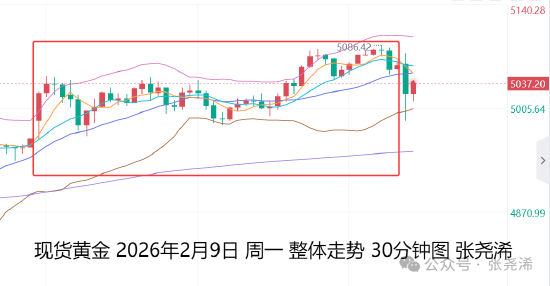
Core Viewpoint - International gold prices experienced a rebound and closed higher on February 9, driven by escalating geopolitical tensions and expectations for significant data releases this week, with the dollar index declining, supporting gold prices above the mid-range and breaking through the 10-day moving average resistance [1][11]. Market Performance - Gold opened at $4987.98 per ounce, dipped to a low of $4964.04, and then rebounded, reaching a high of $5086.29 before closing at $5058.07, marking a daily fluctuation of $122.25 and a gain of $70.09, or 1.41% [1][11]. Short-term Outlook - On February 10, gold prices briefly strengthened before falling back, influenced by U.S. President Trump's comments on bilateral negotiations with Canada and his stance on Israel, which reduced geopolitical risk demand. The dollar strengthened, putting downward pressure on gold prices [3][13]. - Key data to watch includes U.S. retail sales and business inventories, with expectations that these will support gold prices, maintaining a strategy of buying on dips [3][14]. Fundamental Analysis - The bullish trend for gold is expected to strengthen, with recent adjustments viewed as a rapid repricing process rather than a trend reversal. The market is experiencing increased volatility as funds switch between risk and safe-haven assets, indicating a strong bull market outlook [5][16]. - Recent data shows job vacancies have dropped to 6.54 million, and initial jobless claims have risen to 231,000, suggesting a cooling labor market, which may lead to lower inflation and increased bets on the Federal Reserve cutting rates this year [5][16]. Technical Analysis - On a monthly basis, gold prices rebounded after touching support from an upward trend line, indicating that the bearish sentiment from January has dissipated, and new bullish space remains valid. Key support is noted at $4300, with expectations for new highs if prices remain above this level [6][17]. - Weekly analysis shows that gold prices have rebounded from recent lows, suggesting that previous bearish patterns have been exhausted, and the overall trend remains upward, with support from moving averages [8][19]. Trading Strategy - The strategy remains focused on buying on dips, with specific support levels identified at $4950 or $4860, and resistance levels at $5110 or $5190 for gold [10][20].

光大期货0210热点追踪:地缘因素反复,原油带动上游品种同步走高
Xin Lang Cai Jing· 2026-02-10 06:32
Core Viewpoint - Geopolitical uncertainties between the US and Iran continue to influence oil prices, with a recent increase in oil price levels observed, particularly on February 10, where the SC2604 contract saw a rise of over 1% [3][6]. Geopolitical Factors - The geopolitical situation is identified as a core factor affecting short-term fluctuations in oil prices. The US has issued new guidelines for ships flying the American flag to avoid Iranian territorial waters and to refuse boarding by Iranian military forces [4][7]. - The OPEC oil production in January decreased to 28.34 million barrels per day, a reduction of 60,000 barrels per day from December, with Nigeria experiencing the largest decline. This decrease offsets production increases from some member countries, including Venezuela [4][7]. EU Sanctions - The European Union has proposed expanding sanctions against Russia to include ports in Georgia and Indonesia that handle Russian oil, marking the first time sanctions target third-country ports. The proposal includes listing the Kulevi port in Georgia and the Karimun port in Indonesia, prohibiting EU companies and individuals from trading with these ports [4][7]. Market Implications - The combination of fluctuating geopolitical factors and EU sanctions creates ongoing uncertainty in the supply chain, suggesting that oil prices are likely to experience continued volatility in the short term [4][7].