
城投转型

Search documents
2025年中期信用债展望:供求支撑下的波段与品种增厚
HTSC· 2025-06-06 10:52
Group 1: Credit Bond Strategy - The credit bond market is expected to continue in a volatile state, with a focus on interest rate strategies and band trading being more favorable than pure selection of varieties [5][38] - The strategy suggests focusing on short to medium-term credit bonds and high-grade long-term bonds to seek opportunities for interest rate compression [5][38] - The recommendation is to increase allocation in high-grade bonds from local government financing vehicles, real estate, and stable industries during market adjustments [5][38] Group 2: Local Government Financing Bonds - The transformation of local government financing vehicles is entering a complex phase, with potential pricing discrepancies as platforms adapt to new regulations [2][43] - The issuance of local government bonds is expected to remain low due to strict regulatory oversight and the ongoing transition of platforms [2][43] - Focus on short to medium-term bonds from regions with stable cash flows, particularly in Guangdong, Hubei, Jiangsu, and Henan, is recommended [2] Group 3: Financial Bonds and Varieties - High-grade perpetual bonds can be traded in response to interest rate fluctuations, but the trading space is limited and requires high trading standards [3][39] - The strategy includes focusing on high-grade bonds with a maturity of 3-5 years for stable institutions, while actively trading lower-grade bonds during market adjustments [3][39] - The expansion of TLAC non-capital instruments and their comparison with secondary capital bonds is highlighted as an area of interest [3][39] Group 4: Industrial Bonds - Industrial bonds have shown some recovery in profitability, but performance remains varied across sectors, with strong performance in automotive, machinery, and utilities, while real estate and construction sectors lag [4] - The recommendation is to focus on high-quality state-owned enterprises and stable private enterprises for medium-term investments [4] Group 5: Real Estate Bonds - The real estate sector is under pressure, with a recommendation to focus on high-grade bonds from state-owned enterprises while monitoring the recovery of the sector [4] - The potential for policy support in the real estate market could enhance recovery in core cities, but caution is advised for lower-tier cities [4] Group 6: Asset-Backed Securities (ABS) and Public REITs - The market for consumer finance ABS is expanding, with opportunities for variety exploration in a volatile market [3][39] - Public REITs are recommended to balance opportunities in both primary and secondary markets, focusing on stable projects [3][39]
从城投2024年财报看化债成效:平台“造血能力”增强 债务增速降至近年来最低水平
2 1 Shi Ji Jing Ji Bao Dao· 2025-05-30 12:15
Group 1: Core Insights - The year 2024 is pivotal for the urban investment industry, with debt resolution funding and industrial transformation reflected in improved financial metrics from last year's reports [1] - The "Guiding Opinions on Financial Support for the Resolution of Financing Platform Debt Risks" issued in September 2023 serves as a foundation for debt resolution efforts, focusing on high-risk areas and controlling new debt [1][2] - Urban investment companies have shown significant improvement in financial indicators, with operating cash flow turning positive for the first time, indicating enhanced self-sustainability [3] Group 2: Financial Performance - Total assets of urban investment platforms reached a historical high of 162.49 trillion yuan in 2024, but the growth rate fell to 4.99%, the lowest in recent years [3] - The operating cash flow for sample urban investment platforms was 0.4 trillion yuan in 2024, marking a turnaround from continuous net outflows since 2020 [3] - Accounts receivable and other receivables showed a year-on-year increase of 7.8% in 2024, although the growth rate has declined compared to 2023 [4] Group 3: Debt Management - Urban investment companies have effectively curtailed debt growth, with total debt growth dropping to 4.3% in 2024, the lowest in recent years [7] - The issuance rate of urban investment bonds has decreased significantly, from 3.2% at the beginning of last year to around 2.5% by May 2025, reducing financing costs [8] - The introduction of new financing channels, such as technology innovation bonds, is emerging as a new trend for urban investment platforms [10][11] Group 4: Challenges and Opportunities - Urban investment platforms face challenges in aligning existing personnel with future transformation needs, necessitating the hiring of professional managers [2] - The tightening of new financing channels and difficulties in timely receivables collection remain significant challenges for urban investment transformation [2] - The push for specialized bonds for land acquisition and technology innovation presents new opportunities for urban investment companies to alleviate debt pressure and support business transformation [12][13]
发行主体信用资质强或市场化程度高,随城投转型或将进入提速阶段——城投公司发行科创债现状及展望
Lian He Zi Xin· 2025-05-08 04:40
Investment Rating - The report indicates a positive outlook for the issuance of Sci-tech bonds by urban investment companies, suggesting that the marketization transformation of these companies will accelerate [3][15]. Core Insights - Sci-tech bonds are essential financial instruments aimed at promoting technological innovation and industrial transformation, with urban investment companies increasingly participating in their issuance since the pilot program began in March 2021 [3][5]. - The issuance of Sci-tech bonds by urban investment companies has been growing annually, with a notable increase in the number of bonds issued and the total amount raised [15][16]. - The report highlights that urban investment companies are transitioning towards market-oriented operations, utilizing equity investments and industrial funds as part of their transformation strategy [3][15]. Policy Evolution - The report outlines the evolution of policies related to the issuance of Sci-tech bonds, starting from the pilot program in March 2021 to the formal launch in May 2022, and subsequent revisions in October 2023 and December 2024 [5][6]. - Key policies have been established by exchanges and regulatory bodies to guide the issuance of Sci-tech bonds, emphasizing the need for issuers to demonstrate significant technological innovation attributes or direct the raised funds towards technology-related fields [4][8]. Issuance Requirements - The report details the requirements for issuing Sci-tech bonds, which vary between exchanges and the interbank market, focusing on the issuer's creditworthiness and the intended use of raised funds [9][13]. - For exchange-listed bonds, issuers must generally maintain a debt-to-asset ratio below 80% and ensure that at least 70% of the raised funds are directed towards technology innovation [9][10]. Urban Investment Companies' Issuance Status - Since the launch of Sci-tech bonds, urban investment companies have issued a total of 117 bonds amounting to approximately 93.05 billion yuan, with a steady increase in issuance scale observed from 2021 to 2025 [16][22]. - The report notes that urban investment companies primarily issue medium to long-term bonds, with a significant portion of issuers located in Jiangsu, Zhejiang, Chongqing, and Sichuan [17][22]. Characteristics of Issuers - The report categorizes urban investment companies into Sci-tech and non-Sci-tech issuers, with the majority being non-Sci-tech, relying on the allocation of funds towards technology innovation to meet issuance requirements [26][31]. - Among the successful issuers, a small percentage are recognized as Sci-tech issuers, primarily due to their substantial R&D investments, while most non-Sci-tech issuers focus on equity and fund investments [28][31]. Financial and Business Features - The financial characteristics of urban investment companies indicate a diversified income structure, with many companies generating significant revenue from market-oriented activities rather than traditional urban investment operations [34][39]. - The report emphasizes the increasing contribution of investment income to overall profits, highlighting a trend towards greater marketization and diversification within the sector [39][48].
城投债市场运行2025年一季度回顾与展望:净融创近三年新低,政策收紧倒逼城投“真转型”
Zhong Cheng Xin Guo Ji· 2025-05-06 11:12
1. Report Industry Investment Rating No relevant content provided. 2. Core Viewpoints of the Report - In Q1 2025, the issuance and net financing scale of urban investment bonds hit a three - year low. The policy tightening forces urban investment companies to make "real transformations". The debt pressure of urban investment companies may be further relieved, and there is still room for compression of credit spreads [4][14]. - With the implementation of the "6 + 4+2" debt - resolution package, the credit risk of urban investment has slightly converged. It is recommended to invest in high - quality enterprises in strong regions and selectively sink the credit quality to seek the spread compression space [6][13]. - In the future, the borrowing - new - to - repay - old ratio of urban investment bonds will remain high, and the level of financing entities may continue to move up. Attention should be paid to issues such as local investment and financing needs, debt repayment pressure, asset idleness, and transformation authenticity [7][9]. 3. Summary According to Relevant Catalogs 3.1 Q1 2025 Review of Urban Investment Bond Market Operation 3.1.1 Five Characteristics of Urban Investment Bond Market Operation - **Issuance and net financing scale at a three - year low**: The issuance scale was 1.48 trillion yuan, a year - on - year decrease of 15.13%. The net financing was 75.105 billion yuan, a year - on - year decrease of 46.76%. The net financing of low - level and weak - quality entities declined significantly. Some urban investment companies turned to overseas bond issuance, with the new issuance increasing by 9.49% year - on - year [4]. - **Overall decline in issuance interest rates but monthly increase within the quarter**: The weighted average issuance interest rate was 2.45%, a year - on - year decrease of 0.54 percentage points. The decline of weak - quality entities was less than that of stronger ones [4]. - **Long - term issuance and increased reliance on borrowing new to repay old**: The weighted average term increased by 0.29 years to 3.77 years. The proportion of medium - term notes continued to rise. The broad and narrow borrowing - new - to - repay - old ratios reached 97.65% and 94.66% respectively [5]. - **Trading contraction and spread compression**: The trading scale decreased by nearly 20% year - on - year, and the trading spread was further compressed compared with the end of 2024 [5]. - **Improvement in net financing in key areas**: The net financing in key areas turned positive year - on - year and quarter - on - quarter. 17 provinces had a 100% borrowing - new - to - repay - old ratio, and Jilin and Chongqing issued project - construction urban investment bonds [5][39]. 3.1.2 Credit Situation - **Convergence of credit risk**: No non - standard defaults occurred in Q1. The number of commercial paper overdue times decreased year - on - year. Two companies in Jiangsu and Guangdong had their credit ratings upgraded. The number and scale of abnormal transactions decreased significantly year - on - year, with frequent abnormal transactions in Shandong and Guizhou [6]. 3.1.3 Issuance Forecast - It is expected that the issuance scale from April to December will be about 4.4 trillion yuan. The borrowing - new - to - repay - old ratio will remain high, and the level of financing entities may continue to move up. There may be months with negative net financing, and the total net financing scale is about 0.025 trillion yuan [7]. 3.2 Follow - up Concerns - **Local investment and financing needs**: Although there are marginal improvements in local investment and financing, the pressure on new financing is still high. It is necessary to optimize financing policies and support the opening of new investment spaces [9]. - **Debt repayment pressure**: A large amount of debt still needs to be resolved independently. Hidden - debt - related interest and government arrears should be reasonably included in the replacement scope [10]. - **Asset idleness**: Urban investment companies have a large amount of idle land assets. They should seize the opportunity of special bonds for land acquisition and adopt various ways to revitalize the assets [11]. - **Transformation authenticity**: The next two years are the critical period for transformation. Attention should be paid to the authenticity of transformation and the risk of the withdrawal of debt - resolution policies after exiting the platform [12]. 3.3 Urban Investment Bond Strategy - It is recommended to invest in high - quality enterprises in strong regions based on fundamentals to obtain coupon income. Selectively sink the credit quality, such as weak urban investment in strong regions and strong urban investment in weak regions, to seek the spread compression space brought by debt - resolution results [13].
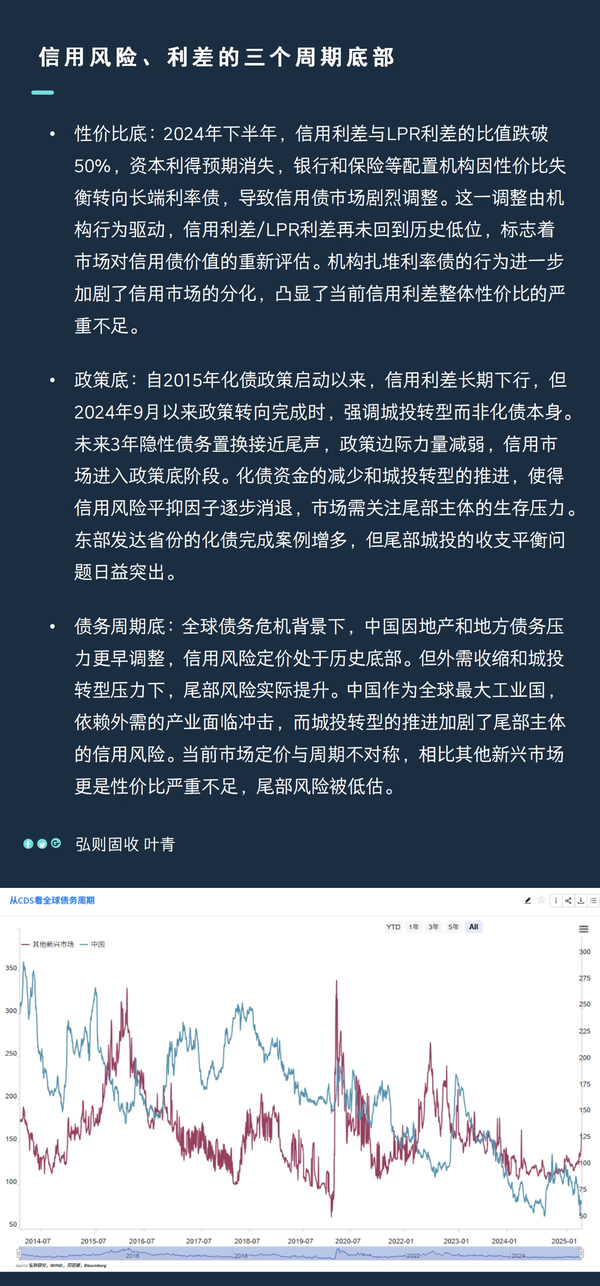
弘则固收叶青:信用风险、利差的三个周期底部
news flash· 2025-05-05 23:29
Core Viewpoint - The Chinese credit market is experiencing a significant shift as credit risks and spreads have reached historical lows, driven by a combination of value imbalance, policy changes, and debt cycle dynamics [1][2]. Group 1: Value Imbalance - The ratio of credit spreads to LPR spreads fell below 50% in the second half of 2024, leading to a disappearance of capital gain expectations [1]. - Institutional investors, such as banks and insurance companies, are shifting towards long-term interest rate bonds due to the imbalance in value, resulting in a sharp adjustment in the credit bond market [1]. - This institutional behavior has intensified the differentiation within the credit market, highlighting the severe inadequacy of overall credit spread value [1]. Group 2: Policy Dynamics - Since the initiation of the debt reduction policy in 2015, credit spreads have been on a long-term decline, but the policy focus has shifted towards urban investment transformation rather than debt reduction itself as of September 2024 [2]. - The next three years will see the completion of implicit debt replacement, leading to a reduction in policy support and a transition into a policy bottom phase for the credit market [2]. - The decrease in debt reduction funds and the advancement of urban investment transformation are gradually diminishing the factors that mitigate credit risk, necessitating attention to the survival pressures of tail-end entities [2]. Group 3: Debt Cycle Context - In the context of a global debt crisis, China has adjusted earlier due to pressures from real estate and local government debt, with credit risk pricing at historical lows [2]. - However, the pressures from external demand contraction and urban investment transformation are increasing actual tail-end risks [2]. - As the largest industrial nation globally, China’s reliance on external demand is facing challenges, while the push for urban investment transformation exacerbates credit risks for tail-end entities [2].

城投发债多项指标再明确 行业闯关“真转型”
Zhong Guo Jing Ying Bao· 2025-04-12 14:59
Core Viewpoint - The recent revision of the Shanghai Stock Exchange's "Guidelines for the Review of Corporate Bond Issuance and Listing" introduces stricter requirements for local government financing vehicles (LGFVs), aiming to enhance transparency and promote genuine transformation in the industry [1][3][4]. Group 1: Regulatory Changes - The revised guidelines expand the number of clauses from 56 to 66, introducing new requirements for the disclosure of the "335" indicators, which limit non-operating assets and income to 30% and government subsidies to 50% of net profit [1][4]. - The guidelines require LGFVs to disclose their asset structure, income structure, and profit structure, marking the first formal acknowledgment of the "335" indicators in public documents [4][6]. - The new rules aim to guide LGFVs towards market-oriented transformation and reduce reliance on government resources, thereby improving profitability and debt repayment capabilities [3][7]. Group 2: Market Impact - As of April 2025, the total scale of canceled corporate bond issuances reached 19.815 billion, with local state-owned enterprises accounting for 88.95% of these cancellations [2]. - In the first quarter of 2025, LGFV bond issuance dropped to 15.762 billion, a year-on-year decrease of 13.7%, while net financing fell by 30.2% [2][5]. - The number of first-time issuers among LGFVs decreased by 18 compared to the same period last year, indicating a more cautious approach to bond issuance [2]. Group 3: Trade Business and Risks - The revised guidelines emphasize the need for LGFVs to disclose the rationality and authenticity of their trade business, addressing issues of "pseudo-trade" practices that have emerged in the industry [6][7]. - There are concerns regarding the authenticity of trade operations, with some LGFVs engaging in non-standard practices such as financing trade and "empty transfers" to inflate revenue [7][8]. - The guidelines require LGFVs with significant trade operations to disclose key customer and supplier information, accounting methods, and the commercial rationale behind their trade activities [7][8].