太空经济

Search documents
中信建投:中美双极格局主导发展进程 商业航天产业边界向多元赛道拓展
智通财经网· 2026-02-04 08:28
Core Viewpoint - The global commercial aerospace industry is entering a new phase focused on large-scale deployment and ecosystem construction, driven by a bipolar structure dominated by China and the U.S. Group 1: Policy and Regulation - The policy framework for China's commercial aerospace is set to mature by 2025, with the establishment of a Commercial Aerospace Department by the National Space Administration, marking a shift from "encouraging exploration" to "systematic governance and standardization" [1]. Group 2: Capital and Financing - The Shanghai Stock Exchange has opened an IPO channel for commercial rocket companies under the new standards, with industry financing expected to reach 18.6 billion yuan by 2025, and the total valuation of the top 100 companies surpassing the trillion yuan mark [2]. Group 3: Satellite Internet and Deployment - Low Earth orbit satellite internet is entering a phase of normalized networking, with Chinese constellations like "StarNet" and "Qianfan" moving into mass deployment, and "one rocket multiple satellites" launches becoming routine to secure scarce frequency resources [3]. Group 4: Manufacturing Innovations - Satellite manufacturing is transitioning into a "super factory" era, focusing on efficiency and consistency in mass production, exemplified by the automated production lines in Hainan's Wenchang Satellite Super Factory, aiming for an annual capacity of 1,000 units [4]. Group 5: Commercial Applications - The commercial sector is exploring business models that follow a "demand-driven" approach, with direct-to-satellite mobile connections becoming a hot topic, and the Ministry of Industry and Information Technology setting a target of over 10 million users by 2030 to lay the groundwork for a 6G integrated network [5]. Group 6: Reusable Rockets - The focus of competition is shifting from "can it be recovered" to "can it be reused frequently," with multiple medium to large liquid rockets expected to make their maiden flights between 2025 and 2026 to tackle the challenges of capacity and cost associated with satellite constellation construction [6]. Group 7: 3D Printing Technology - 3D printing is evolving from prototype manufacturing to direct production of critical components like rocket engines and satellite structures, enabling significant cost reductions and rapid iterations, becoming a key measure of engineering capability [7]. Group 8: Collaboration Between Enterprises - The industry landscape is moving beyond simple complementarity to a phase of "strategic leadership and market agility," where state-owned enterprises ensure strategic security and foundational capabilities, while private enterprises contribute innovation and cost efficiency [8]. Group 9: Global Competition Dynamics - Global competition has expanded from frequency resource contention to the establishment of 6G integrated communication standards and the positioning of future talent ecosystems, with China and the U.S. building their respective political, technological, and supply chain alliances in the space sector [10]. Group 10: Expanding Space Economy - The boundaries of the space economy are significantly broadening, with emerging fields including space computing (e.g., orbital data centers), space tourism (suborbital, orbital, and deep space travel), heavy launch vehicle development, and long-term visions like Mars colonization, marking the beginning of a new era of "starry seas" [11].

马斯克:太空算力成本将“断崖式”下降,卫星产业ETF(159218)份额扩容152.46%,迭创历史新高
Sou Hu Cai Jing· 2026-02-04 01:36
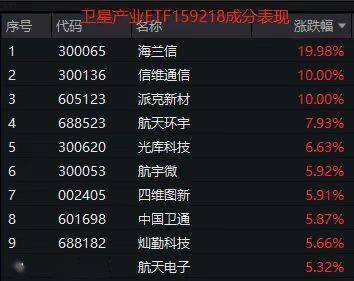
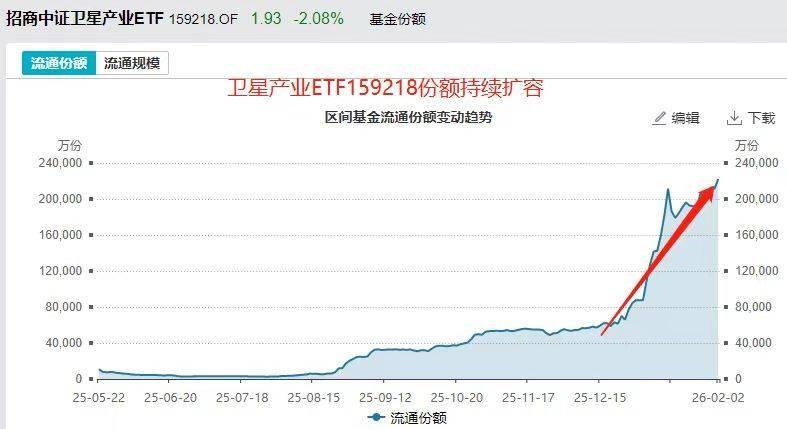
近期,卫星产业持续获得市场资金的强力聚焦。数据显示,开年以来,作为板块核心投资工具的卫星产业 ETF(159218)已累计获得净流入约 27.2亿元,基金份额大幅扩容 152.46%迭创历史新高,显示出市场对太空经济 赛道的空前热情。 板块狂欢背后,一个量化的经济预期提供了关键支撑。马斯克公开预测,未来2-3年内,基于太空的AI计算将成 为成本最低的途径;并规划在未来4-5年,通过星舰实现每年向轨道发射100GW载荷的能力。 分析指出,这一明确的时间表,为所有"太空经济"设想(如太空数据中心、太空光伏电站)提供了至关重要的 经济性锚点。此前,这些概念虽前景广阔,但始终受限于高昂的发射成本。马斯克的预言意味着,制约行业规 模化发展的最大瓶颈——成本,有望在可见的未来被突破。当太空算力的成本低于地面数据中心时,将引发需 求端的指数级增长。此预期是推动产业链各环节,从火箭发射到卫星平台制造公司股价飙升的直接催化剂,使 科幻般的蓝图具备了清晰的商业化路径。 作为市场上首支收益翻倍、跟踪中证卫星产业指数的ETF,卫星产业ETF(159218)涵盖卫星制造、发射、导航通 信应用等上中下游企业,"卫星 制造+发射基础领域权 ...

卫星产业ETF(159218)暴涨超4%领跑!海兰信冲击20cm涨停、信维通信、派克新材涨超10%
Sou Hu Cai Jing· 2026-02-03 03:46
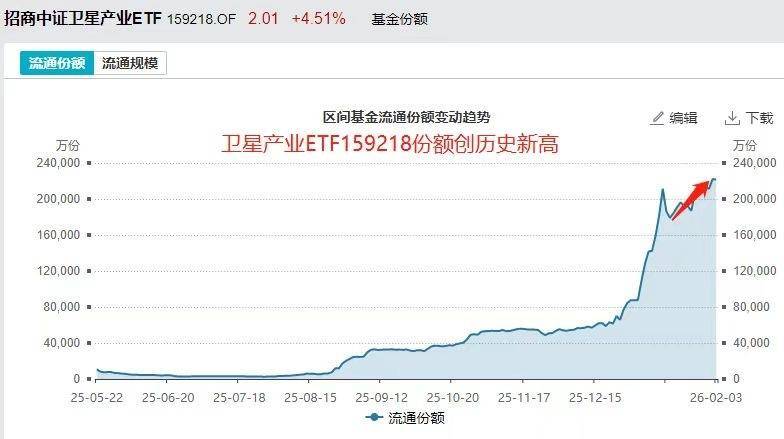
2月3日,卫星产业午盘异动!数据显示,截至11时23分,表征板块的卫星产业ETF(159218)涨4.31%领跑 同类,信维通信、派克新材涨超10%。截至2月2日,该基金获资金年初以来累计净流入约27.2亿。 展望未来,随着国内星座建设加速、可回收火箭等技术突破,整个产业的商业化进程有望提速。卫星产 业ETF(159218)作为一键布局全产业链的核心工具,预计将持续成为资金把握太空经济时代机遇的重 要载体。 风险提示:基金有风险,投资需谨慎。 | 底是 | 代码 | | 159218成分表现 涨跌幅 | | --- | --- | --- | --- | | | 300065 | 海兰信 | 19.98% | | 2 | 300136 | 信维通信 | 10.00% | | 3 | 605123 | 派克新材 | 10.00% | | 4 | 688523 | 航天环宇 | 7.93% | | 5 | 300620 | 光库科技 | 6.6396 | | 6 | 300053 | 航宇微 | 5.92% | | 7 | 002405 | 四维图新 | 5.91% | | 8 | 601698 | #国卫通 | ...


曹操出行官宣:搭载低轨卫星通信!卫星产业ETF(159218)年内爆揽超27亿
Sou Hu Cai Jing· 2026-02-03 01:43
Core Insights - The satellite industry is experiencing significant long-term strategic value, as evidenced by substantial capital inflows into the satellite industry ETF (159218), which saw over 200 million yuan in net inflows on February 2, and a total of approximately 2.72 billion yuan year-to-date [1][3] Group 1 - The recent influx of capital is attributed to key breakthroughs in the commercialization of the industry, particularly highlighted by the announcement from Cao Cao Mobility regarding its Robotaxi 2.0 model, which will utilize low-orbit satellite communication [3] - This development is viewed as a milestone commercial signal, indicating a shift from foundational infrastructure to deep integration with trillion-dollar consumer markets like smart connected vehicles, thereby clarifying the path for performance realization across the industry chain [3] - There is a growing market consensus on the strategic necessity, technological feasibility, and broad market prospects of the satellite industry, supported by nearly 3 billion yuan in continuous net inflows this year and initiatives like SpaceX's "Million Starlink" project [3] Group 2 - The acceleration of domestic satellite constellation construction, breakthroughs in reusable rocket technology, and the emergence of more integrated applications like "vehicle + satellite" are expected to expedite the commercialization process of the entire industry [3] - The satellite industry ETF (159218) is positioned as a key tool for investors to gain exposure to the entire industry chain, likely continuing to serve as an important vehicle for capital to seize opportunities in the space economy era [3]
商业航天出海再添佳绩,一个月在轨交付两国际卫星;特斯拉最新人形机器人2026年底前启动量产;九部门完善支付环境,便利春节入境游客支付——《投资早参》
Mei Ri Jing Ji Xin Wen· 2026-02-03 00:26
Market News - The three major US stock indices closed higher, with the Dow Jones up 1.05%, S&P 500 up 0.54%, and Nasdaq up 0.56%. Major tech stocks had mixed results, with Apple rising over 4%, and Google and Amazon increasing by over 1% [1] - The Nasdaq Golden Dragon China Index fell by 0.65%, while notable Chinese stocks like Century Internet rose nearly 4% and Kingsoft Cloud increased by over 3% [1] - European stock indices also closed higher, with the Euro Stoxx 50 up 1.00%, FTSE 100 up 1.16%, CAC 40 up 0.67%, DAX 30 up 1.15%, and FTSE MIB up 1.05% [1] Currency and Commodity Market - The US dollar index rose by 0.67%, closing at 97.635. The onshore RMB against the USD was reported at 6.9448, an increase of 118 points from the previous Friday [2] - Spot gold experienced a "V" shaped reversal, reaching a peak of $4800 per ounce before settling at $4665 per ounce. Spot silver saw a decline of 2.3%, fluctuating around $80.00 per ounce [2] - WTI crude oil futures fell by 4.71%, closing at $62.14 per barrel, while Brent crude oil futures dropped by 4.36%, closing at $66.30 per barrel [2] Industry Insights - The Long March 2C rocket successfully launched Algeria's remote sensing satellite B into orbit, marking the second launch of the satellite within 16 days. This project represents ongoing cooperation between China and Algeria in the aerospace sector [3] - The satellite internet sector is projected to grow significantly, with the satellite-ground communication industry expected to reach between 200 billion to 400 billion yuan by 2030, with an annual growth rate of 10%-28% [4] - Tesla announced the upcoming launch of its third-generation humanoid robot, with plans for annual production of one million units by 2026. The production line for Model S/X at the Fremont factory will be converted to humanoid robot manufacturing [4][5] - The Ministry of Commerce and other departments released a plan for the "2026 Spring Festival Special Activity," promoting inbound tourism and enhancing payment environments for international visitors [5][6]

中金:调整即序章
中金点睛· 2026-02-02 23:55
Core Viewpoint - The A-share market is experiencing a phase of adjustment after a rapid rise, with potential for a slow bull market supported by favorable factors. The current market favors growth styles, with emerging opportunities in low-priced stocks [2]. Group 1: Energy and Basic Materials - Coal prices are in a state of fluctuation, with January prices for thermal coal, coking coal, and coke rising by 2%, 4%, and 2% respectively. The coal industry maintains stable profitability and cash flow, with a current dividend yield of 5.3% [9]. - Oil prices have shown a 14% increase month-on-month in January, but a year-on-year decrease of 11%. Geopolitical risks are rising, impacting oil supply and prices [10]. - The prices of non-ferrous metals have seen significant increases, with lithium carbonate prices rising by 35% in January. The demand is supported by AI applications and the proliferation of new energy [11]. Group 2: Industrial Products - The AI industry chain remains highly prosperous, with strong domestic demand for engineering machinery and a projected 18% increase in domestic excavator sales by 2025. The photovoltaic industry is also seeing price recoveries [3]. - The automotive sector is facing a projected 6% decline in sales by November 2025, with a focus on opportunities related to overseas markets and smart driving [3]. Group 3: Consumer Products - Traditional consumer sectors are experiencing a decline, with sales of washing machines, refrigerators, and air conditioners dropping by 27%, 37%, and 36% year-on-year in December 2025. The effectiveness of consumption support policies is under observation [4]. - The average purchase price of live pigs remains stable at 14 yuan/kg, with a total pig stock of 429.67 million heads by the end of 2025, indicating a relatively abundant supply [4]. Group 4: Technology - The domestic AI application landscape is seeing significant developments, with multiple domestic large models being released. The semiconductor industry remains robust, with global sales increasing by 30% year-on-year in November [5]. - The gaming industry is recovering, with 1,771 game licenses issued in 2025, indicating a positive trend [5]. Group 5: Financials - The stock market sentiment has improved significantly, with insurance premium income rising by 7% year-on-year in December 2025. The average daily trading volume of A-shares exceeded 30 trillion yuan in January [5].

中国航天发布“十五五”蓝图,万亿级太空基建时代开启
Jin Rong Jie· 2026-02-02 12:04
Core Viewpoint - The China Aerospace Science and Technology Corporation (CASC) has unveiled a new blueprint for the "14th Five-Year Plan" period, focusing on the development of four key areas in commercial space: space tourism, space digital infrastructure, space resource development, and space traffic management, marking a significant shift towards industrialization and large-scale application in China's commercial space sector [1] Strategic Drivers - Establishing space as a new infrastructure hotspot is driven by the dual imperatives of national security and economic development. The increasing number of satellites in orbit (approximately 15,000, with the U.S. accounting for over half) necessitates an effective space traffic management system to ensure the safety of national space assets [2] - The global space economy is projected to grow from approximately $600 billion in 2024 to $1.8 trillion by 2035, highlighting the vast economic potential of space, including the mining of rare elements from celestial bodies [2] Four Key Tracks - The four identified tracks for future space economy development include: 1. **Space Tourism**: Aiming to develop mature suborbital and orbital flight products and establish a comprehensive operational system for suborbital tourism [3] 2. **Space Digital Infrastructure**: Plans to build gigawatt-level space computing facilities to enable "space intelligence" and liberate space-based productivity [3] 3. **Space Resource Development**: The "Tian Gong Kai Wu" initiative will focus on comprehensive experimental systems for space resource development, moving from conceptualization to systematic engineering [3] 4. **Space Traffic Management**: Emphasizing the need for monitoring, early warning, and removal technologies for space debris to ensure safety and gain a proactive stance in future international regulations [3] Solid Foundation - China's advancements in space technology include the establishment of a comprehensive infrastructure network and breakthroughs in metal 3D printing in microgravity, alongside the testing of reusable rockets to significantly reduce space access costs [4] - Policy support is also strengthening, with the establishment of a Commercial Space Bureau by the National Space Administration in 2025 and the release of a three-year action plan to facilitate industry development [4] Market Opportunities - The announcement of this national strategy has garnered significant attention in the capital markets, with expectations that 2026 will be a pivotal year for commercial space. Domestic policy support is unprecedented, and leading companies are likely to achieve breakthroughs in capital markets [6] - The potential successful listings of international commercial space leaders could lead to a revaluation of the global industry chain [6]
科技展望开年演讲|中科天算刘垚圻:从地面到太空,算力大迁徙
Xin Lang Cai Jing· 2026-02-02 09:46
Core Insights - The concept of "Kardashev civilization" is introduced, highlighting the evolution from utilizing Earth's energy to harnessing solar energy and eventually the energy of entire galaxies. This sets the stage for the development of space-based computing networks [1] - Liu Yaoqi, CEO of Zhongke Tiansuan, emphasizes the potential of space computing networks to support various applications, indicating a transformative shift in technology and cost reduction that will enable disruptive applications in the future [1][4] Group 1: Stages of Space Computing Applications - The application of space computing will progress through three stages: 1. The first stage focuses on remote sensing intelligence, where satellite images will be processed in space rather than sent back to Earth for analysis [1] 2. The second stage involves communication intelligence, where satellites can cover vast areas and serve hundreds of thousands of users, enhancing network stability and service [1] 3. The third stage will see the emergence of numerous applications as satellite internet evolves from 2G to 4G, leveraging excess computing power and storage in space [2] Group 2: Cost and Technology Challenges - The reduction of launch costs is crucial for making space computing viable, with SpaceX's Falcon 9 rocket reducing costs from tens of thousands to $1,000 per kilogram, enabling reusability [2] - The development of low-cost chips is essential, transitioning from high-cost aerospace-grade chips to industrial and consumer-grade chips suitable for space, while addressing challenges such as operational reliability in harsh environments and heat dissipation [3] Group 3: Ecosystem Development - Establishing a robust ecosystem for space computing is vital, encompassing everything from chip materials to communication frameworks, and addressing the unique challenges posed by the space environment [4] - The integration of AI and advanced computing technologies in the aerospace sector signifies a pivotal moment in the fourth industrial revolution, where both terrestrial and space-based computing capabilities must expand [4]
“基建狂魔”,要上太空了!
Jing Ji Ri Bao· 2026-02-02 08:01
Core Viewpoint - The China Aerospace Science and Technology Corporation has unveiled a new blueprint for the "14th Five-Year Plan," focusing on the development of space tourism, smart space infrastructure, space resource development, and space traffic management, marking a significant shift in infrastructure development towards space [1] Group 1: Security Perspective - Space is considered a "high frontier" for national security, with approximately 15,000 satellites in orbit globally, over half of which are owned by the United States [2] - The increasing congestion in low Earth orbit raises collision risks, necessitating the establishment of a space traffic management system to ensure safety [2] - Developing key technologies for space debris monitoring, early warning, and removal is crucial for securing China's position in international space traffic management rules [2] Group 2: Economic Perspective - The global space economy is projected to reach approximately $600 billion in 2024, with forecasts suggesting it could grow to $1.8 trillion by 2035 [2] - Space resource development, including mining on the Moon and asteroids, is expected to turn the concept of "space mining" into reality, driven by the rich resources available beyond Earth [2] - Building gigawatt-level smart space infrastructure is essential for unleashing space-based productivity and accelerating the development of the space economy [2] - Space tourism is anticipated to emerge as a new engine for consumer spending [2] Group 3: Current Capabilities - China has established a solid foundation for advancing space infrastructure, with significant technological advancements in satellite navigation and space computing [3] - Successful return of lunar soil samples and breakthroughs in 3D metal printing in microgravity demonstrate China's growing capabilities in space technology [3] - The development of reusable rockets is entering a verification phase, which is expected to significantly reduce launch costs [3] - Favorable policies, such as the establishment of a commercial space administration and initiatives to promote the utilization of commercial satellite data, are emerging [3] Group 4: Challenges Ahead - Technical challenges remain, particularly in the maturity of reusable rocket technology and the need for breakthroughs in key areas such as resource exploration and autonomous mining [4] - There is a significant regulatory gap in international space law, with existing treaties not adequately addressing current commercial space activities [4] - High capital risks associated with commercial space ventures necessitate a layered approach to investment, breaking down operations into independently profitable modules to lower entry barriers for private capital [4]
播客丨探访打造可重复使用火箭的初创公司
阿尔法工场研究院· 2026-02-02 04:08
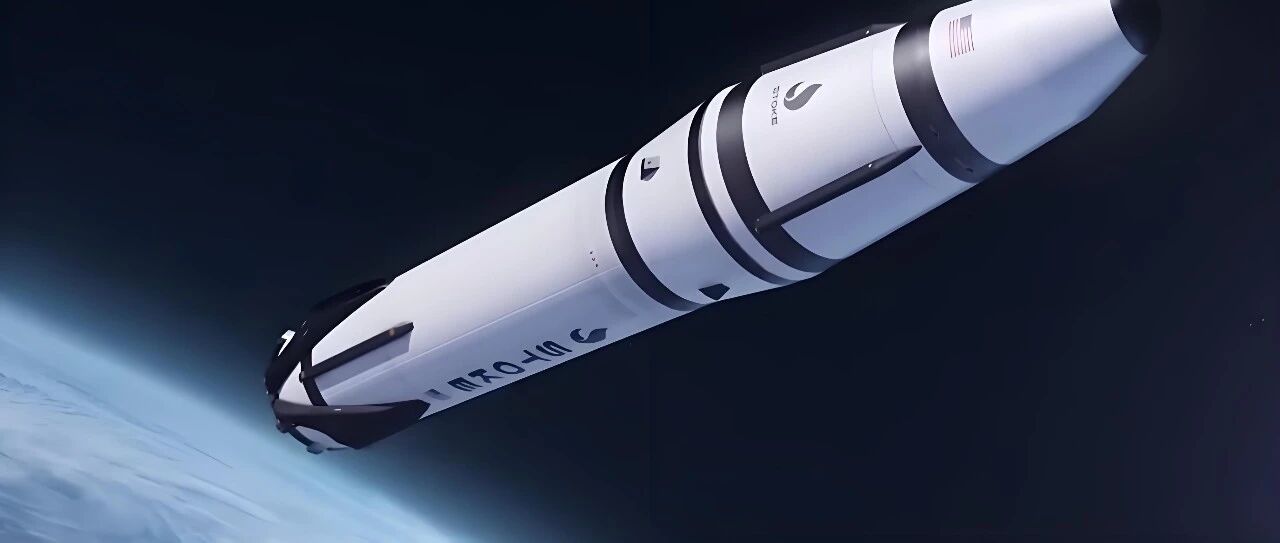
这种具备飞机般复用能力的火箭将极大降低发射成本,并显著提升发射频率,有望像手机应用商店一样开 启太空经济的新纪元。公司从车库起步,坚持自主制造与快速迭代,目前已拥有大规模生产基地并计划于 近期开展轨道发射,努力实现普惠的太空探索。( 全球播客频道 ) 两位前蓝色起源工程师创办了航天公司,致力于研发完全可重复使用的火箭。目前多数火箭的第二级在重 返大气层时会被烧毁,而他们利用创新的液氢冷却热盾技术解决了这一难题。 ...