强省会战略

Search documents
省会强则全省强!多省份启动“强省会”战略
3 6 Ke· 2025-10-28 02:32
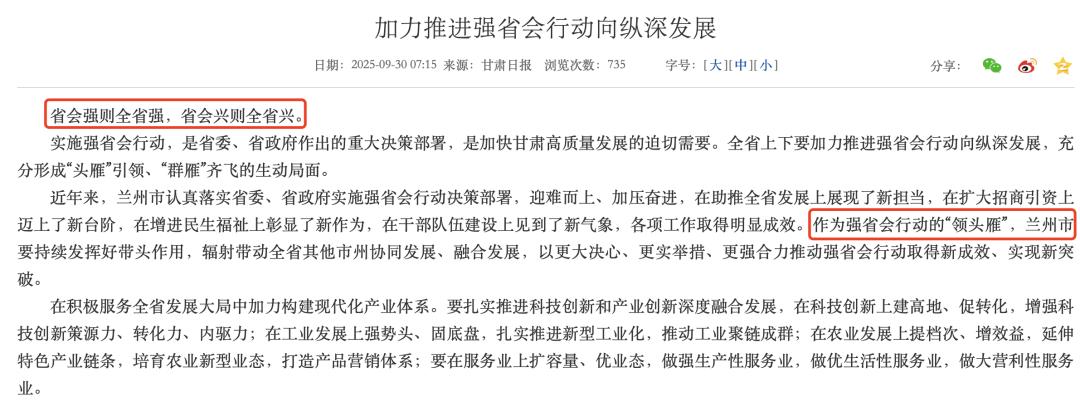
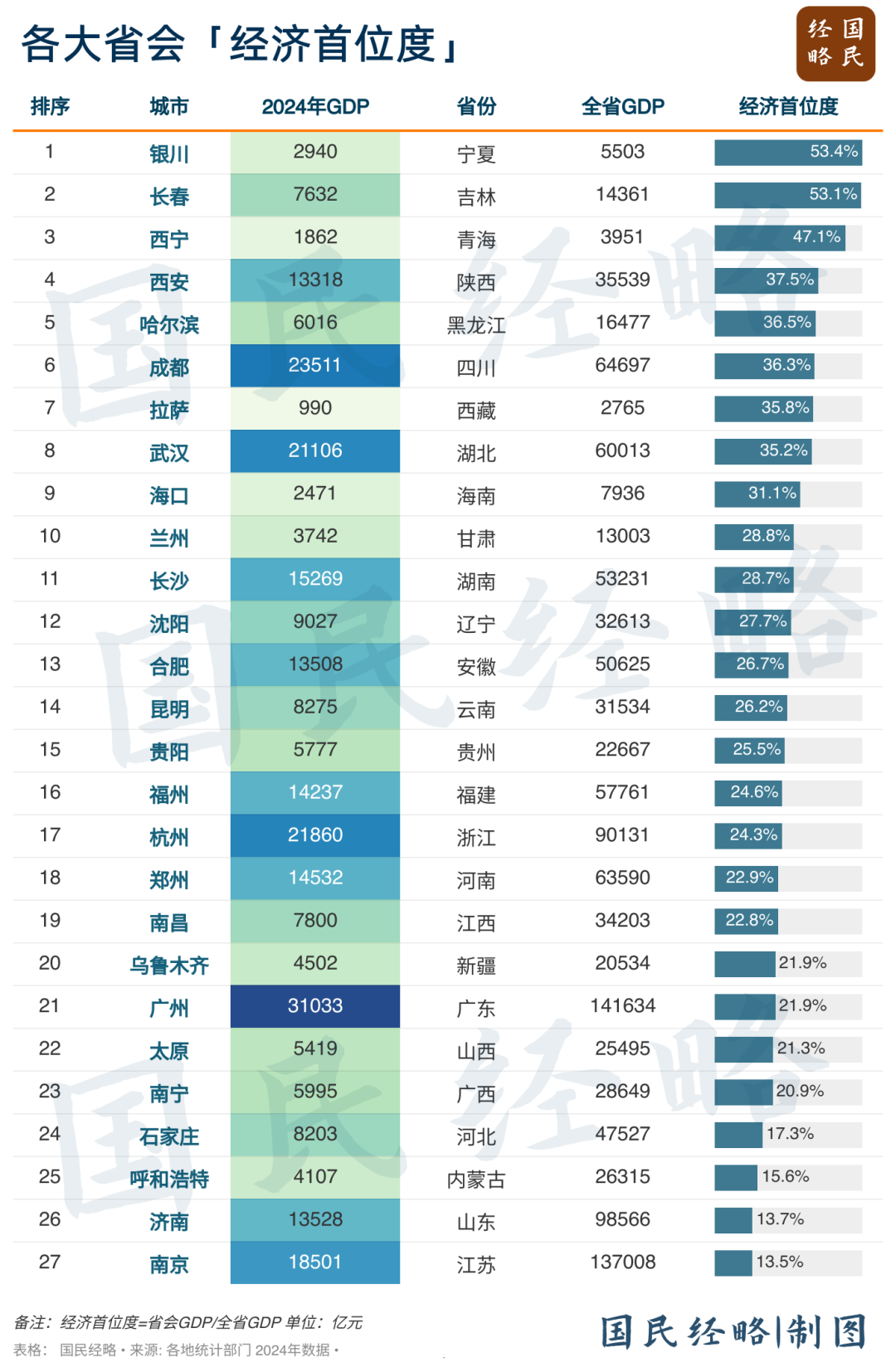
Core Viewpoint - The article discusses the "strong provincial capital" strategy being implemented in various provinces in China, particularly focusing on Gansu, Sichuan, and Shandong, to enhance the economic performance of their respective provincial capitals and drive overall provincial growth [2][4][6][7]. Group 1: Gansu Province - Gansu's government has initiated a "strong provincial capital action" meeting, emphasizing the need for Lanzhou to lead and promote coordinated development across the province [2]. - Gansu's economic total is projected to be 1.3 trillion, ranking 27th nationally, while Lanzhou's economy is only 374.2 billion, also ranking low nationally [4]. Group 2: Sichuan Province - Sichuan has issued a policy to support Chengdu in enhancing its core functions and accelerating high-quality development, aiming for Chengdu's GDP to exceed 3.2 trillion by the end of the 14th Five-Year Plan [6]. - Chengdu's GDP is expected to reach 2.35 trillion in 2024, maintaining its position as the seventh largest city in the country, and is recognized for its commercial vitality and cultural tourism [6]. Group 3: Shandong Province - Shandong has been promoting the "strong provincial capital" strategy since 2021, with Jinan's GDP surpassing 1.3 trillion in 2024, yet its economic strength is seen as insufficient compared to the province's overall economic scale [7]. - Jinan's economic dominance, defined as its share of the provincial GDP, ranks second to last among provincial capitals in China, indicating a need for stronger provincial capital development [7]. Group 4: Economic Dominance and Rankings - A ranking of provincial capitals by their economic dominance shows that Yinchuan and Changchun have the highest ratios, with Yinchuan's GDP accounting for 53.4% of its province [8][9]. - The article highlights that eight provincial capitals have GDPs exceeding one-third of their provincial totals, while Jinan and Nanjing rank at the bottom with ratios of 13.7% and 13.5%, respectively [9].

强省会,卷土重来?
Hu Xiu· 2025-10-16 04:43
Core Viewpoint - The article discusses the resurgence of the "strong provincial capital" strategy in China, emphasizing its importance in driving regional development and economic growth, particularly in the context of cities like Lanzhou and Chengdu [2][12][24]. Group 1: Strong Provincial Capital Strategy - The recent meeting in Gansu highlighted the need for provincial capitals to lead provincial development, echoing the sentiment that a strong provincial capital equates to a strong province [2][12]. - The strategy is not merely a choice between strong provincial capitals and multiple centers; rather, it is about integrating both approaches for comprehensive regional development [4][8]. Group 2: Economic Data and Rankings - A table lists various cities along with their projected GDP for 2024, showcasing the economic primacy of cities like Chengdu and Xi'an within their respective provinces [6][7]. - Chengdu is projected to have a GDP of 23,511 million, representing 36.3% of Sichuan's total GDP, indicating its significant economic role [6]. Group 3: Multi-Center Development - The article notes that some regions are moving away from the "strong provincial capital" mindset to embrace a multi-center model, with cities like Mianyang and Yibin in Sichuan being designated as sub-centers [8][9]. - This shift reflects a broader trend where cities are encouraged to develop their unique strengths while contributing to the overall provincial economy [25][32]. Group 4: Future Directions and Strategic Positioning - The article emphasizes that the logic behind the "strong provincial capital" strategy has evolved, focusing on enhancing core functions rather than merely expanding city size [15][18]. - Cities like Chengdu are being positioned as key economic and innovation centers in the western region, with a focus on international connectivity and advanced manufacturing [21][24]. Group 5: Regional Economic Dynamics - The article argues that the suitability of a strong provincial capital versus a multi-center approach depends on the economic strength and regional layout of the province [32][33]. - Strong provinces tend to adopt multi-center models, while weaker provinces may rely on a strong provincial capital to drive development [36][37].
南方人口减少第一省,东北化了!
商业洞察· 2025-10-05 09:24
Group 1 - The article discusses the talent recruitment initiative in Hunan Province aimed at retaining local talent and attracting external talent to boost innovation and entrepreneurship [4][7][8] - The initiative includes collaboration among the government, schools, and enterprises, with nearly 300,000 job positions available across various sectors [9][10] - Hunan is facing a significant population decline, being the first southern province to experience such a trend, with a total population decrease of over 1 million in the past four years [13][22][23] Group 2 - Hunan's population decline is characterized by three main factors: natural population decrease, net outflow of people, and the siphoning effect from Guangdong [36][44][51] - The natural population decrease in Hunan accounts for a significant portion of the overall decline, with 20.3 million in 2023 and 11.1 million in 2024 [38][39] - The net outflow of population is calculated at 15.7 million in 2023 and 17.9 million in 2024, indicating a trend of people leaving the province [44][45] Group 3 - The article highlights the industrial strength of neighboring provinces, particularly Anhui, which has seen significant growth in industrial revenue, contrasting with Hunan's slower industrial development [66][79] - Hunan's industrial revenue is notably lower than Anhui's by 1.35 trillion yuan, despite having a higher GDP [79] - The article emphasizes the importance of strengthening the provincial capital, Changsha, to mitigate the population decline and retain talent [81][88]
中国三分之二的省,正在面临集体失血
36氪· 2025-07-15 00:11
Core Viewpoint - The article discusses the significant reshaping of China's population distribution, highlighting a decline in population in many provinces and a concentration of growth in economically vibrant regions like Guangdong and Zhejiang [5][9][10]. Population Trends - In 2021, China's total population peaked at 1.4126 billion, but in 2022, the number of deaths exceeded births for the first time, marking a shift from natural population growth to decline [5]. - By 2024, 20 out of 31 provincial-level regions experienced a decrease in permanent resident population, with only 8 regions showing growth [9][10]. - Guangdong, Zhejiang, and Fujian are leading in population growth, while provinces like Shandong, Henan, and Hunan are seeing significant declines [10][14][16]. Regional Population Changes - Shandong's population decreased by 430,000 in 2024, marking the largest decline in the country, continuing a trend of population loss for three consecutive years [14]. - The article notes that from 2001 to 2021, Shandong's population grew by 11.72 million, making it one of the largest provinces by population [15]. - The trend of population decline has accelerated since 2020, affecting more regions, including traditionally populous provinces like Henan and Hunan [19][20]. Urban vs. Rural Dynamics - The article emphasizes that while people are still moving, they are less likely to migrate long distances, with a significant portion of the population now moving within their provinces [21]. - In economically active provinces, population growth is distributed across multiple cities, while in shrinking regions, provincial capitals are becoming the primary destinations for migrants [24][39]. Economic Factors Influencing Migration - Zhejiang is highlighted as a model where all 11 prefecture-level cities saw population growth from 2020 to 2024, driven by a robust economy [25]. - In contrast, Hunan's population growth is concentrated in Changsha, with other cities experiencing significant declines [27][31]. - The article discusses how provinces like Anhui and Guizhou are reversing population trends through industrial development, particularly in the automotive and data center sectors [41][46]. Challenges in Retaining Talent - Despite attracting talent through economic opportunities, many provinces face challenges in retaining workers due to limited job options and growth potential [50]. - The software industry in Guizhou, while growing, has seen a decline in employment numbers after reaching a peak, indicating difficulties in sustaining workforce growth [49].

揭榜:最新全国100强城市排行
虎嗅APP· 2025-06-14 09:26
Core Insights - The article discusses the competitive landscape of China's cities, emphasizing that cities must continuously improve or risk falling behind in economic rankings [3]. Group 1: GDP Rankings and City Competition - China has over 330 cities at the prefecture level or above, with Shanghai's GDP exceeding 5 trillion and some regions like Guoluo Prefecture and Sansha having GDPs below 10 billion [4]. - The threshold for the top 100 cities has increased to 360 billion, doubling compared to ten years ago [5]. - The 2024 GDP rankings show that cities like Nanjing, Tangshan, and Xiangyang are emerging as key players, with Tangshan becoming the first trillion-yuan city in Hebei [7][9]. - The number of trillion-yuan cities is concentrated in the eastern region, with the Yangtze River Delta hosting nine, while the Midwest struggles to have ordinary prefecture-level cities in the rankings [10][11]. Group 2: City Distribution and Economic Balance - The top 100 cities are primarily located in the eastern region, with Jiangsu, Shandong, Guangdong, and Zhejiang having the highest representation [21][24]. - Jiangsu is notable for having all its cities in the top 100, indicating a balanced economic development across its regions [26]. - Guangdong, despite being the largest economy, has fewer cities in the top 100 due to its extensive administrative divisions diluting economic scale [31][32]. Group 3: Midwestern and Western City Dynamics - In the central region, cities like Jiangxi outperform Hubei and Anhui, with Jiangxi's economic structure being more balanced and diverse [40][43]. - The western region has a combination of strong provincial capitals and resource-based cities, with 15 cities making it to the top 100 [58]. - The article highlights that the future of western cities lies in the development of provincial sub-centers, particularly in Sichuan and Shaanxi [73]. Group 4: Northeast Region Challenges - The Northeast region has only four cities in the top 100, reflecting a significant decline from its historical industrial prominence [76][79]. - Population decline and economic stagnation have led to a lack of cities entering the top rankings, with only Dalian and Shenyang nearing the trillion-yuan mark [83][84]. - The article suggests that revitalization efforts in the Northeast face significant challenges, with the potential for only gradual improvement in the coming years [88].
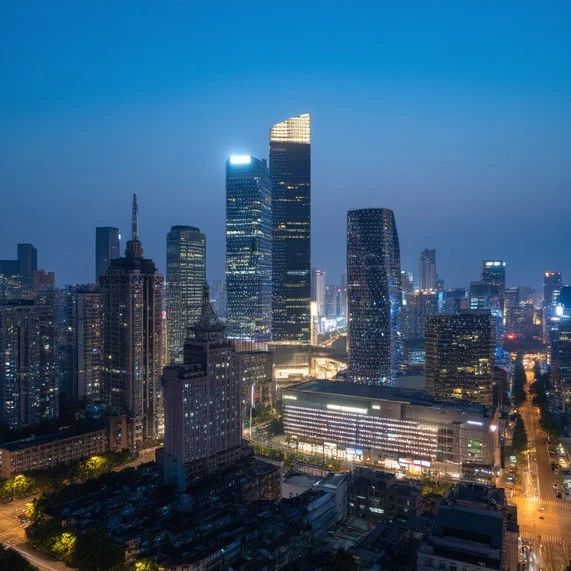
必须要有自己的一线城市,山东离不开强省会战略,把人口留在省内
Sou Hu Cai Jing· 2025-06-06 05:38
Core Insights - The population decline in Shandong Province has reached a record high of 428,000 in 2024, primarily affecting the young and middle-aged demographic, despite a relatively high birth rate ranking third in the country [1][5] - The strong provincial capital strategy is deemed urgent to counteract the population loss and enhance the province's vitality [1][6] Population Dynamics - Shandong's population loss is not solely due to declining birth rates, as the province has a large population base of over 100 million [1] - The outflow of young talent, particularly recent graduates, poses a significant risk to the province's future development [5] Economic Development - Shandong has not produced a leading city despite being China's third-largest economy, with Jinan and Qingdao ranking 18th and 13th respectively in GDP among Chinese cities [4] - Jinan's economic contribution to the province is only 13.7% of the total GDP, significantly lower than other provincial capitals like Chengdu and Wuhan, which contribute around 40% [4] Urbanization and Strategy - The development of the Jiaodong region is progressing but lacks sufficient focus on Jinan as the provincial capital [5] - Jinan's geographical limitations necessitate strategic planning, including the ongoing development of cross-river projects to enhance connectivity and attract talent [6] Future Outlook - The need for a major city in Shandong is critical for maintaining the province's competitive edge, as neighboring regions are increasingly attracting talent and resources [6] - The rise of Jinan is essential not only for the province's status but also for preserving its economic achievements [6]
中部省份打造“新增长极”密码:省域经济发展模式从单核到多极的动态平衡术丨观城势·轻研报
2 1 Shi Ji Jing Ji Bao Dao· 2025-06-03 13:10
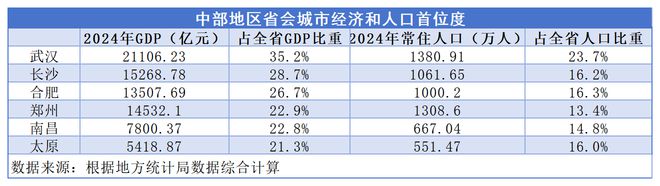
Core Insights - The article discusses the evolving economic landscape of central provinces in China, focusing on the shift from a "strong provincial capital" model to a "multi-polar" development approach [1][2] - It highlights the economic and population primacy of provincial capitals like Wuhan, which leads the central region, while also addressing the challenges faced by other cities [3][5] Economic Performance - In 2024, Wuhan's GDP is projected to be 2110.6 billion yuan, accounting for 35.2% of Hubei's total GDP, with a population of 13.8 million, representing 23.7% of the province's population [4] - Other central provincial capitals like Changsha, Hefei, Zhengzhou, Nanchang, and Taiyuan show varying degrees of economic and population primacy, with their GDP and population shares being 28.7%, 26.7%, 22.9%, 22.8%, and 21.3% respectively [4][5] Development Trends - The article notes that while the population primacy of central provincial capitals has generally increased since the 14th Five-Year Plan, some cities like Wuhan, Changsha, and Taiyuan have seen a decline in economic primacy [2][7] - Zhengzhou, Hefei, and Nanchang have experienced growth in economic primacy, with Zhengzhou's GDP share increasing by 1.1 percentage points since 2020 [7][8] Urbanization Strategies - Central provinces are exploring new growth poles through the development of provincial sub-centers and urban agglomerations to avoid the "one city dominates" issue [2][10] - The article emphasizes the importance of urban agglomeration development, with examples from Hubei's "one main, two sub" strategy and the establishment of urban clusters like the Changsha-Zhuzhou-Xiangtan urban area [9][11] Policy Support - Various provincial governments are implementing policies to enhance the capabilities of provincial capitals while also fostering the growth of sub-centers, indicating a balanced approach between "strong provincial capitals" and "multi-polar" development [12]
福州农信系统助力“有福之州”造福百姓
Zheng Quan Ri Bao· 2025-06-03 02:00
Core Insights - Fuzhou Rural Credit System has achieved significant growth in assets, deposits, and loans, with total assets reaching 266.8 billion yuan, a 20.89% increase from the beginning of 2023 [1] - The system aims to support rural revitalization and high-quality economic development in Fuzhou through innovative financial services and strategic partnerships [2][4] Group 1: Financial Performance - As of the end of Q1 2023, total assets reached 266.8 billion yuan, an increase of 46.1 billion yuan, or 20.89% [1] - Total deposits amounted to 224.5 billion yuan, up by 40.5 billion yuan, reflecting a growth of 22% [1] - Total loans reached 139.2 billion yuan, increasing by 18.9 billion yuan, a growth of 15.7% [1] Group 2: Strategic Initiatives - The system is focusing on deepening specialized operations to support rural revitalization and the development of the real economy [2] - A Rural Property Rights Trading Service Center has been established to facilitate rural property transactions and enhance financial services [2] - The system has launched a "Fuzhou Rural Credit Financial Product Supermarket" to provide efficient credit services for rural resource allocation [2] Group 3: Sector-Specific Services - The system has developed a comprehensive marine financial service plan, issuing 12.5 billion yuan in loans for marine economic activities, leading the province in this sector [3] - It has also supported small and micro enterprises with 10.339 billion yuan in loans, enhancing the local economy [3] Group 4: Collaboration and Agreements - A strategic cooperation agreement was signed with the Fuzhou Municipal Government to establish a 300 billion yuan special credit scale over three years [4] - The system has formed partnerships with 48 government and agricultural entities to enhance rural revitalization efforts [5] Group 5: Digital Transformation and Service Enhancement - The introduction of the "Rongyidai" big data service platform aims to improve financial accessibility and efficiency [5] - The system has upgraded 183 branches and added 96 loan service points, achieving a 93.69% coverage for loan services [7] - A smart marketing platform has been launched to enhance customer outreach and service efficiency [5][6] Group 6: Community Impact - The system is committed to improving the quality of life for citizens by enhancing one-stop service capabilities and optimizing healthcare and housing financial services [7][8] - Initiatives include the establishment of "Medical Insurance e-Stations" and participation in housing fund supervision projects [7][8]
“东强”战略策源城市跃升,中建雲啟鳳華打造白泉生态低密住区
Qi Lu Wan Bao· 2025-05-22 00:22
Core Insights - The "Dongqiang" strategy in Jinan has been a key driver for the city's development since its launch in 2020, aiming to position Jinan as a national central city and a hub for high-quality development in the Yellow River Basin [1][2] - The strategy aligns with national initiatives, including the ecological protection and high-quality development of the Yellow River Basin, and the "Strong Provincial Capital" strategy, which emphasizes the importance of Jinan's growth for the entire Shandong province [2] Group 1: Strategic Development - Jinan is currently in a strategic opportunity period, with the "Yellow River Basin Center City" designation enhancing its development prospects [2] - The "Dongqiang" strategy focuses on high-quality development, aiming to create a modern international metropolis and a strategic hub for domestic and international circulation [2][3] Group 2: Infrastructure and Urban Planning - The CBD Olympic Sports Center area is a primary focus of the "Dongqiang" strategy, featuring major thoroughfares that facilitate urban development [3][5] - The completion of key roads, such as the north extension of Aoti Middle Road, enhances connectivity and supports the growth of the CBD [3][5] Group 3: Ecological Integration - The Olympic Sports Center axis connects with significant ecological parks, including the Huashan-Baiquan Scenic Corridor and the Xiaohanyu River Ecological Belt, promoting a green urban environment [4] - The Huashan-Baiquan Scenic Corridor spans approximately 90 hectares and integrates various urban and natural landscapes, enhancing the ecological framework of the area [4] Group 4: Real Estate Development - China State Construction's project "Yunqi Fenghua" aims to create a low-density ecological residential area in Jinan, leveraging the region's ecological resources [6] - The project incorporates design elements inspired by ancient Chinese architecture and aims to create a harmonious living environment that reflects local cultural heritage [6] Group 5: Upcoming Events - A summit on the "Dongqiang" strategy and the product launch for "Yunqi Fenghua" is scheduled for May 23, aimed at discussing urban strategy and quality of life [7]
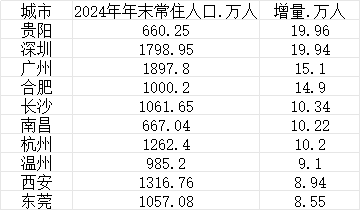
2024年十大人口增长最多的城市,贵阳位居第一
Di Yi Cai Jing· 2025-05-15 09:53
Core Insights - The article highlights the population growth trends in various Chinese cities, with a focus on the top cities that experienced significant increases in their resident populations in 2024, despite a national decline in population. Population Growth Analysis - A total of 12 cities saw a resident population increase of over 80,000 last year, with the top ten cities being Guiyang, Shenzhen, Guangzhou, Hefei, Changsha, Nanchang, Hangzhou, Wenzhou, Xi'an, and Dongguan. The first seven cities each had an increase of over 100,000 residents [1][2] - Guiyang led the population growth with an increase of 199,600 residents, marking a growth rate of 3.12%. This city has consistently added over 100,000 residents annually for four consecutive years [3][4] - Shenzhen and Guangzhou followed, with increases of 199,400 and 151,000 residents, respectively, indicating strong population attraction in these metropolitan areas [4] Economic and Industrial Factors - Guiyang's rapid population growth is attributed to its economic development and industrial support, particularly in sectors like electronic information manufacturing and digital economy, which have been bolstered by local government strategies [3][4] - Hefei has also seen significant growth, with a population of 10 million by the end of 2024, driven by its burgeoning electric vehicle industry, which produced over 1.35 million units last year [8] - The article notes that the population growth in eastern coastal cities like Shenzhen and Guangzhou is complemented by the industrial upgrades and economic transformations in these regions, which attract talent and labor [5][7] Regional Trends - Among the top ten cities for population growth, five are located in the central and western regions of China, including provincial capitals like Guiyang, Hefei, Changsha, Nanchang, and Xi'an. This reflects a broader trend of urbanization and industrialization in these areas [7][8] - The article emphasizes that the provincial capitals serve as economic, cultural, and political centers, which enhances their ability to attract resources and talent [7] - In addition to the top cities, other cities like Jinan and Qingdao also experienced notable population increases, indicating a wider trend of urban growth across various regions [6]