
投资者权益保护

Search documents
6家企业将退市!代表人诉讼步入常态化,年内投资者可索赔证券标的超250家
Zheng Quan Shi Bao Wang· 2025-12-24 05:00
Core Viewpoint - The regulatory environment in the capital market is increasingly stringent, with a "zero tolerance" approach towards financial fraud and information disclosure violations, leading to significant implications for companies and investors [1][4][10]. Group 1: Regulatory Actions and Company Penalties - Kexin Information (300730) received an administrative penalty notice from the China Securities Regulatory Commission (CSRC) for violations, which may lead to further lawsuits from affected investors [1]. - ST Huilun (300460) and ST Jiaao (603822) also faced penalties for information disclosure violations, with fines of 3 million yuan and 5.5 million yuan respectively, highlighting the ongoing scrutiny of companies' financial practices [5]. - The CSRC's intensified enforcement actions reflect a broader trend of holding companies accountable for financial misconduct, with over 250 companies currently facing potential investor lawsuits due to clear violations [3][5]. Group 2: Investor Rights and Legal Framework - Investors have the right to seek compensation for securities violations, as outlined in China's Securities Law, which includes provisions for insider trading, market manipulation, and false statements [6]. - As of December 23, 2025, there are 256 companies eligible for investor claims, with 50 having already won or settled cases, indicating a growing trend in investor activism [6][7]. - The legal framework allows investors to initiate lawsuits even if the company has not yet received an administrative penalty, emphasizing the importance of timely legal action [6]. Group 3: Trends in Investor Litigation - The number of investor lawsuits and the amounts claimed are on the rise, with significant cases involving thousands of investors and claims exceeding 4 billion yuan in some instances [8][9]. - The introduction of representative litigation has lowered the cost for investors, making it easier for large groups to pursue claims collectively [9]. - Legal complexities are increasing, with disputes now often involving nuanced issues such as the materiality of false statements and the allocation of responsibility among various parties, including controlling shareholders and intermediaries [9][10]. Group 4: Recommendations for Improvement - There is a need for optimization in the investor rights protection process, including clearer timelines for case handling and improved mechanisms to prevent delays in litigation [11]. - The establishment of detailed standards for initiating public interest lawsuits and addressing misinformation in the market is recommended to enhance investor protection [12].

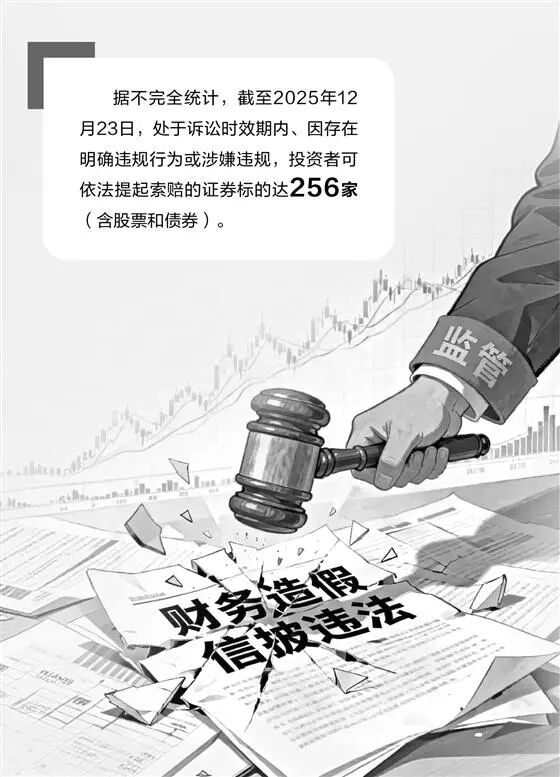
年内投资者可索赔证券标的超250家
Zheng Quan Shi Bao· 2025-12-24 00:37
Core Viewpoint - The normalization of representative lawsuits has led to over 250 companies facing potential securities claims from investors, highlighting the increasing regulatory scrutiny and investor protection efforts in the capital market [1][2][3]. Group 1: Regulatory Environment - The China Securities Regulatory Commission (CSRC) has intensified enforcement against financial fraud and information disclosure violations, signaling a "zero tolerance" approach to such behaviors [1]. - As of December 23, 2025, there are 256 securities (including stocks and bonds) that investors can claim against due to clear violations [1][4]. Group 2: Investor Rights and Legal Framework - Investors have clear rights to compensation under China's Securities Law, which holds responsible parties accountable for insider trading, market manipulation, and false statements [4]. - The statute of limitations for civil claims related to these violations is three years, and investors can initiate lawsuits even if the company has not yet received administrative penalties [4][5]. Group 3: Case Examples and Trends - Recent cases involving ST Huilun and ST Jiaao illustrate the types of violations leading to administrative penalties, including failure to disclose fund usage and inaccuracies in financial reporting [3][4]. - The trend of representative lawsuits is becoming more common, with significant participation from investors, as seen in cases like Jin Tong Ling and *ST Meishang, which involved thousands of investors [7][8]. Group 4: Challenges and Recommendations - Despite progress, there are still areas needing improvement in the investor rights protection process, such as the efficiency of case handling and the clarity of legal standards [10][12]. - Legal experts suggest that regulatory bodies and judicial authorities should collaborate to establish clear timelines for case processing and address issues like "case suppression" [10][12].
年内投资者可索赔证券标的超250家 6家公司的投资者索赔诉讼时效年底将正式届满
Zheng Quan Shi Bao Wang· 2025-12-23 23:31
据不完全统计,截至2025年12月23日,处于诉讼时效期内、因存在明确违规行为或涉嫌违规,投资者可 依法提起索赔的证券标的达256家(含股票和债券)。 2025年年底前,将有6家公司的投资者索赔诉讼时效正式届满。投资者若未在此前通过提起诉讼、申请 仲裁等方式主张权利,将丧失依法维权的实体胜诉权,错失通过司法途径挽回损失的最后机会。 人民财讯12月24日电,近年来,资本市场监管部门持续聚焦违法违规行为,以"长牙带刺"的执法力度强 化监管震慑,释放出对财务造假、信息披露违法等行为"零容忍"的严管高压信号。 在"零容忍"监管大背景下,投资者权益保护工作已取得显著成效,但有证券维权律师指出,当前投资者 证券维权索赔过程中,仍有部分细节亟待优化完善。若能针对性解决相关问题,不仅可进一步健全投资 者权益保护体系,更能有效增强投资者对资本市场的信心,为市场健康发展注入更多动能。 ...
代表人诉讼步入常态化 年内投资者可索赔证券标的超250家
Zheng Quan Shi Bao· 2025-12-23 18:44
Core Viewpoint - The regulatory environment in China's capital market is increasingly stringent, with a focus on punishing financial fraud and information disclosure violations, leading to a significant rise in investor lawsuits against companies for securities fraud [1][3][6]. Group 1: Regulatory Actions and Company Violations - Companies such as ST Hui Lun and ST Jia Ao have received administrative penalty notices for violations related to information disclosure, with fines of 3 million yuan and 5.5 million yuan respectively [2]. - The China Securities Regulatory Commission (CSRC) has intensified its enforcement actions, indicating a "zero tolerance" policy towards financial misconduct [1][6]. - As of December 23, 2025, there are 256 companies (including stocks and bonds) that investors can sue for securities fraud, with 50 companies already having won or settled claims [3][4]. Group 2: Investor Rights and Legal Framework - Investors have clear rights to compensation under China's Securities Law, which holds responsible parties accountable for insider trading, market manipulation, and false statements [3]. - The statute of limitations for filing claims is three years, and investors are encouraged to act quickly, even if the company has not yet received an administrative penalty [3][4]. - The legal landscape is evolving, with a notable increase in the number of representative lawsuits and the complexity of cases, reflecting a shift towards more robust investor protection [6][7]. Group 3: Trends in Investor Litigation - The number of investor lawsuits and the amounts claimed are on the rise, with cases involving thousands of investors becoming common [6]. - The introduction of representative lawsuits has significantly reduced the cost of litigation for investors, allowing for broader participation in claims [6][7]. - Recent cases have seen claims exceeding 4 billion yuan, with some cases potentially reaching over 10 billion yuan, indicating a growing trend in the scale of investor claims [6]. Group 4: Challenges and Recommendations - Despite improvements in investor rights protection, there are still procedural inefficiencies, such as delays in case processing and a lack of clarity in legal standards [8][9]. - Legal experts suggest that regulatory bodies and judicial authorities need to collaborate to streamline the litigation process and establish clear timelines for case handling [8]. - There is a call for more detailed judicial interpretations to address the complexities of securities fraud cases, which would help clarify the legal landscape for investors [9].
吴晓求:投资端的改革核心是要扩大市场的流动性
Xin Lang Cai Jing· 2025-12-07 13:23
Core Viewpoint - The restructuring of China's capital market ecosystem should shift from a financing-centered approach to one that prioritizes investor rights protection, indicating that existing rules are outdated and need to be reconsidered [1][4]. Group 1: Asset Side Reforms - The reform should begin with the asset side, focusing on enterprises in the financial market, highlighting the importance of the ChiNext and Sci-Tech Innovation Board, which, despite their flaws, are on the right track, including the reform of the registration system [3][6]. Group 2: Funding Side Reforms - Following changes on the asset side, the funding side must also be reformed, moving away from a market dominated by retail investors. A market primarily composed of individual investors lacks growth potential. The core of this reform is to enhance market liquidity, which is essential for effective price discovery and asset combination [3][6]. Group 3: Institutional Reforms - The third aspect of the ecosystem is institutional reform, which should focus on protecting investor interests and rights. This requires a comprehensive adjustment of existing rules, acknowledging that this is a lengthy process [3][6].

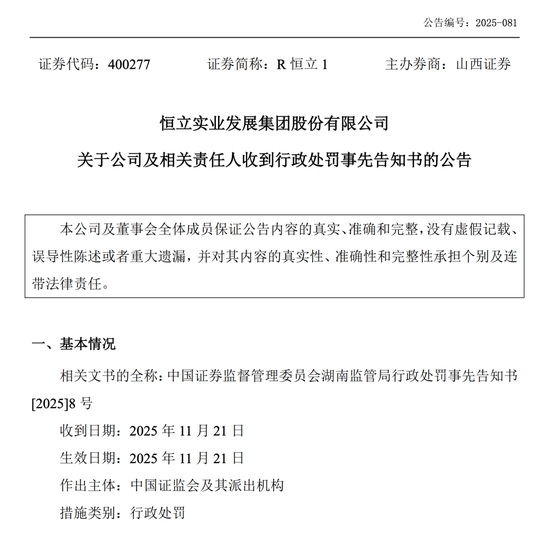
退市不“免责” 恒立实业及责任人涉财务造假被罚3940万元
Shang Hai Zheng Quan Bao· 2025-11-21 18:43
Core Viewpoint - The regulatory authority maintains a "zero tolerance" stance towards violations in the capital market, emphasizing that delisting does not equate to immunity from penalties [1][8]. Group 1: Regulatory Actions - On November 21, the Hunan Securities Regulatory Bureau issued a notice of administrative penalty to Hengli Industrial Development Group Co., Ltd. (referred to as "Hengli Industrial" or "R Hengli 1") and 19 related individuals, proposing a total fine of 39.4 million yuan [1][6]. - Hengli Industrial has been subjected to two investigations by the regulatory authority due to suspected violations of financial data disclosure [1][7]. Group 2: Financial Misconduct - Hengli Industrial inflated its revenue through fictitious transactions in ethylene glycol trading, resulting in inflated revenues of approximately 227 million yuan, 181 million yuan, 135 million yuan, and 51.19 million yuan from 2020 to the first half of 2023, representing 74.24%, 52.27%, 55.08%, and 47.77% of the reported revenues for those periods [2][4]. - The company also inflated its costs by approximately 220 million yuan, 175 million yuan, 132 million yuan, and 49.41 million yuan during the same periods, constituting 77.53%, 53.9%, 55.45%, and 50.43% of the reported costs [2][4]. Group 3: Accountability of Executives - The investigation identified five key executives, including the former chairman and president, as directly responsible for the violations related to financial disclosures [4][5]. - Additional executives, including the former financial director and other board members, were also implicated for failing to exercise due diligence regarding the abnormal trading activities [5][6]. Group 4: Consequences and Future Implications - The regulatory authority plans to impose an 8 million yuan fine on Hengli Industrial and a total of 31.4 million yuan in fines on the 19 responsible individuals, with some facing market bans of 3 to 5 years due to the severity of their violations [6][7]. - The case serves as a precedent, reinforcing the message that delisting does not exempt companies from accountability, and it highlights the ongoing commitment to investor protection even after a company has been delisted [8][9].

退市不免责!涉财务造假,恒立实业及19人被重罚
Shang Hai Zheng Quan Bao· 2025-11-21 14:35
Core Viewpoint - The regulatory authority demonstrates a "zero tolerance" approach towards violations in the capital market, as evidenced by the administrative penalties imposed on Hengli Industrial Development Group Co., Ltd. for false financial disclosures [3][10][14]. Summary by Sections Regulatory Actions - On November 21, the Hunan Securities Regulatory Bureau issued an administrative penalty notice to Hengli Industrial and 19 related individuals, proposing a total fine of 39.4 million yuan [3][9]. - The penalties reflect the regulatory body's commitment to addressing illegal activities in the capital market, with ongoing investigations into Hengli Industrial's irregularities [3][10]. Financial Misconduct - Hengli Industrial was found to have inflated its revenue and costs through fictitious transactions in its glycol trading business, leading to significant discrepancies in its financial reports from 2020 to the first half of 2023 [4][5]. - The company reported inflated revenues of approximately 227 million yuan, 181 million yuan, 135 million yuan, and 51.19 million yuan for the respective years, constituting 74.24%, 52.27%, 55.08%, and 47.77% of the reported revenues [5]. Accountability of Executives - Key executives, including the chairman and president, were identified as directly responsible for the violations, with penalties totaling 31.4 million yuan for these individuals [6][9]. - Additional executives and board members were also implicated for failing to exercise due diligence regarding the company's trading activities and financial disclosures [7][8]. Consequences of Delisting - Hengli Industrial's stock was delisted on July 16 due to failure to disclose its 2024 annual report within the legal timeframe, marking a significant decline in its operational status [10][14]. - The company faced two separate investigations within a month, highlighting the regulatory body's swift action against non-compliance [13][14]. Investor Protection - Despite the company's delisting, the protection of investor rights remains a priority, with ongoing legal actions against companies for false disclosures, reinforcing the message that delisting does not equate to immunity from accountability [14].
证监会出台23项务实举措 织密投资者权益保护网
Jing Ji Ri Bao· 2025-11-20 08:00
资本市场关系千家万户,中小投资者合法权益保护更是重中之重。中国证监会近日发布《关于加强 资本市场中小投资者保护的若干意见》(以下简称《若干意见》)。这份资本市场投资者保护领域的综 合性政策文件,为中小投资者保护提供了新的行动指南。 加强投资者保护,是资本市场监管永恒的主题,也是推动资本市场高质量发展的关键一环。党中 央、国务院对此高度重视。2024年9月召开的中央政治局会议明确提出,"研究出台保护中小投资者的政 策措施";党的二十届三中全会强调,"健全投资者保护机制";国务院《关于加强监管防范风险推动资 本市场高质量发展的若干意见》明确提出,"必须始终践行金融为民的理念,突出以人民为中心的价值 取向,更加有效保护投资者特别是中小投资者合法权益,助力更好满足人民群众日益增长的财富管理需 求"。 在信息披露方面,提升披露质量。针对中小投资者的信息劣势,《若干意见》要求严格落实信息披 露简明清晰、通俗易懂要求,健全招股说明书信息披露指引体系,加大对公司首次公开发行股票项目涉 及的保荐机构、律师事务所、会计师事务所的检查督导力度,实现现场监管全覆盖。 严厉打击侵害中小投资者利益的违法行为。对欺诈发行、财务造假、内幕交 ...
《2024年度证券公司履行社会责任情况报告》发布
Shang Hai Zheng Quan Bao· 2025-11-19 14:55
Core Viewpoint - The report highlights the exemplary practices of securities companies in fulfilling social responsibilities, particularly in supporting rural revitalization and poverty alleviation efforts in China [1][2]. Group 1: Support for Rural Revitalization - By the end of 2024, 104 securities companies will have paired with 398 poverty-stricken counties, with 66 companies specifically assisting 91 key rural revitalization counties [1]. - Securities companies facilitated direct financing of 75.405 billion yuan for enterprises in poverty-stricken counties through various financial instruments [1]. Group 2: Public Welfare Contributions - The industry’s total public welfare expenditure for the year reached 594 million yuan, with 43 companies contributing over 5 million yuan and 19 companies exceeding 10 million yuan [1]. - Cumulatively, the industry has invested 3.926 billion yuan in public welfare over the past five years, maintaining a high level of commitment [1]. Group 3: Support for the Real Economy - The securities industry provided 5.6 trillion yuan in direct financing to support the development of the real economy, directing funds towards national strategic initiatives and key sectors [1]. Group 4: Investor Rights Protection - Securities companies have enhanced investor education efforts, conducting 5,490 educational activities and reaching over 149,000 participants through various programs [2]. - The industry aims to continue supporting agricultural modernization and rural revitalization through practical measures and partnerships [2].
证监会出台23项务实举措回应社会关切 全方位织密投资者权益保护网
Jing Ji Ri Bao· 2025-11-13 23:53
资本市场关系千家万户,中小投资者合法权益保护更是重中之重。中国证监会近日发布《关于加强资本 市场中小投资者保护的若干意见》(以下简称《若干意见》)。这份资本市场投资者保护领域的综合性政 策文件,为中小投资者保护提供了新的行动指南。 加强投资者保护,是资本市场监管永恒的主题,也是推动资本市场高质量发展的关键一环。党中央、国 务院对此高度重视。2024年9月召开的中央政治局会议明确提出,"研究出台保护中小投资者的政策措 施";党的二十届三中全会强调,"健全投资者保护机制";国务院《关于加强监管防范风险推动资本市 场高质量发展的若干意见》明确提出,"必须始终践行金融为民的理念,突出以人民为中心的价值取 向,更加有效保护投资者特别是中小投资者合法权益,助力更好满足人民群众日益增长的财富管理需 求"。 严厉打击侵害中小投资者利益的违法行为。对欺诈发行、财务造假、内幕交易、操纵市场、违规减持、 短线交易、利用自媒体传播虚假信息等违法行为从严查处。违法违规行为往往是中小投资者权益受损的 根源,加强打击可提升制度威慑、防止"割韭菜"。 退市是中小投资者损失易发的领域。对于重大违法强制退市的公司,投资者与上市公司间矛盾、纠纷更 ...