折叠屏技术

Search documents
折叠iPhone明年见,苹果未来两年发布路线曝光,主打手机五款变七款
3 6 Ke· 2025-12-18 02:23
Core Viewpoint - Apple plans to significantly expand its iPhone product line over the next two years, introducing at least seven new models by fall 2027, including its first foldable iPhone and a 20th-anniversary edition [1][4]. Product Line Expansion - The core new product is the foldable iPhone, expected to launch in fall 2026, featuring a width greater than its height when opened, resembling a small iPad [1]. - Following the foldable iPhone, Apple will release a 20th-anniversary edition in fall 2027, featuring a curved glass design and a true edge-to-edge display [1][9]. - Apple is also set to release the iPhone 18 Pro series in fall 2026, which will incorporate under-display Face ID technology and new camera features [6]. Market Strategy - The expansion of the iPhone lineup is part of Apple's strategy to rejuvenate its most important business segment, which has seen stagnant growth due to extended consumer upgrade cycles [1][7]. - Apple aims to cover a broader range of consumer budgets by introducing innovative products like the foldable iPhone and more affordable models [7]. Manufacturing and Development - The foldable iPhone is being developed with complex multi-layer display materials, and production is currently facing a high defect rate, which is considered normal at this stage [4][5]. - Apple plans to manufacture the iPhone 18 in India before moving production to China, marking a significant shift in its manufacturing strategy [8]. Additional Product Developments - Apple is also working on a second-generation iPhone Air, which has been delayed to spring 2027 due to redesign efforts aimed at improving its market appeal [10][11]. - Other product lines, including new versions of AirTag, Apple Studio Display, and various Mac and iPad models, are also in development, with some expected to launch in 2026 [12][13].



折叠iPhone明年见!苹果未来两年发布路线曝光,主打手机五款变七款
美股IPO· 2025-12-16 23:06
Core Viewpoint - Apple is set to launch its first truly foldable iPhone, with a 7.7-inch display, expected to debut in the fall of 2026, as part of a significant expansion of its iPhone product line, which will include at least seven new models by fall 2027 [1][2][3]. Product Launch Plans - The foldable iPhone, codenamed V68, will feature a design that resembles a small iPad when opened, with a 5.3-inch outer screen and a 7.7-inch inner screen [5][6]. - The iPhone 20th Anniversary Edition is planned for fall 2027, featuring a curved glass design and a true edge-to-edge display [2][14]. - Apple aims to release the iPhone 18 Pro and Pro Max in fall 2026, followed by the iPhone 18 and 18e in spring 2027, with the iPhone Air 2 delayed to spring 2027 [1][11][15]. Market Strategy - The expansion of the iPhone lineup is a strategic move to rejuvenate growth in Apple's most critical business segment, which has seen stagnation due to extended consumer upgrade cycles [2][11]. - The company plans to introduce a budget model, the iPhone 17e, in spring 2026, to cater to a broader consumer budget range [11]. Technological Innovations - The foldable iPhone will utilize a complex hinge design aimed at eliminating visible creases, a common issue in current foldable devices [6][7]. - The iPhone 18 Pro series will feature an under-display Face ID sensor, eliminating the black oval area on the screen [8][9]. - Apple is adopting new chip packaging technology from TSMC to enhance AI capabilities without relying on cloud servers [10]. Production Adjustments - The iPhone 18 will be the first base model released in spring, six months after the Pro models, with production initially taking place in India before moving to China [12][13]. - The iPhone Air 2's release has been postponed due to poor sales of the first generation, with plans for redesign and cost reduction [15]. Other Product Developments - Apple is also developing various other products, including new versions of AirTag, Apple Studio Display, and smart home devices, alongside advancements in wearables and Mac products [16][17].

2026年折叠屏手机将迎来爆发期,苹果入局重塑市场格局
Xin Lang Cai Jing· 2025-12-11 10:21
Core Insights - The global foldable smartphone market is expected to see significant growth in 2026, driven by Apple's first foldable iPhone and Samsung's Galaxy Z Trifold, with an annual growth rate projected at 30% [1][4] - By 2025, global foldable smartphone shipments are anticipated to reach 20.6 million units, a 10% increase from the previous year, with a long-term compound annual growth rate of 17% until 2029 [1][4] - Foldable smartphones are projected to account for over 10% of the total smartphone market value by 2029, marking a substantial shift in the high-end mobile device sector [1][4] Industry Dynamics - The introduction of Apple's foldable iPhone is expected to reshape the market structure, with Apple likely to capture over 22% of the shipment share in its launch year and 34% of the revenue share due to a high average selling price of $2,400 [3][5] - Major manufacturers are focusing on substantial innovations to stimulate upgrade demand as the traditional smartphone market becomes saturated and user upgrade cycles lengthen [6] - Foldable devices, including tri-fold models, are seen as a key direction for overcoming current industry bottlenecks, with their average price being approximately three times that of regular smartphones, enhancing brand value and profitability for participating companies [6]
汇顶科技:为三星首款三折叠屏手机 Galaxy Z TriFold 提供触控与指纹方案
Ju Chao Zi Xun· 2025-12-08 17:08
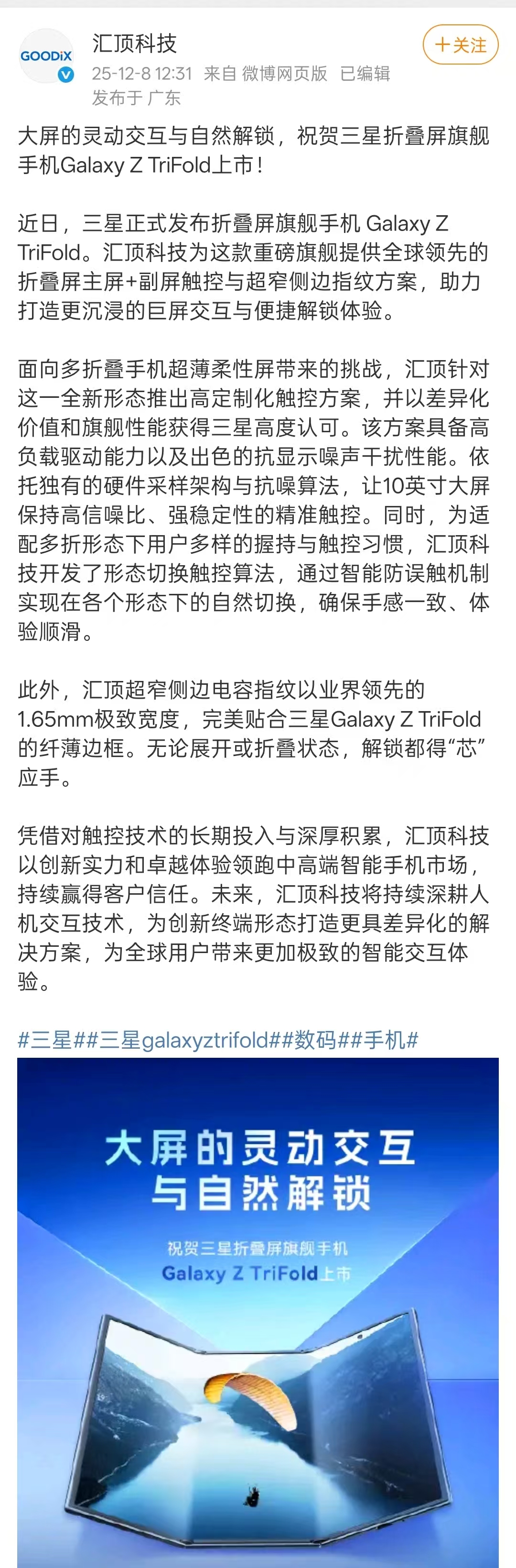
(文/罗叶馨梅)12月8日,汇顶科技(603160.SH)在其官方微博披露,公司为三星首款三折叠手机 Galaxy Z TriFold 提供折叠屏主屏与副屏触控方案及超 窄侧边电容指纹方案,该消息来自公司对外宣示与产业链确认。汇顶称其触控方案具备高负载驱动能力与抗显示噪声干扰能力,能够在 10 英寸级大屏上 维持高信噪比和稳定触控响应。该公司还指出,针对多折形态特别开发了形态切换触控算法以减少误触并兼顾握持多样性。相关报道与公司宣示已被多家 媒体转载并在产业链处获证实。 技术层面上,汇顶本次交付的主屏与副屏触控方案强调两项能力:一是高驱动/高灵敏度的硬件采样架构,用以应对柔性大屏的更高电容负载;二是通过 算法层面的抗显示噪声与形态自适配来提升在折叠缝合区域及不同折叠角度下的触控一致性。公司称这些能力使得在 10 英寸 QXGA 级别的大屏上仍能保 持"高信噪比、强稳定性"的精准触控,这对三折叠形态的用户体验至关重要。产业链人士表示,硬件+算法的双轮驱动是折叠屏触控导入旗舰机的关键门 槛。 汇顶提供的侧边电容指纹模组宽度约为 1.65mm,公司称为"业界领先"级别,便于在纤薄侧框中实现可靠识别。相比传统大面积指 ...

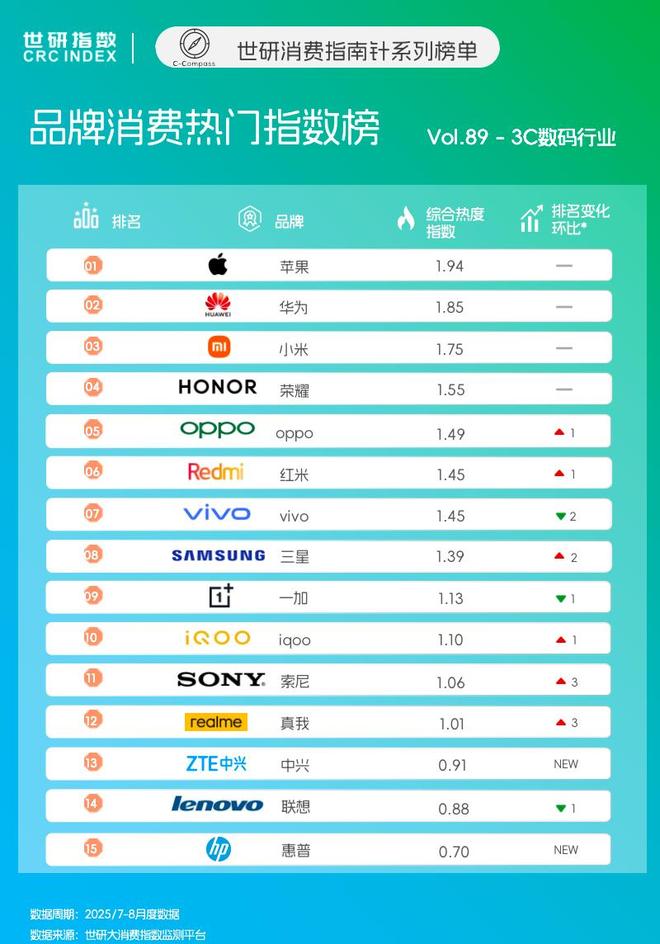
体验消费至上,折叠屏卷向主力机|世研消费指数品牌榜Vol.89
3 6 Ke· 2025-12-08 03:07
Group 1 - The 3C industry is experiencing a "downward" and "upward" strategic competition, with OPPO focusing on affordable cooling technology for budget phones, while Honor and Samsung are emphasizing lightweight foldable screens and AI integration for high-end devices [1][4][5] - In the budget segment, OPPO launched the K13 Turbo series featuring a "wind cooling engine" that enhances cooling efficiency by 120%, targeting a price point under 2000 yuan [4] - Honor's new foldable phone, Magic V5, is positioned as the thinnest and lightest in the industry, featuring advanced AI capabilities and priced starting at 8999 yuan, marking a significant step in its high-end strategy [4] Group 2 - The tablet market is evolving with Huawei's MatePad Pro 12.2, which integrates HarmonyOS 5 and focuses on professional software and AI functionalities, catering to mobile office and creative needs [6] - The wearable segment is also expanding, with iQOO launching the iQOO WATCH GT and OnePlus introducing the OnePlus Watch 3, both targeting specific niches in the market [6] - The competitive landscape is shifting towards technology experience, innovative forms, and ecosystem collaboration, moving beyond traditional parameter comparisons [1]
从尝鲜到依赖:华为如何占据折叠屏用户的「主力心智」
36氪· 2025-12-05 13:35
Core Viewpoint - The article discusses the evolution and acceptance of foldable smartphones, highlighting their transition from skepticism to mainstream adoption, driven by user demand for enhanced productivity and multitasking capabilities [3][4][44]. Group 1: Market Evolution - The foldable smartphone market has seen significant growth, with projected shipments in China exceeding 10 million units by 2024, indicating a shift from niche to mainstream [4][42]. - Initial skepticism surrounding foldable phones mirrors the early criticism faced by the first iPhone, showcasing a pattern of innovation facing initial resistance [3][4]. - The article emphasizes that foldable screens are now recognized as essential tools for productivity, particularly for business and creative professionals [4][6]. Group 2: User Trust and Hardware Reliability - User concerns about hardware reliability, such as screen durability and hinge stability, are critical for gaining trust in foldable devices [8][10]. - Over 50% of users prioritize screen reliability, with a focus on scratch resistance and crease control, followed by hinge stability and overall performance [10][12]. - Huawei has positioned itself as a leader in the foldable market by addressing these hardware concerns through innovative engineering solutions [12][19]. Group 3: Technological Innovations - The introduction of advanced hinge designs, such as the waterdrop hinge, has significantly improved the durability and user experience of foldable phones [13][14]. - The transition from CPI to UTG (Ultra-Thin Glass) for screen materials has enhanced the hardness and usability of foldable devices, making them more appealing to consumers [15][16]. - Huawei's Mate X7 features multiple upgrades, including a robust hinge and advanced materials, providing enhanced protection and user experience [18][19]. Group 4: User Experience and Ecosystem - The article highlights the importance of seamless user experience, with over 55% of users concerned about the functionality of screen switching and multitasking capabilities [21][23]. - Foldable phones enable unique use cases in social media, photography, and productivity, allowing for more efficient workflows and creative expression [26][27][30]. - Huawei's diverse foldable product lineup caters to various user needs, from social interaction to productivity, reinforcing the brand's commitment to enhancing user experience [29][30]. Group 5: Future Outlook - The foldable smartphone category is positioned as a reliable alternative to traditional smartphones, with 95.5% of consumers expressing willingness to switch to foldable devices in the future [44]. - Huawei's approach focuses on long-term user trust and experience rather than short-term sales spikes, indicating a strategic vision for the future of mobile technology [41][44].

从“猎奇”到“信赖”折叠屏手机用户发展洞察报告
Ai Rui Zi Xun· 2025-12-04 01:42
Investment Rating - The report does not explicitly state an investment rating for the folding screen mobile phone industry Core Insights - The folding screen mobile phone has emerged as a strategic direction to break the growth bottleneck in the smartphone market, with significant growth expected from 2022 to 2024 [10][11] - The folding screen technology has evolved significantly, focusing on durability, user experience, and diverse forms [14][24] - The Chinese folding screen mobile phone industry is expected to lead globally due to technological advancements, cost control, and market innovation [23][24] Summary by Sections 01 Current Development of the Folding Screen Mobile Phone Industry - The global smartphone market has entered a phase of stock competition since 2017, with annual shipments declining by approximately 2.52%, projected to reach 1.22 billion units by 2024 [6][7] - Folding screen mobile phones are redefining user experience and are expected to maintain high growth rates in shipments from 2022 to 2024 [11][12] - The folding screen technology has undergone continuous evolution, focusing on core hardware reliability and software ecosystem optimization [14] 02 Brand Competition in the Folding Screen Mobile Phone Market - The global shipment of folding screen smartphones is projected to reach 6.6 million units in the first half of 2025, with a 0.1% year-on-year growth expected for the entire year [71] - In China, the shipment of folding screen smartphones is expected to reach 9.69 million units in 2024, with a steady growth trend observed [74] - The market is dominated by horizontal folding phones, which are expected to account for 6.31 million units in 2024 [80] 03 Consumer Psychology Insights of Folding Screen Mobile Phone Users - The user demographic for folding screen phones is predominantly male and urban, with a significant preference among high-education individuals [91][92] - The primary reasons for purchasing folding screen phones include a stronger sense of technology and innovation, with a budget of 8,000 to 10,000 yuan being common among users [109][110] - Users are primarily corporate managers, with a high interest in technology and brand reputation [94][95]
Counterpoint:Q3全球折叠屏智能手机出货量同比增长14% 创季度历史新高
Zhi Tong Cai Jing· 2025-12-04 01:28
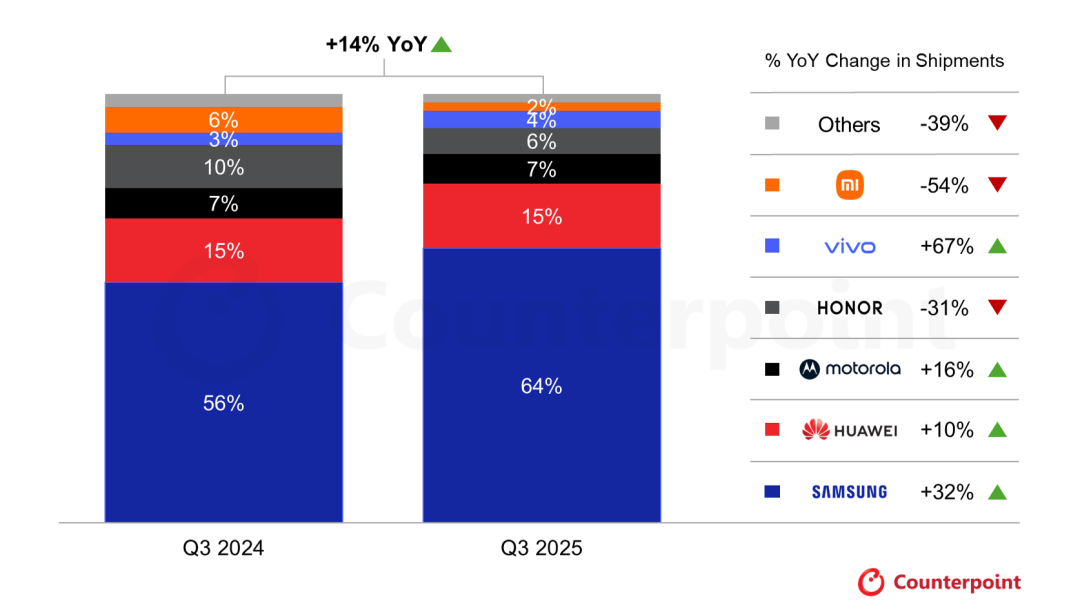
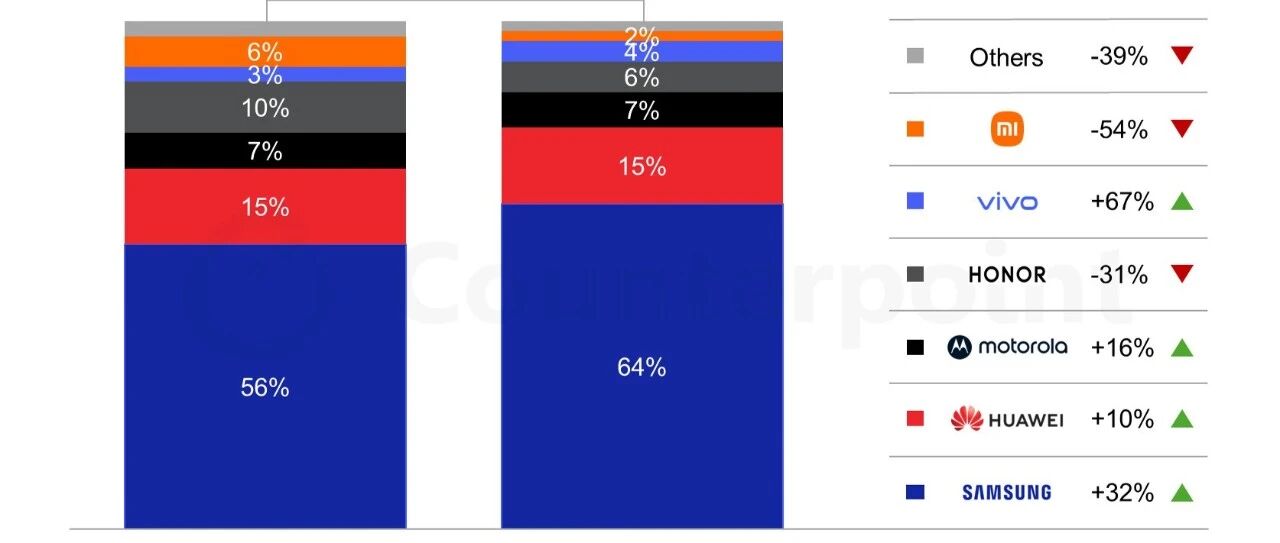
Group 1 - The global foldable smartphone shipment is expected to grow by 14% year-on-year in Q3 2025, reaching a historical high for the category, with foldable devices now accounting for 2.5% of global smartphone shipments [1] - The market expansion is driven by the Samsung Galaxy Z Fold7 and Huawei Mate series, with book-style models leading the growth, while clamshell models also perform well due to Samsung's refreshed product line and the strong performance of the Motorola Razr60 series [1] - Samsung's Galaxy Z series, particularly the Z Fold7, has significantly enhanced its appeal in the high-end market due to its thinner body, lighter weight, more durable hinge, and less visible crease, contributing to unexpected growth [1] Group 2 - The foldable smartphone market is projected to close 2025 with a stable growth rate of around 16% year-on-year, driven by high-end users' preference for larger screens and improved durability [4] - The market is expected to enter a significant expansion phase in 2026, with key drivers including enhanced durability, thinner and lighter designs, optimized hinge and panel structures, and richer AI-driven software experiences [4] - Apple is anticipated to enter the foldable market in the second half of 2026, leveraging its large iPhone user base to drive a new round of high-end product upgrades [4] Group 3 - The competition landscape is expected to change significantly with Apple's entry into the foldable market, prompting existing manufacturers to accelerate their technological advancements and product differentiation strategies [4] - A notable trend is the gradual move away from traditional book-style designs in foldable smartphones, with Huawei's early multi-fold solutions demonstrating engineering feasibility and Samsung's new tri-fold product marking a shift from concept to practical testing [4][5] - Samsung's first tri-fold model will have limited shipments, focusing on validating durability, hinge structure, and software optimization before larger-scale commercialization [5]
全球折叠屏智能手机出货量在 2025 年 Q3 创历史新高,为 2026 年爆发式增长奠定基础
Counterpoint Research· 2025-12-04 01:03
Core Insights - The global foldable smartphone shipment volume reached a record high in Q3 2025, with a year-on-year growth of 14%, driven primarily by the strong performance of Samsung's Galaxy Z7 series [4][5]. Market Performance - In Q3 2025, foldable smartphones accounted for 2.5% of global smartphone shipments, indicating a growing acceptance in the high-end market [5]. - The book-style foldable models led market expansion, supported by the launch of Samsung's Galaxy Z Fold7 and Huawei's Mate series [5]. - The clamshell foldable models also performed well, benefiting from Samsung's refreshed product line and the strong showing of Motorola's Razr 60 series [5]. Future Projections - The foldable smartphone market is expected to close 2025 with a year-on-year growth of around 16%, maintaining a stable growth trajectory [8]. - By 2026, the market is anticipated to enter a significant expansion phase, driven by improvements in durability, thinner and lighter designs, and enhanced AI-driven software experiences [8]. - Apple is expected to enter the foldable market in the second half of 2026, potentially triggering a new upgrade cycle among high-end users [8][9]. Competitive Landscape - The competition in the foldable smartphone market is set to intensify with Apple's entry, prompting existing manufacturers to accelerate their technological advancements and product differentiation strategies [8][10]. - Samsung's recent launch of the Galaxy Z TriFold is a strategic pilot aimed at solidifying its technological leadership before broader commercialization [9][10].
从“猎奇”到“信赖”:折叠屏手机用户发展洞察报告
艾瑞咨询· 2025-12-04 00:05
Group 1 - The core viewpoint of the report highlights the continuous growth of the global foldable smartphone market, particularly in China, driven by technological advancements and an improved supply chain, leading to product diversification [1][4][5] - The report indicates that the foldable smartphone market is transitioning from a niche to a mainstream market, with increasing consumer acceptance and willingness to purchase [1][43][47] - Huawei is identified as a leading player in the foldable smartphone market, significantly increasing its market share from 35.0% in Q1 2023 to 75.0% in Q1 2025, showcasing its dominant position [18] Group 2 - The global smartphone market has entered a phase of stock competition since 2017, with annual shipment volumes declining by approximately 2.52%, projected to reach 1.22 billion units by 2024 [2] - The foldable smartphone segment is seen as a strategic direction to break through the stagnation in market growth, with expected high shipment growth from 2022 to 2024 [5][15] - The foldable smartphone industry chain includes upstream raw material supply, midstream design and manufacturing, and downstream sales, with major players like Huawei and Samsung leading the charge [7] Group 3 - The Chinese foldable smartphone industry has matured, achieving international advanced standards in technology, and creating a virtuous cycle of technology, cost, and market [8][9] - The report outlines the diverse product forms in the foldable smartphone market, with Huawei leading in innovative designs such as tri-fold and wide-fold models [11] - The user demographics indicate a strong preference for foldable smartphones among high-education users, with over 75% of users holding a bachelor's degree or higher [20] Group 4 - The primary reasons for purchasing foldable smartphones include a stronger sense of technology and future, with 44.7% of users citing this as a key factor [24] - Users show a willingness to spend, with 28.4% budgeting between 8,000 to 10,000 yuan for their next foldable smartphone [24] - Huawei leads in brand recognition and user satisfaction, with a significant market share and positive user feedback on its products [26][30] Group 5 - The report notes that foldable smartphones are perceived as carriers of innovation and multifunctional devices, with varying perceptions between male and female consumers [34] - Social interaction and entertainment are the primary use cases for foldable smartphones, indicating a need for further exploration of productivity applications [36] - Users express concerns regarding hardware durability and software experience, highlighting areas for improvement in future models [39] Group 6 - Over 90% of consumers are considering purchasing a foldable smartphone for their next device, focusing on reliability, battery life, and hardware specifications [41] - The transition from "niche novelty" to "mainstream utility" is emphasized, driven by advancements in hardware technology and software ecosystems [43][45] - The report concludes that foldable smartphones are moving towards becoming reliable, everyday devices, with a significant percentage of users willing to switch to foldable models in the future [47]