
新能源商用车

Search documents
南华期货:基本面支撑依旧稳固 当前依然看好碳酸锂需求
Cai Jing Wang· 2026-01-12 01:26
Core Viewpoint - The report from Nanhua Futures indicates an expected surge in lithium battery exports before the end of April, maintaining a positive outlook on lithium carbonate demand [1] Industry Summary - The long-term growth logic for lithium carbonate demand in three key downstream application areas—energy storage, new energy passenger vehicles, and commercial vehicles—remains fundamentally unchanged [1] - The industry fundamentals continue to support the long-term value of lithium carbonate [1] Price Dynamics - There is a need to be cautious about the rapid increase in lithium carbonate prices and related non-ferrous metal prices, as this may erode the economic viability in the energy storage and commercial vehicle sectors [1] - Such price increases could potentially suppress the elasticity of downstream demand in the short term [1]

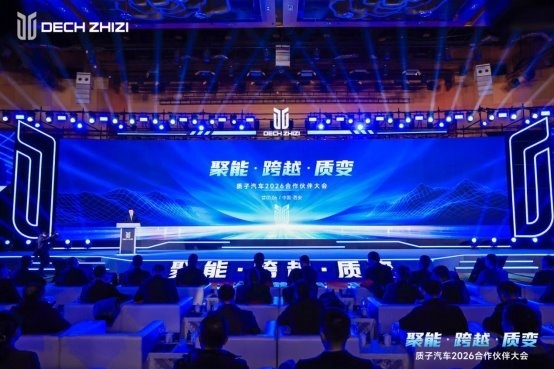
质子汽车召开2026合作伙伴大会
Huan Qiu Wang· 2026-01-09 02:50
Core Insights - The Proton Automobile 2026 Partner Conference, themed "Energy Gathering, Crossing, and Quality Change," was held in Xi'an, marking the company's transition from an "industry new force" to a "leader" [1] Group 1: Strategic Developments - The conference was hosted by Wang Bin, Secretary of the Party Committee and Executive Director of Dechuang Future, with key speeches from Zhou Xiangqiang, General Manager of Shaanxi Automobile Holdings, and Wang Zhao, Chairman of Proton Automobile, who presented the "2026 Strategic Development Report" [3] - Zhou Xiangqiang emphasized Proton Automobile's role as a significant practice of new productive forces in Shaanxi Automobile's development, focusing on innovation in new energy, intelligent networking, and new materials, with a sales target of over 8,000 vehicles in 2025 and overseas bulk sales of hydrogen energy products [3] - Wang Zhao analyzed industry changes and outlined Proton Automobile's development path, committing to a product-driven and ecosystem-win development philosophy centered on maximizing asset returns over the entire lifecycle (BAR) [3] Group 2: Technological and Marketing Initiatives - Vice General Manager Chao Pengxiang presented the R&D report, detailing the 2026 technology blueprint and product roadmap for Proton Automobile [3] - Vice General Manager Lü Wenyas delivered a marketing report focusing on channel ecology, regional segmentation, incentive structuring, and product systematization, reinforcing confidence in collaborative future success with partners [3] Group 3: Financial Collaborations - Proton Automobile signed strategic cooperation credit agreements for 2026 with five banks during the "Capital Win-Win Signing Ceremony," indicating strong market confidence from financial institutions in the company's future development [4] - These collaborations are expected to provide robust financial support for technology R&D, capacity expansion, and market development [4] Group 4: Customer Engagement and Recognition - The "Caring for Card Friends Annual Activity" was launched, in collaboration with the Shaanxi Mechanical Metallurgical Building Materials Trade Union and industry partners, to enhance customer service and operational efficiency amid increasing price competition [6] - Proton Automobile recognized outstanding partners from the past year, aiming to strengthen product competitiveness and system capabilities for high-quality development in the new energy commercial vehicle sector [6]

商用车新势力现融资热潮 谁将引领2026年新趋势?| 头条
第一商用车网· 2026-01-08 06:57
Core Viewpoint - The commercial vehicle industry is witnessing a surge in new players attracting significant capital investment, indicating a transformative phase for the sector in 2026 [1][23]. Group 1: Financing and Investment - Haipote completed a 450 million yuan Series A financing round, with a hydrogen consumption rate of 7.1 kg per 100 km for its H49 model [1][4]. - Zhitu Technology raised over 100 million yuan in Series B financing to enhance smart driving technology and deploy autonomous sanitation vehicles [5][6]. - Kaven New Energy secured over 1.2 billion yuan in Pre-A financing, focusing on R&D and digital infrastructure [6][7]. - Chuan Hydrogen Technology raised over 200 million USD in its third financing round, totaling over 335 million USD since its inception [10][11]. - Zero One Auto completed a 500 million yuan Series A financing, aiming to sell over 10,000 vehicles by 2028 [12][13]. - Guangqi Lingcheng announced a 300 million yuan financing to support its transition into the new energy commercial vehicle sector [20][21]. Group 2: Product Development and Market Strategy - Haipote's H49 model boasts a range exceeding 1000 km, targeting logistics applications [3][4]. - Zhitu Technology's autonomous driving system has achieved industry-leading metrics, with products showcased at the 2026 Global Partner Conference [6]. - Kaven New Energy launched its full product line, including the Kaven Leto light truck and Kaven heavy truck BEACON [8][9]. - Chuan Hydrogen Technology aims to advance liquid sunlight hydrogen technology for sustainable energy solutions [10][11]. - Zero One Auto has deployed over 1,000 vehicles with a total operational mileage exceeding 30 million km [12][13]. - Guangqi Lingcheng introduced the world's first L4 autonomous city bus and a new intelligent electric heavy truck [20][21]. Group 3: Industry Trends and Future Outlook - The rise of new players reflects strong market confidence in the innovative development of the commercial vehicle sector [23]. - The industry is expected to experience significant growth in new energy commercial vehicles and accelerated development of intelligent driving technologies in 2026 [23].

2026头部企业,要在这三个战场“定”胜负!
Xin Lang Cai Jing· 2026-01-07 01:29
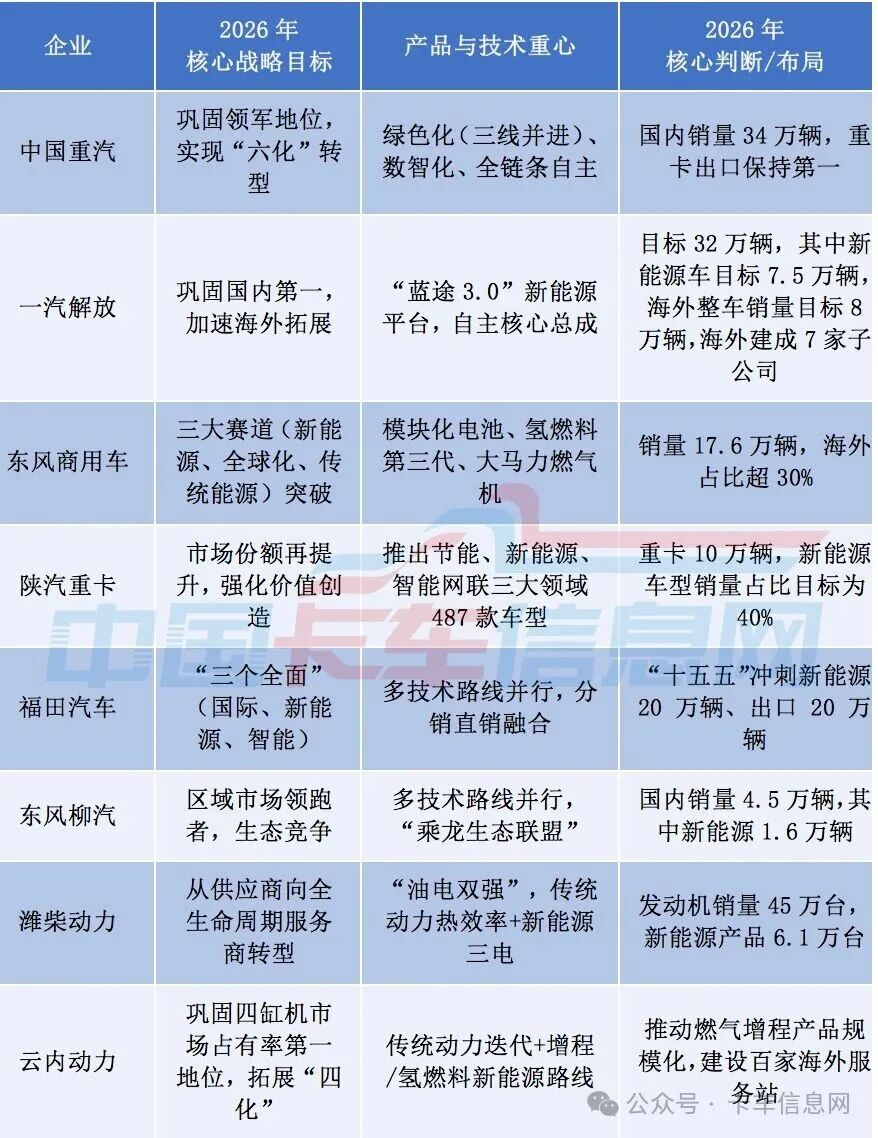
Core Insights - The industry consensus indicates a shift from an incremental expansion phase to a new cycle focused on deepening the value of existing assets, with competition evolving from price-based to providing comprehensive lifecycle value (TCO) [1][9] Industry Consensus: Three Deterministic Trends - The market is expected to enter a phase of "high-level consolidation and structural differentiation," with the medium and heavy truck market projected to remain stable at 1.1 to 1.25 million units, similar to 2025, as the driving force shifts from policy stimulus to optimizing existing resources [2][10] - Three major trends have emerged as strategic anchors for all companies: 1. Accelerated penetration of new energy vehicles (NEVs), with a consensus that the penetration rate will exceed 30% and potentially reach 35% or higher by 2026, driven by market demand rather than policy [3][11] 2. Value competition is replacing price wars, with a focus on service and ecosystem as key differentiators, emphasizing the importance of a comprehensive ecosystem that includes finance, used vehicles, and connectivity [3][11] 3. Globalization is becoming a core growth driver, with exports viewed as a crucial growth engine, as companies shift from simple trade to a more integrated approach involving products, technology, services, and finance [3][11] Strategic Differentiation: Paths of Eight Major Companies - Companies are adopting different strategic focuses based on their resources and capabilities: - China National Heavy Duty Truck Corporation aims to consolidate its leading position through a comprehensive transformation strategy [4][13] - FAW Jiefang focuses on accelerating overseas expansion and enhancing its core components [4][13] - Dongfeng Commercial Vehicle targets breakthroughs in new energy, globalization, and traditional energy markets [4][13] - Shaanxi Heavy Duty Truck emphasizes value creation through a diversified product lineup [4][13] - Foton Motor is pursuing a multi-faceted strategy focusing on internationalization and new energy [4][13] - Dongfeng Liuzhou Motor is leading in regional markets through ecosystem competition [4][13] - Weichai Power and Yunnei Power are adopting a pragmatic approach by diversifying their energy technology routes [6][14] Technology Routes: Diverse Approaches Based on Application Scenarios - The commercial vehicle power technology landscape is expected to be diverse, with choices heavily influenced by application scenarios: - Traditional power is evolving towards high-end and specialized applications, focusing on improving thermal efficiency and reducing fuel consumption [7][15] - Pure electric technology is becoming the preferred choice for short-distance fixed routes, with competition centered on battery energy density and lifecycle costs [7][15] - Hybrid and range-extended technologies are seen as key solutions for long-distance logistics, with significant R&D efforts underway [7][15] - Hydrogen fuel technology is being explored as a future strategic reserve, with ongoing commercial exploration [7][15] Ecosystem Construction: From Chain Leaders to Symbiosis - Leading companies are actively reshaping the industry ecosystem, moving beyond simple supplier relationships to create a community that shares risks and values: - China National Heavy Duty Truck Corporation leverages its capabilities for strong collaboration [8][16] - Dongfeng Liuzhou Motor is integrating upstream and downstream through the "Chenglong Ecosystem Alliance" [8][16] - Weichai Power is collaborating with multiple strategic partners to create a comprehensive service system [8][16] Observations: Coexistence of Consensus and Differentiation - The 2026 Chinese commercial vehicle market is characterized by both consensus on the shift to value-based competition and differentiation in strategic paths chosen by companies [9][17] - The upcoming competition will focus on technological depth, ecosystem breadth, and precision in user operations, with companies that effectively reduce operational costs and enhance efficiency poised to lead in this transformative phase [9][17]



汉马科技2025年全年货车销量同比增长58.45% 新能源业务板块表现亮眼
Zheng Quan Ri Bao· 2026-01-05 13:36
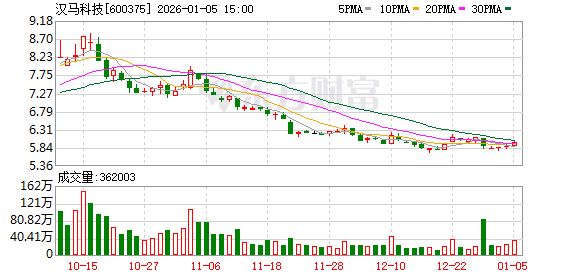
Core Viewpoint - Hanma Technology Group Co., Ltd. has demonstrated significant growth in truck sales and a successful transition to the new energy vehicle sector, with a clear strategic focus on fully electric and clean energy solutions by the end of 2025 [2][3]. Group 1: Sales Performance - The total truck sales for the previous year reached 14,005 units, marking a year-on-year increase of 58.45%, with December sales alone at 1,206 units, up 93.27% [2]. - The electric medium and heavy truck sales reached 11,449 units for the year, reflecting a remarkable growth of 153.46%, while December sales were 1,126 units, up 135.56% [2]. Group 2: Strategic Transition - The company's transition from fuel vehicles to new energy vehicles is not merely a product replacement but involves a comprehensive restructuring of the entire industry chain based on a "methanol-hydrogen + electric" dual technology approach [3]. - Hanma Technology has committed to ceasing the production and sales of traditional fuel vehicles by December 31, 2025, focusing entirely on new energy and clean energy sectors [2]. Group 3: Product Innovation and Market Expansion - The company has developed a complete product matrix, including models like the Xinghan H, Xinghan G, and Yancheng X7, tailored to various transportation needs [3]. - By the end of 2025, the company's new energy medium and heavy trucks will have achieved large-scale operations in 28 provinces and over 100 cities across China, with successful deliveries in Southeast Asia and Central Asia [3]. Group 4: Future Outlook - The development strategy for 2026 is expected to focus on dual drivers of scale expansion and quality improvement, with an enriched product matrix and enhanced operational ecosystem [4]. - Hanma Technology is poised to further strengthen its leading position in the new energy commercial vehicle market, creating long-term value for shareholders and contributing to low-carbon transportation [4].

从2020年全年销量4564台到如今月销量超2万台,远程稳扎稳打稳健发展引领绿色商用
Quan Jing Wang· 2025-12-31 11:22
Group 1 - The core viewpoint is that the company, YuanCheng, has achieved significant growth in the new energy commercial vehicle market, with December sales exceeding 20,000 units, representing a compound annual growth rate of 120% compared to 4,564 units sold in 2020 [1] - YuanCheng's new energy logistics vehicles have maintained the top market position since 2022, with a market share exceeding 20% in 2023, demonstrating strong competitive advantages and stability in the industry [1] - The continuous championship status of YuanCheng indicates its strong market reputation and the successful penetration of new energy logistics vehicles into the first tier of the industry [1] Group 2 - YuanCheng aims to lead the green commercial vehicle sector by integrating passenger and commercial vehicle development, leveraging the strong support from Geely Holding for collaborative research and resource sharing [2] - The company has established a core competitive advantage through the integration of key technologies such as powertrains, intelligent networking, and new energy, marking the transition to a dedicated architecture for commercial vehicle manufacturing [2] Group 3 - The company is advancing its "methanol-hydrogen + electric" technology routes to address the limitations of pure electric vehicles in specific scenarios, achieving comprehensive coverage across various commercial vehicle categories [3] - YuanCheng's methanol-hydrogen technology offers advantages such as long range, low-temperature adaptability, and cost-effectiveness, positioning it as the optimal solution for all scenarios in the new energy commercial vehicle sector [3] Group 4 - The transition from a manufacturing-focused company to an integrated service provider is essential in the new energy commercial vehicle era, with YuanCheng leading the way by implementing the "Ecology 3.0 Strategy" to enhance collaboration among dealers, operators, and service providers [4] - The company has successfully expanded its market presence from selling fewer than 5,000 vehicles annually five years ago to achieving over 20,000 units in monthly sales, solidifying its position as a leading brand in the new energy commercial vehicle market [4]

宇通集团|写入《2025 汽车行业影响力年鉴》
Jing Ji Guan Cha Bao· 2025-12-31 07:06
Core Insights - The Chinese automotive industry is entering a new development phase as the "14th Five-Year Plan" concludes, with a focus on the impact of technology and market dynamics on the sector [1] - Yutong Group is positioned as a leading enterprise in the new energy commercial vehicle sector, showcasing a model for industry leadership through significant breakthroughs planned for 2025 [1][4] Group 1: Yutong's Technological Advancements - Yutong's innovation strategy is systematic, focusing on platform construction and strategic layout, achieving over 10% improvement in product range and a 20% reduction in operational costs [2] - The self-developed electric platform "Rui Control E Platform" integrates hardware and software, enhancing product competitiveness in the commercial vehicle sector [2] - Yutong's heavy-duty truck "Yuanjie T800" features an 800 kWh battery, extending its range to over 550 kilometers, facilitating entry into the medium and long-distance logistics market [2] Group 2: Globalization and Customization - Yutong is expanding its growth boundaries through globalization and customization, developing unique competitive advantages tailored to different market demands [3] - The company is not merely exporting products but extending its core technology capabilities through localized services, achieving bulk operations in various countries [3] - Continuous investment in R&D and participation in industry standards solidify Yutong's leadership position, driving product performance optimization and industry technology upgrades [3] Group 3: Industry Leadership and Recognition - Yutong's capabilities in core technology autonomy, global customization, and industry standard leadership position it as one of the few companies in the domestic new energy commercial vehicle sector with depth in technology and breadth in market reach [4] - The company has been recognized in the "2025 Automotive Industry Influence Yearbook" as a pioneering leader in the new energy commercial vehicle sector, reflecting its sustained industry impact [4]

金杯汽车与德国巨头签约!发力哪一领域?
第一商用车网· 2025-12-29 07:13
Core Viewpoint - The company, Jinbei Automotive, has signed a memorandum of understanding with E-Works Mobility GmbH to establish a research and development center, aiming to enhance competitiveness in the electric light commercial vehicle market in Germany and Europe [1][4]. Group 1: Basic Information about the Memorandum - The memorandum serves as a foundational framework for potential joint cooperation, with specific details and implementation still uncertain [2]. - E-Works Mobility GmbH, established in 2017 and based in Germany, specializes in electric light commercial vehicle design and engineering [3]. Group 2: Strategic Goals and Market Expansion - The collaboration aims to explore key segments of the electric light commercial vehicle industry chain, establishing R&D centers in both China and Germany to enhance technological collaboration and resource sharing [4]. - The goal is to capture a market share of 10% or more in the European electric chassis and electric van market by 2040, positioning both companies as influential brands in the sector [4]. - The partnership is designed to create a win-win model, combining Chinese manufacturing capabilities with European market integration, thereby facilitating entry into high-end markets and overcoming regulatory barriers [4].

宇通/福田/联合重卡/解放各爆100辆大单
第一商用车网· 2025-12-29 07:13
Core Insights - The article highlights the recent delivery of significant orders of electric and smart commercial vehicles by various companies, showcasing the industry's shift towards green and efficient transportation solutions [1][9]. Group 1: Joint Heavy Truck Deliveries - On December 23, Chery Commercial Vehicles' Joint Heavy Truck delivered 100 units of the "Electric Qilin" battery swap tractors to strategic partners, marking a significant step in the green transformation of the industry [1][3]. - The 100 "Electric Qilin" trucks will be used specifically for coal transportation tasks, ensuring efficient operations for the "Public-Rail Intermodal" and "Xinjiang Coal Transportation" projects, which demand high reliability and performance [3][4]. Group 2: Eurocargo Super Truck Delivery - On December 27, a strategic release event for the Eurocargo Super Truck was held, where 100 units were delivered to a major logistics client, emphasizing the collaboration between commercial vehicle manufacturers and logistics companies [6][8]. - The delivery meets the client's stringent requirements for automotive parts transportation, showcasing Eurocargo's strong market presence and technological capabilities [8]. Group 3: FAW Jiefang's New Electric Light Trucks - On December 27, FAW Jiefang announced a strategic cooperation agreement for the promotion of standard battery swap light trucks in the Changchun metropolitan area, marking the product's market entry [9][11]. - The project aims to establish a comprehensive smart energy center and a cold-resistant battery factory, filling a gap in the northern region's new energy commercial vehicle market [11]. Group 4: Yutong's Cold Chain Delivery - On December 28, Yutong Light Truck delivered multiple units of its new energy refrigerated trucks in Haikou, enhancing the cold chain transportation solutions in the Hainan Free Trade Port [12][13]. - The refrigerated trucks feature advanced temperature control technology, improving insulation performance by 50% and enabling real-time temperature monitoring, thus ensuring efficient cold chain logistics [13].

三大关键词解锁2026商用车市场
Zhong Guo Qi Che Bao Wang· 2025-12-29 03:46
Core Insights - In 2025, China's commercial vehicle industry is expected to complete a critical phase of accumulation driven by policies, technology, and market forces, with a clear transition to a new cycle of value competition in 2026 [1] - The industry will focus on three key themes: "stability domestically and expansion internationally," "acceleration of electrification and intelligence," and "value deepening and ecological collaboration" [1] Group 1: Overall Market "Stability and Expansion" - In the first 11 months of 2025, China's commercial vehicle sales reached 3.87 million units, with an estimated total of 4.25 million units for the year, indicating a stable market expected to maintain similar sales levels in 2026 [2] - The domestic market is characterized by stability, with a consensus that sales will remain around 4.25 million units, supported by the replacement of old vehicles and major investment projects [2] - The heavy truck market is projected to have a capacity of approximately 800,000 units, while the light truck market is expected to be between 700,000 and 740,000 units, with significant growth in new energy penetration rates [2] - The overseas market is anticipated to be a core growth engine, with exports expected to reach 400,000 units in 2026, representing a nearly 19% year-on-year increase [2] Group 2: Acceleration of New Energy and Intelligence - The new energy commercial vehicle sector is entering a high penetration phase, with expectations that the penetration rate will exceed 30% in 2026, potentially matching that of traditional fuel vehicles [3] - In the first 11 months of 2025, domestic new energy commercial vehicle sales reached 750,000 units, a year-on-year increase of 62.4%, with a penetration rate of 25.7% [3] - The growth of new energy vehicles is supported by improved lifecycle cost advantages and advancements in technology, such as fast charging and battery systems [3][4] - The market is witnessing differentiated growth across segments, with light trucks exceeding a 40% penetration rate and new energy heavy trucks expanding into long-distance logistics [4] - Intelligent technology is becoming a key competitive differentiator, with predictions that advanced driver assistance systems will progress towards L3/L4 levels in the next three to five years [5] Group 3: Value Deepening and Ecological Collaboration - The trends of increasing new energy penetration and the practical application of intelligent technology are reshaping the industry landscape, shifting the focus from scale expansion to value deepening [7] - Companies are transitioning from being "single product suppliers" to full value chain solution providers, emphasizing ecological collaboration and compliance as core competitive advantages [7] - To achieve high-quality development, companies need to innovate in new energy and intelligent technologies, enhance lifecycle services, and optimize organizational structures and marketing models [7]