智能原生

Search documents
(经济观察)中国“人工智能+”行动明确产业智能化跃迁路线图
Zhong Guo Xin Wen Wang· 2025-08-27 13:18
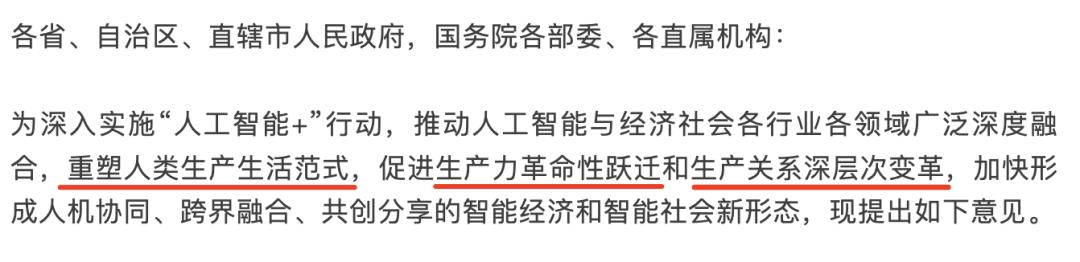
Core Viewpoint - The Chinese government has issued a comprehensive plan for the "Artificial Intelligence +" initiative, aiming to drive the intelligent transformation of key industries and enhance economic growth through AI integration [1][2]. Group 1: AI Industry Development - The AI industry is undergoing a critical phase of global restructuring, with a shift from isolated breakthroughs to systematic innovation and from consumer applications to various sectors like technology, transportation, and healthcare [1]. - The "Artificial Intelligence +" initiative is expected to lead to significant opportunities, surpassing those presented by the internet, as domestic AI models gain international competitiveness and an open-source ecosystem emerges [1][2]. - The initiative outlines a three-stage goal: by 2027, AI will be widely integrated into key sectors; by 2030, it will form important growth poles; and by 2035, it will fully transition into an intelligent economy and society [2][3]. Group 2: Implementation Strategies - The initiative emphasizes a sector-specific approach, focusing on six areas: scientific technology, industrial development, quality improvement in consumption, public welfare, governance capabilities, and global cooperation [2]. - Key performance indicators, such as the penetration rate of AI applications, have been established to provide a clear roadmap for the "Artificial Intelligence +" efforts [2]. - The core objective is to achieve deep integration of AI with the real economy across all elements, chains, and scenarios, transforming traditional industries and fostering new "AI-native" business models [3]. Group 3: Future Outlook - The "AI-native" concept refers to businesses built entirely on AI infrastructure and logic, which are expected to dominate the future economy [3]. - The "Artificial Intelligence +" initiative is seen as a strategic guide for accelerating AI application across various sectors, promoting quality, efficiency, and dynamic transformations in industries such as manufacturing, services, finance, and transportation [3].
中国“人工智能+”行动明确产业智能化跃迁路线图
Zhong Guo Xin Wen Wang· 2025-08-27 12:57
Core Viewpoint - The Chinese government has issued a strategic document to promote the integration of artificial intelligence (AI) into various industries, marking a significant step towards an intelligent economy and society. Group 1: AI Industry Development - AI is accelerating the transition of the national economy towards intelligence across three major industries [1] - The AI industry is undergoing a global restructuring, with a shift from isolated technological breakthroughs to systematic innovation [1] - The emergence of domestic AI models has positioned China among the top tier internationally, creating a scalable commercial application era [1] Group 2: Implementation Pathways - The document outlines a three-stage goal for AI integration: widespread application in key areas by 2027, formation of significant growth poles by 2030, and full transition to an intelligent economy by 2035 [2] - The strategy emphasizes sector-specific policies, focusing on six areas: scientific technology, industrial development, quality improvement in consumption, public welfare, governance capabilities, and global cooperation [2] Group 3: Core Objectives and Future Outlook - The core objective is to deeply integrate AI with the real economy across all elements, chains, and scenarios, transforming traditional industries and creating new "AI-native" business models [3] - The "AI-native" concept refers to businesses built entirely on AI infrastructure and logic, which are expected to dominate the future economy [3] - The initiative is seen as a comprehensive and strategic guide to accelerate AI application across various sectors, driving quality, efficiency, and dynamic changes in industries such as manufacturing, services, finance, and transportation [3]
国家重磅 AI 新政发布,未来10年的超级机会来了
3 6 Ke· 2025-08-27 10:01
Group 1 - The article emphasizes the significance of the Chinese government's "Artificial Intelligence+" initiative, which is seen as a major opportunity for the next decade [2][7][11] - The initiative is compared to the "Internet+" policy from 2015, which marked the beginning of a transformative era in mobile internet [4][6] - The "Artificial Intelligence+" policy is described as a top-level product planning framework that will direct resources and support towards AI development [9][10] Group 2 - The policy outlines three key milestones for AI integration: by 2027, AI should be deeply integrated into six major sectors with a 70% application rate; by 2030, this should rise to 90%; and by 2035, a fully developed intelligent economy and society is expected [18][19][20] - The six targeted sectors include: 1. AI + Science and Technology, focusing on research and innovation [20][21] 2. AI + Industrial Development, introducing "intelligent native" products that leverage AI from the ground up [24][27] 3. AI + Quality of Consumption, enhancing consumer products with smart technology [34] 4. AI + Welfare, improving education and healthcare through AI applications [37][39] 5. AI + Governance, enhancing capabilities in traffic, climate, and safety management [41][43] 6. AI + Global Cooperation, promoting international collaboration in AI development [44][45] Group 3 - The article highlights the importance of foundational support capabilities for the "Artificial Intelligence+" initiative, including model enhancement, data innovation, and talent development [46] - It argues that the advancement of AI will create new opportunities across various sectors, countering the notion that the internet industry has stagnated [46][62] - The article encourages individuals and companies to embrace AI technologies and adapt their skills to align with the evolving landscape [47][51][53]

AI顶层纲领发布,开启AI应用浪潮
HTSC· 2025-08-27 07:09
Investment Rating - The report maintains a "Buy" rating for several companies, including Kingsoft Office, Fourth Paradigm, Fanwei Network, Yonyou Network, Deepin, Inspur Information, Zhongke Chuangda, and Ying Shi Network [8][11]. Core Insights - The "Artificial Intelligence+" action plan released by the State Council marks a strategic shift in China's AI industry, focusing on deep integration with the real economy and commercialization [1]. - The report emphasizes the importance of AI applications, with a goal for integration rates in key areas to exceed 70% by 2027 and 90% by 2030 [2]. - AI infrastructure, particularly computing power and data, is highlighted as a national strategic priority, indicating a potential for rapid growth in these sectors [3]. - The concept of "AI-Native" businesses is introduced, which fundamentally differs from traditional AI models, suggesting new investment opportunities in companies that can create disruptive value [4]. Summary by Sections AI Applications - The report anticipates that various government departments will introduce supporting policies to facilitate AI application deployment, addressing the "last mile" challenges [2]. - A clear roadmap is established with quantitative targets for AI integration in key sectors [2]. AI Infrastructure - The report identifies computing power and high-quality data as critical components for AI development, with a focus on building a unified national computing network [3]. - The emphasis on data supply innovation and the construction of high-quality AI datasets indicates a strategic move towards enhancing AI capabilities [3]. Investment Opportunities - The report outlines four main investment themes: AI + Computing Power, AI + Data, AI + Applications, and AI + End Devices, recommending specific companies within these categories [5]. - Companies such as Kingsoft Office, Fourth Paradigm, and others are highlighted for their potential in rapidly deploying AI solutions [5]. Company Performance - Kingsoft Office reported a revenue of 2.657 billion yuan in H1 2025, with a year-on-year growth of 10.12% [12]. - Fourth Paradigm's revenue reached 2.63 billion yuan in H1 2025, reflecting a year-on-year increase of 40.7% [13]. - Fanwei Network's H1 2025 revenue was 808 million yuan, down 8.79% year-on-year, but with a significant net profit increase [14]. - Yonyou Network's revenue for H1 2025 was 3.581 billion yuan, showing a decline of 5.89% year-on-year, but with positive growth in Q2 [15]. - Deepin's revenue for H1 2025 was 3.009 billion yuan, with a year-on-year growth of 11.16% [16].





“人工智能+”行动迎顶层设计,聚焦六大领域首次布局智能原生
Bei Ke Cai Jing· 2025-08-27 06:12
Core Insights - The launch of the "Artificial Intelligence +" national strategy marks a significant step towards achieving a leading position in the intelligent era, emphasizing the integration of technology, governance, and industry collaboration [4][7][10]. Group 1: Policy and Strategic Goals - The State Council issued the "Opinions on Deepening the Implementation of the 'Artificial Intelligence +' Action," identifying six key areas for AI application: science and technology, industrial development, consumption quality, public welfare, governance capacity, and global cooperation [2][5]. - The "Artificial Intelligence +" action aims to enhance economic and social development, improve people's quality of life, and ensure that all citizens share in the benefits of AI advancements [3][5]. - By 2027, the goal is to achieve widespread integration of AI in six key sectors, with over 70% penetration of new intelligent terminals and applications, and to enhance AI's role in public governance [11]. Group 2: Economic Impact and Development - The implementation of the "Artificial Intelligence +" action is expected to stimulate demand growth, accelerate energy transition, attract global investment, and contribute to high-quality economic development [5][13]. - The strategy is anticipated to create a virtuous economic cycle of investment, innovation, employment, consumption, and reinvestment, generating high-value job opportunities [13][14]. - AI is projected to assist traditional industries in upgrading and transforming, addressing efficiency challenges, and creating new value, thereby driving economic growth [14]. Group 3: Technological Integration and Innovation - The "Artificial Intelligence +" initiative emphasizes the deep integration of AI with traditional industries, similar to the impact of "Internet +" on traditional sectors, enhancing productivity and quality [11][18]. - The concept of "intelligent native" models is introduced, encouraging companies to incorporate AI into their strategic planning and business processes, fostering the development of new business models and industries [18][19]. - AI technologies are expected to evolve from experimental stages to value creation, significantly transforming various sectors and enhancing operational efficiency [8][10].
【钛晨报】布局智能原生、力推新一代智能终端,“人工智能+”行动意见16条要点速览;寒武纪上半年营收暴增43倍,狂赚10亿;京东官宣进军团播
Tai Mei Ti A P P· 2025-08-26 23:49
Group 1 - The State Council has issued opinions on the implementation of "Artificial Intelligence +" actions, focusing on six key areas [2][3] - By 2027, the goal is to achieve over 70% penetration of new generation intelligent terminals and intelligent applications [2] - The plan emphasizes the integration of AI with various fields such as biomanufacturing, quantum technology, and 6G [2] Group 2 - The initiative aims to promote the intelligent transformation of traditional industries and develop new strategic emerging industries [2][3] - There is a strong push for the development of AI-native technologies, products, and service systems [2][3] - The plan includes the acceleration of intelligent applications like smart assistants and the development of new intelligent terminals such as smart cars and smart home devices [2][3] Group 3 - AI will be integrated into all aspects of education and training, with a focus on skill development [2][3] - The initiative supports the application of AI in various sectors, including healthcare and cultural content creation [2][3] - There is a commitment to enhancing the safety and security of AI applications, addressing issues like algorithmic bias and data privacy [2][3][4] Group 4 - The plan includes the establishment of national AI application pilot bases and common platforms for industry applications [6][7] - Financial and fiscal support for the AI sector will be increased to foster long-term and strategic capital [8][9] - The initiative encourages the development of AI service providers and the creation of a service chain for AI applications [7][8]