
智能金融

Search documents
Alice投顾智能助手荣获金融AI领域解决方案赛道“标杆奖”!
Wind万得· 2025-12-05 03:30
Core Insights - Wind's "Alice Investment Advisor" has won the "Benchmark Award" at the 2025 AI Model Financial Innovation Application Competition, highlighting its leading position in China's financial AI sector [1] - The solution has evolved from winning an "Innovation Model" award in 2024 to becoming an industry benchmark in 2025, focusing on AI empowerment in wealth management and enhancing service efficiency [3] Innovation Journey - The Alice Investment Advisor aims to eliminate repetitive tasks for investment advisors, allowing them to focus on client service and enhancing their professional capabilities [3] - The solution is designed to transform wealth management professionals into "super advisors" in the era of digital intelligence [3] Future Directions - Wind plans to deepen the integration of financial models and intelligent investment advisory services, aiming to enhance service professionalism and create greater value through AI [6] - The platform offers features such as automatic integration and analysis of various financial products, personalized asset allocation based on client profiles, and detailed ETF insights [6] - It also includes automated report generation and an Agent function for building personalized AI workflows, significantly improving work efficiency [6]


凝聚资本之力,照亮未来之路
Sou Hu Cai Jing· 2025-12-03 13:05
Core Insights - The article emphasizes the transformative power of funds, viewing them not merely as financial instruments but as carriers of historical wisdom, institutional trust, and future vision, providing a profound perspective on the modern financial ecosystem [1] Historical Context - The evolution of funds is traced from the establishment of the world's first contractual fund in 1868 to the development of the U.S. venture capital landscape over the past seventy years, and the rise of China's fund industry from "Zhu Xin Fund" to a significant player in the global capital market [3] - The Suzhou Fund Museum is highlighted as a key institution preserving and narrating this history, utilizing various multimedia methods to make abstract financial concepts tangible for the public [4] Conceptual Framework - The article presents deep insights from prominent figures in finance, emphasizing that the core of funds lies in the integration of trust, wealth management, and values, which elevates the discussion from a technical to a value-based perspective [6] - The discourse includes critiques of the current financial market's short-term profit focus and underscores the importance of long-termism in fostering new productive forces [6][7] Patience Capital - "Patience capital" is identified as a strategic pillar for China's capital market, characterized by long-term orientation, stability, and a higher risk tolerance, which is essential for supporting the development of new industries [8] - As of June 2024, China has 24,344 active venture capital funds with a total scale of 3.3 trillion, providing robust support for technology innovation [9] Fund Safety - The safety of funds is a critical concern, with China having over 20,000 GP management teams and more than 60,000 funds, raising questions about the reliability of these investments [12] - The article reflects on the rapid growth of the fund industry in China compared to the U.S., highlighting the need for safety and trust in this expanding market [12] Practical Narratives - The article employs case studies to illustrate the journey of IDG Capital from replicating Silicon Valley models to leading China's internet sector, showcasing the growth trajectory of domestic venture capital institutions [26] - It also addresses the lessons learned from early market imperfections and discusses current trends in ESG investment and smart finance [26] Future Outlook - The article captures the evolving role of funds in shaping the future, with AI and algorithms transforming investment decisions and ESG becoming a core metric for investment value [17] - Funds are positioned as not only wealth amplifiers but also as strategic forces in driving national core industry development and addressing significant social needs [17][18]

金融壹账通荣获2025年“数据要素×”大赛全国总决赛二等奖
Qi Lu Wan Bao· 2025-11-26 05:59
Core Insights - The "Digital Risk Control Project" won the second prize in the national finals of the 2025 "Data Element ×" competition, showcasing a significant achievement among 22,000 participating projects [1] - The competition aims to promote the marketization of data elements and the deep integration of data with industries, with a focus on various sectors including financial services [1] Group 1: Project Overview - The "Digital Risk Control Project" addresses industry pain points such as data integration, circulation, and application difficulties, establishing the first "data-risk-ecosystem" digital risk control system in the insurance sector [2] - The project utilizes a robust data foundation from Ping An Group, creating a comprehensive database covering ten high-quality data categories, with a total data volume exceeding PB level [2] - It integrates over 370 authoritative data sources, achieving a compliance data fusion model and a claims knowledge engineering system, with data standards reaching DCMM level five [2] Group 2: Technological Innovations - The project has developed a large model and knowledge engineering system for the insurance domain, utilizing trillions of insurance corpus and hundreds of millions of claims data to create an interpretable knowledge graph and intelligent reasoning chain [2] - The automation rate of knowledge has reached 70%, while the data knowledge rate stands at 50%, significantly enhancing risk identification accuracy and control efficiency [2] - The model has been implemented in scenarios such as claims risk control, risk pricing, and fraud detection, benefiting over 20 insurance institutions and generating economic and social benefits exceeding 10 billion [2] Group 3: Company Strengths - Ping An Group's technological innovation and ecological collaboration are highlighted through this award, reflecting its systemic strength in driving intelligent financial development with data elements [3] - The company has accumulated over 30 trillion bytes of data, covering nearly 250 million individual customers, and has trained large models based on this vast data [3] - AI has been fully integrated into Ping An's core business, achieving a 63% automation rate in personal injury claims and processing car insurance applications in an average of one minute [3] Group 4: Future Directions - Financial One Account will continue to act as a technology output window, collaborating with the Ping An ecosystem and the industry to explore new intelligent financial models driven by data elements [4] - The aim is to contribute to the high-quality development of the financial industry, support the real economy, enhance financial risk prevention capabilities, and promote new productive forces [4]
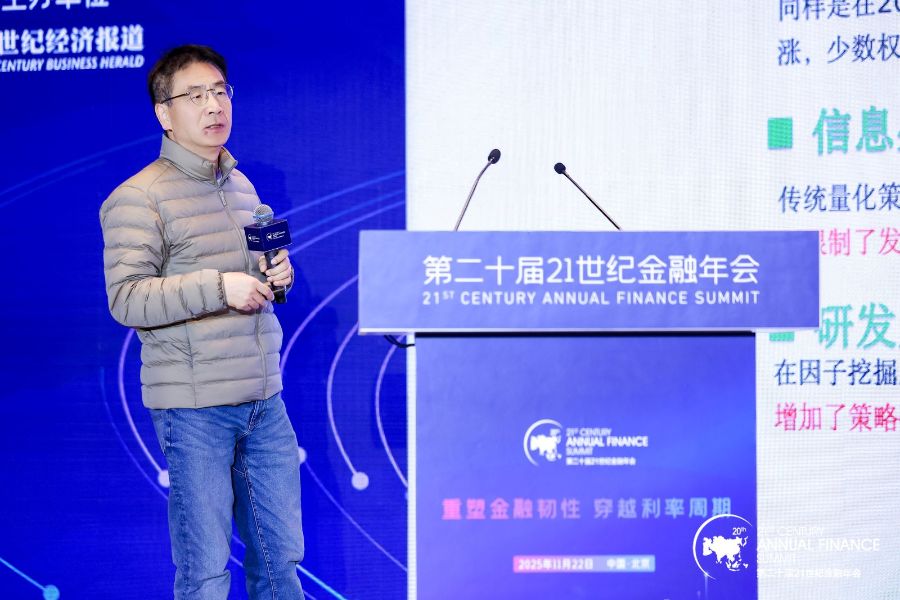
中国科学院大学教授张玉清:大模型开启智能金融新纪元
2 1 Shi Ji Jing Ji Bao Dao· 2025-11-25 01:20
Core Viewpoint - The financial large models are transitioning towards specialization, lightweight design, and compliance, marking the beginning of a new era in intelligent finance rather than being the endpoint of quantitative trading [1][8]. Group 1: Current State of Quantitative Trading - Quantitative funds have shown relatively strong performance in both returns and risk control compared to fundamental funds, with quantitative trading accounting for over 60% of the U.S. stock market and approximately 20%-30% in the A-share market as of 2023 [4]. - The number of quantitative funds in the A-share market doubled from 2019 to 2022, making up 18% of actively managed public funds [4]. - Despite their strengths, quantitative trading faces challenges such as strategy homogeneity, poor adaptability, narrow information processing, and high R&D costs [4][6]. Group 2: Challenges in Quantitative Trading - A significant issue is the homogeneity of trading strategies, as evidenced by over 70% of quantitative long products underperforming the benchmark index during extreme market conditions in August [4]. - The adaptability of quantitative strategies is limited, particularly in market structures where only a few stocks surge while many others remain stagnant [4]. - Traditional quantitative strategies often rely on outdated financial data and indicators, leading to a lack of unique Alpha returns [4]. - The increasing number of selectable factors complicates strategy development and raises trial-and-error costs [4]. Group 3: Role of Large Models in Quantitative Trading - Large models are set to redefine quantitative trading by shifting from experience-driven to intelligence-driven paradigms, enhancing the ability to process vast amounts of unstructured data and perform logical reasoning [6][8]. - These models can automate information extraction, generate trading signals, and optimize decision-making processes, thereby improving the depth, breadth, and adaptability of trading strategies [6][7]. - The integration of multi-agent systems and multi-source information will empower the entire quantitative trading process, from data collection to risk control [6][7]. Group 4: Practical Applications and Performance - Real-world applications of large models have demonstrated their value, with Chinese models outperforming U.S. models in a recent trading competition, achieving an average of 3.4 trades per day and a single trade profit of $181.53 [8]. - The successful strategies of these models include selective trading, maximizing profits, quick loss-cutting, and patient holding of profitable positions [8]. - However, caution is advised regarding the "hallucination problem" in financial large models, which can lead to significant shifts in market sentiment and trading strategies based on minor adjustments in input [8].
金融壹账通连续第四年荣获央行“金发奖”
Zheng Quan Ri Bao Wang· 2025-11-12 06:11
Core Insights - The People's Bank of China has announced the winners of the "2024 Financial Technology Development Award," with Financial One Account winning for the fourth consecutive year [1][2] Group 1: Award Recognition - Financial One Account, in collaboration with Ping An Life and Ping An Technology, received the second prize for the project "Data-Driven and Human-Machine Collaborative Comprehensive Digital Transformation in Life Insurance" [1] - The project aims to create an intelligent operational system covering customers, agents, and internal staff, driven by AI technology [1] Group 2: Innovation in Insurance - The project "New Energy 'Technology + Insurance' New Model Construction," developed by Ping An Property & Casualty and Financial One Account, focuses on the risk characteristics of the new energy industry [2] - It establishes a collaborative insurance ecosystem among car manufacturers, insurance companies, and car owners, promoting green financial innovation [2] - The project features a dynamic pricing model that integrates insurance companies, car manufacturers, and industry stakeholders, enabling automated accident responsibility determination and claims processing [2] - The integrated claims model reduces customer claim waiting time by 60% and decreases secondary accident occurrence by 26% [2] - An AI-based accident simulation platform supports product iteration for car manufacturers, enhancing risk reduction and industry collaboration [2] - The project also includes the development of a global risk map and quantitative model to provide safety and risk management support for new energy enterprises expanding internationally [2] Group 3: Future Outlook - Financial One Account plans to continue its role as a technology output window, collaborating with Ping An's ecosystem and industry partners to explore new intelligent financial models [2] - The company aims to contribute to the service of the real economy, foster new productive forces, and enhance financial risk prevention capabilities [2]
金融壹账通荣获2025年“数据要素×”大赛全国总决赛二等奖:以数据要素驱动智能风控创新
Xin Hua Cai Jing· 2025-11-07 02:35
Core Insights - The "Digital Risk Control Project" won the second prize in the national finals of the 2025 "Data Element ×" competition, showcasing a significant achievement among 22,000 participating projects [1] - The competition aims to promote the marketization of data elements and the deep integration of data with industries, featuring 13 industry tracks including financial services [1] Group 1: Project Overview - The "Digital Risk Control Project" addresses industry pain points such as data integration, circulation, and application difficulties, establishing the first "data-risk-ecosystem" digital risk control system in the insurance sector [2] - The project utilizes a robust data foundation and distributed computing capabilities from Ping An Group, creating a comprehensive database covering ten high-quality data categories, with a total data volume exceeding PB level [2] - It integrates over 370 authoritative data sources, forming the first compliance data fusion model and claims knowledge engineering system in the industry, achieving a data standard at DCMM level five [2] Group 2: Technological Innovations - The project has developed a large model and knowledge engineering system for the insurance domain, utilizing trillions of insurance corpus and hundreds of millions of claims data to create an interpretable knowledge graph and intelligent reasoning chain [2] - The automation rate of knowledge has reached 70%, while the data knowledge rate stands at 50%, significantly enhancing risk identification accuracy and control efficiency [2] - The project has empowered over 20 insurance institutions through an inclusive financial open platform, generating economic and social benefits exceeding 10 billion [2] Group 3: Company Strengths - Ping An Group's technology innovation and ecological collaboration are highlighted by this award, reflecting its systemic strength in driving intelligent financial development through data elements [3] - The company has accumulated over 30 trillion bytes of data, covering nearly 250 million individual customers, and has trained large models based on vast data resources [3] - AI has been fully integrated into Ping An's core business, with 89% of car insurance policies being issued in an average of one minute, and the automation rate for personal injury claims reaching 63% [3] Group 4: Future Directions - Financial One Account will continue to act as a technology output window, collaborating with the Ping An ecosystem and the industry to explore new intelligent financial models driven by data elements [4] - The aim is to contribute to the high-quality development of the financial industry, support the real economy, enhance financial risk prevention capabilities, and promote new productive forces [4]

平安数字化风控项目斩获全国“数据要素×”大赛二等奖 以科技创新赋能金融高质量发展
Zheng Quan Ri Bao Wang· 2025-11-06 07:13
Core Insights - The "Digital Risk Control Project" won the second prize in the national finals of the 2025 "Data Element ×" competition, showcasing a significant achievement for the project among 22,000 entries nationwide [1] - The competition aims to promote the marketization of data elements and the deep integration of data with industries, featuring 13 industry tracks including financial services [1] Group 1: Project Overview - The "Digital Risk Control Project" addresses key industry pain points such as data integration, circulation, and application difficulties, establishing the first "data-risk-ecosystem" digital risk control system in the industry [2] - The project leverages Ping An Group's robust data foundation and distributed computing capabilities, creating a comprehensive database covering ten high-quality data categories, with total data volume exceeding PB level [2] Group 2: Technological Capabilities - The project integrates over 370 authoritative data sources, forming the industry's first compliant data fusion model and claims knowledge engineering system, achieving a data standard at DCMM level five [2] - Ping An has accumulated over 30 trillion bytes of data, covering nearly 250 million individual customers, and has trained large models based on massive datasets [2] Group 3: AI Integration and Impact - AI has been fully integrated into Ping An's core business, with 89% of car insurance policies being issued in an average of one minute, and the automation rate for personal injury claims reaching 63% [2] - In the first three quarters of 2025, AI service volume exceeded 1.292 billion instances, covering 80% of the group's total customer service volume, and AI-assisted sales amounted to 99.074 billion yuan, enhancing customer experience and operational efficiency [2] Group 4: Future Directions - Financial One Account will continue to act as a technology output window, collaborating with the Ping An ecosystem and the industry to explore new models of intelligent finance driven by data elements, contributing to high-quality development in the financial sector [3]
聚焦2025服贸会:奇富科技信贷超级智能体升维之路
Zhong Guo Jing Ji Wang· 2025-09-11 10:08
Core Viewpoint - The 2025 China International Service Trade Fair, themed "Digital Intelligence Leading, Service Trade Renewed," showcases advancements in financial technology, particularly by Qifu Technology, under the national "Artificial Intelligence+" strategy [1][4]. Group 1: Company Developments - Qifu Technology has aligned its technological advancements with national policies, focusing on integrating AI into financial services, aiming for over 70% application penetration by 2027 [1][4]. - The company has invested nearly 10 billion in R&D, with over half of its nearly 1,000 patents related to AI, and has a research team exceeding 1,000 members [4]. - Qifu Technology has developed an AI Approval Officer that automates the loan application review process, achieving T+0 approval times and significantly enhancing efficiency while ensuring compliance with regulatory requirements [4][6]. Group 2: Industry Trends - The financial sector is viewed as a prime testing ground for AI technologies, with Qifu Technology aiming to transform AI from a tool into a productive factor through intelligent applications [4][6]. - The company plans to enable one-third of its core business demands to be met through intelligent agents by the end of 2025, indicating a shift towards deeper integration of AI in financial operations [6]. - The evolution of financial intelligent agents is moving from auxiliary roles to core decision-making functions, reflecting a broader trend in the industry towards enhanced efficiency and safety in financial services [6].
重磅报告|智启新章:2025金融业大模型应用报告正式发布(附下载)
腾讯研究院· 2025-08-22 08:04
Core Viewpoint - The core viewpoint of the report is that the key to AI application in finance is not to engage in a technology race for the sake of AI, but to return to the essence of technology serving business, using ROI as a benchmark to calibrate application paradigms and optimize implementation paths [1][4]. Group 1: Current State of AI in Finance - A productivity revolution driven by large models is quietly occurring in leading financial institutions, indicating a paradigm shift in the industry [1]. - By 2025, it is anticipated that the financial industry will deeply integrate AI and realize the benefits of large model technologies [1]. Group 2: Transformative Practices - A leading bank has reduced complex credit approval report analysis from hours or days to just 3 minutes, with accuracy improved by over 15% [3]. - A top brokerage firm has implemented AI agents to monitor over 5,000 listed companies 24/7, significantly enhancing research coverage and response speed [3]. - An overseas top investment bank has deployed hundreds of AI programmers, with plans to increase this number to thousands, aiming to boost engineer productivity by three to four times [3]. Group 3: Strategic Framework - The report aims to provide a strategic compass that is both forward-looking and actionable, emphasizing the importance of understanding opportunities and challenges, making proactive layouts, and building systematic capabilities [4][8]. - The financial industry is seen as the core battlefield for the comprehensive reconstruction driven by AI, where technology and human wisdom will collaborate to explore the essence of financial services [6][8]. Group 4: Trends and Challenges - The report identifies six core trends driving industry evolution, aiming to provide a strategic roadmap for financial decision-makers and innovators [9]. - The evolution of large models is characterized by a shift from capability exploration to efficiency revolution, with a focus on high-value data rather than just large-scale data [11]. - Financial institutions are moving from experimental phases to large-scale deployment of AI applications, with banks leading the way [12]. Group 5: Implementation Challenges - The implementation of large models in finance reflects the deepening contradictions of digital transformation, requiring institutions to balance fragmented construction, resource allocation, and compliance with safety [14][15]. - Key challenges include data fragmentation, unclear strategic planning and ROI, low tolerance for error in technology adaptation, and lagging organizational talent upgrades [15]. Group 6: Future Outlook - AI is driving financial services towards unprecedented levels of inclusivity, intelligence, and personalization, redefining operational and management models [16]. - The integration of AI with human expertise is expected to accelerate the demand for innovative financial talent, with high-quality private data becoming a core competitive advantage for institutions [16].


中邮消费金融智能反欺诈项目入选“智能金融十佳案例”
Zheng Quan Ri Bao Wang· 2025-07-17 11:52
Core Insights - Zhongyou Consumer Finance Co., Ltd. was recognized as one of the "Top Ten Smart Finance Cases" for its innovative research and application in intelligent risk anti-fraud [1][2] - The company developed a three-pronged intelligent defense system against fraud, focusing on AI technology misuse [1] Group 1: Technological Innovations - The intelligent defense system includes dynamic biometric deep defense, which integrates multiple live detection technologies and video 3D dynamic analysis to intercept identity impersonation and deepfake fraud attacks [1] - The system employs an innovative graph neural network model (NEI-GraphSage) for precise identification of professional fraud rings [1] - A unified cross-modal decision framework was established to break down data silos, enabling deep integration and collaborative analysis of multi-dimensional information such as images, videos, sounds, and texts [1] Group 2: Application and Impact - The system covers the entire process of loan approval, from pre-loan access to post-loan management, achieving breakthroughs in key scenarios such as marketing fraud detection and identity verification [2] - In 2024, the system successfully intercepted over 1.09 million non-compliant applications and blocked 8,479 fraud cases, recovering marketing losses of 4.55 million yuan [2] - The company aims to deepen the application of this system and continue advancing research in intelligent anti-fraud technologies to enhance its risk control framework [2]