机器人即服务(RaaS)

Search documents
今年前八月全国机器人行业营业收入同比增长29.5%
Zhong Guo Xin Wen Wang· 2025-10-29 08:59
Group 1 - The core viewpoint of the articles highlights the significant growth and transformation of the robotics industry in China, with a reported revenue increase of 29.5% in the first eight months of the year [1] - The production of industrial robots reached 512,000 units, while service robots totaled 11.856 million sets during the same period [1] - The global robotics industry is entering a golden development period characterized by technological leaps, expanded applications, and ecosystem restructuring, with a notable shift from traditional functional equipment to intelligent partners [1][2] Group 2 - China's robotics industry revenue is projected to double from 106.1 billion yuan in 2020 to 237.9 billion yuan by 2024, indicating robust growth [2] - Key components such as precision reducers, high-performance servo systems, and intelligent controllers have seen significant breakthroughs, enhancing the capabilities of high-performance industrial robots [2] - Dongguan, a manufacturing hub, has over 7,000 robotics-related enterprises, ranking third nationally, and is developing a complete industrial chain from core components to system integration [2] Group 3 - The "Dongguan Action Plan for Accelerating the Innovative Development of the Intelligent Robotics Industry (2025-2027)" aims to establish Dongguan as a global influential hub for robotics innovation, targeting breakthroughs in key technologies by 2027 [3] - The plan anticipates the establishment of over 1,000 related enterprises and the cultivation of more than 120 "single champion" companies, with industry revenue exceeding 100 billion yuan [3]

《2025年世界机器人报告》发布:中国市占率碾压全球,印度逆袭第六,日美韩德全线下滑
3 6 Ke· 2025-09-28 02:31
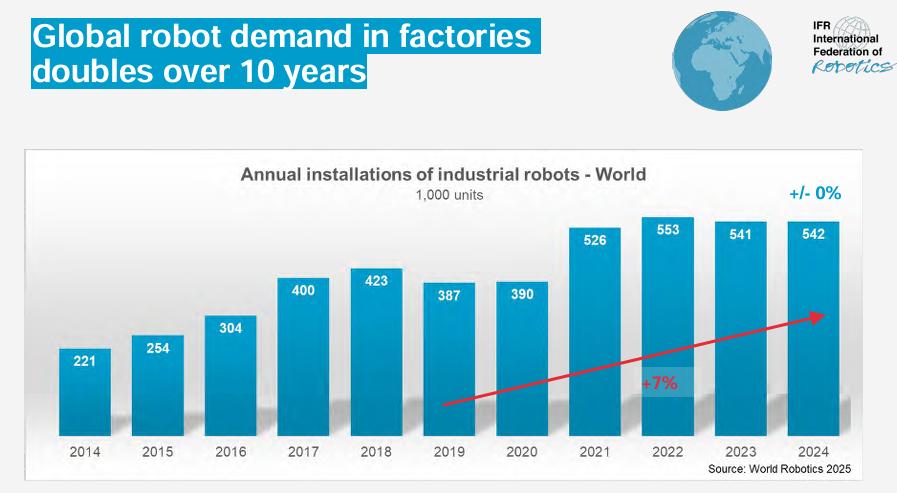
Group 1 - The core viewpoint of the article highlights that the automotive industry has become the largest variable in the global industrial robot market, with China's domestic market share surpassing foreign suppliers for the first time [14][11][3] - In 2024, global industrial robot installations are projected to reach 542,000 units, marking a more than twofold increase over the past decade, with Asia accounting for 74% of new deployments [3][11][13] - China leads the global market with 295,000 new installations in 2024, representing 54% of the global total, while other major markets like Japan, the US, South Korea, and Germany experience declines [3][11][18] Group 2 - The report indicates that the industrial robot market in China has seen a significant increase in domestic manufacturers, with their market share rising from approximately 28% a decade ago to 57% [14][11] - The application of industrial robots has diversified, with the general industry now accounting for 53% of installations in 2024, up from 36% in 2014, compensating for the weakness in the automotive sector [4][11] - The total number of operational industrial robots globally is expected to reach 4.664 million units in 2024, reflecting a 9% year-on-year growth [3][11] Group 3 - The report forecasts that the global industrial robot market will continue to grow, with an expected increase of 6% in installations to 575,000 units by 2025, and projections to exceed 700,000 units by 2028 [3][30] - The service robot market is also experiencing growth, with new installations of specialized service robots reaching 199,000 units in 2024, a 9% increase year-on-year [32][38] - The medical robot segment shows remarkable growth, with an increase of 91% in new installations, totaling 16,700 units in 2024 [32][41]

港仔机器人(00370)获达闼近2000项具身智能知识产权及专利独家授权,共同开启人型机器人香港本地制造新纪元
智通财经网· 2025-09-26 07:56
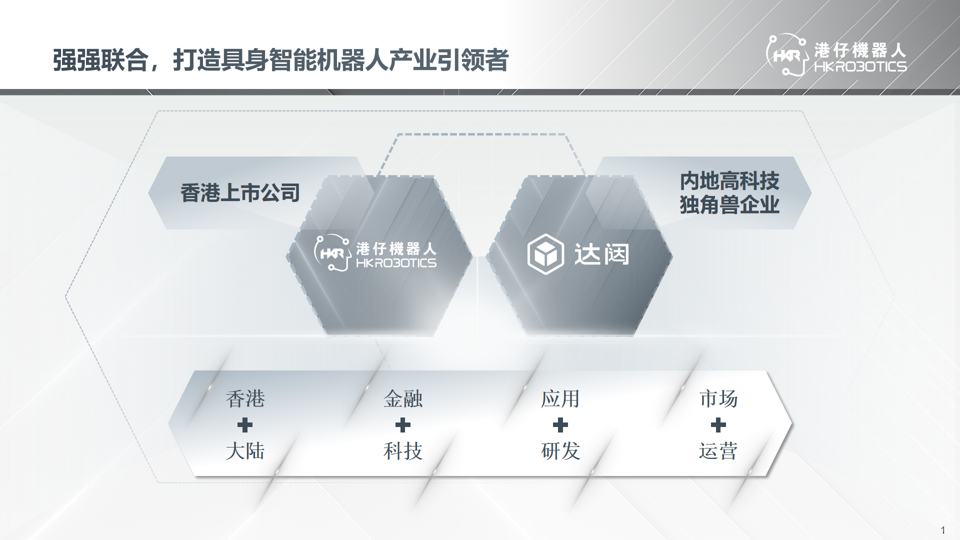
Core Viewpoint - The collaboration between 港仔机器人 and 达闼机器人 marks a significant milestone in the humanoid robotics industry, with 港仔机器人 receiving exclusive authorization for nearly 2000 patents from 达闼, indicating strong confidence in the sector and the technology involved [1][2]. Group 1: Strategic Collaboration - The partnership is described as a "strong union," combining 港仔机器人的 advantages in financial resource integration and market expansion with 达闼机器人的 deep technological expertise and innovation [2]. - The collaboration aims to create an industry leader in the embodied intelligence robotics field by integrating resources across multiple dimensions, including finance, technology, application, and operations [2]. Group 2: Technological Advancements - 港仔机器人的 core competitiveness is significantly enhanced through the acquisition of 达闼's patents, enabling the development of an advanced operating system that achieves full-chain intelligence in perception, cognition, decision-making, and control [5]. - The company has overcome hardware challenges, achieving mass production of high-precision components, which supports complex operations in various environments [5]. Group 3: Market Applications and Achievements - 港仔机器人 has demonstrated substantial market application capabilities, securing strategic agreements worth over 800 million with health management giant 美年健康 to deploy 20,000 smart health robots [8]. - The company has also achieved record-breaking orders, including a 3 billion order for 1000 security robots and the first global order for 10,000 home care robots, enhancing its competitive edge in various sectors [8]. Group 4: Impact on Hong Kong's Tech Industry - The collaboration is pivotal for Hong Kong's innovation and technology sector, promoting local manufacturing of humanoid robots and aligning with the vision of "Hong Kong innovation, world standards" [10]. - 港仔机器人 is positioned to lead the industry into a new phase of practicality and efficiency, potentially creating sustainable returns for investors and setting a benchmark for the global embodied intelligence robotics industry [10].
科技制造产业月报(2025年9月)-20250912
Huachuang Securities· 2025-09-12 14:14
Investment Rating - The report does not explicitly provide an investment rating for the humanoid robotics industry Core Insights - The humanoid robotics industry is in the early stages of transitioning from laboratory to commercial applications, with significant potential driven by leaders like Tesla's Optimus pushing for large-scale deployment [2][5] - The industry faces five key conditions for full commercialization: technological maturity, cost control, clear market positioning, infrastructure and ecosystem development, and social/legal acceptance [2][5] - The current core contradiction lies between high costs and unproven application scenarios/ROI, which constrains market demand and cost reduction efforts [2][5] Summary by Sections Upstream Core Components - The upstream segment is characterized by high technical barriers and cost concentration, determining the performance limits of robots, including components like high-torque density joint assemblies and AI chips [8][9] - The value of the three main actuators constitutes 73% of the humanoid robot's main component value, with high precision and performance requirements [9][12] - Domestic suppliers have significant room for improvement in high-tech components, with some achieving breakthroughs in key areas like harmonic reducers [12][17] Midstream Body Design, Manufacturing, and Integration - The midstream focuses on assembling core components into complete robotic products, requiring strong integration capabilities and scalable production [36][39] - Key tasks include body design, assembly manufacturing, system integration, and testing to ensure compatibility and performance [37][38] - The competition in the midstream is intense, with various companies attempting to overcome technological and commercial barriers [39] Downstream Applications and Services - The downstream segment has diverse application scenarios, ranging from industrial to personal services, with significant growth potential [2][5] - The commercialization of humanoid robots requires meeting specific conditions, including technological maturity and market demand alignment [2][5] - The market space is expected to expand exponentially with technological breakthroughs and demand surges [2][5] Potential Business Model Exploration - Future winners in the humanoid robotics industry will be those who can create integrated hardware, software, and ecosystem services [2][5] - Short-term opportunities may lie in B2B RaaS models and specific industry solutions, while long-term value will come from software platforms and ecosystems [2][5]
透过2025年 WRC,看见具身智能的真实进度
3 6 Ke· 2025-08-12 10:44
Core Insights - The focus of humanoid robots has shifted from mere mobility to practical applications and deployment capabilities, with an emphasis on multi-robot collaboration and system integration [2][5][8] - The 2025 World Robot Conference showcases a significant change in the presentation logic, highlighting the ability of robots to be deployed in real-world scenarios rather than just demonstrating their capabilities [8][9] Group 1: Technological Advancements - The integration of multi-modal large models and embodied intelligence has significantly improved the stability of robots in perception, understanding, and execution [6] - The decline in hardware costs and the increased penetration of domestic components have made it possible for more products to be defined as SKUs and deployed in bulk [6][21] - Robots are now capable of receiving vague semantic instructions and autonomously completing tasks such as grasping and transporting, indicating progress from laboratory testing to pilot operations [20][22] Group 2: Market Trends - The number of participating companies and the focus on usable and replicable products have increased compared to 2024, with manufacturing, medical, and service industries becoming key areas for deployment [5][6] - The shift from showcasing technology to discussing pricing, delivery cycles, and maintenance mechanisms reflects the industry's movement towards commercialization and practical application [18][19] - The emergence of a clear mechanism for "scene + policy + enterprise linkage" has facilitated the testing and implementation of robots in various local settings [24][26] Group 3: Industry Applications - Humanoid robots are now being demonstrated in near-real work scenarios, performing tasks such as material handling and collaborative operations, moving away from being mere prototypes [9][11] - Service robots have become more focused on high-frequency, stable, and sustainable scenarios, such as retail and indoor delivery, indicating a shift towards practical applications [14][15] - The medical and rehabilitation robot sector is showing trends towards systematization and platformization, with robots being deployed in real healthcare settings [17] Group 4: Future Challenges - The next phase of robot deployment will focus on deepening scene penetration and maturing business models and operational systems [27][28] - Reliability issues remain a concern, as robots may face challenges in real-world environments due to factors like lighting and temperature [30] - The integration costs associated with seamlessly connecting robots to existing systems like WMS and MES can hinder deployment speed and scalability [31]

大单频现 人形机器人商业化加速
经济观察报· 2025-08-03 04:23
Core Viewpoint - The humanoid robot industry is transitioning from a phase of technical demonstrations to commercial implementation, marked by significant business contracts and increased financing activities [1][4]. Group 1: Industry Developments - The efficiency of humanoid robots is currently around 40% compared to human workers, with ongoing efforts to improve this metric [2]. - Major contracts have been awarded in the humanoid robot sector, including a procurement project worth 90.51 million yuan by UBTECH and a total of 124 million yuan for a project involving Zhiyuan Robotics and Yushu Technology [3]. - The capital market is witnessing increased activity, with companies like Yushu Technology and Zhiyuan Robotics pursuing IPOs and financing rounds [4][7]. Group 2: Technological Advancements - UBTECH's latest humanoid robot, WalkerS2, features a pioneering hot-swappable battery system that allows for continuous operation, addressing the need for robots to work up to 16 hours a day [6]. - The industry is focusing on real-world applications, with demonstrations of robots performing tasks in various settings, such as factories and service environments [6]. Group 3: Market Trends - The humanoid robot industry is experiencing rapid growth, with estimates of 50% to 100% growth in the first half of the year [7]. - Companies are increasingly looking to integrate capital from various sectors, including cloud computing and automotive, to enhance their operational capabilities and market reach [8]. Group 4: Business Models - The industry is diversifying its business strategies, with some companies adopting platform-based approaches to empower developers and researchers, while others focus on deep specialization in specific verticals [9][12]. - The "robot as a service" (RaaS) model is emerging, allowing customers to rent robotic services instead of purchasing robots outright [11]. Group 5: Challenges and Solutions - Cost remains a significant barrier to widespread adoption, with the need for effective integration of diverse hardware components being a critical challenge [17]. - Data quality and availability are also major hurdles, with companies exploring solutions to gather high-quality, real-world data to improve robot performance [18]. Group 6: Future Outlook - The path to large-scale commercialization of humanoid robots is expected to be a long-term endeavor, requiring patience and ongoing advancements in technology and regulatory frameworks [20].

大单频现 人形机器人商业化加速
Jing Ji Guan Cha Wang· 2025-08-02 07:57
Core Insights - The efficiency of humanoid robots is currently around 40% compared to human workers, with ongoing efforts to improve this metric [2] - The humanoid robot industry is transitioning from a technology showcase phase to a commercialization phase, marked by significant contracts and IPO activities [3][4] - Continuous operation capability is crucial for industrial robots, with advancements like the autonomous battery swap system enabling 24/7 operation [4][5] Industry Developments - Recent contracts include a procurement project worth approximately 90.51 million yuan for robot equipment by UBTECH and a total of 124 million yuan for humanoid robot services by Zhiyuan Robotics and Yushu Technology [3] - The humanoid robot sector is experiencing rapid growth, with an estimated 50% to 100% increase in the first half of the year, and a surge in new product launches [6] - Major companies are exploring diverse business models, including "robot as a service" (RaaS) and platform-based strategies to enhance customer engagement [11][10] Technological Innovations - The latest humanoid robot from UBTECH, WalkerS2, features a pioneering hot-swappable battery system that allows for quick battery changes without human intervention [4] - Companies are focusing on practical applications and customer pain points to drive product development, moving away from merely showcasing technical specifications [14][15] Market Dynamics - The humanoid robot market is characterized by varied strategies, including platform-based approaches and deep vertical integration in specific industries [9][12] - Investment is shifting towards the entire supply chain, with significant capital flowing into both hardware and software components to enhance integration and reduce costs [7][15] Challenges and Future Outlook - High costs and the complexity of integrating diverse components remain significant barriers to widespread adoption of humanoid robots [15] - Data scarcity and the need for high-quality, real-world data are critical challenges that companies are beginning to address through innovative data collection initiatives [16] - The path to large-scale commercialization of humanoid robots is expected to be gradual, requiring advancements in model capabilities, cost reductions, and ethical considerations [17][18]

数智科技国能信控自研创新成果亮相第9届南博会
Jing Ji Wang· 2025-06-27 09:23
Group 1 - The 9th China-South Asia Expo and the 29th China Kunming Import and Export Commodities Fair opened in Kunming, Yunnan, showcasing innovative products from Guoneng Xinkong, including a new energy centralized control system and a virtual power plant management platform [1] - The new energy regional centralized control system aims for "unmanned operation and minimal staffing," significantly improving operational efficiency and transitioning from decentralized to centralized management of renewable energy plants [1] - Guoneng Xinkong's virtual power plant solution integrates distributed photovoltaic, energy storage, charging piles, and commercial loads, facilitating user participation in electricity market transactions and grid auxiliary services [1] Group 2 - Guoneng Xinkong employs a "Robots as a Service (RaaS)" model, developing intelligent robots for complex operations and emergency inspections, enhancing inspection efficiency by 50% and reducing risks in high-risk jobs by over 80% [2] - The company has introduced an intelligent gas detection solution for confined spaces, utilizing real-time monitoring and smart alerts to ensure safety during operations [2] - The expo, co-hosted by the Ministry of Commerce of China and the Yunnan Provincial Government, featured 16 exhibition halls and attracted nearly 120 leading industry enterprises, focusing on green trade, digital trade, and service trade [2]
人形机器人,到底能不能投资?
3 6 Ke· 2025-05-27 01:36
Group 1: Core Insights - Humanoid robots can drive smarter automation, reduce costs, and enhance human labor productivity, but improper investment questions can lead to high costs and counterproductive outcomes [1][4] - The rapid development of general-purpose humanoid robots, driven by advancements in generative AI, mechatronics, and simulation technology, may reshape labor dynamics across various industries [3][4] - The cost of manufacturing humanoid robots has decreased by 40% in recent years, with projections indicating a drop from approximately $58,000 to $20,000 per robot by 2032 [4] Group 2: Investment Considerations - Companies must evaluate the specific roles humanoid robots can play in their operations, focusing on areas where they can outperform traditional industrial robots and create greater value [6] - A comprehensive cost-benefit analysis is essential for humanoid robot investments, considering both direct and indirect costs, with Robot as a Service (RaaS) offering a more cost-effective entry point [12] Group 3: Application Areas - Humanoid robots have proven valuable in manufacturing and warehousing, addressing labor shortages and performing hazardous tasks, with 58% of large factory managers believing they will become a cost-effective assembly standard by 2040 [7] - In healthcare, humanoid robots can assist with daily tasks for the elderly and those with special needs, demonstrating positive outcomes in social interaction and communication skills for children with autism [9] - In customer service, humanoid robots are increasingly being adopted in retail and hospitality sectors, particularly for tasks that are monotonous, dangerous, or repetitive [10] Group 4: Integration and Collaboration - Effective integration of humanoid robots into existing processes requires a focus on optimizing broader organizational workflows rather than isolated tasks [13] - Ensuring safe collaboration between personnel and humanoid robots is crucial, necessitating a culture of human-robot collaboration and adherence to safety best practices [14][15] Group 5: Future Outlook - The future of work is evolving with humanoid robots becoming integral to the workforce, offering new growth opportunities, efficiency improvements, and enhanced innovation capabilities [17]