杠杆

Search documents
X @Yuyue
Yuyue· 2025-10-17 20:01
Market Analysis - The cryptocurrency market discussion revolves around identifying the most affected parties [1] - The report suggests that retail investors, particularly those with moderate leverage and diverse altcoin holdings, may be the most vulnerable in the current market situation [1]
How MGM Resorts Stock Could Drop Another 50%
Forbes· 2025-10-14 12:50
Core Insights - MGM Resorts stock has declined by 18% over the past year, contrasting with an 18% increase in the S&P 500, despite appearing undervalued based on various financial multiples [2][3] - The company's reliance on consumer spending and high debt levels pose significant risks, complicating its investment appeal [3][5] Financial Performance - MGM's revenue increased by only 0.9% over the past year to $17 billion, with quarterly revenue rising just 1.8% to $4.4 billion [5] - Operating income for the past twelve months was $1.5 billion, resulting in an 8.6% margin, while net income stands at $540 million (3.1%) [5] - Cash flow margin is at 14.7%, significantly below industry peers [5] Debt and Leverage - MGM's heavily leveraged balance sheet limits its flexibility, making it vulnerable in a rising-rate environment or during travel downturns [6][12] - The company lacks the financial buffer that more conservatively financed competitors possess [6] Historical Context - MGM's stock has shown profound vulnerability during economic downturns, with a 46% drop during the 2022 inflation crisis and a 79% decline during the 2020 pandemic [6] - The stock has not regained its pre-crisis high from the 2008 financial crisis, which saw a 98% drop compared to a 57% decline in the S&P 500 [6] Risk Factors - MGM's cyclical characteristics and financial setup indicate significant downside risk if the economy falters, particularly with rising interest rates affecting debt management [9][10] - The company's recovery relies on the growth of the global leisure market and sustained consumer confidence, which is precarious [10] Key Vulnerabilities - High debt load means small disruptions in cash flow could hinder MGM's ability to meet obligations [12] - Revenues are highly sensitive to economic fluctuations, with declines in travel and consumer spending having disproportionate impacts [12] - Narrow profit margins provide little cushion to withstand shocks or invest in expansion [12]



X @憨巴龙王
憨巴龙王· 2025-10-11 04:26
Risk Management - The industry emphasizes the importance of avoiding cyclical loans, even when annualized returns on the chain are 100% [3] - The industry suggests that current market conditions are often designed to target arbitrage strategies due to the large capital and positions involved, making it difficult to replenish margin or reduce positions quickly enough [3] - The industry warns against underestimating the complexities of financial management, especially in 2025 [3] Trading Strategies - The individual previously separated trading positions from arbitrage positions for clarity [1] - The individual's previous strategy involved simultaneously buying 1,000 units and shorting 900 units for arbitrage and long positions [2] - The individual's current strategy involves buying 1,000 units and shorting 1,000 units, with a separate account holding a long position of 900 units [2] Market Observations - The individual's smaller account, primarily used for trading smaller cryptocurrencies with moderate leverage, experienced significant losses due to the near-zero value of many of these cryptocurrencies [2] - The individual failed to replenish margin during a market downturn [3] - The industry notes that USDT interest rates exceeding 12% would have resulted in even greater losses [3]
X @憨巴龙王
憨巴龙王· 2025-10-07 01:51
Market Manipulation & Trading Strategies - Prior to 2021, retail investors primarily engaged in long positions, freely utilizing high leverage in altcoins [1] - By 2022, retail investors began shorting, leading market makers to manipulate altcoin prices by pumping them to induce short positions and then continuously raising spot prices [1] - As of 2025, with retail investors aware of the risks of shorting altcoins, market makers have shifted to exploiting arbitrage opportunities [1] Risk Management & Liquidation - Large-scale liquidations, such as the "pumpbtc" event, exemplify the risks of arbitrage, where a significant price surge led to substantial losses for leveraged traders [1] - Market makers are allegedly targeting large accounts with substantial margin to trigger liquidations by manipulating prices [3] - Even with high leverage (e g, 100x), smaller accounts can manage risk by quickly cutting losses, but larger accounts face challenges in reducing positions due to the potential for accelerated price movements and targeted liquidations [3] Examples of Exploitation - Examples of arbitrage exploitation include Hype on XPL and Seraph on Bybit [2]
杠杆炒股,你永远赢不了的概率游戏
Sou Hu Cai Jing· 2025-09-10 11:49
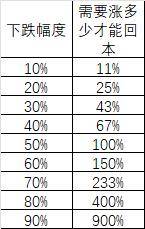
Group 1 - The core message emphasizes the importance of stop-loss strategies and the dangers of high leverage in trading [1][28] - The article discusses how most traders neglect to set stop-loss limits, leading to significant losses when the market turns against them [2][19] - It highlights the asymmetry between gains and losses, where a loss requires a greater percentage gain to recover [17][19] Group 2 - The article provides a table illustrating the percentage increase needed to recover from various levels of loss, showing that a 50% loss requires a 100% gain to break even [6][10] - It explains that effective stop-loss strategies can significantly enhance long-term profitability, even with the same win-loss ratio [11][15] - The discussion includes a comparison of two traders, A and B, demonstrating how better stop-loss management leads to superior outcomes over time [13][14] Group 3 - The dangers of leverage are outlined, indicating that using high leverage can exacerbate the asymmetry of returns, leading to total loss of capital [22][25] - The article references Edward Thorp's mathematical proof that suggests investors should not exceed a leverage ratio of 1.7 to avoid bankruptcy [23][30] - It warns that excessive leverage can lead to irreversible losses, particularly in volatile markets like futures trading [24][27] Group 4 - The conclusion stresses three key points: always set stop-loss limits, avoid high leverage, and recognize the mathematical limits of leverage to prevent financial ruin [28][29][30]
凯利公式告诉我们为什么要分散,分散!!
集思录· 2025-09-05 13:48
Core Viewpoint - The article emphasizes the importance of accurately estimating one's own winning probabilities and odds in investment decisions, highlighting the risks of overconfidence and the potential for significant losses when using the Kelly Criterion improperly [1][2][3]. Group 1: Kelly Criterion and Overconfidence - The Kelly Criterion is a strategy that helps prevent total loss by advising against betting more than a calculated limit based on winning probabilities [1][3]. - Historical data shows that individuals tend to overestimate their winning probabilities, leading to potentially disastrous investment decisions [2][3]. - The article presents statistical findings indicating that as perceived winning probabilities increase, the actual success rates do not correspondingly rise, often resulting in over-leveraging [2]. Group 2: Risk Management and Investment Strategy - It is crucial to avoid full allocation to a single asset, as this exposes investors to excessive risk and potential catastrophic losses due to unforeseen events [4][12]. - Diversification is highlighted as a fundamental principle in risk management, with the understanding that not all investments will perform well simultaneously [5][12]. - The article suggests that using a fraction of the Kelly Criterion (such as half or a quarter) can mitigate risks associated with overconfidence and market volatility [3][11]. Group 3: Practical Investment Insights - The article discusses the challenges of accurately determining the parameters needed for the Kelly Criterion, such as winning probabilities and odds, in real-world scenarios [11][12]. - It emphasizes the need for a multi-strategy approach in investing, combining high-conviction bets with diversified positions to balance risk and reward [12]. - The importance of maintaining liquidity and having additional capital available for potential market corrections is also noted, as it allows for more flexible investment strategies [4][12].

为什么不要加杠杆? | 思考汇
高毅资产管理· 2025-08-29 07:04
Core Viewpoint - Leverage is not a shortcut to wealth but a double-edged sword that amplifies both risks and returns, often leading to significant losses in volatile markets [7][8]. Group 1: The Nature of Leverage - Leverage itself does not create value and is not a low-risk, high-return arbitrage tool [8]. - Leveraged ETFs experience "volatility drag," which erodes returns over time, especially in fluctuating markets [9][28]. - The asymmetry of gains and losses is exacerbated by leverage, making it more challenging to recover from losses [12][17]. Group 2: Risks of Leveraged ETFs - A 3x leveraged ETF can theoretically become worthless if the underlying index drops more than 33.33% in a single day [14]. - The concept of "fixed leverage trap" indicates that after a loss, the base for future leverage is reduced, complicating recovery [17]. - High management fees and tracking errors in leveraged ETFs further diminish returns, akin to physical energy losses [21]. Group 3: Historical Performance and Market Conditions - The 3x leveraged semiconductor ETF (SOXL) has shown impressive annualized returns of over 30% in certain periods, outperforming broader indices like NASDAQ and S&P 500 [23][40]. - However, the extreme volatility and significant drawdowns, such as in 2022, highlight the risks associated with leveraged products [26][40]. - The timing of market conditions is crucial for leveraged investments, making long-term holding risky [27][41]. Group 4: Guidelines for Ordinary Investors - Leverage amplifies both risk and reward, making it essential for investors to approach it with caution [47]. - The long-term viability of investments should focus on value creation rather than merely leveraging returns [53]. - Ordinary investors are advised to avoid heavy leverage and to prioritize survival and long-term investment strategies over short-term gains [55].

在股市里生存的10条黄金法则
雪球· 2025-08-28 08:12
Core Viewpoint - The article presents ten golden rules for survival in the stock market, emphasizing the importance of risk management, independent thinking, and long-term investment strategies [3][4][5][6]. Group 1: Investment Strategies - Avoid using leverage as it amplifies both gains and risks, leading to potential losses [3]. - Focus on understanding industry logic and long-term value rather than relying solely on intelligence or K-line charts [3][4]. - Stay away from penny stocks and companies with poor financial health, as they are likely to face significant downturns [3][4]. Group 2: Market Behavior - Independent thinking is crucial; following market trends or "hot stocks" often leads to losses [4]. - The stock market is likened to gambling, where long-term value investing is seen as a more favorable bet compared to short-term speculation [5][6]. - Recognize that even high-quality stocks can decline in value during bear markets, thus investors should buy low and hold rather than chase high prices [5][6]. Group 3: Investment Timing and Valuation - Emphasize the importance of understanding valuation, market sentiment, and the potential for price appreciation when making investment decisions [5][6]. - The article suggests that while predicting market timing is challenging, focusing on the potential for price movement (space) is more feasible than trying to predict speed or timing [6].

为什么大家都认定现在是牛市?
集思录· 2025-08-26 14:24
Core Viewpoint - The article discusses the complexities and risks associated with investing during a bull market, emphasizing that historical patterns do not guarantee future outcomes and cautioning against excessive leverage [1][4][5]. Group 1: Market Phases and Investor Behavior - The current market phase is debated, with opinions varying on whether it is in the early, middle, or late stages of a bull market [6][7][8]. - Investors are advised to be cautious, as the market can experience significant downturns despite the prevailing bullish sentiment [1][5]. - There is a sentiment that many investors are heavily leveraged, which could lead to substantial losses if the market turns [10][15]. Group 2: Regulatory Environment and Market Sentiment - There are negative signals from the government, such as certain funds reducing their holdings and regulatory scrutiny on speculative trading [4]. - Despite the current bullish market, there is a concern that the absence of cheap stocks and ineffective negative news could indicate a market nearing its peak [6][14]. - The article highlights a strong profit-making effect in the market, suggesting that skepticism about the bull market may stem from inadequate information or flawed reasoning [14][15].