汽车消费

Search documents
汽车股多数上扬 商务部将推进汽车流通消费改革试点 聚焦行业格局及产业趋势变化
Zhi Tong Cai Jing· 2025-11-27 03:55
Group 1 - The automotive stocks mostly rose, with Chery Automobile (09973) up 3.61% to HKD 31.58, GAC Group (02238) up 3.52% to HKD 3.53, Leap Motor (09863) up 3.27% to HKD 52.05, Beijing Automotive (01958) up 3.02% to HKD 2.05, and XPeng Inc. -W (09868) up 1.46% to HKD 83.3 [1] - On November 27, the State Council Information Office held a regular press conference to introduce policies aimed at enhancing the adaptability of supply and demand for consumer goods, with a focus on promoting automotive consumption [1] - The Ministry of Commerce's official stated that commodity consumption is a crucial area for promoting consumption and improving people's livelihoods, with plans to advance automotive circulation reforms, expand used car markets, and develop automotive aftermarket services [1] Group 2 - Everbright Securities released a report indicating that the end-of-year peak season and the reduction of vehicle purchase tax may lead to record high orders by the end of the year, emphasizing the importance of model cycles [1] - The firm forecasts a slight year-on-year decline in domestic passenger vehicle retail sales for 2026, while exports of new energy passenger vehicles are expected to maintain rapid growth, stabilizing overall wholesale sales for the year [1] - CITIC Construction Investment pointed out that the automotive industry has three investment directions: cyclical growth, expansion, and overseas markets, suggesting a focus on industry structure and trends rather than total domestic demand expectations as policy expectations weaken in 2026 [1]

港股异动 | 汽车股多数上扬 商务部将推进汽车流通消费改革试点 聚焦行业格局及产业趋势变化
智通财经网· 2025-11-27 03:42
Group 1 - The majority of automotive stocks have risen, with notable increases in Chery Automobile (up 3.61% to HKD 31.58), GAC Group (up 3.52% to HKD 3.53), and Leap Motor (up 3.27% to HKD 52.05) [1] - The State Council's policy briefing on November 27 highlighted measures to enhance the adaptability of supply and demand in consumer goods, with a focus on promoting automotive consumption through reforms in the automotive circulation market [1] - The Ministry of Commerce plans to expand the second-hand car market and develop automotive aftermarket sectors such as modifications, rentals, events, and RV camping to boost overall automotive consumption [1] Group 2 - Everbright Securities forecasts that the end of 2025 will see a peak in orders due to the reduction of vehicle purchase tax, emphasizing the importance of model cycles [1] - Citic Construction Investment notes that the automotive industry has three investment directions: cyclical growth, expansion, and internationalization, suggesting a shift in focus from domestic demand to industry structure and trends as policy expectations weaken in 2026 [1]
商务部:将推进汽车流通消费改革试点,全链条扩大汽车消费
Zheng Quan Shi Bao Wang· 2025-11-27 02:48
人民财讯11月27日电,11月27日,国新办举行国务院政策例行吹风会,介绍增强消费品供需适配性进一 步促进消费政策措施有关情况。商务部市场运行和消费促进司负责人杨枿表示,商品消费是促消费惠民 生的重要领域,下一步商务部将推进汽车流通消费改革试点,扩大二手车流通,拓展汽车改装、租赁、 赛事、房车露营等汽车后市场,全链条扩大汽车消费。 ...
商务部:将推进汽车流通消费改革试点 全链条扩大汽车消费
Zheng Quan Shi Bao· 2025-11-27 02:44
(文章来源:证券时报) 11月27日,国新办举行国务院政策例行吹风会,介绍增强消费品供需适配性进一步促进消费政策措施有 关情况。商务部市场运行和消费促进司负责人杨枿表示,商品消费是促消费惠民生的重要领域,下一步 商务部将推进汽车流通消费改革试点,扩大二手车流通,拓展汽车改装、租赁、赛事、房车露营等汽车 后市场,全链条扩大汽车消费。 ...
港股异动丨汽车股走低 小鹏汽车绩后跌超8% 长城汽车跌2.6%
Ge Long Hui· 2025-11-18 01:59
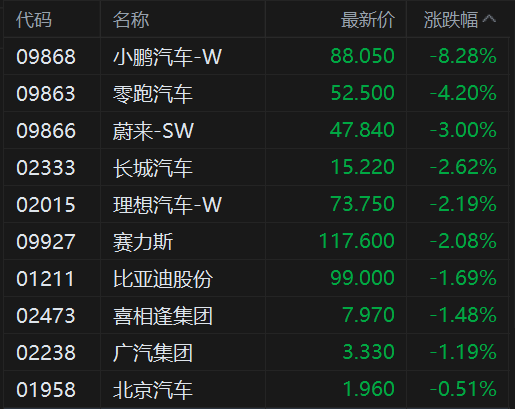
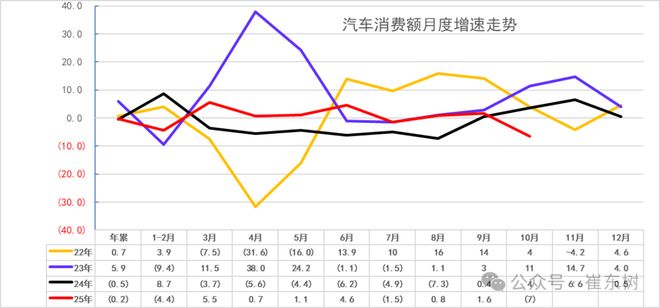
Core Viewpoint - The Hong Kong automotive stocks are experiencing a continuous decline, with significant drops in shares of various companies following the earnings report of XPeng Motors, which reported a larger-than-expected loss and lower-than-expected revenue growth [1] Group 1: Company Performance - XPeng Motors reported Q3 revenue of 20.38 billion yuan, a year-on-year increase of 102%, but below the market estimate of 20.45 billion yuan; adjusted loss per share was 0.080 yuan [1] - The gross margin for the quarter was 20.1%, an increase of 4.8 percentage points compared to the same period in 2024 [1] - XPeng Motors expects Q4 revenue to be between 21.5 billion and 23 billion yuan, representing a year-on-year increase of approximately 33.5% to 42.8% [1] Group 2: Market Trends - In October, the total retail sales of consumer goods reached 46.291 billion yuan, a year-on-year increase of 2.9%; however, automotive consumption was 4.255 billion yuan, a year-on-year decline of 7% [1] - From January to October, automotive consumption totaled 40.009 billion yuan, showing a slight year-on-year decline of 0.2% [1] Group 3: Stock Performance - XPeng Motors shares fell by 8.28% to 88.050 yuan, making it the weakest performer among automotive stocks [2] - Other companies also saw declines, with Li Auto down 2.19%, NIO down 3.00%, and BYD down 1.69% [2]


10月汽车消费额同比降7%
第一财经· 2025-11-17 09:50
Group 1 - The core viewpoint of the article highlights a decline in automotive consumption in October 2025, with a total consumption amount of 425.5 billion yuan, representing a year-on-year decrease of 7% [1] - From January to October, the total automotive consumption reached 4,000.9 billion yuan, showing a slight year-on-year decline of 0.2% [1] - Despite the drop in consumption, automotive production and investment have experienced year-on-year growth, with production reaching 27.33 million vehicles, an increase of 11% [1] Group 2 - Automotive investment has seen a significant year-on-year growth rate of 17.5%, marking a historical high for the period from January to October in recent years [1] - The investment growth in the automotive sector is notably higher than that of other manufacturing industries [1]

10月汽车消费额同比降7%
Di Yi Cai Jing· 2025-11-17 09:10
Group 1 - The core viewpoint of the article indicates a decline in automotive consumption in October 2025, with a total consumption amount of 425.5 billion yuan, representing a year-on-year decrease of 7% [1] - From January to October, the total automotive consumption reached 4,000.9 billion yuan, showing a slight year-on-year decline of 0.2% [1] - Despite the drop in consumption, automotive production and investment have experienced year-on-year growth, with production volume reaching 27.33 million vehicles, an increase of 11% [1] Group 2 - Automotive investment has seen a significant year-on-year growth rate of 17.5%, marking a historical high for the period from January to October in recent years [1] - The investment growth in the automotive sector is notably higher than that of other manufacturing industries [1]
崔东树:1-10月新能源汽车生产同比增28% 渗透率46%
Zhi Tong Cai Jing· 2025-11-17 07:57
Core Insights - The automotive industry in China is experiencing a significant recovery, with a notable increase in production and investment, despite challenges in the broader economic environment [1][2][19]. Investment Trends - Fixed asset investment (excluding rural households) in China for January to October 2025 reached 408,914 billion yuan, a year-on-year decrease of 1.7% [19]. - Automotive investment growth for the same period was 17.5%, significantly higher than other manufacturing sectors [19]. Production and Sales Performance - In October 2025, total automotive production was 328,000 units, reflecting an 11% year-on-year increase [17]. - From January to October 2025, automotive production totaled 27.33 million units, also up 11% year-on-year [17]. - New energy vehicle (NEV) production reached 1.267 million units from January to October 2025, marking a 28% increase year-on-year, with a penetration rate of 46% [17]. Consumption Patterns - Automotive consumption in October 2025 saw a year-on-year decline of 7%, while the consumption amount from January to October 2025 decreased by 0.2% [4][27]. - The overall automotive consumption has increased from 3.94 trillion yuan in 2020 to 5.03 trillion yuan in 2024, indicating a recovery from previous years [4][27]. Economic Context - The external environment remains complex, with rising unilateralism and protectionism impacting supply chains [2]. - The real estate market's downturn has positively influenced automotive consumption, alleviating previous pressures on consumer spending [23][25]. Future Outlook - The automotive industry anticipates continued growth, supported by policies aimed at stimulating demand, such as tax reductions for car buyers and incentives for purchasing new energy vehicles [2][19].
铸造铝合金产业链周报-20251102
Guo Tai Jun An Qi Huo· 2025-11-02 11:47
Report Industry Investment Rating No relevant content provided. Core Viewpoints - This week, the price of cast aluminum alloy showed a volatile and upward trend, reaching a high of 20,920 yuan/ton during the week. With the end - of - year sales push in the automotive industry, the seasonal performance in the fourth quarter may be stronger. Considering the cancellation of tax - refund policies and the tight supply of scrap aluminum, the cost increase will strongly support the price. It is expected that the price of cast aluminum alloy will be volatile and upward in the short term, and the long - term view is bullish, suggesting looking for buying opportunities on dips [7]. - As of October 31, the combined inventory of aluminum alloy ingot factories and social warehouses decreased by 0.38 tons to 13.22 tons compared with the previous week, indicating a possible inflection point in inventory. The "trade - in" policy has been effective, and the fourth - batch of funds was advanced in late September, which is conducive to stabilizing consumer confidence and boosting automobile consumption. With the end - of - year sales push in the automotive industry, automobile sales are expected to improve month - on - month [7]. Summary by Directory 1. Transaction End - Volume and Price - Relevant data on trading volume, open interest, and capital precipitation are presented, but no specific conclusions are drawn from the data [10]. 2. Transaction End - Arbitrage 2.1 Inter - period Positive Arbitrage Cost Calculation - The cost of inter - period positive arbitrage for cast aluminum alloy was calculated. The fixed cost was 20.80 yuan/ton, the floating cost was 65.03 yuan/ton, and the total cost was 86 yuan/ton [13]. 2.2 Spot - Futures Arbitrage Cost Calculation - The cost of spot - futures arbitrage for cast aluminum alloy was calculated. The spot price was 20,800 yuan/ton, and the total cost of the warehouse receipt was 21,016.9 yuan/ton [15]. 3. Supply End - Scrap Aluminum - Scrap aluminum production is at a high level, and social inventory is continuously decreasing [17]. - Scrap aluminum imports are at a high level, with a relatively fast year - on - year growth rate. In September 2025, the import volume was 15.54 tons, a year - on - year increase of 17.69% [20]. 4. Supply End - Recycled Aluminum - The price of Baotai ADC12 has been slightly adjusted upwards, and the spread between recycled and primary aluminum has been volatile. The regional spread of cast aluminum alloy shows certain seasonal patterns [37][39]. - The weekly operating rate of recycled aluminum alloy has declined, while the monthly operating rate has increased. The monthly output of recycled aluminum alloy and its regional proportion are presented [44][47][49]. - The cost of ADC12 is mainly composed of scrap aluminum, and it is currently around the break - even point. The factory and social inventories of cast aluminum alloy have decreased, and the import window is temporarily closed [50][55][60]. - The production and inventory of recycled aluminum rods and their regional proportions are presented [63][64][66]. 5. Demand End - Terminal Consumption - Fuel - powered vehicles have entered the end - of - year sales push phase, which will drive die - casting consumption [69].
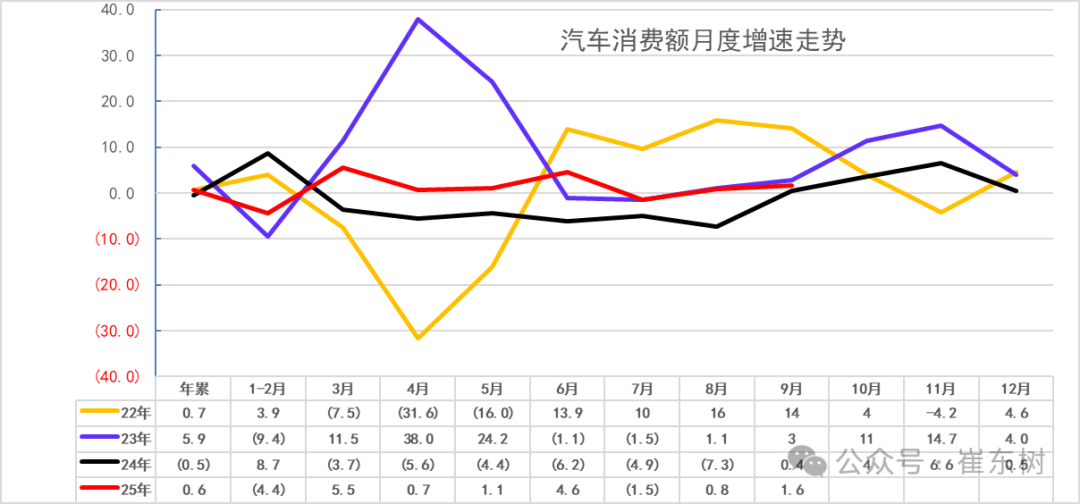
崔东树:1—9月汽车消费额同比增1% 车市需要有持续政策支持
智通财经网· 2025-10-20 22:37
Core Insights - The automotive industry in China is experiencing a strong recovery, driven by the implementation of vehicle replacement policies and a significant increase in new energy vehicle production [1][2][5] Group 1: Automotive Consumption - In September 2025, the total retail sales of consumer goods reached 41,971 billion yuan, with automotive consumption accounting for 4,711 billion yuan, a year-on-year increase of 2% [1][28] - From January to September 2025, total retail sales of consumer goods amounted to 365,877 billion yuan, growing by 4.5%, while automotive consumption reached 35,923 billion yuan, a year-on-year increase of 1% [1][28] - Since the decline of the real estate market in 2021, automotive consumption has risen from 3.94 trillion yuan in 2020 to 5.03 trillion yuan in 2024, indicating a recovery from previous stagnation [5][26] Group 2: Automotive Production - In September 2025, automotive production reached 3.23 million units, a year-on-year increase of 14%, with new energy vehicles accounting for 1.58 million units produced, up 20% [1][19] - From January to September 2025, total automotive production was 24.05 million units, an 11% increase year-on-year, with new energy vehicles at 1.096 million units, a 30% increase [1][19] - The penetration rate of new energy vehicles in September 2025 reached 49%, up from 46% in the same period last year [1][19] Group 3: Investment Trends - In the first nine months of 2025, automotive investment grew by 19.2%, significantly outpacing the overall industrial investment growth of 6.4% [21][22] - The automotive investment in 2025 is at its highest level in six years, indicating a strong recovery in the sector [22] Group 4: Economic Context - The external environment remains complex, with challenges such as unilateralism and protectionism impacting supply chains, while domestic economic recovery is still fragile [2] - The automotive industry is expected to face significant pressure in 2026, necessitating long-term supportive policies to sustain growth [2][26]