猪价走势

Search documents
山东猪价上涨,反弹能持续多久,后市走势成谜?
Da Zhong Ri Bao· 2026-01-09 06:58
Core Viewpoint - The recent increase in pig prices in Shandong Province is attributed to a decline in pig slaughter numbers and rising demand during the New Year holiday season [1] Group 1: Price Trends - The average price for fat pigs in the first week of the new year was 12.57 yuan per kilogram, showing a year-on-year decrease of 21.97% but a week-on-week increase of 6.44% [1] - The average price for pork in the province was 22.38 yuan per kilogram, reflecting a year-on-year decrease of 20.30% and a week-on-week recovery of 3.85% [1] - The average price for piglets currently stands at 21.65 yuan per kilogram, which is a year-on-year decrease of 31.23% but a week-on-week increase of 1.17% [1] Group 2: Market Dynamics - The primary factors influencing the recent rise in pig prices include a reduction in pig slaughter and increased demand due to the New Year holiday [1] - The market is expected to maintain a stable yet slightly declining price trend, with narrow fluctuations anticipated [1] - Despite the recovery in pig prices, the supply side still faces challenges such as excess production capacity and concentrated slaughtering [1] Group 3: Consumption Patterns - Post-New Year, fresh pork demand is expected to weaken, leading to a potential reduction in orders from slaughter enterprises [2] - Changes in consumer preferences are impacting pork consumption, with a growing demand for fresh pork and a decline in demand for high-salt, high-fat cured products [2] - The upcoming Spring Festival in mid-February may limit the immediate demand for pigs, as the peak stocking period has not yet begun [2] Group 4: Industry Recommendations - Industry stakeholders are advised to monitor the real-time impact of policies on the market, as well as factors such as the rhythm of secondary fattening, price differentials, and slaughter weights [2]


大越期货生猪期货早报-20260105
Da Yue Qi Huo· 2026-01-05 03:05
1. Report Industry Investment Rating - The report does not provide an overall industry investment rating. 2. Core Viewpoints - The pig market is expected to see an increase in both supply and demand this week, with short - term price fluctuations and a mid - term range - bound pattern. The price of live pigs is expected to rise first and then fall, remaining within a certain range. The LH2603 contract is expected to oscillate between 11,600 and 12,000 [10]. 3. Summary by Directory 3.1 Daily Prompt - The fundamentals suggest that supply of pigs and pork will increase due to secondary fattening and demand for cured meat. Demand may improve slightly but remains pessimistic overall. The market is expected to have a short - term upward trend and mid - term range - bound movement. Attention should be paid to the monthly slaughter rhythm of large farms and the dynamics of the secondary fattening market. The overall view is neutral [10]. - The basis shows that the national average spot price is 12,670 yuan/ton, and the basis of the 2603 contract is 875 yuan/ton, with the spot price at a premium to the futures price, indicating a bullish signal [10]. - Inventory data as of September 30 shows that the pig inventory was 436.8 million heads, a 0.2% month - on - month and 2.3% year - on - year increase; the sow inventory was 40.35 million heads, a 0.01% month - on - month increase and 0.66% year - on - year decrease, suggesting a bearish signal [10]. - The price is above the 20 - day moving average and trending upwards, which is a bullish sign [10]. - The net position of the main players is short, and short positions are increasing, indicating a bearish signal [10]. - The short - term outlook is that the supply and demand of live pigs will increase, and the price is expected to rise first and then fall, remaining within a range, with the LH2603 contract oscillating between 11,600 and 12,000 [10]. 3.2 Recent News - The domestic pig consumption market is affected by the approaching peak season, with an increase in secondary fattening in the south and a decrease in slaughter. The supply is expected to increase, and the spot price is likely to rebound in the short term and remain range - bound in the mid - term [12]. - With the arrival of the demand for cured meat at the end of the year, the pig market is entering a stage of high supply and demand. However, the short - term price increase may be limited, and the price may fall back to a range - bound pattern [12]. - The pig farming profit has shifted from losses to small fluctuations, but still remains in the red. The enthusiasm for slaughtering large pigs has increased in the short term, supporting the short - term price of pig futures and spot [12]. - The spot price of live pigs has stopped falling and stabilized, and the futures price is expected to rise in the short term and remain range - bound in the mid - term. Further observation of supply and demand growth is needed [12]. 3.3 Bullish and Bearish Factors - Bullish factors include the entry of the domestic pig supply into the peak season at the end of the year and the limited potential for further decline in the domestic pig spot price [14]. - Bearish factors are the expected improvement in the domestic macro - environment due to the initial Sino - US trade agreement and the year - on - year increase in domestic pig inventory [14]. 3.4 Fundamental Data - The report presents various data on pig prices, including futures prices, spot prices, and price differentials. It also shows the trends of different pig - related prices over time, such as the basis, price spreads between different contracts, and the average prices of different pig specifications [15][16][18]. - On the supply side, it covers data on pig inventory (including different scales and types), import volume, breeding costs, feed profit expectations, slaughter volume, and profit margins. For example, as of March 31, the pig inventory was 408.5 million heads, a 5.9% month - on - month and 5.2% year - on - year decrease; as of May 2024, the sow inventory was 39.96 million heads, a 0.2% month - on - month increase and 6.2% year - on - year decrease [28][29]. - On the demand side, it includes data on consumption trends, slaughter demand, and the relationship between pig and substitute meat prices [61][63]. - The report also analyzes the pig - grain ratio and the situation of pig reserve purchases and releases [64][68]. 3.5 Position Data - The report does not explicitly provide detailed position data other than stating that the main players' net position is short and short positions are increasing [10].
供需错配支撑12月月末猪价翘尾 1月或仅在月初出现错配情况
Xin Lang Cai Jing· 2026-01-05 01:27
Core Viewpoint - The demand for large pigs is gradually increasing, but the early market release of large pigs has led to a mismatch in supply and demand at the end of the month, significantly supporting pig prices [1][4]. Supply and Demand Analysis - In December, the initial bearish expectations for pig prices were based on the assumption of increased supply from the breeding sector and insufficient demand [1]. - The accelerated release of pigs from the supply side, combined with strong market absorption capacity, initially led to a stalemate in supply and demand [1]. - As the breeding sector's release gradually declined and demand for cured meat increased, the supply gap for large pigs widened, supporting a rapid price increase [1][2]. Price Trends - From December 26 to 30, the national average price of lean pigs rose from 11.63 yuan/kg to 12.47 yuan/kg, an increase of 0.84 yuan/kg, primarily due to the supply-demand mismatch in the large pig market [2]. - As of December 30, the national average price was 11.52 yuan/kg, with a slight decrease of 0.54% month-on-month, indicating that the price drop was less than expected [1]. Regional Price Differences - Provinces with prices significantly above the national average include Zhejiang, Guangdong, Jiangsu, Sichuan, and Chongqing, primarily in consumption areas, while provinces with lower prices include Guangxi, Jilin, Guizhou, and Hunan, primarily in production areas [1]. Supply-Demand Dynamics for January - The theoretical supply of pigs in January is expected to slightly decline, but the actual supply may increase due to the potential for early release of pigs from the breeding sector [4]. - The demand in January is anticipated to be concentrated in northern regions, particularly in central areas like Henan, Shandong, Hebei, Jiangsu, and Anhui, while southern demand is expected to decrease [4][6]. Market Outlook - The market may initially experience a slight supply shortage in January, followed by an improvement in the supply-demand relationship, leading to a potential price increase followed by a slight decrease before a final uptick [6]. - The transfer of market power from southern to central regions is expected as the supply-demand dynamics evolve [6].
涨涨涨!1月的猪还能涨,能涨多高?
Sou Hu Cai Jing· 2026-01-01 07:18
Group 1 - The core viewpoint is that pig prices have increased significantly since the end of December, reaching an average of 12 yuan/kg by January 1, 2026, indicating a successful price rise during the New Year period [2] - There is ongoing debate in the market regarding whether pig prices can continue to rise in January, with some believing that prices may drop after the holiday stockpiling ends [2] - The main driver of the recent price increase is the heightened sentiment among farmers to hold back pigs from market, influenced by weak market conditions and the upcoming Spring Festival [4] Group 2 - Consumer demand for pork is gradually increasing, with many taking advantage of lower prices to stock up, which provides some support for pig prices [6] - Despite the increase in consumer demand, there is a significant supply of pigs, with slaughter numbers in November showing a year-on-year increase of 17.4% [7] - From January to November, the total number of pigs slaughtered reached 36.246 million, a year-on-year increase of 19.3%, indicating ongoing supply pressure [8] Group 3 - There is a concern that the current stockpiling behavior may lead to a slowdown in future consumer demand, as it effectively preempts later consumption [10] - Although there is potential for prices to exceed the highs seen in October, the risk of increased selling from farmers may limit further price increases [10]
二师兄果然支棱起来了!好消息:还要继续涨!
Sou Hu Cai Jing· 2025-12-29 12:31
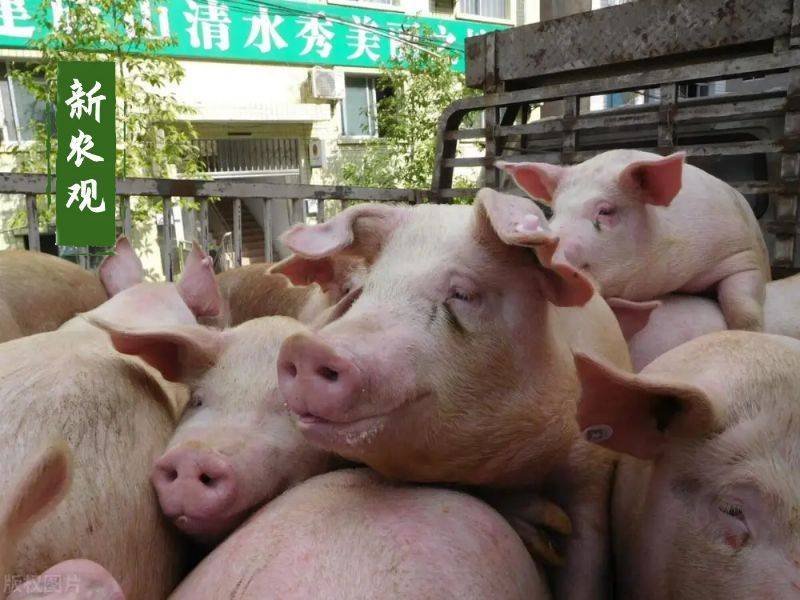
马上就要元旦了,二师兄果然支棱起来了。 之前我们说,猪价可能会有两个机会,一个就是春节,一个就是元旦。 现在来看,元旦猪价上涨,正在应验。 那么,为啥冬至没涨起来,而仅相隔十来天的元旦却涨起来了呢? 原因就两个字:缺猪。 是的,没听错,不过确切的说,缺的不是标猪,而是中大猪。 今年的猪确实不少,也一度压得养殖端喘不过气来,尤其是11月份一直阴跌,使得养殖端出栏明显提速。 再加上饲料涨价,养殖端的压力就更大,于是中大猪出栏提升。 在这么一通操作之后,中大猪的压力就明显减轻了,不少二次育肥户出现了空栏现象。 而随着时间的推移,一是气温开始下降了,北方多地终于迎来再次降温,猪肉消费明显有抬头迹象。 而南方的腌腊也稀稀拉拉地拖到了月底,再加上临近元旦,节日备货增加,于是猪肉消费整体提升。 再加上月底集团厂出栏缩量,于是在中大猪的带领下,猪价整体上移。 目前,全国生猪均价已贴近12元/公斤(由于统计方法不同,部分机构统计猪价已经超过12元/公斤了)。 随着猪价上涨,大家又开始关心另一个问题,那就是猪价能涨多久?到春节前会一直涨吗? 从总趋势上来看,我认为猪价是呈上升趋势的。 一方面,进入1月份以后,距离春节就更近了,消 ...
大越期货生猪期货早报-20251229
Da Yue Qi Huo· 2025-12-29 02:11
交易咨询业务资格:证监许可【2012】1091号 生猪期货早报 2025-12-29 大越期货投资咨询部:王明伟 从业资格证号:F0283029 投资咨询资格证号:Z0010442 联系方式:0575-85226759 1 重要提示:本报告非期货交易咨询业务项下服务,其中的观点和信息仅作参考之用,不构成对任何人的投资建议。 我司不会因为关注、收到或阅读本报告内容而视相关人员为客户;市场有风险,投资需谨慎。 CONTENTS 目 录 ✸生猪观点和策略 生猪: 1. 基本面:供应方面,近期国内南方生猪二次育肥有所上升,出栏短期减少支撑生猪价格,加上腊肉 和灌肠需求释放,预计供给猪、肉双增。需求方面,国内宏观环境预期有所回升,北方腊肉需求逐 渐释放支撑价格底部,但未来整体消费仍不乐观。综合来看,预计本周市场或供需双增、猪价短期 震荡回升中期或维持区间震荡格局。关注月底集团场出栏节奏变化、二次育肥市场动态变化情况。 中性。 2. 基差:现货全国均价11520元/吨,2603合约基差125元/吨,现货贴水期货。偏空。 3. 库存:截至9月30日,生猪存栏量43680万头,环比增加0.2%,同比增加2.3%;截至9月末, ...
数据出来了,今年的猪价真是一言难尽!
Sou Hu Cai Jing· 2025-12-27 07:15
但为啥猪价没啥反应呢? 原因出在消费上。 市场都说消费不及预期,其实今年猪肉消费还可以,一方面是宏观经济在慢慢恢复,另一方面呢,就是今年的猪肉确实便宜。 所以其实腌腊、灌肠的也并不是特别弱,而且有部分肉店反映,有的已经开始囤过年的猪肉了。原因就是因为现在猪肉价格便宜,担心后续大家都开始囤 货,肉价就会上涨。 所以你看,这个消费并不是没有,而是分散了。 现在就有囤肉的了,过年肯定就要少囤了,里外里这个消费就变得不那么集中了。 所以现在虽然标肥价差有走扩的迹象,但是下游消费量还没起来,猪价也就涨得墨墨叽叽的。 盼了好几天,终于官方11月的数据出来了,不过产能数据还没出来,但是生猪定点屠宰量出来了。 11月全国生猪定点屠宰量为3957万头,环比10月份增长了3.2%,同比则增长了17.4%。 单看这两个数据其实都不算高,因为之前几个月,无论是环比还是同比,增幅都要更高。 但现在已经是11月的数据了,12月预计也依然是增量的趋势,所以全年看下来,今年的猪那真叫一个多啊。 猪多,就是生猪市场最大的压力,所以猪价想抬头,那叫一个费劲。 不过经过前一轮的卖猪以后,市场也出现了一些空隙,就是所谓的中大猪出多了,现在有点不够了 ...
标肥价差开始走扩了,猪价真要涨?
Sou Hu Cai Jing· 2025-12-25 12:31
Group 1 - The core viewpoint is that pig prices are entering an upward trend, driven by reduced supply and expanding price differentials in the market [2][7] - The upcoming opportunities for pig price increases are identified as the New Year and pre-Spring Festival periods, with the latter expected to have a more significant impact on demand [3][5] Group 2 - Factors contributing to increased consumption include lower temperatures, which are expected to boost pork consumption as winter progresses [5] - There are three waves of consumption anticipated: the first wave is related to traditional cured meats, the second wave is for New Year celebrations, and the third wave is for the Spring Festival, which is expected to drive demand significantly [5][7] - The trend of secondary fattening is rising, with an increase in the outflow of medium and large pigs, as farmers anticipate higher prices due to increased demand leading up to the Spring Festival [7][9] - Market sentiment remains weak, but there is an expectation that pig prices will stabilize and begin to rise steadily soon [9]

高瞻远“猪”:2025年猪价震荡下滑 2026年能否有起色?
Xin Lang Cai Jing· 2025-12-24 03:17
热点栏目 自选股 数据中心 行情中心 资金流向 模拟交易 客户端 卓创资讯生猪行业分析师邹莹吉 【导语】2025年猪价呈震荡下滑态势,年内产能释放推高出栏量,而需求增幅有限,难以形成有效支 撑。展望2026年,生猪供应仍较充裕,需求变动相对被动,预计猪价前低后高,二季度有望出现重要转 折点。 2025年猪价震荡下滑 截至12月22日,卓创资讯监测2025年全国瘦肉型生猪均价平均为13.80元/公斤,同比降低17.66%,年内 呈降后横盘稳定再震荡下滑态势。其中,最高价为1月4日的16.36元/公斤,最低价为10月13日的10.72 元/公斤。2025年产能释放,生猪出栏量增加,需求增幅有限,导致猪价同比下跌。其中,一、二季度 肥标价差高位,养殖端压栏挺价,猪价降后横盘稳定。二季度末之后,肥标价差缩小、养殖端产能释 放,同时政策层面降体重、禁二育、减产能等要求,养殖端出栏节奏加快,猪价震荡下滑。 2025年生猪出栏量增加 利空猪价 按照生猪繁育周期推算,2025年1-11月的生猪出栏量是由2024年3月到2025年1月份的能繁母猪存栏量决 定的,卓创资讯监测此阶段内196家样本企业能繁母猪平均为852.64万头 ...

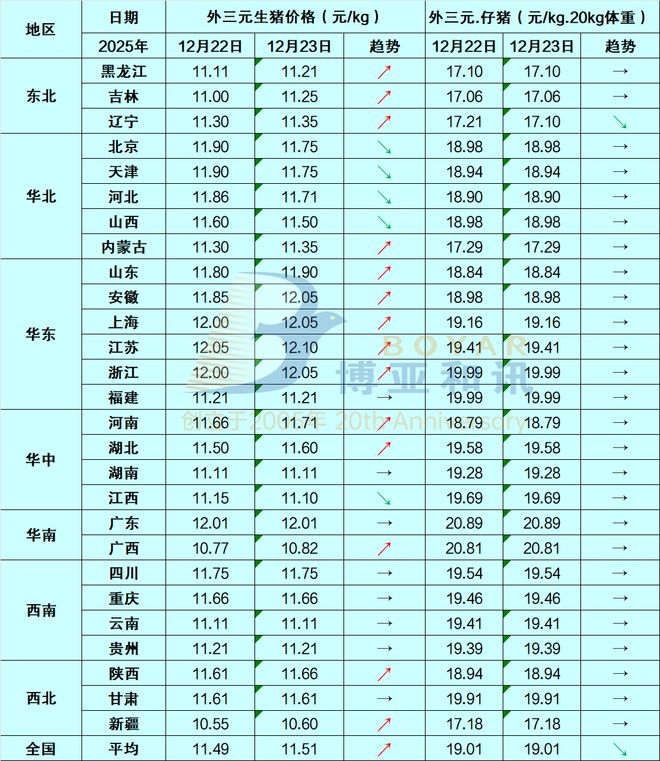
【BOYAR监测】生猪市场每日简评【12.23】
Xin Lang Cai Jing· 2025-12-23 10:27
Group 1 - The average price of external three-yuan pigs in China on December 23, 2025, is 11.51 yuan/kg, an increase of 0.02 yuan/kg from the previous day [1] - The average price of piglets is 19.01 yuan/kg, remaining stable compared to the previous day [1] - The average price of white strip meat is 15.58 yuan/kg, a decrease of 0.12 yuan/kg from the previous day [1] Group 2 - The market for pig prices is experiencing slight fluctuations, with northern regions showing stronger adjustments while eastern China sees minor declines [2] - The demand for fresh pork has increased due to the winter solstice holiday, leading to a recovery in the price difference between live pigs and white strip meat [2] - Market sentiment is slightly improving due to better consumption, with farmers reluctant to sell at low prices, and slaughterhouses are passively raising procurement prices [2]