电动汽车

Search documents
盘后股价飙涨15%!Rivian第四季度亏损低于预期!营收超预期!
美股IPO· 2026-02-12 23:58
Core Viewpoint - Rivian Automotive Inc. reported better-than-expected fourth-quarter revenue, leading to a 12.7% increase in stock price during after-hours trading, despite a significant decline in vehicle sales compared to the previous year [1]. Group 1: Financial Performance - The company reported fourth-quarter revenue of $1.29 billion, slightly above analyst expectations of $1.27 billion [3]. - Adjusted earnings per share were -$0.70, marginally better than the expected -$0.71 [3]. - Total revenue decreased from $1.73 billion in the same quarter last year, with automotive revenue dropping 45% to $839 million, primarily due to a $270 million reduction in regulatory credit sales and the expiration of tax credits affecting vehicle deliveries [3]. Group 2: Operational Highlights - Rivian produced 10,974 vehicles and delivered 9,745 in the quarter at its manufacturing facility in Normal, Illinois [4]. - The company’s software and services segment showed strong performance, with revenue more than doubling to $447 million from $214 million year-over-year [3]. Group 3: Future Outlook - Rivian provided guidance for 2026, expecting vehicle deliveries between 62,000 and 67,000 units, with capital expenditures projected between $1.95 billion and $2.05 billion [4]. - The manufacturing progress of the R2 model is on track, with initial customer deliveries expected to begin in the second quarter of 2026 [4]. Group 4: Cash Position - As of the end of 2025, Rivian had $6.08 billion in cash, cash equivalents, short-term investments, and restricted cash [5].



纳微半导体氮化镓芯片获进展,股价受板块压力回调
Jing Ji Guan Cha Wang· 2026-02-12 22:48
Group 1 - Company has made significant progress in the gallium nitride (GaN) chip sector, collaborating with Powerchip Semiconductor Manufacturing Corp. to advance the mass production of 8-inch silicon-based GaN products, with a 100V series expected to achieve mass production in the first half of 2026 [1] - The 650V product's foundry process is anticipated to shift from TSMC to Powerchip within the next 12-24 months to enhance supply capabilities for AI data centers and electric vehicles [1] - Ongoing collaboration with NVIDIA on the development of an 800V high-voltage direct current architecture is expected to create new opportunities in the high-power application market [1] Group 2 - On February 10, 2026, the company's stock price experienced a significant decline of 4.66%, closing at $8.79, primarily due to overall pressure on the semiconductor sector and macroeconomic data expectations [2] - The stock showed notable volatility, with a 19.25% rebound on February 6, followed by a correction, resulting in a price of $8.75 as of February 12, indicating a total price fluctuation of 23.54% [2] - The current price-to-earnings ratio is negative, indicating that the company is still in a loss-making state [2] Group 3 - In February 2026, nine institutions covered the company, with 22% recommending buy or hold, and 67% suggesting hold, indicating a cautious outlook [3] - The average target price is set at $8.28, with a high target of $13.00 and a low of $4.20 [3] - Earnings forecast for Q4 2025 predicts a loss of $0.053 per share, reflecting a year-on-year increase of 13.11%, while revenue is expected to decline by 63.51%, highlighting concerns over profitability improvement and order fulfillment progress [3]
福特汽车2025年净亏81.8亿美元,大众搁置美国建厂计划
Jing Ji Guan Cha Wang· 2026-02-12 19:02
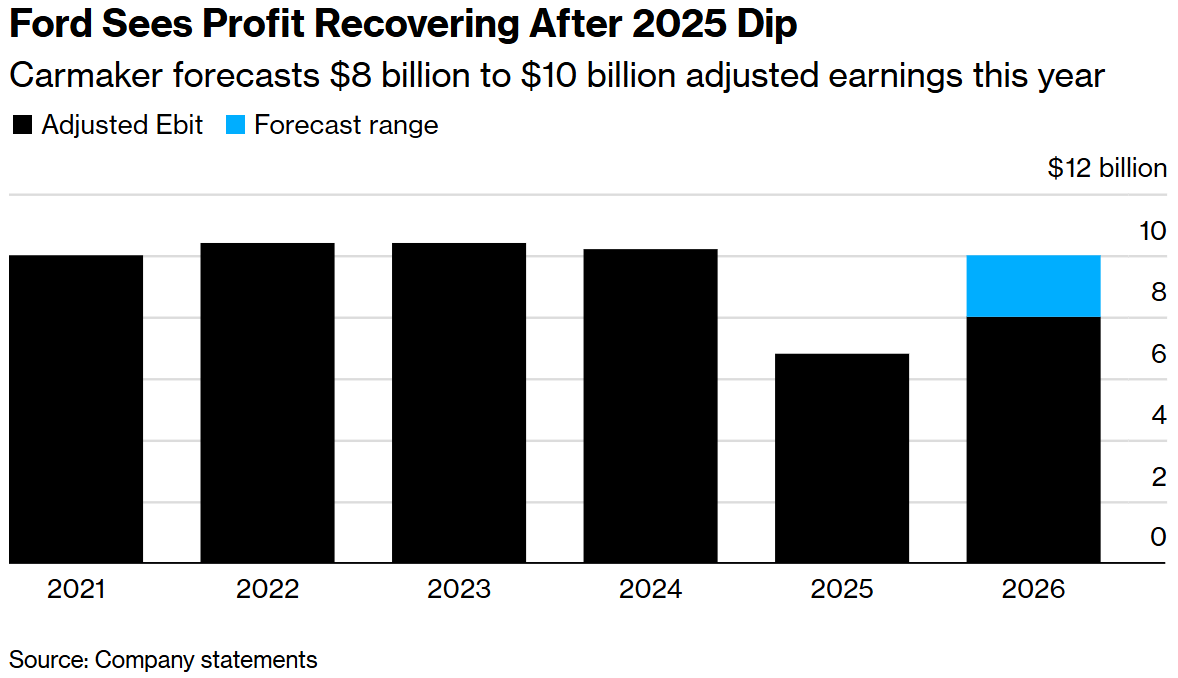
Group 1: Core Insights - The impact of Trump's tariff policy continues to affect the U.S. automotive manufacturing industry, with Volkswagen suspending its plan to build a new Audi factory in the U.S. due to tariffs, freezing a project worth over $4 billion, and potentially canceling it if tariffs are not reduced [1] - Ford is actively seeking partnerships with Chinese automakers to address transformation challenges, indicating a trend of reliance on the Chinese supply chain [2] Group 2: Financial Performance - Ford reported a revenue of $187.3 billion for 2025, a slight increase of 1.23% year-over-year, but recorded a net loss of $8.182 billion, marking a shift from profit to loss and the lowest in nearly five years [3] - The fourth quarter loss was $11.1 billion, primarily due to impairments in the electric vehicle business and rising costs, with expectations for adjusted EBIT in 2026 to be between $8 billion and $10 billion, and projected losses in the electric vehicle segment to be between $4 billion and $4.5 billion [3]

商务部回应欧盟批准对一款中国品牌SUV免征关税
Xin Hua She· 2026-02-12 07:18
Core Viewpoint - The European Commission has approved a tariff exemption for a Chinese-manufactured Volkswagen SUV, which will now be imported under a minimum price and quota system, indicating a significant development in China-EU trade relations in the electric vehicle sector [1] Group 1: China-EU Cooperation - The Chinese Ministry of Commerce expressed support for electric vehicle manufacturers to negotiate case-by-case with the EU, highlighting the importance of dialogue and cooperation [1] - Previous negotiations between China and the EU have led to a "soft landing" for the electric vehicle case under WTO rules, which has been positively received by the international community and various industries [1] - Both parties have agreed to utilize price commitments effectively, with the EU issuing guidance documents based on the outcomes of these negotiations [1] Group 2: Market Environment - The Chinese side hopes that the EU will implement the important consensus reached during the China-EU leaders' meeting and the results of the case negotiations, fostering a stable and open market environment for industry development [1] - There is an expectation for more Chinese companies to reach agreements with the EU regarding price commitments, indicating a potential increase in bilateral trade and collaboration in the automotive sector [1]
美股尾盘 彭博电动汽车价格回报指数涨1.32%
Mei Ri Jing Ji Xin Wen· 2026-02-11 21:51
Group 1 - The Bloomberg Electric Vehicle Price Return Index increased by 1.32%, closing at 3662.78 points [1] - SQM, a Chilean chemical and mining company, saw a stock price increase of 7.1% [1] - US-based Albemarle Corporation's stock rose by 4.3% [1] - Xiaomi Group's H-shares closed up by 4.27% [1] - STMicroelectronics' stock in Europe increased by 2.92% [1] - Hesai Technology's stock declined by 6.2% [1] - Lucid Group's stock fell by 8.3% [1]






亚德诺产品涨价与业绩超预期,股价持续上涨
Jing Ji Guan Cha Wang· 2026-02-11 14:38
Core Viewpoint - Analog Devices (ADI.US) has implemented a price adjustment across its product range, with financial performance exceeding expectations, driven by clear signals from the end market, leading to active stock performance and updated institutional views [1] Recent Events - Analog Devices announced a price increase effective February 1, 2026, with an overall increase of approximately 15%, and nearly a thousand military-grade products seeing increases of up to 30% to address global inflation pressures. This adjustment may impact supply chain costs and customer orders [2] Performance and Operating Conditions - For the fourth fiscal quarter of 2026 (ending November 1, 2025), the company reported a revenue increase of 26% year-over-year to $3.076 billion, with Non-GAAP earnings per share rising 35% to $2.26. The revenue outlook for the first fiscal quarter of 2026 is projected at $3.1 billion (with a fluctuation of $100 million), surpassing market expectations and highlighting a recovery in demand for analog chips [3] Industry Conditions - The integration of electric vehicles, industrial automation, and artificial intelligence continues to drive growth. In the fourth fiscal quarter of 2026, automotive revenue increased by 19% year-over-year to $852 million, while industrial revenue rose by 34% to $1.43 billion. This trend may serve as a key observation point for industry recovery [4] Recent Stock Performance - On February 2, 2026, Analog Devices' stock price was $316.86, with a trading volume of $1.165 billion. The stock has increased by 49.54% over the past 52 weeks, indicating high market attention [5] Institutional Views - Several institutions, including Baird, raised their target price to $275 in November 2025, expressing optimism about the company's growth prospects in the industrial and communications sectors, while noting that macroeconomic uncertainties could impact future performance [6]

美财长一句话摊牌,中美划时代变化就在眼前,马斯克做出神预测!
Sou Hu Cai Jing· 2026-02-11 10:45
Group 1 - The recent victory of Japan's ruling coalition in the House of Representatives elections has elevated the political stature of Kishi Sanae, indicating a potential shift in the geopolitical landscape, particularly in U.S.-China relations [1][3][5] - U.S. Treasury Secretary Besant's remarks suggest that Japan's strengthened position may provide the U.S. with renewed opportunities to engage in competition with China, highlighting Japan's potential role as a key player in this geopolitical rivalry [5][9] - The upcoming military sales plan to Taiwan, potentially worth $20 billion, could significantly impact the Taiwan Strait situation and challenge China's bottom line, indicating the complexities of U.S.-China relations [7] Group 2 - Elon Musk's predictions regarding U.S.-China technological competition emphasize that by 2026, China's power generation capacity may reach three times that of the U.S., underscoring the importance of technological innovation for national economic strength [9][10] - Musk warns that without breakthroughs in technology, particularly in AI, humanoid robots, and electric vehicles, the U.S. risks falling behind China, highlighting vulnerabilities in U.S. strategic resources like rare earth elements [10][12] - The attitudes of Europe, Russia, and India towards U.S.-China relations are crucial, with European leaders expressing support for Japan's new leadership, while India's Prime Minister Modi acknowledges Kishi Sanae's potential contributions to regional stability [13][15]

Retail Traders Ignite Silver & Gold Volatility, Impacts in AI & EV Industries
Youtube· 2026-02-11 01:01
Market Overview - Precious metals, including gold, silver, copper, and platinum, have experienced notable price volatility at the start of 2026, contrasting with a more stable 2025 [1] - The decline in the dollar's strength has contributed to the fluctuations in precious metal prices [1] Speculation and Market Dynamics - Speculators have shifted their focus from Bitcoin to precious metals, particularly SLV and GLD, treating them as new "meme stocks" [1] - Silver is characterized as a slower market compared to gold, making it easier for speculators to influence its price [1] Price Trends and Predictions - Despite recent declines, gold and silver prices are still up approximately 18-19% year-to-date [2] - There is a belief that silver prices could rise significantly, potentially surprising many investors [5] Market Manipulation - A notable incident involved a large Chinese speculator who deliberately pushed silver prices down, which is reminiscent of past market behaviors [4] - The market is currently facing a significant short position, indicating potential for future price rebounds [4] Industrial Demand and Substitution Risks - Silver's industrial demand is increasing due to its applications in renewables, electric vehicles, and AI data centers [8] - There is a concern that if silver prices rise too high, industries may seek substitutes, similar to trends seen in semiconductor pricing [10] Global Market Trends - There is a rotation occurring in the markets, with capital moving from technology stocks to other sectors and international markets [12] - The U.S. technology sector, particularly the "Magnificent Seven," has dominated market performance, but there are signs of a shift towards broader market participation [15][18] Performance Metrics - The Russell index has shown an increase of 8%, while the S&P is up 2%, and the NASDAQ remains flat year-to-date [17] - Energy stocks and mining companies have seen significant gains, with increases of 20-30% [17]

福特汽车季度盈利不及预期 首席执行官认为2026年将更强劲
Jin Rong Jie· 2026-02-10 23:36
福特汽车季度核心利润下降约50%,降至10亿美元,原因是该公司吸收了铝供应商火灾造成的高于预期 的成本,但该公司首席执行官吉姆-法利预计,随着该汽车制造商削减成本并努力生产具有全球竞争力 的车型,今年的业绩将强劲增长。福特公布第四季度净亏损为 111 亿美元,此前曾披露其电动汽车项目 出现大幅减值。本季度调整后每股收益为 13 美分,低于分析师预测的每股 19 美分。福特汽车股价在盘 后交易中 持平 。常规交易时段收于 13.57 美元,下跌 0.15%。特朗普的关税,以及一家铝供应商发生 的严重火灾,导致福特去年的利润下降。福特险些未能达到其修订后的 70 亿美元指导目标,全年息税 前利润为 68 亿美元。 ...
意外关税账单重创四季度业绩,福特汽车(F.US)预计2026年利润将触底强势反弹
Zhi Tong Cai Jing· 2026-02-10 23:33
Core Insights - Ford Motor Company reported its first disappointing quarterly profit of 2024, with Q4 revenue declining 5% year-over-year to $45.9 billion and adjusted earnings per share of $0.13, below the market expectation of $0.18 [1] - The company anticipates significant profit growth by 2026, despite facing challenges from unexpected tariff bills and losses in its electric vehicle segment [1][2] Financial Performance - In Q4, Ford's adjusted EBIT was $1 billion, impacted by an unexpected change in tariff terms that resulted in a loss of approximately $900 million in expected savings [1] - The company expects adjusted EBIT for 2026 to reach between $8 billion and $10 billion, surpassing the $6.8 billion projected for 2025 [2] Tariff and Cost Impacts - Ford's CFO indicated that tariffs would again reduce profits by about $2 billion this year due to the need to purchase foreign-manufactured aluminum for its best-selling F-series trucks [5] - The company plans to increase capital expenditures to a maximum of $10.5 billion this year, up from less than $9 billion in 2025, including an additional $1 billion investment in a new business for energy storage batteries [5] Market Sentiment and Strategic Outlook - Investor sentiment has improved as Ford appears to be making progress in reducing high costs that have historically placed it at an $8 billion competitive disadvantage [5] - The company is expected to produce more high-margin SUVs and trucks, benefiting from regulatory changes that allow for increased production of these vehicles [5] Segment Performance - Ford's traditional business, Ford Blue, reported an EBIT of $727 million in Q4, approximately half of the previous year's figure, while U.S. vehicle deliveries increased by 2.7% [6] - The electric vehicle segment, Model e, reported a loss of $1.22 billion, an improvement from a nearly $1.4 billion loss in the previous year [6][7]