
科创金融

Search documents
杭州银行去年净利润超190亿!理财子公司规模增近40%
Nan Fang Du Shi Bao· 2026-01-23 14:03
| 项目 | 2025 年度 (未经审计) | 2024 年度 (经审计) | 增减变动幅度(%) | | --- | --- | --- | --- | | 营业收入 | 387.99 | 383.81 | 1.09 | | 营业利润 | 212.10 | 192.59 | 10.13 | | 利润总额 | 211.89 | 192.26 | 10.21 | | 归属于上市公司股东的净利润 | 190.30 | 169.83 | 12.05 | | 归属于上市公司股东的扣除非 经常性损益的净利润 | 188.33 | 167.62 | 12.36 | | 基本每股收益(元/股) | 2.66 | 2.74 | -2.92 | | 加权平均净资产收益率(%) | 14.65 | 16.00 | 下降 1.35 个百分点 | 营收、净利润增长分化,归母净利润超190亿元 1月23日,杭州银行发布2025年度业绩快报。财务数据显示,2025年,该行实现营业收入387.99亿元, 同比增长1.09%;其中,利息净收入275.94亿元,同比增长12.83%,手续费及佣金净收入42.07亿元,同 比增长13.10%;实 ...


科创金融亟需 银行经营范式转型
Jin Rong Shi Bao· 2026-01-22 01:29
目前,我国经济处于高质量发展阶段,实体经济需求正在发生深刻变化,传统基建、房地产相关行业式 微,高新技术等新兴产业加速发展壮大。作为服务实体经济的主力军,银行业需要从传统的"应对信息 不对称"转向"应对高度不确定性",适应科创时代的新范式,从部门银行向流程银行转型,加强"投行- 资管-财富"协同能力,更好地支持实体经济高质量发展。 一、需求变迁:银行服务实体经济的历史回顾 20世纪下半叶以来,全球经历了一轮长期的经济增长,期间产生了从美国到亚洲"四小龙"再到我国的区 域间产业梯度转移现象。目前这一过程还在继续,随着我国积极推进产业升级,将科技创新作为主要驱 动力,目前一些传统制造业正在向东南亚等地区进行转移。 在此前的工业化时期,银行贷款投向基建、房地产、制造业等领域。我国改革开放之后成功承接了发达 国家的产业转移,尤其是2001年加入WTO之后更是成为"世界工厂"。这一阶段属于工业化阶段,是银 行发展的黄金时期,原因在于这一时期实体经济需求与银行信贷供给高度契合。一是工业化有很多发达 国家的案例可供参考,产业发展方向明确。"要想富、先修路"意味着基建投资需求旺盛,工业化也伴随 着城镇化,从而带来房地产投资需 ...
锚定“价值银行”战略目标 贡献兴业创新力量——兴业银行上海大零号湾支行正式开业
Zhong Guo Jing Ji Wang· 2026-01-21 08:20
2026年1月20日,兴业银行(601166)上海大零号湾支行开业仪式隆重举行。该支行的设立是兴业银行 上海分行服务科技创新、融入区域发展的重要举措,旨在为上海大零号湾科技创新策源功能区注入金融 活力。上海市闵行区财政局副局长谢怡雯、上海大零号湾投资发展(集团)有限公司董事长任巍、兴业 银行上海分行行长柯楷等嘉宾出席仪式。 兴业银行上海分行行长柯楷表示,分行将继续以科技金融作为重点赛道,构建覆盖企业全周期的综合服 务体系。大零号湾支行将依托总行"商行+投行"优势,把"芝麻开花·科创小巨人"培育计划与区域产业特 色深度结合,通过"技术流"专属评价体系,为专精特新企业提供精准支持,助力区域新质生产力加速成 长。 作为科技企业代表,万国数据控股有限公司资金管理部负责人马勇强表示,兴业银行上海分行始终是我 们发展路上的'同行者'。大零号湾支行的开业让金融服务更贴近企业,期待未来在技术研发、市场拓展 等方面获得更精准的支持,与兴业银行上海分行一起扎根湾区、共谋发展。 潮起湾区,风正帆扬。兴业银行上海大零号湾支行将以科创金融为引擎,以人文服务为底色,持续赋能 区域科技创新与产业升级,为构建世界级科创策源地贡献兴业力量。 ...

观察|去年深圳8家银行密集“换将”,新行长们的角色之变
Nan Fang Du Shi Bao· 2026-01-21 06:03
Core Viewpoint - Shenzhen's "15th Five-Year Plan" aims to establish itself as a global "industrial financial center," raising expectations for local financial institutions, particularly banks, in their roles and responsibilities [22][23]. Group 1: Leadership Changes in Shenzhen Banks - Over the past year, at least eight commercial banks in Shenzhen have changed their leadership, including major state-owned banks and leading joint-stock banks [2]. - The appointment of Xiong Tao as the head of the Industrial and Commercial Bank of China (ICBC) Shenzhen branch reflects a strategic move to enhance the bank's focus on technology and innovation [2][4]. - Similarly, Ma Mingjun has been appointed as the head of the Bank of China Shenzhen branch, indicating a strengthened commitment to the Guangdong-Hong Kong-Macao Greater Bay Area [4][7]. Group 2: Key Appointments and Their Implications - Wang Xinghai, a veteran of China Merchants Bank, has taken over as the head of the Shenzhen branch, showcasing the bank's internal talent development strategy [9]. - Ping An Bank has also seen significant leadership changes, with Zhang Chaohui becoming the head of the Shenzhen branch, emphasizing the importance of this branch within the bank's overall strategy [11]. - New leaders at various banks, such as Shang Wencheng of China Everbright Bank and Yuan Rui of Shanghai Pudong Development Bank, are focusing on technology finance and innovative service models to meet the needs of Shenzhen's tech-driven economy [12][15]. Group 3: Strategic Focus on Technology Finance - The new leaders are expected to align their banks' strategies with Shenzhen's identity as a technology innovation hub, emphasizing the importance of "investment-loan linkage" services [12][23]. - The financial institutions are being urged to develop comprehensive service models that support the entire lifecycle of technology enterprises, particularly in critical sectors like semiconductors and advanced manufacturing [12][15]. - The shift towards a more integrated financial service approach reflects a broader trend in which banks are expected to act as "deep partners" and "comprehensive service providers" rather than just capital providers [23]. Group 4: Challenges and Future Directions - The banks in Shenzhen face challenges in transitioning from traditional financing to more complex service models, requiring enhanced risk management and understanding of emerging technologies [23]. - There is a growing need for collaboration with venture capital, insurance, and other financial institutions to meet the comprehensive needs of enterprises [23]. - The emphasis on long-term investment strategies and the establishment of a long-term assessment mechanism are critical for supporting sustainable growth in the technology sector [23].




商业银行赋能“冷资源”变“热经济”
Zheng Quan Ri Bao· 2026-01-19 16:44
Core Insights - The winter ice and snow economy is becoming a significant driver for consumption upgrades, regional development, and industrial integration, supported by innovative financial services from banks [1] Group 1: Financial Support for the Ice and Snow Economy - Banks are embedding services throughout the entire ice and snow economy chain, providing differentiated financial support tailored to various segments such as infrastructure, equipment manufacturing, and tourism [2] - Construction Bank's Heilongjiang branch has provided billions in loans for major infrastructure projects to enhance tourism connectivity between key ice and snow attractions [2] - Agricultural Bank of China quickly issued a 2.73 million yuan loan to a local beverage company facing cash flow issues during peak tourism season, demonstrating the banks' responsiveness to small and micro enterprises [2][3] Group 2: Support for Small and Micro Enterprises - Small and micro enterprises are crucial to the ice and snow economy, with Construction Bank providing over 100 million yuan in credit support to more than 130 hotels and restaurants in Heilongjiang since 2025 [3] - Financial institutions are actively identifying and addressing the funding needs of local businesses, ensuring they can upgrade facilities and meet increased demand during the winter season [3] Group 3: Consumer Experience and Payment Solutions - Banks are enhancing consumer experiences by integrating financial services into consumption scenarios, such as the "Love Ice and Snow Carnival" campaign by Industrial and Commercial Bank of China, which offers discounts to stimulate spending [4] - Agricultural Bank and Construction Bank have established "Ice and Snow Stations" to provide free services like hot drinks and luggage storage, improving visitor satisfaction [5][6] - The introduction of comprehensive payment solutions, including support for international card payments, aims to accommodate diverse consumer payment preferences [5] Group 4: Future Projections and Strategic Directions - The "China Ice and Snow Tourism Development Report (2026)" predicts that ice and snow tourism will attract 360 million visitors and generate 450 billion yuan in revenue during the 2025-2026 winter season [6] - Financial institutions are encouraged to leverage technology and green finance to support high-tech equipment production and eco-tourism projects, enhancing the overall ice and snow industry [6]


5年跨过4个千亿级台阶,济南“十四五”规划圆满收官
Qi Lu Wan Bao· 2026-01-19 06:42
Core Insights - The report highlights the significant achievements and future goals of Jinan City, emphasizing the completion of the "14th Five-Year Plan" by 2025, marking a pivotal period of development for the city [1] Economic Development - Jinan's GDP is projected to surpass four trillion yuan over five years, maintaining its position among the top 20 cities in China, with six districts achieving over one hundred billion yuan in GDP [1] - The average annual growth rate of general public budget revenue is 3.9%, with 45 major projects exceeding one billion yuan implemented [1] - The industrial economy has seen a historic leap, with revenues from large-scale industrial enterprises exceeding one trillion yuan, and key industries such as electronics, automotive, and steel each surpassing one hundred billion yuan [1] Innovation and Technology - Jinan has accelerated the cultivation of new productive forces, with the number of high-tech enterprises exceeding 7,000 and R&D expenditure as a percentage of GDP rising from 2.62% to 3% [2] - The city ranks 27th in the global research city list by Nature magazine, improving by 30 places since 2021 [2] - The establishment of the Quantum National Laboratory and the increase in national and provincial key laboratories from 5 to 20 and 98 to 126, respectively, highlight Jinan's commitment to innovation [2] Infrastructure and Urban Development - The city has received approval for its overall land spatial planning, enhancing its urban carrying capacity [3] - Major infrastructure projects include the operation of eight rail transit lines and the construction of 900 kilometers of urban roads, contributing to a comprehensive transportation network [3] - The area for centralized heating has increased by 10 million square meters, and the city has improved its flood prevention capabilities [3] Social Welfare and Quality of Life - Jinan has made significant strides in rural revitalization, with continuous growth in grain planting area and total output, and a rural water supply rate of 99% [4] - The city has implemented 103 livelihood projects, with fiscal spending on social welfare consistently around 80% [4] - The healthcare system has expanded with over 750 new medical institutions, and the average life expectancy is projected to reach 81 years [4] Environmental Sustainability - Jinan has achieved notable progress in ecological civilization, with energy consumption per unit of GDP expected to decrease by 26% and water consumption by 29% [5] - The city has completed tasks related to rainwater and sewage systems, and the proportion of good-quality water bodies has remained at 100% for five consecutive years [5] - The construction of parks and the restoration of historical mining sites reflect Jinan's commitment to environmental protection [5] Governance and Safety - The city has improved its governance modernity, effectively managing the impacts of the pandemic while ensuring economic and social development [6] - Jinan has been recognized as a national model city for legal governance and has made significant progress in social stability and safety measures [6]
代行半年后转正,长城证券官宣28年“老将”周钟山正式就任总裁
Xin Lang Cai Jing· 2026-01-19 03:14
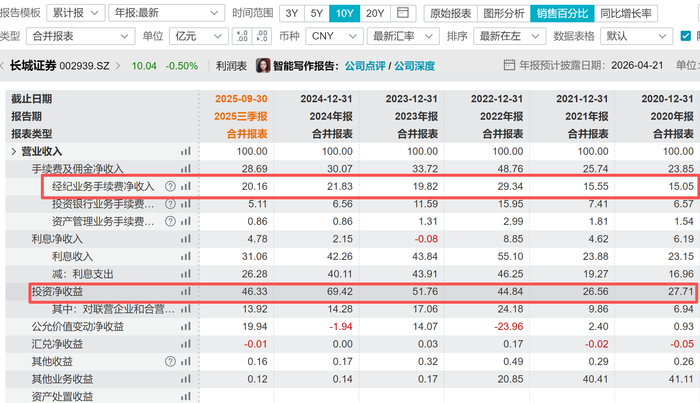
Group 1: Leadership Changes - Zhou Zhongshan has officially been appointed as the President and CFO of Changcheng Securities after serving as acting president for six months [1][2] - Zhou has a long tenure at Changcheng Securities, having joined in 1998 and held various management positions [1] - The new board secretary, Ruan Huixian, has also been promoted from within the company, having worked there since 2003 [1] Group 2: Financial Performance - For the first three quarters of 2025, Changcheng Securities reported total revenue of 4.121 billion yuan, a year-on-year increase of 44.61%, and a net profit attributable to shareholders of 1.931 billion yuan, up 75.83% [5][6] - The increase in revenue and profit is attributed to higher financial asset returns and increased brokerage fees and commissions [6] - Investment income's contribution to total revenue has risen significantly, reaching 69.42% in 2024, compared to 44.84% in 2022 [7][9] Group 3: Regulatory Issues - Changcheng Securities has faced scrutiny due to financial fraud issues related to companies it sponsored, including Yuebo Power and Te Fa Information, leading to penalties [4] - Yuebo Power was delisted in July 2024 after being found to have significant reporting inaccuracies, resulting in fines totaling 950 million yuan for the company and its executives [4] - Te Fa Information was also penalized for inflating profits by 191 million yuan from 2015 to 2019, with fines totaling approximately 23.5 million yuan [4] Group 4: Business Focus and Strategy - Changcheng Securities is focusing on the energy sector, leveraging its parent company, China Huaneng Group, to develop a comprehensive investment banking model centered on the dual carbon industry chain and innovative financial services [5] - The company has shifted its investment banking strategy to emphasize mergers and acquisitions, refinancing, and business in the Beijing Stock Exchange, especially after experiencing a lack of IPO underwriting success in 2024 and 2025 [9][10]

济南市万人有效发明专利拥有量87.2件,增长17.8%
Qi Lu Wan Bao· 2026-01-19 01:46
Core Insights - The government report highlights the continuous improvement in innovation and development levels in Jinan, emphasizing efforts in ecological preservation, talent attraction, and industrial strength [3] Group 1: Economic Development - Jinan registered 179,800 new business entities last year, with the number of technology-based small and medium enterprises reaching 9,404 [3] - The total transaction value of technology contracts in the city reached 102.5 billion yuan, marking a 10.7% increase [3] - The number of valid invention patents per ten thousand people was 87.2, reflecting a growth of 17.8% [3] Group 2: Innovation Achievements - The city successfully launched innovative drugs such as "Ruilintang" and "Mailisheng," and achieved the world's first mass production of synthetic biology royal jelly acid [3] - The first domestically produced steam compression machine for the boron recovery system of a third-generation pressurized water reactor was officially completed [3] - The global first commercial supercritical carbon dioxide power generation unit, operated by Jinan Steel Group, commenced successful operations [3] Group 3: Talent Attraction and Policies - Jinan implemented the "Haiyou Talent" plan, resulting in the addition of 137 provincial-level key talents and over 160,000 young talents [4] - The city hosted the third "Haiyou Talent Festival" and two high-level talent recruitment conferences, enhancing its talent policies with the "Double 30 Measures" [4] - The talent work experience was recognized as one of the "2025 National Talent Work Innovation Best Cases" [4] Group 4: Financial Initiatives - Jinan is advancing the construction of a science and technology innovation financial reform pilot zone, initiating pilot projects for mergers and acquisitions loans for tech companies [3] - The issuance of science and technology innovation bonds by quality enterprises reached 28.1 billion yuan, ranking first in the province [3] - The balance of loans for science and technology enterprises exceeded 300 billion yuan [3]
穿越周期 徽商银行的硬科技陪伴三重叙事
Zhong Guo Zheng Quan Bao· 2026-01-14 20:51
Core Insights - The article highlights the innovative financial support provided by Huishang Bank to technology companies, enabling their growth and development in the competitive market [1][2][4] Group 1: Huishang Bank's Support Mechanism - Huishang Bank has developed a unique financial service mechanism to address the challenges of technology financing, including establishing a dedicated department for technology finance and creating "Innovation Homes" in various provincial parks [1][4] - The bank offers a 3% tolerance for non-performing loans in technology credit business and has implemented a negative list for credit due diligence, allowing for more flexible financing options [1][2] - The bank's approach focuses on the growth potential and technological capabilities of companies rather than their current financial performance, marking a shift in risk assessment [2][3] Group 2: Success Stories of Supported Companies - Dezhihang Technology, which relocated to Hefei, received a 10 million yuan credit line from Huishang Bank during a challenging period, helping the company recover from a significant drop in sales [1][2] - The company expects its sales revenue to increase from 2.76 million yuan in 2021 to 80 million yuan by 2025, showcasing the impact of Huishang Bank's support [2] - Ruisi Medical, another beneficiary, received 20 million yuan in special credit to support its research and market expansion, demonstrating the bank's commitment to fostering innovation [2][3] Group 3: Broader Impact on the Innovation Ecosystem - The collaboration between local government and Huishang Bank has created an efficient "government-bank-enterprise" ecosystem that supports technology companies by providing application scenarios and connecting them with resources [3][4] - Huishang Bank's technology finance strategy aims to build an innovation ecosystem by offering comprehensive services that include funding and intellectual support [4] - By the end of 2025, Huishang Bank's technology loan balance is expected to exceed 210 billion yuan, with over 13,000 loan accounts, indicating a robust growth in technology financing [4]
上海:“股贷债保担”联动,助科创企业跃升
Ke Ji Ri Bao· 2026-01-14 04:58
Core Viewpoint - Shanghai's "Equity-Loan-Debt-Guarantee" linkage mechanism is a comprehensive financial service system aimed at addressing the financing challenges faced by technology and small to medium-sized enterprises, facilitating their growth and innovation [1][2][4]. Group 1: Mechanism Overview - The "Equity-Loan-Debt-Guarantee" mechanism integrates five financial tools: equity financing, loans, bonds, insurance, and guarantees, to effectively address the financing bottlenecks for enterprises at different stages of development [1][2]. - The Shanghai Science and Technology Financial Alliance was established to implement this mechanism, collaborating with various stakeholders to provide tailored financial services throughout the entire lifecycle of technology enterprises [2][3]. Group 2: Financial Support and Impact - Over the past two years, the Shanghai Science and Technology Financial Alliance has facilitated financing exceeding 1 trillion yuan for technology enterprises, covering various innovative entities such as specialized and new enterprises [4]. - Financial institutions have developed customized service plans to meet the unique funding needs of technology enterprises, resulting in a collaborative financial service matrix that supports innovation [5][6]. Group 3: Specific Initiatives and Collaborations - The introduction of the "New Power Loan" has increased credit guarantee limits for small and medium enterprises to a maximum of 20 million yuan, addressing the issues of high financing costs [3][6]. - Various banks, such as CITIC Bank and Bank of China, have implemented collaborative financing models that combine equity and loan services, enabling technology companies to secure necessary funding for their growth [6][7]. Group 4: Future Directions - Shanghai aims to enhance information sharing and resource complementarity among financial institutions, further deepening the "Equity-Loan-Debt-Guarantee" linkage mechanism to explore new financial products and services for technology innovation [9].