财政压力

Search documents
美国降息之争走向何方
Jing Ji Ri Bao· 2025-08-11 22:05
Core Viewpoint - The ongoing conflict between the U.S. government and the Federal Reserve regarding interest rate cuts has escalated from policy disagreements to a broader struggle over economic governance, impacting global markets. Group 1: Government Pressures for Rate Cuts - The U.S. government is under significant pressure to push for rapid and substantial interest rate cuts due to three main factors: fiscal pressure, political cycle dynamics, and the need to counteract the effects of increased tariffs [1][2]. - The federal government's interest expenditure for the fiscal year 2024 is projected to be approximately $1.1 trillion, with the national debt exceeding $37 trillion as of August 10, indicating a growing fiscal burden that the government hopes to alleviate through lower interest rates [1]. - The urgency for rate cuts is heightened by the upcoming 2026 midterm elections, as the government seeks to stimulate the economy and improve public perception through short-term market gains [1]. Group 2: Federal Reserve's Stance - The Federal Reserve remains resistant to the government's pressures, citing the need for a low inflation environment to justify rate cuts, and expressing concerns that high inflation could lead to a wage-price spiral if cuts are implemented prematurely [2][4]. - The core PCE price index rose by 2.8% year-on-year in June, exceeding expectations, which reinforces the Fed's cautious approach to interest rate adjustments [2]. - The Fed emphasizes its independence and the importance of maintaining data integrity, suggesting that succumbing to political pressure could undermine market trust and lead to adverse long-term effects [2][4]. Group 3: Employment Data and Political Maneuvering - Recent employment data indicates a rise in the unemployment rate and a downward revision of job creation figures, prompting the U.S. government to attempt to influence labor statistics and reshape the Federal Reserve's decision-making body [3][4]. - The dismissal of the Bureau of Labor Statistics head and the push for a new appointee who supports rate cuts reflect the government's strategy to manipulate data to create a rationale for lowering rates [3]. - The potential impact of these political maneuvers on the Federal Reserve's voting structure could influence upcoming decisions on interest rates, although the long-term consequences of undermining data credibility could be detrimental [3][4]. Group 4: Economic Implications and Future Outlook - The standoff between the U.S. government and the Federal Reserve highlights deep-rooted issues in U.S. economic governance, with the government’s push for rate cuts driven by an unsustainable debt-driven growth model [4][5]. - The Federal Reserve may be compelled to lower rates if unemployment rises significantly or consumer spending weakens, while a rebound in inflation due to tariffs could lead to a more cautious approach [4]. - Regardless of the outcome, this ongoing conflict reveals significant fractures in the governance of the U.S. economy, indicating a complex interplay between short-term political objectives and long-term economic stability [5].
宝盛集团:政策不稳与财政压力或致美元继续走低
news flash· 2025-07-18 05:22
Core Viewpoint - The US dollar is expected to continue its downward trend due to unstable policy-making and increasing fiscal pressures, as stated by David A. Meier from Baosheng Group [1]. Summary by Relevant Sections Dollar Depreciation - Since peaking in September 2022, the dollar has depreciated by approximately 15% [1]. Policy Impact - Recent US policy-making has further impacted the currency value, extending the bear market for the dollar [1]. Safe-Haven Status - There is uncertainty regarding whether the dollar's safe-haven status is being challenged, particularly when the US becomes a source of risk aversion, which typically weakens the dollar [1]. Market Sentiment - The likelihood of negative news causing volatility remains high; however, if unstable policy-making stabilizes, it could restore market confidence in the dollar, creating a positive risk scenario [1].
星展:第三季转向防御性策略 维持股票中性配置 看好美国科技行业
Zhi Tong Cai Jing· 2025-07-14 08:25
Group 1 - The core viewpoint is that the financial landscape in the U.S. is being reshaped by Trump's policies, leading to increased risk premiums for financial assets due to policy ambiguity and excessive fiscal consumption [1][2] - Trump's trade war aims to strategically contain China and generate revenue to address U.S. debt issues, but even a 20% tariff could only yield an additional $185.2 billion, insufficient to cover interest payments on the debt [1] - The bank's investment strategy has been adjusted to maintain a neutral allocation to equities, with expectations of performance divergence across sectors and regions, favoring the U.S. technology sector and service industries over commodity-focused sectors [1][2] Group 2 - The market in Q3 2025 is expected to be dominated by three themes: easing of tariff tensions, divergence in stock performance, and fiscal pressures that are unfavorable for government bonds and the dollar but beneficial for gold [2] - The unexpected easing of U.S.-China tensions is driven by pragmatic considerations, as the high tariffs effectively act as a trade embargo harming both parties [2] - The bank anticipates that while practical approaches may reduce tariff tensions, stock performance will significantly diverge, with technology and service sectors outperforming the market [2]
穆迪维持以色列Baa1评级 警告与伊朗冲突将加剧财政压力
news flash· 2025-07-07 23:08
Core Viewpoint - Moody's maintains Israel's long-term local and foreign currency rating at Baa1, warning that direct military conflict with Iran will further increase fiscal pressure [1] Group 1: Rating and Fiscal Pressure - Moody's indicates that geopolitical risks have led to a weakening of Israel's fiscal situation since October 2023 [1] - The agency expects Israel's debt-to-GDP ratio to peak at around 75% in the medium term due to increased defense spending and slowing economic growth [1] - Prior to the onset of military conflict with Iran, Moody's had projected this ratio to peak at 70% [1]

英国财政大臣为何落泪
Xin Hua She· 2025-07-03 11:27
Core Points - The UK government is facing significant fiscal pressure, primarily due to insufficient funds to meet various spending commitments [1][2][3] Group 1: Fiscal Challenges - The government is experiencing uncontrolled welfare spending and a collapsing fiscal space, with a projected fiscal gap of £18 billion to £32 billion before the autumn budget announcement [1][2] - There is a sharp contradiction between military expansion commitments and fiscal capacity, with a pledge to increase defense spending to 2.5% of GDP and an additional £15 billion for nuclear upgrades [2] - The ambitious "Roosevelt Plan" for economic stimulation is mismatched with fiscal realities, including a £29 billion annual increase in the National Health Service budget and a £39 billion investment in affordable housing [2][3] Group 2: Economic Outlook - The UK's public debt-to-GDP ratio has exceeded 100%, with interest payments on government debt nearly doubling since 2018, now accounting for almost 10% of total expenditures [2] - Economic growth expectations have been downgraded from 2% to 1% for 2025, indicating ongoing economic weakness despite government efforts to boost business confidence [2][3] - The emotional response of a key government official reflects broader governmental struggles amidst fiscal cliffs, military ambitions, welfare pressures, and infrastructure dreams [3]
X @外汇交易员
外汇交易员· 2025-07-03 00:55
Market Trends & Industry Dynamics - UK market experienced a "bond-currency double kill" on Wednesday [1] - UK 10-year government bond yields rose 16 basis points to 463%, the largest single-day increase since April [1] - The British pound fell 1% against the US dollar during the day [1] - The UK stock market closed down 014% on Wednesday [1] Political & Fiscal Risks - The Labour Party's U-turn on welfare reform legislation has exacerbated fiscal pressures [1] - The Labour Party's U-turn on welfare reform legislation poses a £5 billion funding gap for Chancellor Reeves' fiscal plans [1] - Chancellor Reeves' political future faces serious threats [1]
固定收益策略报告:三大长债市场一级招标接连“发飞”:是偶发,还是共性?
SINOLINK SECURITIES· 2025-05-26 02:55
Group 1: Market Trends - Recent bond auctions in Japan, the US, and China have shown significantly reduced demand, indicating a cooling in the primary market[2] - Japan's 20-year bond auction on May 20 had a bid-to-cover ratio of only 2.5, the lowest since 2012, with a tail of 1.14, the highest since 1987[7] - The US 20-year bond auction on May 21 saw a yield of 5.047%, exceeding expectations, with a bid-to-cover ratio dropping to 2.46, the lowest since February[7] Group 2: Interest Rate Movements - Following the weak bond auctions, long-term interest rates surged, with Japanese bond yields rising approximately 15 basis points, and 30-year US Treasury yields surpassing 5%[2] - The domestic 50-year bond auction on May 23 reported a yield of 2.10%, higher than the estimated yield of 2.025%, reflecting a decline in market enthusiasm[7] Group 3: Economic Factors - Uncertainty in policy expectations has increased, with the market pricing in potential rate hikes in Japan and a reduced urgency for rate cuts in the US due to strong employment data and rising inflation[3] - Concerns over fiscal sustainability are growing, particularly in the US, where high deficits and tax cuts have weakened demand for government bonds[4] Group 4: Domestic Market Resilience - Despite the volatility in US and Japanese markets, China's long-term bond market has shown resilience, supported by a relatively loose monetary policy and attractive yield levels around 1.70% for 10-year bonds and 1.90% for 30-year bonds[5] - The trading environment in China remains stable, with market heat indices falling below the 40th percentile, indicating low risk of forced adjustments[5]
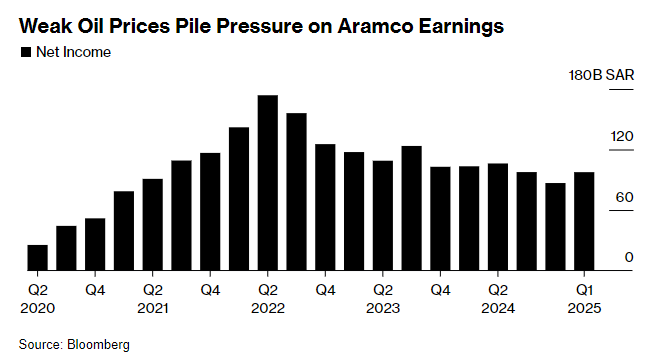
油价低迷重创沙特阿美!一季度利润缩水近5% 政府财政雪上加霜
Zhi Tong Cai Jing· 2025-05-12 04:10
Group 1 - Saudi Aramco reported a 4.6% decline in net profit for Q1, amounting to 97.5 billion Saudi Riyals (approximately $26 billion), primarily due to lower crude oil prices [1][3] - The company's total dividend for the quarter decreased to $21.36 billion, down from $31 billion in the same period last year, largely due to a significant cut in performance-linked dividends [3] - The average selling price of crude oil for Saudi Aramco in Q1 was $76.30 per barrel, lower than $83 per barrel in the previous year [4] Group 2 - The ongoing decline in oil prices, with Brent crude trading around $64 per barrel, is significantly below the $92 per barrel needed for Saudi Arabia's fiscal balance, indicating potential financial strain [4] - Major banks and energy institutions have lowered their oil price forecasts for the year, with the U.S. Energy Information Administration predicting an average Brent crude price of $65.85 per barrel [5] - Saudi Arabia's budget deficit could potentially double if oil prices remain around $62 per barrel, leading to increased borrowing, spending cuts, and asset sales [5]

大变局!人口收缩地区,要被优化了
城市财经· 2025-03-26 03:34
Core Viewpoint - The article discusses the ongoing trend of population decline in China, emphasizing the need for administrative restructuring in shrinking regions to optimize resources and address fiscal pressures [1][2][3]. Group 1: Population Decline and Administrative Optimization - The article highlights the significant impact of population decline, leading to a reshuffling of urban and rural areas, with some towns and cities potentially merging or disappearing [1][9]. - The Ministry of Civil Affairs has called for exploring administrative optimization paths in areas experiencing population decline, although specific methods were not detailed [2][3]. - The proposed optimization involves two main steps: significantly reducing administrative units and personnel in severely affected areas, followed by potential mergers [3][4]. Group 2: Current Population Trends - In 2023, China's population decreased by 2.08 million, with 20 out of 31 provinces experiencing a decline [13][15]. - A total of 309 cities reported population data, with 188 cities experiencing a decline, representing 60.8% of the total [18][24]. - Notable population decreases were observed in provinces like Henan (570,000) and Shandong (398,200) [15][16]. Group 3: Fiscal Pressures and Administrative Reforms - The article points out that the increasing number of government employees amidst a declining population leads to greater fiscal strain, with the ratio of government employee compensation to disposable income rising significantly over the past decade [28][30]. - In 2023, the central government’s transfer payments to local budgets exceeded 1 trillion yuan, marking a historical high, indicating growing fiscal pressures on local governments [37][39]. - The article mentions specific cases of local governments reducing personnel to alleviate financial burdens, such as Shanxi Province's significant cuts in administrative staff [50][51]. Group 4: Future Implications and Mergers - The article predicts that as the population continues to decline, the merging and even dissolution of towns and villages will become increasingly necessary [9][54]. - Historical precedents are cited, illustrating that past reforms aimed at reducing bureaucratic excess have been essential for managing fiscal pressures [66].