
财政压力

Search documents
"洞见商品”系列之一:政府储备的变迁与影响
SINOLINK SECURITIES· 2026-03-12 14:57
Group 1: U.S. Strategic Resource Reserves History - The U.S. government has a history of strategic resource reserves dating back to 1939, which can be divided into four phases: expansion (1939-1960), initial reduction (1960s), policy entanglement (1970s-1980s), and significant reduction (1990s onwards) [2][13][14]. - The first phase saw a rapid expansion of strategic resource inventories due to geopolitical conflicts such as World War II and the Korean War, with the government authorizing $100 million for purchasing and storing critical strategic materials [14][31]. - In the second phase, the focus shifted from military confrontation to economic and technological competition, leading to a reduction in reserves and significant sales of strategic materials to address supply shortages [14][15]. Group 2: Global Official Gold Reserves Changes - The changes in global official gold reserves can be categorized into four stages: post-war decline until the early 1970s, an increase during the 1970s, a significant decline until the 2008 financial crisis, and a trend of increase post-crisis [3][38]. - Geopolitical risk trends have been a key factor in the fluctuations of gold's share in official reserves, with a notable decline in geopolitical risk correlating with a decrease in gold's proportion in reserves during the 1960s and 1980s [39][49]. - Concerns over U.S. dollar credibility have driven increases in gold reserves, particularly after the dollar decoupled from gold in the early 1970s and during the post-2008 financial crisis when the Federal Reserve expanded its balance sheet significantly [40][41]. Group 3: Opportunities and Risks in Commodities from a Government Reserve Perspective - The geopolitical risk index has been on the rise since 2020, suggesting that the U.S. may end the long-term decline in resource reserves, similar to the trend observed after the 1930s [4]. - The U.S. has proposed a $12 billion "Treasury Plan" for strategic resource reserves, marking the beginning of a global trend towards resource accumulation, focusing on supply chain security rather than solely defense [4][12]. - Strategic resources benefiting from high domestic production and AI development include copper, silicon, rare earths, gallium, and germanium, with China being the largest producer of these materials [4][23].
日本国债去年底创新高
Sou Hu Cai Jing· 2026-02-11 08:23
Group 1 - The core viewpoint of the article highlights that Japan's national debt is projected to reach a record high of 134.217 trillion yen (approximately 8.77 trillion USD) by the end of 2025, an increase of 24.54 trillion yen (160.26 billion USD) from the end of 2024 [1] - Japan's debt has surpassed twice its economic output, driven by rising costs in social security, defense, and debt repayment [1] - Prime Minister Fumio Kishida's commitment to expand spending further complicates the country's fiscal outlook [1] Group 2 - The Ministry of Finance anticipates that Japan's total debt will reach 147.35 trillion yen (9.6 trillion USD) by the end of March this year [1] - Market expectations suggest that the Bank of Japan will continue to raise interest rates, leading to an upward trend in long-term borrowing costs [1] - An increase in interest rates would significantly raise the interest expenses on government bonds, worsening the fiscal situation for the Japanese government [1]
俄罗斯的钱去哪了?三年狂卖近400吨黄金,财政压力藏不住了
Sou Hu Cai Jing· 2026-01-23 15:47
Core Insights - Russia's financial situation is deteriorating, with its available "safety cushion" becoming increasingly thin, particularly in terms of gold reserves [1][3] - The country has sold nearly 400 tons of gold from its national welfare fund over the past three years, indicating a reliance on past accumulations to stabilize current finances [1][3] - The gold is not being used for investment or structural adjustments but is directly funding the budget and covering rigid national expenditures [3][5] Financial Condition - By early this year, the gold reserves in the national welfare fund had significantly decreased to about 30% of their pre-conflict levels, indicating a heavy reliance on these reserves to meet increased financial obligations [3][5] - The welfare fund, originally designed for "emergency situations," is now tasked with covering not only regular welfare expenditures but also substantial costs related to military conflicts, such as compensation for casualties and support for military families [3][5] Economic Dynamics - The expenditures funded by gold sales do not generate long-term returns and only maintain the status quo, leading to a weakening of the financial model as gold reserves are depleted [5][7] - Despite the economic pressure, the Russian economy has not collapsed, partly due to domestic investments stimulated by capital restrictions and a wartime economic structure that has absorbed significant labor in sectors like military, energy, and transportation [5][7] Challenges Ahead - The internal economic cycle remains incomplete, as many essential technologies and materials still need to be imported, limiting the effectiveness of domestic production [7][9] - The shift in transaction methods, with a preference for gold and energy over the ruble, has accelerated the consumption of gold reserves, making it a critical payment tool for military procurement and essential goods [7][9] Future Outlook - While Russia's gold reserves have not yet reached a critical level, the ongoing reliance on these reserves for funding indicates a persistent financial pressure that could lead to challenges in the future [9] - The sustainability of this financial model is in question, as continued high expenditure rates could outpace the ability to replenish reserves, leading to increased economic and social costs down the line [9]


景顺:有必要对日本国债采取更谨慎的投资立场
Xin Lang Cai Jing· 2026-01-21 05:09
Group 1 - The core viewpoint is that there is a need for a more cautious investment stance on Japanese government bonds due to the risk of rising long-term yields [1] - Tomo Kinoshita, a global market strategist, indicates that if Prime Minister Fumio Kishida's proposed temporary consumption tax cut becomes permanent, it could pressure Japan's fiscal situation [1] - Kinoshita projects that by the end of 2025, Japan's total government debt will reach 229.6% of GDP, raising concerns about the future fiscal health of Japan [1] Group 2 - The rising concerns about Japan's fiscal health have led to an upward trend in long-term Japanese government bond yields [1] - Increased debt servicing costs are further exacerbating fiscal pressures on the government [1]
摩通发布欧元区成员国评级动向展望 料法国遭降级的概率约五成
Xin Lang Cai Jing· 2026-01-06 12:15
Core Viewpoint - Morgan Stanley identifies France, Belgium, and Austria as the Eurozone countries most likely to face credit rating downgrades by 2026, with each having a 50% probability of downgrade from at least one of the major rating agencies [1] Group 1: Credit Rating Risks - The report highlights that France, Belgium, Austria, and Finland are facing negative rating action risks due to ongoing fiscal challenges [1] - The analysts expect limited changes in credit ratings across the region overall [1] Group 2: Southern Europe Outlook - There is an increasing potential for credit rating upgrades or positive outlooks for Southern European countries [1] - The predictions emphasize the impact of fiscal pressures on countries previously considered the safest borrowers in the Eurozone [1] Group 3: France's Fiscal Challenges - France's credit rating continues to deteriorate, raising investor concerns about the country's difficulties in restoring public finances [1] - The delay in the 2026 budget proposal underscores the fiscal challenges faced by France [1]


年末全球贸易答卷:有望首破35万亿美元,AI引领与风险并存
Di Yi Cai Jing· 2025-12-25 12:25
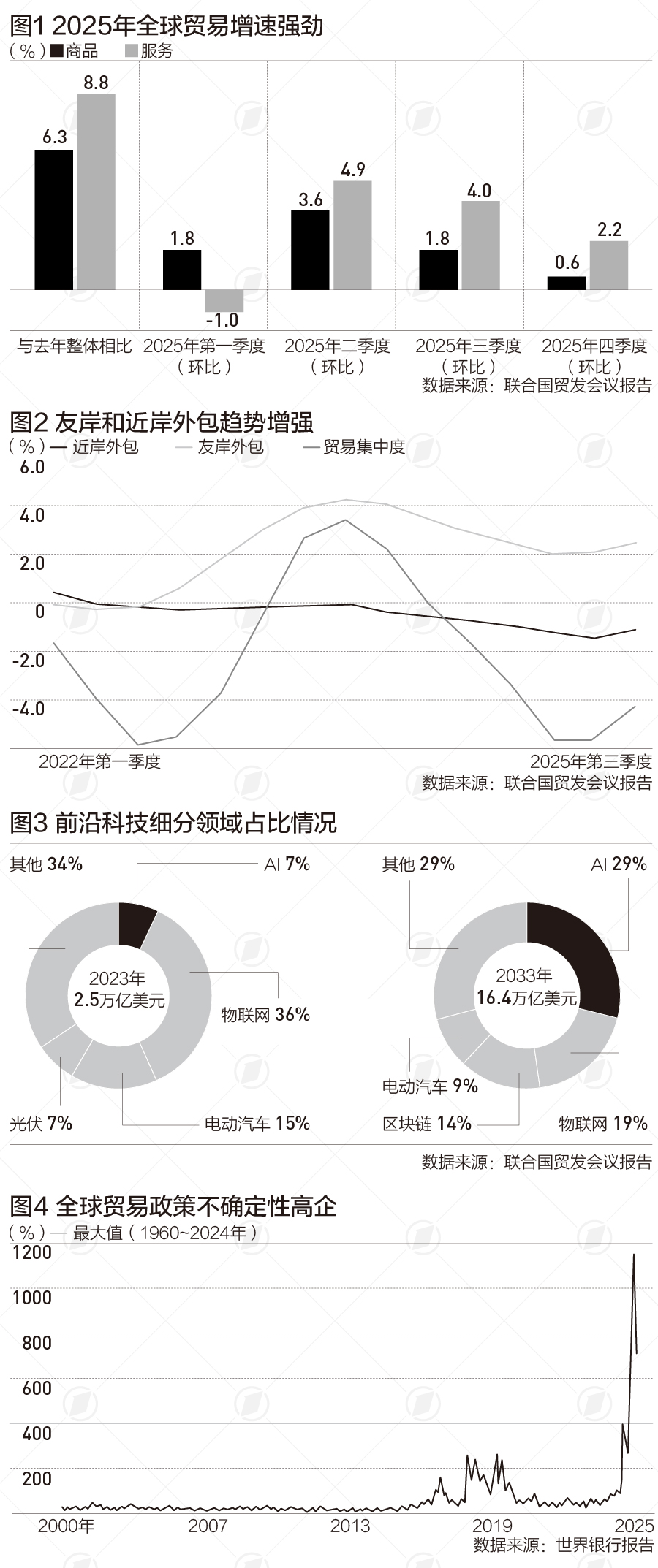
Group 1 - The report highlights that global trade is expected to exceed $35 trillion for the first time this year, with an increase of approximately $2.2 trillion compared to last year, representing a growth rate of about 7% [1] - The growth in global merchandise trade is projected to be around $1.5 trillion, while service trade is expected to grow by $750 billion, with respective growth rates of 6.3% and 8.8% compared to 2024 [1] - UNCTAD's report indicates that manufacturing, particularly in electronics, is leading the growth in global trade, while the energy and automotive sectors are experiencing relatively weak growth [2] Group 2 - The "Global Economic Policy Uncertainty Index" from UNCTAD has surpassed 500, reaching a 20-year high, indicating significant uncertainty in trade policies due to the U.S. government's fluctuating tariff policies [2] - The World Bank reports that global trade policy uncertainty has reached a historical peak since 2000, which has led many companies to expedite shipments to avoid tariff risks, thereby depleting future demand [2] - The forecast for global goods trade growth has declined, with a predicted increase of only 0.6% in the fourth quarter of this year, following a peak growth rate of 3.6% in the second quarter [2] Group 3 - UNCTAD predicts that by 2033, the global AI market size will surge from $189 billion in 2023 to $4.8 trillion, with a growth rate of 25 times over the next decade [3] - AI is expected to significantly enhance global trade and GDP growth, with trade potentially increasing by 34% to 37% and GDP growing by 12% to 13% by 2040, depending on policy and technological advancements [3] - The World Bank warns of the risks of imbalanced AI development, particularly affecting the economic transformation of developing countries [3]
野村:料明年美国经济增2.4% 6月和9月有两次减息 美元全年贬值5%
智通财经网· 2025-12-08 07:20
Core Viewpoint - Nomura's macroeconomic research head, Rob Subbaraman, anticipates a 2.4% growth in the US economy next year, driven by increased AI investment and a more accommodative economic environment, while core inflation remains close to 3% [1] Economic Outlook - The US is expected to reduce interest rates by 25 basis points this year, with no cuts anticipated from January to May next year, followed by two cuts in June and September [1] - Concerns are raised regarding the lack of significant fiscal consolidation in the US, with expectations of increased government spending on defense, aging society, climate change-related disasters, and interest payments, leading to greater fiscal pressure [1] Inflation and Monetary Policy - The increased fiscal pressure may compel the US government to push the Federal Reserve for more rate cuts or to encourage financial institutions to purchase more government bonds, potentially resulting in higher inflation in the long term [1] Market Predictions - Nomura predicts that Asian stock markets will perform better in 2026, attracting more capital inflows, and highlights Asia as a manufacturer of AI phenomena [1] - The global head of foreign exchange strategy at Nomura, Chen Liwei, forecasts that the US dollar will remain stable in the first quarter of next year, but the dollar index (DXY) is expected to depreciate by approximately 5% over the year, with downward pressure still present in the first quarter [1]
野村:预期明年美国经济将增长2.4%,通胀维持于约3%水平
Sou Hu Cai Jing· 2025-12-08 06:26
Core Viewpoint - Nomura's macroeconomic research head, Rob Subbaraman, forecasts a 2.4% growth in the US economy next year, driven by sustained AI investments and a more accommodative economic environment [1] Group 1: Economic Growth - The expected growth rate for the US economy in 2024 is 2.4% [1] - AI investments are anticipated to continue contributing positively to economic growth [1] Group 2: Inflation and Monetary Policy - US inflation is expected to remain sticky at around 3% [1] - The Federal Reserve is predicted to maintain a cautious stance, with a 25 basis point rate cut expected in December of this year [1] - Further rate cuts may occur between June and September next year, contingent on the new chairperson's appointment [1] Group 3: Fiscal Policy - There are no clear signs of fiscal consolidation in the US at present [1] - Anticipated increases in government spending on defense, aging population, and climate change will likely exacerbate fiscal pressures [1]
机构:美国国债长端收益率料将不会跟随美联储降息而走低
Sou Hu Cai Jing· 2025-11-26 04:59
Core Viewpoint - Nuveen predicts that long-term U.S. Treasury yields will not decline in line with the Federal Reserve's policy interest rates, expecting the 10-year Treasury yield to remain around current levels for the next two years [1] Group 1: Economic Outlook - The company highlights that the primary driver for a steepening yield curve is the fiscal backdrop, with ongoing high deficits expected to increase U.S. debt levels by approximately 20% of GDP over the next decade [1] - Nuveen indicates that the deteriorating fiscal environment alone could provide about 75 basis points of upward pressure on the 10-year Treasury yield, effectively offsetting any downward pressure from potential Fed rate cuts [1]
【财经分析】土耳其外汇保护型存款机制即将谢幕 市场化政策转向前景几何
Xin Hua Cai Jing· 2025-11-18 00:06
Core Viewpoint - The Turkish foreign exchange-protected deposit mechanism (KKM) is set to be phased out, marking a shift towards more market-oriented macroeconomic policies while facing short-term risks to the lira and market uncertainty [1][2][3] Group 1: KKM Mechanism Overview - The KKM was established in response to the lira's significant depreciation in 2021, which saw a 44% decline against the dollar, and allowed individuals and businesses to deposit lira in special accounts with state compensation during currency depreciation [2] - Since its inception, the KKM has incurred costs of approximately $60 billion, stabilizing short-term capital outflows but increasing long-term fiscal pressure [2][3] Group 2: Policy Transition and Market Implications - The Turkish Central Bank announced that KKM accounts will no longer accept new accounts or renewals, indicating a move away from unconventional monetary policies [1][3] - The balance of protected deposits has decreased sharply from a peak of $140 billion to about $7 billion, reflecting a growing confidence in the lira and the new monetary policy framework [2][3] Group 3: Future Challenges and Investor Sentiment - The end of the KKM is expected to lead to increased exchange rate volatility and market fluctuations, with investors needing to manage currency risks in the short term [4][5] - The Turkish government aims to enhance policy credibility and attract capital inflows through tighter monetary policies and improved transparency, despite ongoing challenges such as high inflation and external economic pressures [4][5]