资产管理

Search documents
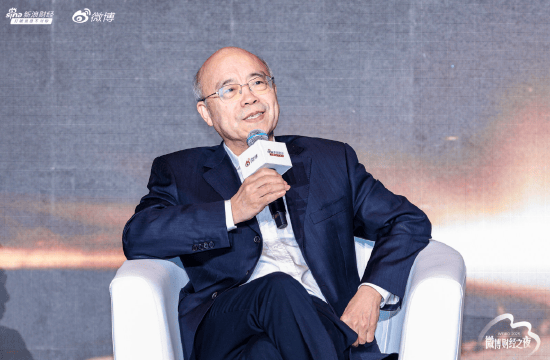
林义相:上市公司的质量问题不应由证监会承担
Sou Hu Cai Jing· 2026-01-15 13:03
Group 1 - The core viewpoint of the article emphasizes that the quality of listed companies should not be overly reliant on the regulatory authority, as it is not their responsibility to ensure company performance and profitability [3] - The regulatory authority's role is primarily to remove poor-performing companies from the market and allow good companies to enter, rather than directly influencing company quality [3] - Concerns are raised regarding high-frequency trading, with the current legal threshold of 300 trades per second being deemed arbitrary and lacking theoretical and practical justification [3] Group 2 - The article highlights the potential market manipulation risks associated with frequent order placements and cancellations, which can create false trading volumes and disrupt market order [3] - The market is characterized by a high proportion of retail investors, who have a high savings rate, leading to skepticism about entrusting their funds to management institutions, especially when significant losses occur while management fees are still collected [3] - The design of trading systems should return to the fundamental purpose of the market, questioning the necessity of high-frequency trading and suggesting that its removal could serve as a reassurance to retail investors [4]

入住率跌至45.8%,客房不足8000间,绿地酒店怎么了?
Tai Mei Ti A P P· 2026-01-14 03:36
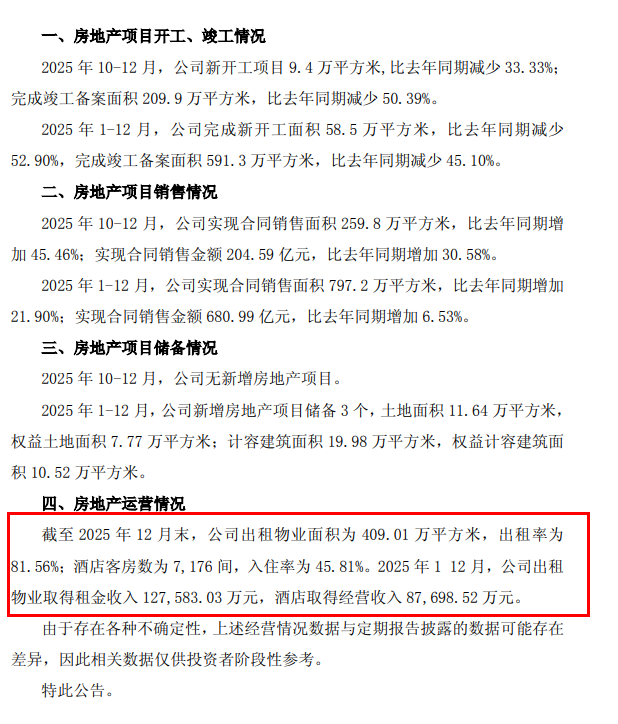
Core Insights - Greenland Holdings' hotel business is facing significant challenges, with a decline in occupancy rates, a reduction in the number of hotel rooms, and a drop in revenue per room [1][9][12] Group 1: Performance Metrics - As of the end of 2025, the number of hotel rooms has decreased to 7,176, down from 9,738 at the end of 2024 and 11,455 in 2023 [1][6][7] - The occupancy rate for 2025 stands at 45.81%, a decline from 49.1% in 2024 and 53.4% in 2023, indicating a downward trend in the hotel industry [9][10] - Average daily revenue per room has fallen to 335 yuan in 2025, down from 365 yuan in 2024 and 420 yuan in 2023, marking a new low over the past five years [12][14] Group 2: Strategic Challenges - The management has acknowledged that many hotels are inefficient and unprofitable, failing to meet investment return requirements [1][17] - The slow expansion of light-asset models is evident, with a low conversion rate of project reserves into actual contracts, despite a reported near 100 signed projects [18] - The hotel sector's performance is reflective of a broader industry trend where supply exceeds demand, leading to continued declines [9][10] Group 3: Industry Context - Owner-operated hotel groups, including Greenland, are struggling in a post-real estate era, facing operational and expansion difficulties [20][22] - The company has been forced to adapt to liquidity issues, with a projected loss of up to 19 billion yuan in 2025, leading to asset sales [23][24] - The future of owner-operated hotel groups may involve a shift towards asset management and diversified business models, leveraging their experience in integrated projects [35][36]

戴德梁行:房地产转型提质大有可为 以资产管理激活行业发展新动能
Zheng Quan Ri Bao Wang· 2026-01-12 13:50
Core Insights - The event hosted by CBRE focused on the latest trends in the real estate market, featuring discussions on office buildings, commercial trends, large transactions, REITs, and asset management, aiming to provide insights into market dynamics and pathways for breakthroughs [1] - The expansion of public REITs to include office and hotel assets marks a new phase in the financialization of real estate in China, providing standardized exit channels for existing assets and enhancing investment options for institutional investors [1] - The future growth of the real estate sector will increasingly rely on the optimization of existing assets, quality upgrades in property services, and the regulated development of the rental market, rather than solely on new developments [1] Market Trends - The Chief Policy Analyst at CBRE highlighted that expanding domestic demand and boosting consumption will be key drivers of economic growth in the complex international environment leading up to 2026 [2] - The performance of Beijing's office market in 2025 was reviewed, identifying core opportunities for market breakthroughs through industrial upgrades and operational strategy optimization, despite facing multiple challenges [2] - The retail market in Beijing is expected to see the opening of 13 quality projects in 2025, adding over 1.1 million square meters of retail space, alongside the renovation of older commercial projects to enhance market quality [2] REITs and Capitalization Rates - CBRE released the sixth edition of the "China REITs Index Real Estate Capitalization Rate Survey Report," indicating that capitalization rates serve as a core pricing anchor for real estate, reflecting industry confidence and investment logic [3] - The report aims to guide the development direction of the industry and assist in the value extraction of commercial real estate as public REITs expand into office and hotel sectors [3] Asset Management Strategies - The asset management strategy emphasizes "long-term resilience" as a core logic, with REITs serving as a key practical vehicle for this approach, evolving from single asset products to sustainable value operation platforms [4] - The investment logic is shifting from "profit from price differences" to "long-term holding and self-use adaptation," providing stable liquidity and operational certainty for core assets [4]
中国房企可能如何发展?
Ge Long Hui· 2026-01-09 02:21
Core Viewpoint - The real estate industry is undergoing a transformation towards asset management, driven by financial deepening and the need for high-quality development in housing business and operational real estate [1][2][3] Group 1: Overseas Market Insights - The transition of real estate companies to asset management firms has been primarily driven by financial deepening over the past 40 years, with Western economies progressing faster than Asian markets [2] - The real estate sector's contribution to GDP in developed countries has shown an upward trend when including virtual rent in calculations, despite a downward trend in housing development investment's share of GDP [5][6] - Financial deepening has led to a stabilization of supply-demand cycles in real estate, with more fluctuations arising from capital flows and asset prices [7][8] Group 2: China's Market Outlook - China is at a dual turning point of urbanization and financial market development, making the exploration of asset management by real estate companies an inevitable direction [3][41] - The "14th Five-Year Plan" period is expected to be crucial for institutional development in asset management, with a need for policy support to address challenges in market structure and organizational capabilities [3][41] - The transition from traditional development to asset management is recognized, but significant challenges remain, including reliance on policy guidance and the need for further market cultivation [3][41] Group 3: Structural Changes and Opportunities - The post-urbanization era presents structural growth opportunities in the real estate sector, with a focus on professional deepening and business segmentation as key trends [10][19] - The evolution of asset management companies has been marked by the rise of REITs and alternative asset management firms, which have significantly increased their scale and market presence [25][26] - The diversity of real estate business models and the changing commercial logic within various asset types highlight the industry's structural development characteristics [9][10] Group 4: Comparative Analysis of East Asia and Western Markets - There are notable differences in the development stages of real estate companies between East Asia and Western markets, with East Asian firms often exhibiting a mixed business model while Western firms tend to focus on specialization [14][15] - The marketization and competitive environment in Western economies have led to stronger overall competitiveness among their real estate firms compared to those in East Asia [15][16] - The capital dynamics and external investment strategies differ significantly, with East Asian firms generally being more conservative in their international expansion compared to their Western counterparts [16][18] Group 5: Future Development Directions - The future of China's real estate market will focus on managing existing assets and optimizing new developments, with a shift towards a more market-oriented pricing mechanism for new homes [43][44] - The ongoing process of destocking and deleveraging in the real estate sector is expected to continue, with a gradual improvement in cash flow and market stability [46][49] - The development of a securities market for operational real estate is anticipated to gain momentum, supported by policy initiatives aimed at revitalizing existing assets [47][48]
A股指数涨跌不一:创业板指跌0.69%,石油、航天系等板块涨幅居前
Feng Huang Wang Cai Jing· 2026-01-09 01:30
Market Overview - The three major indices opened mixed, with the Shanghai Composite Index up by 0.09%, the Shenzhen Component down by 0.30%, and the ChiNext Index down by 0.69% [1] - The oil, aerospace, and telecommunications sectors showed strong performance, while industrial gases, electronic chemicals, and energy metals faced declines [1] Index Performance - Shanghai Composite Index: 4086.76, up 0.09%, with a trading volume of 116.12 billion [2] - Shenzhen Component Index: 13917.78, down 0.30%, with a trading volume of 192.72 billion [2] - ChiNext Index: 3279.38, down 0.69%, with a trading volume of 75.19 billion [2] - Northbound 50 Index: 1511.97, up 0.24%, with a trading volume of 2.78 billion [2] External Market - U.S. stock indices closed mixed, with the Dow Jones up by 270.03 points (0.55%) at 49266.11, while the Nasdaq fell by 104.26 points (0.44%) to 23480.02 [3] - The Nasdaq China Golden Dragon Index rose by 1.09%, with notable gains in stocks like Bilibili (up over 6%) and Alibaba (up over 5%) [3] Institutional Insights - Huatai Securities suggests continuing to position for the spring market, with a balanced allocation between growth and cyclical sectors, highlighting improvements in upstream resources, public industries, TMT, and essential consumer goods [4] - CITIC Securities emphasizes capturing structural market opportunities, focusing on large-cap growth stocks with improving fundamentals [5] - Guojin Securities sees potential for value reconstruction in the wind power industry, recommending focus on manufacturing, subsea cables, and component companies benefiting from domestic and international market changes [6] - Tianfeng Securities is optimistic about A-share gaming companies entering a strong product cycle in 2026, driven by improved supply conditions and stable regulatory environments [7][8] - CICC notes the real estate sector's shift towards asset management, emphasizing the need for high-quality development in housing and operational real estate [9]


中金:房地产行业发展与转型迈向资产管理
Di Yi Cai Jing· 2026-01-09 00:20
Group 1 - The core viewpoint of the article emphasizes the ongoing policy focus on transforming the real estate industry towards new models [1] - From the perspective of enterprises, the high-quality development of housing business and the increasing focus on operational real estate is a fundamental trend [1] - There is a growing consensus on building new capabilities and ecosystems around the keyword "asset management" [1]
中金:中国房企发展与转型——迈向资产管理
中金点睛· 2026-01-08 23:59
Core Viewpoint - The article emphasizes the ongoing transformation of the real estate industry towards a new model, focusing on asset management as a key capability for high-quality development in housing and operational real estate businesses [2][5]. Group 1: Historical Context and Trends - The transition of real estate companies to asset management firms has been primarily driven by financial deepening over the past 40 years, with significant progress observed in Western economies during the 2010s, while Asian markets are still in the early stages of this transformation [4][5]. - The level of securitization and liquidity in the real estate sector has evolved in tandem with the overall development of capital markets, indicating a crucial part of global capital market development [4]. Group 2: China's Market Dynamics - China is at a dual turning point of urbanization and financial market development, making the exploration of asset management by real estate companies an inevitable direction, with the 14th Five-Year Plan potentially being a critical period for institutional development [5][41]. - The market has begun to recognize the transition path from "traditional development" to "development + holding" and then to "asset management," with leading companies starting to implement this model [5][41]. - The transformation of real estate companies in China faces challenges, including reliance on policy support to address various bottlenecks and the need for organizational and capability adjustments [5][42]. Group 3: Financial Deepening and Structural Changes - The financial deepening over the past four decades has led to a more stable housing ownership rate in developed economies, with cyclical fluctuations in supply and demand being increasingly influenced by capital flows and asset prices [9][10]. - The rise of asset management companies has been facilitated by the development of securitization and the increasing liquidity of real estate assets, which has allowed for a shift from direct asset accumulation to managing larger portfolios [13][25]. Group 4: International Comparisons - The evolution of real estate companies in Western markets, particularly the U.S., showcases a more market-oriented and financialized approach, leading to a more competitive landscape compared to East Asian markets, where companies often maintain a mixed business model [16][21]. - Japanese real estate firms have undergone significant structural adjustments post-1990s, focusing on diversification and service-oriented business models, although they have not fully transitioned to asset management firms [27][30]. - Singaporean firms exemplify an outward-looking asset management model, leveraging their REITs market to facilitate international investments and capital expansion [33][35]. Group 5: Future Outlook for China's Real Estate Industry - The future of China's real estate market is expected to focus on managing existing assets and optimizing new developments, with a shift towards a sales model based on completed properties rather than pre-sales [41][48]. - The ongoing process of destocking and deleveraging in the real estate sector is anticipated to continue, with a significant reduction in the scale of many companies as they adapt to new market conditions [42][46]. - The development of a robust REITs market is seen as essential for promoting the securitization of operational real estate and enhancing liquidity, which will support the transition to a new business model in the industry [47][50].

2026年大中华区房地产市场展望
Cushman & Wakefield· 2026-01-07 02:05
Investment Rating - The report does not explicitly state an investment rating for the real estate sector in Greater China for 2026 Core Insights - 2026 will be a year of adjustment for economic structural transformation, with expanding domestic demand and boosting consumption as the main drivers for economic growth [7] - The integration of logistics and manufacturing facilities will continue to enhance the resilience and competitiveness of the supply chain in Greater China [11] - The rise of domestic retail brands and the shift from "scale expansion" to "value creation" will redefine the retail property market [10] - The demand for office spaces will be significantly driven by the TMT sector, with a focus on high-quality office environments [9] - The expansion of public REITs to include office buildings and hotels will increase investor interest in these sectors [12] Summary by Sections Macro Trends - 2026 will focus on boosting consumption and expanding domestic demand, shifting the development emphasis from the supply side to the demand side [14] - The transition from "investing in things" to "investing in people" will enhance consumer confidence in areas such as education, social security, and housing [14] - The high-quality development of real estate will shift from merely providing housing to ensuring quality living conditions, stabilizing market prices over the next two years [16] Hot Topics and Alternative Assets - AI-driven data centers will continue to attract investor attention, with asset management becoming increasingly important in enhancing asset value [8][22] - The emphasis on green transformation and sustainable development will significantly impact the real estate industry, with green-certified buildings gaining value [23] - The rapid development of data centers driven by AI and cloud computing will create significant growth potential in this asset class [24] Office Market - The TMT sector's demand for office space will see significant growth, with a focus on high-standard office spaces [29] - Self-use buyers will remain a crucial support for the office market, with high-growth domestic companies actively purchasing self-use spaces [30] - The availability of supporting facilities will be key to enhancing the competitiveness of office spaces [31] Retail Property Market - Domestic retail brands are emerging strongly, transitioning from aggressive growth to a focus on value creation [37] - The new generation of consumers is shifting from material satisfaction to emotional value, driving the rise of niche brands and customized services [38] - The integration of smart technology in retail will reshape consumption scenarios and enhance operational efficiency [39] Industrial Logistics Market - The integration of logistics and manufacturing will strengthen supply chain resilience and competitiveness [44] - The introduction of smart automation systems will enhance logistics efficiency amid rising labor costs [45] - The "China +1" strategy will create investment opportunities in high-quality factory spaces as some low-value production moves abroad [46] Bulk Transaction Market - The total transaction volume of commercial real estate in Greater China remained stable at RMB 268.6 billion in the first three quarters of 2025 [52] - Domestic buyers dominated the market, with foreign investment at a historical low due to external market conditions [53] - The REITs market is expected to grow as the scope of C-REITs expands to include more commercial real estate sectors [54] City Markets - In Beijing, the office market is expected to face pressure from increased supply, with a projected 1.26 million square meters of new supply in 2026 [66] - The retail market in Beijing will see over 1.1 million square meters of new supply, focusing on high-quality consumer spaces [66] - In Shanghai, the office market will continue to adjust, with TMT and financial sectors being the main demand drivers [84] - Shenzhen's logistics market will benefit from the growth of cross-border e-commerce, while the retail market will see a rise in demand for innovative commercial spaces [102]
1+2.5亿资本落沪!友邦、荷全两家独资保险资管来了,我国金融开放迈入深水区
Sou Hu Cai Jing· 2026-01-04 10:16
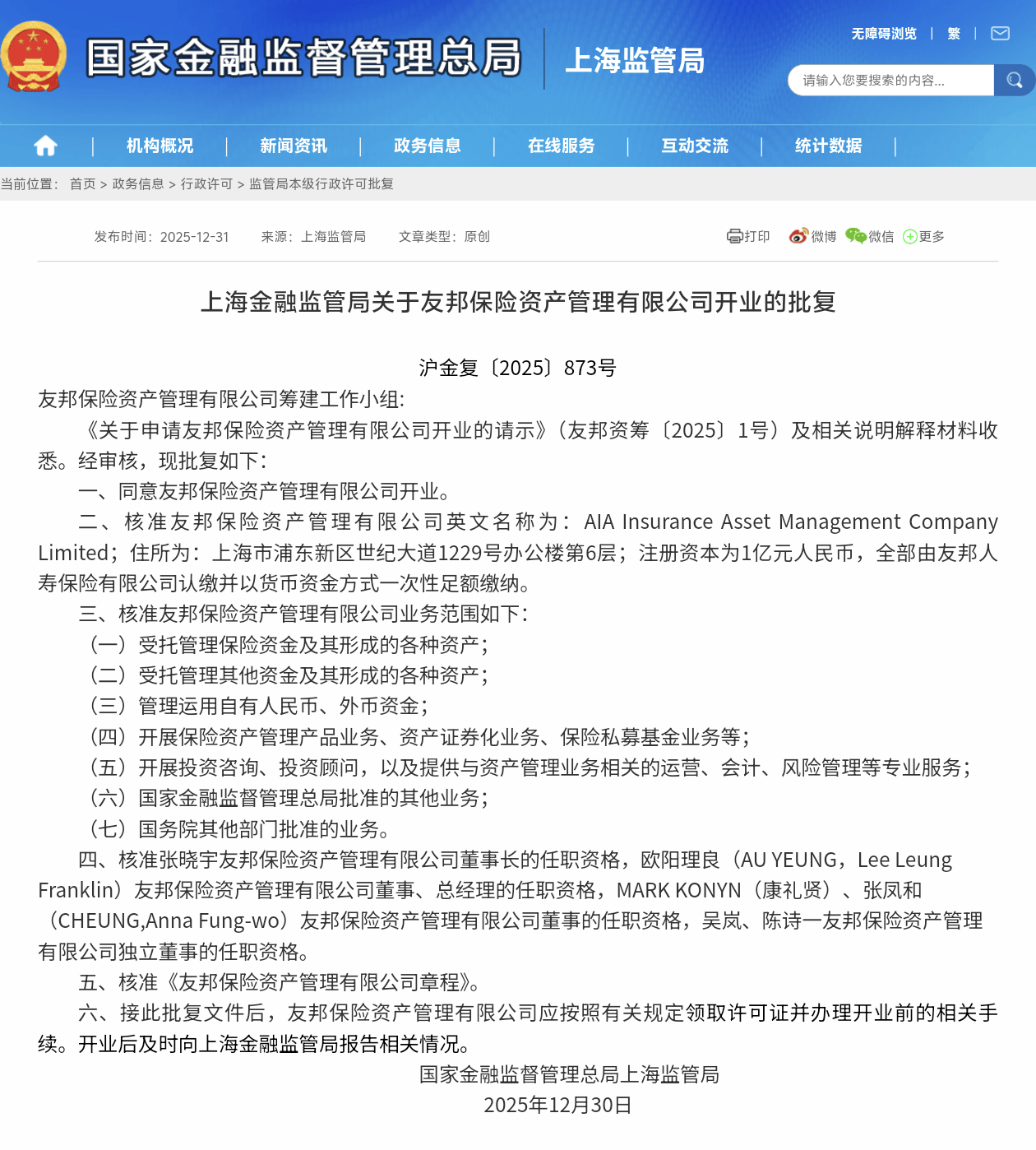
Core Viewpoint - The approval of AIA Insurance Asset Management Co., Ltd. and Aegon Insurance Asset Management Company Limited marks a significant step in China's financial sector's ongoing opening-up strategy, enhancing Shanghai's position as an international financial center and injecting new vitality into the capital market [1][13]. Company Summary - AIA Insurance Asset Management has a registered capital of 100 million RMB, fully subscribed by AIA Life Insurance Co., Ltd. in cash [4][9]. - The management team includes experienced professionals: Zhang Xiaoyu as Chairman, Au Yeung Lee Leung Franklin as CEO, and several other directors and independent directors, establishing a governance structure with industry experience and independent oversight [5][9]. - Aegon Insurance Asset Management has a larger initial capital of 250 million RMB, fully subscribed by Aegon Global Life Insurance Group, indicating a long-term commitment to the Chinese market [11]. - The management team for Aegon includes Zhang Mengjiao as Chairman and Liang Jiangang as CEO, with a diverse board of directors and independent directors, ensuring a robust governance framework [11]. Business Scope - Both companies have a comprehensive business scope covering seven core areas, including managing insurance funds, managing other compliant funds, self-managing RMB and foreign currency funds, and developing innovative asset management products [12]. - They will also provide investment consulting and related operational services, creating an integrated service system that meets diverse market needs [12]. Industry Significance - The establishment of these foreign-owned insurance asset management firms reflects China's steady progress in financial openness, with measures to ease foreign market access and enhance the internationalization of the financial market [13]. - The influx of foreign asset management institutions is strategically significant for Shanghai's development as an international financial center, bringing advanced asset management practices and risk management techniques to the domestic market [13]. - The entry of these firms is expected to provide stable long-term funding sources for China's capital market, optimizing the investor structure and enhancing the overall professionalism of the industry [13]. Future Outlook - As China's financial opening continues, more foreign financial institutions are expected to accelerate their entry into the Chinese market, with Shanghai maintaining its role as a "bridgehead" for global financial governance [14].
32万亿资管遇见AI 福州峰会重构财富逻辑
Jing Ji Guan Cha Bao· 2025-12-29 04:02
Core Insights - The Chinese asset management industry is at a critical juncture of scale and paradigm shift, influenced by the integration of AI technology and a market size exceeding 32 trillion yuan [1] Group 1: Industry Challenges and Transformations - The industry faces structural issues characterized by "high savings, financing difficulties, and asset scarcity," necessitating a shift from product sales to client-centric services and from homogeneous competition to professional empowerment [1][4] - Wealth management must transition towards multi-asset and theme-based investments to adapt to changing economic conditions, including declining deposit yields and real estate value [3][4] - The asset management sector is urged to enhance its service capabilities, focusing on risk management, client engagement, and creating a diversified investment ecosystem [4][5] Group 2: Key Insights from Industry Leaders - Wang Zhongmin emphasized the need for asset management institutions to adopt multi-asset strategies and capitalize on AI-related industries to enhance risk resilience and returns [3] - Yang Zaiping highlighted the importance of moving away from traditional product sales to comprehensive service solutions that meet client needs, while also improving the risk-return matching of financial products [4] - Industry representatives noted the necessity for collaboration and resource sharing to build a healthy ecosystem that supports economic growth and wealth distribution [6][7] Group 3: Market Trends and Future Outlook - The report indicates that the asset management industry is entering a new phase focused on high-quality development, driven by regulatory guidance and a return to core principles of client asset management [5] - The insurance sector is positioned to play a crucial role in wealth management by providing stability through various insurance products, addressing the long-term needs of clients [7] - The shift in asset allocation from deposits to financial assets is accelerating, with increasing market activity in the A-share market, indicating a new development pattern in wealth management [8]