
资金入市

Search documents
问佣金,问两融,券商咨询小高峰,调研:尚温和状态,不及924
Feng Huang Wang· 2025-08-18 22:30
Group 1 - The core viewpoint of the article highlights a significant increase in online customer consultations at brokerage firms, driven by rising market activity and a focus on commission adjustments [1][3][4] - Investors are primarily inquiring about commission reductions as brokerages compete to attract new clients with lower fees, leading to a surge in requests for commission adjustments [4][9] - There is a notable increase in inquiries related to basic account operations, such as fund transfers and app functionalities, indicating a growing interest in trading various products [4][5] Group 2 - Margin trading (two-way financing) inquiries and account openings have also risen, with experienced investors becoming the main drivers of this trend [5][6] - Brokerages are enhancing risk management for margin trading, ensuring strict reviews of clients' credit histories and trading records to mitigate potential losses [6] - Fund sales are experiencing a revival, particularly in equity products, as investor confidence increases and more clients actively seek fund investment opportunities [7] Group 3 - Overall, the influx of funds into the market is characterized as moderate, with seasoned investors showing a strong willingness to invest, while new investors remain cautious [8] - There is a noticeable preference among investors for small-cap stocks, which are perceived to offer greater potential for returns during market upswings [8] - Competition among brokerages for clients is intensifying, with increased marketing efforts and a focus on low commissions to attract and retain customers [9]
3700点!沪指创下近10年新高 险资、私募、散户、外资等成为推动本轮市场反弹主要力量
Shen Zhen Shang Bao· 2025-08-18 16:49
Market Performance - A-shares continue to strengthen, with the Shanghai Composite Index surpassing 3700 points, reaching a nearly 10-year high, and the total market capitalization exceeding 100 trillion yuan [1] - Since July, A-shares have accelerated their rise, with the Shanghai Composite Index increasing over 8%, the Sci-Tech 50 Index rising over 10%, and the ChiNext Index soaring nearly 20% [1] Driving Forces Behind Market Rally - The main forces driving the current market rebound include insurance funds, private equity, retail investors, and foreign capital [1] - As of the end of Q2, the total investment in stocks by life and property insurance companies reached 3.07 trillion yuan, an increase of nearly 1 trillion yuan year-on-year, with a net increase of 251.3 billion yuan in Q2 [1] - Private equity funds are seeing a continuous increase in new products, with 1298 new private equity funds registered in July, marking an 18% month-on-month growth [1] Retail Investor Activity - In July, new A-share accounts reached 1.9636 million, a year-on-year increase of nearly 71%, with a total of 14.5613 million new accounts opened this year, up 36.88% year-on-year [2] - High-net-worth investors are entering the market, but retail funds are primarily flowing into bank wealth management products rather than directly into the stock market [2] Leverage and Foreign Investment - A-share margin financing has returned, with the financing balance exceeding 2 trillion yuan for the first time in 10 years, increasing by over 210 billion yuan in the last month and a half [2] - Foreign investment is also on the rise, with a net inflow of 199 million USD into ETFs focused on China in the last month, accounting for 47% of last year's total net inflow [3] Future Market Outlook - Short-term market liquidity support remains, with expectations of continued upward momentum, although technical adjustment pressures may persist [4] - Investment strategies are suggested to focus on large technology and large financial sectors, with potential for a rebalancing between large and small-cap stocks [4]
问佣金 问两融 券商营业部线上咨询小高峰 调研:尚处温和状态 不及924爆发式
智通财经网· 2025-08-18 13:17
Group 1 - The surge in market activity has led to a peak in customer inquiries at brokerage firms, primarily through online channels rather than in-person visits [1][3][4] - Investors are focusing on actual trading needs, with commission adjustments being the main topic of discussion as brokerages lower fees to attract new clients [4][9] - There is a notable increase in inquiries regarding basic account operations, such as fund transfers and app functionalities, reflecting a growing interest in various trading permissions [4][5] Group 2 - Margin trading inquiries and account openings have risen significantly, with experienced investors driving this trend due to their familiarity with leveraging tools [5][6] - Brokerages are enhancing risk management for margin trading, ensuring strict reviews of clients' credit histories and trading records [6] - Fund sales are experiencing a revival, particularly in equity products, as investor confidence grows and they show increased interest in fund performance and sector growth [7] Group 3 - Overall market participation is characterized by a moderate increase in capital inflow, with seasoned investors showing a strong willingness to invest compared to newer, more cautious entrants [8] - Investors are favoring small-cap stocks over large-cap stocks, as they seek higher returns during market upswings [8] - Competition among brokerages is intensifying, with increased client mobility and a focus on low commission rates to attract and retain customers [9]
【大涨解读】金融:市场成交再破两万亿,央行数据也透露居民入市积极性提升,未来A股有望持续迎来增量资金
Xuan Gu Bao· 2025-08-14 03:16
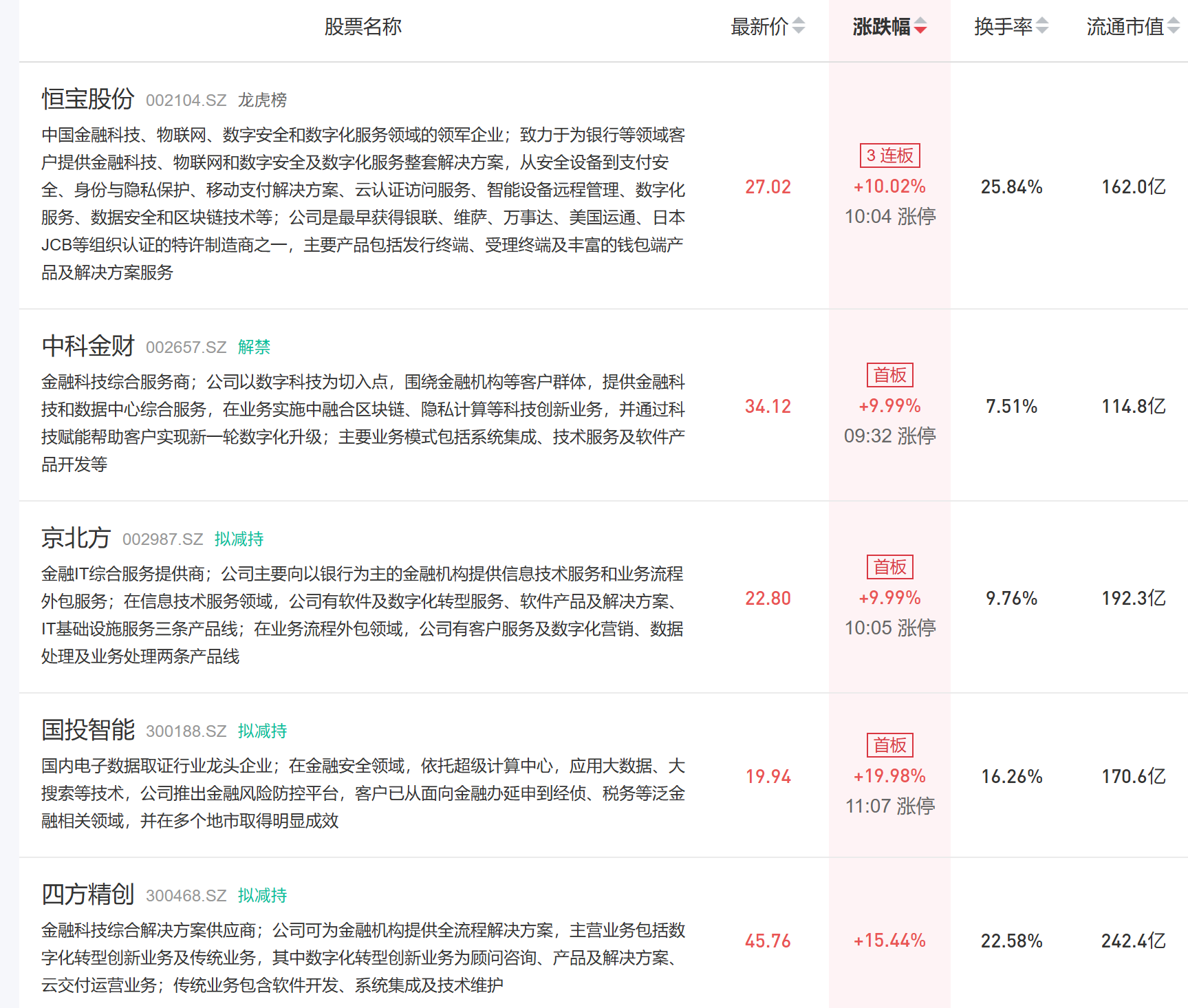
Market Performance - On August 14, the brokerage and fintech sectors experienced a strong morning rally, with companies like Hengbao Co., Ltd. achieving three consecutive trading limit increases, and others such as Zhongke Jincai and Jida Zhengyuan hitting the daily limit [1] - The total trading volume in the Shanghai and Shenzhen markets reached 2.18 trillion yuan, marking a return above 2 trillion yuan after 114 trading days, with the Shanghai Composite Index touching 3688.63 points, the highest since December 14, 2021 [8] Financial Data Insights - The People's Bank of China reported that in July, the new social financing amounted to 1.2 trillion yuan, while new RMB loans decreased by 500 million yuan. The total social financing stock grew by 9.0% year-on-year, and M2 increased by 8.8% year-on-year [6] - The M2 growth rate increased by 0.5 percentage points compared to the previous month, with the M2-M1 spread narrowing to 3.2% from 3.7% [9] Institutional Analysis - The increase in M1 and M2 exceeded expectations, with non-bank deposits rising by 2.14 trillion yuan in July, contributing significantly to M2 growth [9] - There is a notable shift in household savings, with excess savings accumulating in bank deposits. As deposit rates decline, there is a growing trend of funds moving into wealth management products, indirectly entering the equity market [9] - The two-way financing balance reaching 2 trillion yuan indicates strong bullish sentiment in the short term, although its proportion relative to A-share trading volume is lower than in 2015, suggesting a relatively safe position [9] - Upcoming domestic and international events are expected to influence market dynamics, with non-bank financials, particularly brokerages, likely to experience significant volatility [9]






赚钱效应激发入市热情 A股入金调查:六类资金担当主力
智通财经网· 2025-08-05 13:23
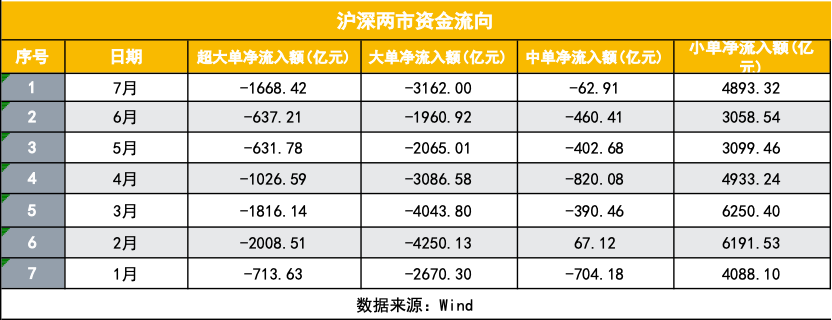
Core Viewpoint - The A-share market is experiencing a surge in investor enthusiasm, with significant inflows of capital from various sources, contributing to a positive market outlook. Group 1: National Team - The national team has invested over 210 billion yuan in ETFs, significantly supporting the A-share market by purchasing at least eight broad-based ETFs since April [1][3]. - The national team's buying behavior is characterized by a broad coverage of ETFs, including traditional and new indices, indicating a strong commitment to stabilizing the market [3]. Group 2: Public and Private Funds - The public fund industry has seen rapid growth, with net assets reaching 34.05 trillion yuan, a 5.34% increase since the beginning of the year [4]. - In the first seven months of the year, 903 new public funds were launched, with a total issuance of 600.715 billion units, reflecting a rising trend in equity fund issuance [4]. - Private fund issuance is also robust, with two private institutions registering over 100 funds each this year, indicating strong market interest [6]. Group 3: Insurance Capital - Insurance capital has made 21 significant equity investments this year, the highest in five years, with a focus on high-dividend sectors [7]. - By the end of Q1, insurance companies had a total investment balance of 34.93 trillion yuan, with stock investments increasing by over 16% [7]. Group 4: Retail Investors - Retail investors have contributed over 3.2 trillion yuan in net inflows, becoming a crucial force in the market [1][9]. - The number of new retail accounts opened in the first seven months reached 14.56 million, a 37% year-on-year increase, indicating a growing interest among individual investors [12]. Group 5: Leverage Capital - As of August 4, the financing balance in the A-share market reached 1.98 trillion yuan, reflecting a strong interest in leveraged investments [14]. - The number of trading days with financing balances exceeding 1.9 trillion yuan indicates a growing trend in leveraging among investors [14]. Group 6: Foreign Capital - Foreign capital has shown renewed interest in the Chinese market, with a net increase of 10.1 billion USD in domestic stocks and funds in the first half of the year, reversing a two-year trend of net selling [16]. - The trading activity of foreign capital in A-shares has increased, with a total holding value of 2.29 trillion yuan by the end of Q2, marking a significant rise [16].
重要信号!资金快步入场
天天基金网· 2025-08-04 05:42
Group 1 - The core viewpoint of the article indicates a significant influx of capital into the market, with private equity and public funds showing a notable increase in new registrations and fundraising activities [1][3][4] - In July, the number of newly registered private equity securities investment funds increased by 18.1% month-on-month, totaling 1,299 funds, while the year-to-date figure reached 6,564, marking a 64.1% increase compared to the same period last year [3][12] - The public fund issuance market also showed signs of recovery, with over 140 new funds established in July, setting a new monthly record for the year [4][12] Group 2 - Insurance and trust funds are actively entering the market, with significant investments being made by major insurance companies, targeting over 200 billion yuan in private equity funds [7][9] - The trust market has seen a resurgence, with a more than 70% increase in the scale of established trust products during the week of July 21-27 [9][12] - The sentiment in the market is improving, with private equity positions reaching 77.36% in early July, indicating a strong bullish trend among investors [11][12] Group 3 - The article highlights that the structural opportunities in the Chinese stock market are supported by factors such as the nearing of U.S. interest rate cuts and improved trade negotiations, which are attracting more capital into the market [11][13] - The overall equity fund positions have shown a recovery trend, with public equity funds reaching an average position of 92.7% by the end of July [11][12] - Various "fixed income plus" products have increased their equity allocations, reflecting a strategic shift towards higher-risk investments [11][12]

沪指冲高3600点燃券商行情!证券ETF(512880)连续10日吸金超11亿
Sou Hu Cai Jing· 2025-07-24 02:33
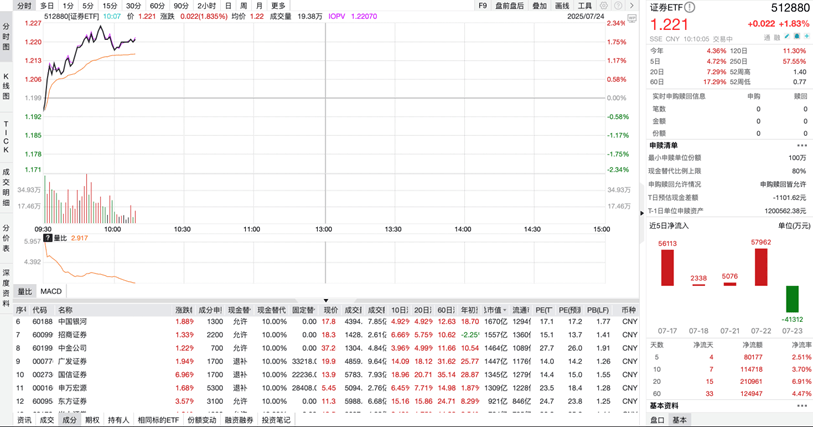
Group 1 - The Shanghai Composite Index (沪指) broke through 3600 points, reaching a new high for the year, with the securities ETF (512880) rising nearly 2% and experiencing a net inflow of over 1.1 billion yuan for 10 consecutive days, bringing its current scale to nearly 34 billion yuan, ranking first among similar products [1][3][4] - Since September 24 of last year, the A-share market has benefited from supportive policies, leading to ample liquidity and a high willingness and speed of capital entering the market. The recent surge in the Shanghai Composite Index provides significant support for the performance recovery of the securities sector [3][4] - Continuous and stable measures to support an active capital market are expected to maintain high trading activity, benefiting the performance and valuation recovery of the brokerage sector [3][4] Group 2 - The securities ETF (512880) tracks the securities company index (399975), selecting listed companies in the comprehensive financial services sector, including securities brokerage and investment banking, to reflect the overall performance of the securities industry [4] - The securities ETF (512880) has achieved a 57.55% increase over the past year, significantly outperforming the Shanghai Composite Index during the same period [4] - Non-bank financial sectors have seen significant allocation increases, with the non-bank financial sector being a key focus for capital allocation due to its valuation advantages and expected performance recovery [3][4]
站在3500点关口,后面的路怎么走?
天天基金网· 2025-07-17 12:32
Group 1 - The core viewpoint of the article is that the Shanghai Composite Index has returned to the 3500-point level, which is considered relatively high but not overly concerning. Historical data shows that the index has crossed this level multiple times, indicating that fluctuations around this point are common [5][8]. - The article discusses the historical context of the Shanghai Composite Index crossing 3500 points, noting that it has done so 23 times in the past 20 years, with approximately 12.18% of that time spent above this level. This suggests that reaching 3500 points can signal the beginning of a new market phase rather than an immediate peak [5][8]. - Institutional perspectives on the market's future direction are characterized by a consensus of "optimism tempered with caution," with various institutions providing insights into potential market movements [10][12]. Group 2 - Key factors influencing the current market include dual drivers of policy and capital. Since 2025, the central bank has implemented measures to release significant liquidity, maintaining a loose monetary policy that supports market activity [15]. - The article highlights the continuous inflow of incremental capital into the market, particularly from insurance funds and foreign investments, which reflects a positive outlook on the A-share market [17]. - Expectations for mid-year earnings reports are improving, with signs of stabilization in the economic fundamentals and significant profit recovery in mid- to downstream industries, providing essential support for the market [19]. Group 3 - For ordinary investors, the article emphasizes the importance of avoiding emotional reactions to market fluctuations and suggests strategies for asset allocation, including diversification across different asset classes and markets [21]. - It recommends a core-satellite investment strategy, where a significant portion of the portfolio is allocated to broad index funds while a smaller portion is invested in thematic funds to capture structural market opportunities [21]. - The article also advocates for a systematic investment approach, such as dollar-cost averaging in equity funds, to mitigate timing pressures and capitalize on market corrections [22].

又创新高!600亿神秘资金入市了?
格隆汇APP· 2025-05-13 09:04
Core Viewpoint - The article discusses the recent influx of 60 billion in mysterious funds into the market, indicating a significant trend in ETF investments and their evolution [1] Group 1 - The article highlights that the ETF market has reached new highs, driven by substantial capital inflows [1] - It mentions the role of institutional investors in propelling the growth of ETFs, suggesting a shift in investment strategies [1] - The analysis points out the increasing popularity of thematic ETFs, which cater to specific sectors or trends, reflecting changing investor preferences [1] Group 2 - The article provides insights into the performance metrics of various ETFs, noting that many have outperformed traditional investment vehicles [1] - It discusses the implications of this capital influx for market volatility and liquidity, emphasizing the need for investors to stay informed [1] - The piece concludes with a forecast on the future of ETFs, suggesting continued growth and innovation in the sector [1]

存量强势吸金 新品密集成立 今年以来2700亿元资金借道ETF入市
Shang Hai Zheng Quan Bao· 2025-05-05 18:18
Core Insights - Despite experiencing net capital outflows at the beginning of the year, the net subscription amount for ETFs reached 1.7 trillion yuan in the first four months, driven by significant institutional purchases on April 7 [1][2] - A total of approximately 2.7 trillion yuan has entered the market through ETFs this year, marking them as a crucial stabilizing force [1] - The strong inflow into ETFs is primarily led by broad-based ETFs, with notable net subscriptions for the Huaxia CSI 300 ETF, Huatai-PB CSI 300 ETF, and E Fund CSI 300 ETF [2] ETF Subscription Trends - April 7 marked a turning point in ETF subscription trends, with net redemptions of nearly 40 billion yuan prior to this date reversing into substantial inflows following institutional support [2] - By the end of April, the net subscription amount for equity ETFs totaled 172.43 billion yuan, indicating a significant recovery in investor sentiment [2] New ETF Products - A total of 167 new ETFs and ETF-linked funds have been established this year, with an issuance scale of 97.43 billion yuan, particularly accelerating after April 7 [4] - The rapid establishment of new ETFs includes 51 funds launched since April 7, collectively raising over 30 billion yuan [4] Institutional Support - Morgan Fund announced plans to invest at least 54 million yuan in newly launched equity public funds, with a commitment to hold investments for at least one year, highlighting institutional confidence in the market [5] Holder Structure and Participation - State-owned and insurance institutions lead in ETF holdings, favoring traditional broad-based indices, while foreign and private equity institutions are increasingly participating as significant sources of new capital [6] - Recent ETF launches have seen a predominance of institutional investors among the top holders, indicating a trend towards institutional dominance in ETF ownership [6]