
软件定义硬件

Search documents
九号公司首发两轮电动车专属系统凌波OS,股价上涨超13%
Zheng Quan Zhi Xing· 2025-08-29 06:43
Core Viewpoint - The release of NimbleOS by Ninebot represents a revolutionary advancement in the two-wheeled transportation industry, integrating various core modules for enhanced performance and user experience [1][2]. Group 1: Product Innovation - NimbleOS is the first comprehensive operating system designed specifically for short-distance two-wheeled travel in China, breaking the traditional hardware isolation model [1]. - The system integrates motor control, battery management, multi-sensor perception, and vehicle interaction, achieving system-level collaboration in hardware performance [1]. - Features such as seamless unlocking, mouse control, and hill assist provide millisecond-level response times, significantly improving vehicle stability in complex road conditions [1]. Group 2: Market Performance - Ninebot's stock price surged over 13% to 73.5 yuan, with a trading volume of 19.65 billion yuan and a turnover rate of 5.02% [1]. - The company reported a revenue of 11.742 billion yuan for the first half of 2025, a year-on-year increase of 76.14%, and a net profit of 1.242 billion yuan, up 108.45% year-on-year [2]. Group 3: Industry Impact - The launch of NimbleOS is seen as a milestone, addressing the fragmentation of underlying technologies in the two-wheeled vehicle sector and introducing a "software-defined hardware" model [2]. - Future functionalities such as vehicle-road collaboration, smart traffic light control, and AI adaptive riding scenarios are expected to evolve from this platform, promoting a collaborative and intelligent two-wheeled transportation ecosystem [2]. - The OTA upgrade capability allows all models to receive continuous updates, transforming the traditional notion of two-wheeled vehicles as fixed products upon delivery [2].
折叠屏出货增速刹车,华为占据中国75%份额
Guan Cha Zhe Wang· 2025-08-26 07:01
Core Insights - The global foldable smartphone market is projected to reach approximately 19.83 million units in 2025, with a year-on-year growth of 6.0%, and is expected to approach 27.29 million units by 2029, reflecting a five-year compound annual growth rate (CAGR) of 7.8% [1] - China has officially surpassed other markets to become the largest foldable smartphone market globally, driven by a mature local supply chain, high consumer acceptance of cutting-edge technology, and manufacturers' precise capture of user demands [1][3] - The market share of China in the global foldable smartphone market is expected to remain above 40% over the next five years, leading innovation and driving the global adoption of foldable technology [1] Market Performance - In the first half of 2025, China's foldable smartphone shipments reached 4.98 million units, marking a year-on-year increase of 12.6%, despite a slowdown compared to previous years [3] - Huawei maintained its leading position in the foldable market with a shipment of 3.74 million units, capturing 75% of the market share, achieving a historical high [5] - Honor, despite not launching new products in the first half of the year, held a market share of 8.4%, while OPPO, Xiaomi, and vivo showcased diverse market vitality with shares of 6.1%, and lower percentages respectively [6] Future Trends - The foldable smartphone market in China is expected to reach 9.47 million units in 2025, with a modest year-on-year growth of 3.3%, indicating a stabilization compared to the previous year [8] - As hardware innovation faces limitations, the focus will shift towards software upgrades, marking a transition to a "software-defined hardware" phase in the foldable industry [10] - Manufacturers are encouraged to deepen collaboration with developers to enhance the large-screen ecosystem and explore the integration of AI technology to maximize productivity potential in various applications [10]


IDC:预计2025年全球折叠屏手机市场出货量约1983万台 同比增长6%
智通财经网· 2025-08-26 05:53
Group 1 - The global foldable smartphone market is expected to reach approximately 19.83 million units in 2025, with a year-on-year growth of 6.0%, and is projected to approach 27.29 million units by 2029, achieving a five-year compound annual growth rate (CAGR) of 7.8% [1] - China has officially surpassed other markets to become the largest foldable smartphone market globally, with a stable market share of over 40% expected in the next five years [1][6] - The first half of 2025 saw China's foldable smartphone shipments reach 4.98 million units, marking a year-on-year increase of 12.6%, despite a slowdown compared to previous years [3] Group 2 - Huawei maintained its leading position in the foldable smartphone market in the first half of 2025, with a shipment of 3.74 million units, capturing 75% of the market share, marking a historical high [5] - Honor, despite not launching new products in the first half of 2025, held an 8.4% market share, demonstrating strong user loyalty [5] - The introduction of new foldable designs, including tri-fold and wide-fold models, has invigorated the market, with the first tri-fold product nearing 500,000 units shipped in the first half of 2025 [3][5] Group 3 - The foldable smartphone market is entering a phase where software upgrades will become the core competitive factor, as hardware innovation is expected to slow down [6] - The development of a robust software ecosystem and collaboration with developers will be crucial for enhancing user experience and productivity in foldable devices [6] - The integration of AI technology with software applications is anticipated to unlock the productivity potential of foldable smartphones in various scenarios [6]
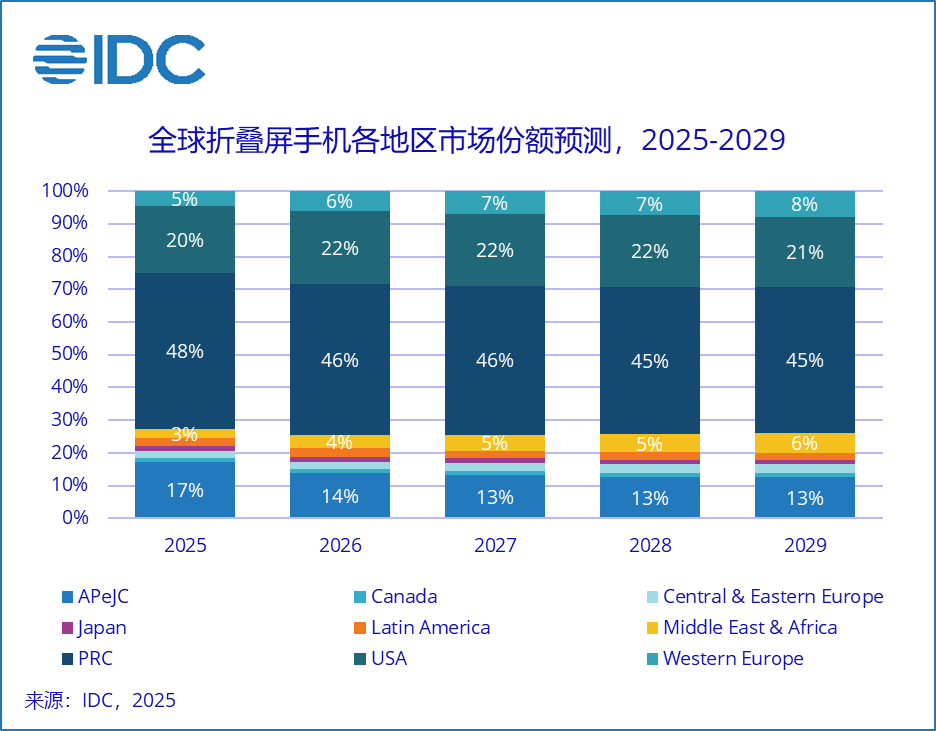
IDC:2025年中国折叠屏手机市场出货量预计达947万台 同比增长3.3%
Zheng Quan Shi Bao Wang· 2025-08-26 04:06
Core Insights - The International Data Corporation (IDC) predicts that the shipment volume of foldable smartphones in China will reach 9.47 million units by 2025, representing a year-on-year growth of 3.3%, which is essentially flat compared to the previous year [1] Industry Trends - The development of component technology has reached a bottleneck, limiting breakthroughs in the "thin and light" aspect of foldable smartphones, leading to a focus on continuous iteration of product forms in the future [1] - Innovative form factors such as tri-fold and wide-fold designs are expected to attract more manufacturers to enter the market, driving deeper innovation in product shapes [1] Software and Hardware Integration - As hardware innovation slows down, software upgrades will become the core factor determining market competitiveness, marking a transition for the foldable screen industry into a "software-defined hardware" era [1] - Manufacturers need to deepen collaboration with developers to accelerate the construction of a large-screen ecosystem, optimizing software applications for large-screen compatibility while exploring deep integration with AI technology [1] - This integration aims to fully unleash the productivity potential of foldable screens in scenarios such as large-screen office work and smart interaction, which will be a significant direction for future industry development [1]
Deepseek发布V3.1 为何火的却是官方留言?
Huan Qiu Wang Zi Xun· 2025-08-23 05:26
Core Viewpoint - DeepSeek has launched DeepSeek-V3.1, featuring comprehensive upgrades in mixed reasoning architecture, cognitive efficiency, and agent capabilities, with a notable focus on the UE8M0 FP8 technology designed for the next generation of domestic chips [1][3]. Company Insights - The announcement of UE8M0 FP8 technology has triggered a positive response in the capital market, with stocks of companies like Cambrian and Haiguang Information experiencing short-term increases [3]. - DeepSeek's introduction of UE8M0 FP8 technology signifies a strategic move into chip technology, reflecting the trend of software-defined hardware, where software stacks and algorithm optimization are crucial for enhancing hardware performance [5]. Industry Trends - The FP8 format is emerging as a new standard for AI training and inference, with major international players like NVIDIA and AMD also investing in this technology, indicating a potential shift in global technology direction [5]. - The FP8 technology optimizes data storage and transmission, significantly improving chip throughput and energy efficiency, thereby enhancing the competitiveness of domestic AI chips in both domestic and international markets [4][5]. - The balance between data precision and computational efficiency remains a core issue in the evolution of technology within the artificial intelligence and high-performance computing sectors [3].

小米强势杀入“前三”,7月线上销量超格力,空调格局变了吗?
华尔街见闻· 2025-08-17 12:49
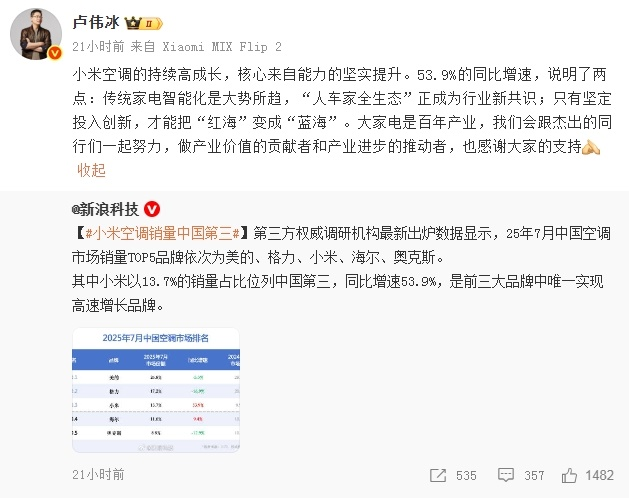
Core Viewpoint - The Chinese air conditioning market is experiencing a significant shift, with Xiaomi surpassing Gree in online sales market share for the first time, indicating a potential disruption in the long-standing duopoly of Midea and Gree [2][6][20]. Market Dynamics - In July 2025, Xiaomi's online sales market share reached 16.71%, overtaking Gree's 15.22%, while Midea remains the market leader [2]. - Xiaomi's year-on-year growth rate of 53.9% has positioned it as the third-largest player in the industry, highlighting its status as the only "high-growth" variable among the top three brands [2]. Competitive Strategies - Xiaomi's strategy focuses on leveraging software to redefine hardware value, transforming air conditioners into integral components of smart home ecosystems [7]. - The company has established a significant partnership with Changhong, contributing approximately 60% of its revenue, which has led to a compression of Changhong's profit margins [7][10]. Cost Constraints - A financial model indicates that the lowest possible retail price for a quality 1.5 HP air conditioner, under ideal conditions, cannot fall below 1900 yuan, suggesting that Xiaomi's pricing strategy is nearing its limits [8][10]. Traditional Giants' Advantages - Midea and Gree possess historical experience, absolute scale, and control over the supply chain, forming a robust defense against new entrants like Xiaomi [11][14]. - The market size is approximately 300 billion yuan, with Midea and Gree generating over 100 billion yuan in domestic sales, providing them with significant purchasing power and cost advantages [12][14]. Future Competition Landscape - The competition is expected to evolve from direct brand confrontations to a more nuanced "agent war" involving sub-brands, allowing traditional giants to maintain their premium positioning while competing with Xiaomi [17][18]. - Sub-brands like Midea's "Hualing" and Haier's "Tongshuai" have gained market share without undermining their parent brands, indicating a strategic shift in competitive tactics [17][18]. Conclusion on Market Structure - While Xiaomi's entry has altered the competitive landscape, the foundational structures of the industry, characterized by historical patterns, scale advantages, and technological control, remain intact [21][22]. - The current market dynamics suggest a more diverse and competitive environment for consumers, driven by the need for traditional players to adapt to new challenges [22].




小米强势杀入“前三”,7月线上销量超格力,空调格局变了吗?
Hua Er Jie Jian Wen· 2025-08-16 12:07
Core Insights - The Chinese air conditioning market is experiencing a significant shift, with Xiaomi surpassing Gree in online sales market share for the first time in July 2025, achieving 16.71% compared to Gree's 15.22% [2] - Xiaomi's annual growth rate reached 53.9%, positioning it as the third-largest player in the market, making it the only high-growth variable among the top three brands [2][6] - The competitive landscape is evolving, with Xiaomi's entry challenging the long-standing dominance of Midea and Gree, which have ruled the market for nearly two decades [6][19] Group 1: Xiaomi's Strategy - Xiaomi's approach leverages software to redefine hardware value, focusing on the smart home ecosystem, with over 70% of its air conditioning users connected online [7] - The company has established a significant partnership with Changhong, contributing approximately 60% of its revenue from air conditioning sales, but this has pressured Changhong's profit margins [10][11] - Despite its aggressive pricing strategy, Xiaomi faces limitations due to physical cost constraints, with a quality air conditioner priced no lower than 1900 yuan under ideal conditions [10][12] Group 2: Traditional Giants' Resilience - Midea and Gree maintain a strong defensive position through historical experience, scale, and control over the supply chain, which have proven effective against price wars in the past [12][13] - The market size of approximately 300 billion yuan allows these giants to leverage their scale, with Midea and Gree generating over 100 billion yuan in domestic sales, significantly outpacing their competitors [12][13] - The vertical integration in the compressor market, where Midea and Gree hold a combined 65% market share, further solidifies their control over the industry [13][16] Group 3: Future Competitive Landscape - The future competition is expected to shift from direct brand confrontations to a more nuanced "agent war" involving sub-brands, allowing giants to maintain their premium positioning while competing with Xiaomi [17][21] - Sub-brands like Midea's "Hualing" and Haier's "Tongshuai" have gained market share, indicating a strategic pivot to capture value in the price-sensitive segment without undermining the main brand [17][21] - The overall market dynamics are changing, with Xiaomi's entry prompting traditional players to adapt their strategies rather than engage in destructive price wars [19][20]

对话星动纪元陈建宇:人形机器人的通途与征途
Huan Qiu Wang Zi Xun· 2025-08-12 10:01
Core Insights - The core viewpoint of the article is that the robotics industry is experiencing a significant convergence towards the "end-to-end" VLA (Vision-Language-Action) paradigm, which is becoming the foundational technology for embodied intelligence [1][2]. VLA Paradigm - The VLA paradigm is defined as a complete closed loop encompassing perception (Vision), understanding (Language), and action (Action), allowing robots to perform tasks in the physical world [2]. - The recent focus on "world models" is seen as an important evolution within the VLA framework, aimed at enhancing robots' precision, generalization, and cognitive abilities [2]. Efficiency and Collaboration - Current humanoid robots still lag behind human efficiency, but there is optimism as some industrial applications have achieved over 70% efficiency compared to humans, with expectations to reach 90% next year [3]. - The end-to-end architecture facilitates real-time feedback and control, breaking the traditional phase delays in recognition, planning, and execution, which is crucial for efficiency improvements [3]. - Deep collaboration between software and hardware is emphasized, with a focus on self-developed dexterous hands that have achieved stable mass production and significant cost reductions [3]. Application Pathway - The pathway to killer applications for humanoid robots is outlined as starting with B-end (business applications) before moving to household applications, with industrial scenarios serving as a necessary phase for technology validation and data accumulation [4]. - The next five years are predicted to be a critical window for the explosion of household robots, with simple forms expected to become widespread and high-net-worth families potentially being the first to adopt general-purpose humanoid robots [4]. Ecosystem Development - The company advocates for a "software defines hardware" approach, where models can adapt to different hardware, but hardware sets the upper limits of model capabilities [5]. - Open-source initiatives are highlighted as a strategic choice, with the company's humanoid robot reinforcement learning framework "Humanoid Gym" and generative large model "VPP" gaining significant attention in the community [5]. - The belief in ecosystem co-prosperity is emphasized, suggesting that improvements made by others on their work will ultimately benefit the company as well [5]. Future Aspirations - The company continues to strive for world-class achievements, with the founder expressing humility about not yet reaching the set standards [6].

那些交付需等一年以上的车,都有谁?
3 6 Ke· 2025-07-07 08:50
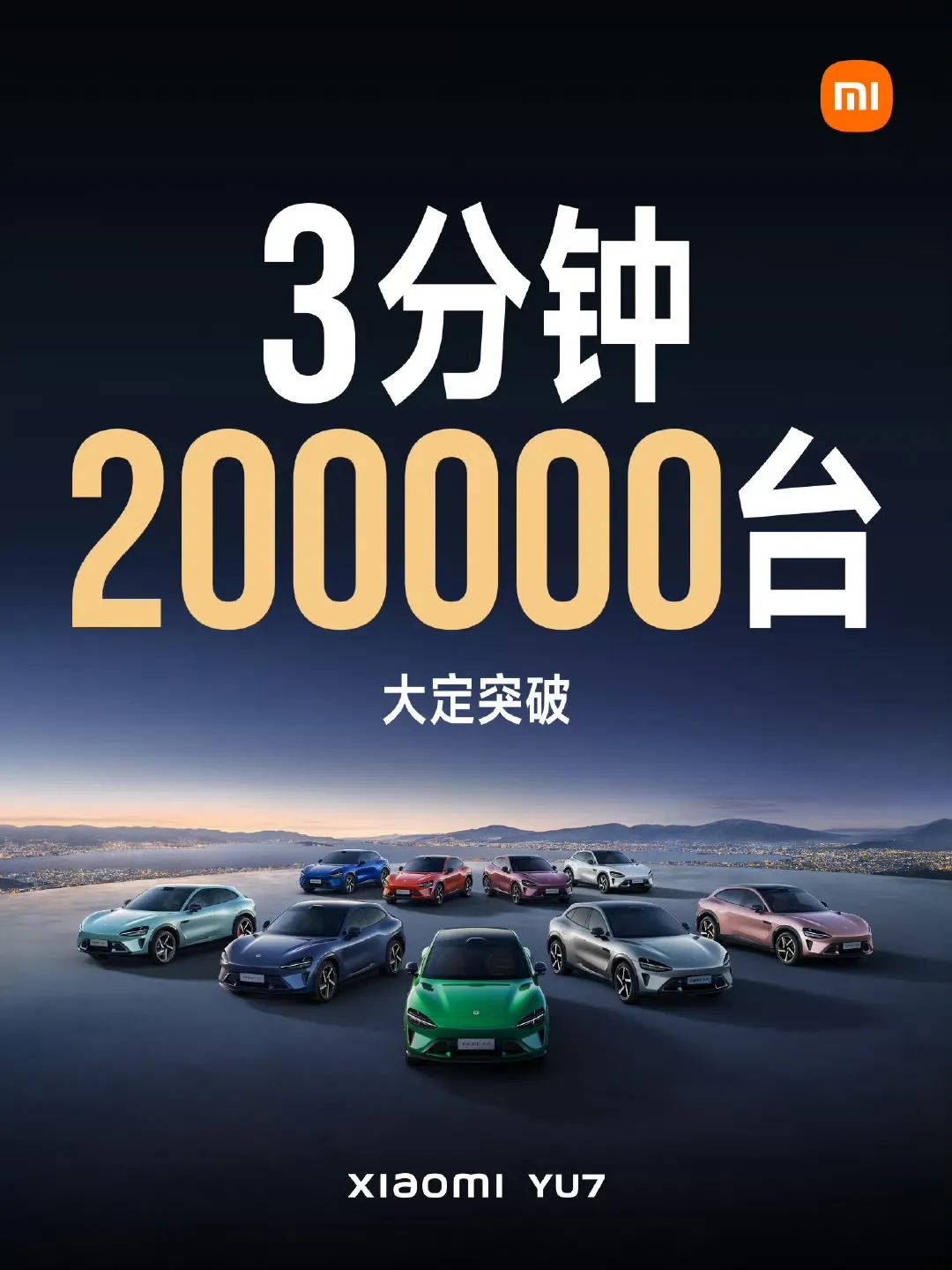
Core Viewpoint - The long delivery times for popular electric vehicles, particularly the Xiaomi YU7, have sparked consumer frustration, despite the high demand and initial excitement surrounding these models [1][5][20]. Group 1: Delivery Times and Consumer Reactions - The Xiaomi YU7 has a delivery time of up to 61 weeks, which translates to over a year, causing significant consumer dissatisfaction and even calls for refunds [5][7][9]. - Other luxury brands also experience long delivery times, with Lamborghini's Revuelto requiring over two years for delivery, while Porsche's Panamera maintains a shorter six-month wait [10][14]. - The phenomenon of long delivery times is not unique to Xiaomi, as many high-demand models across various brands face similar delays due to supply chain issues and production limitations [9][20]. Group 2: Factors Contributing to Delays - The delays in delivery are attributed to several factors, including high demand for these "hot" models, supply chain vulnerabilities, and production capacity constraints [22][23][27]. - For instance, Xiaomi's SU7 has faced extended delivery times due to battery supply issues, which have been partially alleviated by switching to a new battery supplier [24][27]. - The production capacity of Xiaomi's factories is limited, with the current maximum capacity being 300,000 units, while there are over 140,000 outstanding orders for the SU7 alone [27]. Group 3: Consumer Sentiment and Market Dynamics - Despite the long wait times, many consumers are willing to wait due to brand loyalty and the perceived value of the vehicles, particularly among Xiaomi's existing customer base [31][33]. - The emotional value and brand attachment play significant roles in consumer decisions, with some consumers viewing the wait as an opportunity to save more money [34][35]. - However, there are concerns about the potential for the vehicles to become outdated by the time they are delivered, as software updates and new features may be released during the waiting period [38][39].
慧博云通拟收购宝德计算机 计划最晚于5月20日开市起复牌
Quan Jing Wang· 2025-05-13 09:07
Group 1 - Huibo Yuntong (301316.SZ) plans to acquire control of Baode Computer Systems Co., Ltd. through a combination of share issuance and cash payment, aiming to expand from IT services to intelligent computing hardware [1][2] - The acquisition is expected to create a new paradigm of software-hardware integration for the Xinchuang industry ecosystem [1][5] - Huibo Yuntong has established long-term partnerships with major global companies such as ByteDance, Xiaomi, and Alibaba, and reported a revenue of 1.743 billion yuan in 2024, a year-on-year increase of 28.3% [3] Group 2 - Baode Computer, founded in 2003 with a registered capital of 668 million yuan, is a leading provider of ARM server solutions in China and has deep ties with Huawei [4] - The company has been a key player in the Xinchuang field, recognized as a "Kirin Preferred Hardware Partner" and has collaborated with various domestic chip manufacturers [4] - The transaction is seen as a strategic move to reshape the Xinchuang industry landscape, addressing the need for integrated software and hardware solutions [5][6] Group 3 - The integration of software and hardware capabilities is becoming essential for the upgrade and restructuring of the Xinchuang industry, as evidenced by successful precedents in the market [6][7] - The partnership between Huibo Yuntong and Baode Computer is viewed as a critical step in seizing opportunities within the rapidly evolving Xinchuang sector, potentially creating a significant player with comprehensive capabilities [7][8] - Huibo Yuntong's market-oriented approach and experience with large enterprises may enhance the commercialization of Xinchuang devices, particularly in AI applications [8]