防风险

Search documents
2026年置换债披露发行规模超3000亿元 部分省份2026年额度已用完
Xin Hua Cai Jing· 2026-01-28 15:03
业内人士指出,2026年置换债的快速推进,不仅有助于降低地方政府利息负担、优化债务结构,也为腾 出财政空间支持重大项目建设和民生保障提供支撑。东方金诚研究发展部执行总监冯琳表示,一季度地 方债发行规模预计超2万亿元,其中再融资专项债占比近半,凸显"稳增长"与"防风险"双目标协同推 进。 新华财经上海1月28日电据新华财经专项债项目库显示,截至1月28日,年内各地已披露用于置换存量隐 性债务的地方政府再融资专项债规模超过3000亿元。从期限结构看,债券以10年期及以上品种为主。 根据公布的置换债发行方案,2024至2026年每年将安排约2万亿元置换债额度。2026年作为三年置换计 划的收官之年,政策节奏明显前倾。 截至发稿,全国已有多个省份披露2026年用于置换存量隐性债务的再融资专项债发行计划,合计披露的 计划规模达3027.8991亿元,已完成发行规模约2592.5亿元。其中,江苏、山东、浙江等省份已率先启动 发行,成为本轮化债政策"靠前发力"的重要抓手。 值得注意的是,根据相关安排,新疆于2024至2026年共获得648亿元用于置换存量隐性债务的地方政府 专项债务额度,每年分配216亿元,相关债券已于1月 ...
2026年国企改革如何“更上层楼”
Xin Lang Cai Jing· 2026-01-27 22:08
(来源:中国改革报) 围绕这一目标,国资国企将重点推进五大能力建设。要以制定实施"十五五"规划和进一步深化国资国企 改革为牵引,加快提升国有企业价值创造能力,引导企业更加注重内在价值、长期价值,实现质量更 高、效益更好、结构更优、带动更强的发展;加快提升科技创新能力,加强考核引导和政策支持,集中 力量攻克一批辐射性、全局性、战略性技术,增强国家创新体系效能;加快提升产业升级能力,着眼开 辟增长"第二曲线",坚持智能化、绿色化、融合化发展方向,更好支撑现代化产业体系建设;加快提升 改革突破能力,强化思维更新、理念创新、机制革新,以构建新型生产关系为重点深化改革,为高质量 发展提供强大动力;加快提升党建引领能力,着力构建同国资国企新征程新使命更相适应的党建工作新 格局,纵深推进全面从严治党,为企业改革发展提供坚强保证。 2026年是"十五五"开局之年。国务院国资委主任张玉卓表示,起步决定后势,开局关乎全局。为确 保"十五五"开好局起好步,本次会议部署了提质增效稳增长、强化科技创新能力、推进国有经济布局优 化和结构调整、深化国资国企改革、加强国有资产监管、防范化解重大风险六个方面重点工作。 转自:中国改革报 □ 本 ...
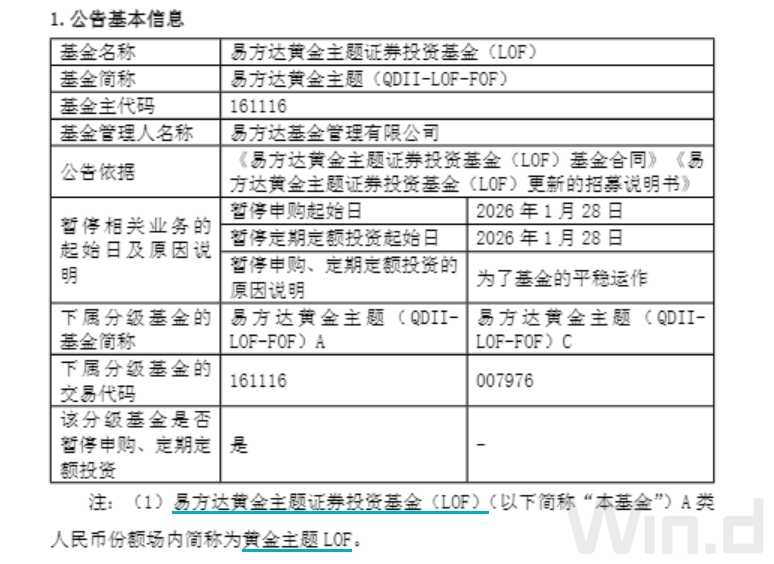
易方达黄金主题LOF,暂停申购!
2 1 Shi Ji Jing Ji Bao Dao· 2026-01-27 13:28
Core Viewpoint - E Fund and Guotai Junan have announced the suspension of subscription and regular investment for their respective gold and silver LOF funds starting January 28, 2026, to ensure stable fund operations [1][3]. Group 1: E Fund Gold LOF - E Fund Gold LOF has suspended subscription and regular investment services effective January 28, 2026, while redemption services will continue as usual [1][2]. - The fund experienced a significant increase in market price, with a rise of over 60% in 2025 and over 15% in 2026 year-to-date [3]. - As of the end of the fourth quarter last year, the fund's total size was 453 million yuan [3]. Group 2: Guotai Junan Silver LOF - Guotai Junan has also suspended subscription services for its silver LOF fund effective January 28, 2026, to protect the interests of fund shareholders and maintain stable operations [3]. - The announcement was made via the official WeChat account of Guotai Junan [3]. Group 3: Market Conditions - Recent market conditions have seen gold prices reaching historical highs, with London spot gold surpassing $5,100 per ounce [5]. - Silver prices have also surged, with COMEX silver futures reaching a peak of $117.7 per ounce before experiencing a decline [5].

全省金融系统工作会议在沈阳召开
Liao Ning Ri Bao· 2026-01-23 01:25
Core Viewpoint - The meeting emphasized the importance of aligning the financial system's actions with the central government's scientific judgment of the current situation, focusing on risk prevention, strong regulation, and promoting high-quality development for 2026 [1] Group 1: Financial System Performance - In the past year, the provincial financial system effectively implemented the central government's decisions and the provincial work requirements, contributing positively to the province's economic development [1] - The leadership of the Party over financial work has become more robust, and financial support for revitalization has been more effective [1] Group 2: 2026 Financial Work Focus - The financial system is tasked with strengthening political guidance and enhancing the Party's comprehensive leadership over financial work [1] - There is a need to establish a long-term mechanism for preventing and resolving financial risks to maintain regional financial stability [1] - The focus will also be on enhancing central-local collaboration and improving regulatory capabilities to create a cohesive regulatory force [1] Group 3: Service to the Economy - The financial system aims to actively serve the overall situation by innovating financial products and improving financial services [1] - There will be a strong emphasis on supporting key areas of the economy and meeting the daily financial service needs of the public [1] - The goal is to continuously enhance the quality and effectiveness of financial services to inject "vitality" into high-quality development [1]
大行看中国:2026中国经济怎么走?
Sou Hu Cai Jing· 2026-01-23 01:07
Core Viewpoint - China's GDP for 2025 is projected to reach approximately 140.2 trillion yuan, with a growth rate of 5% compared to the previous year, despite challenges such as weak domestic consumption and a prolonged real estate crisis [2] Economic Growth Dynamics - The economic growth in 2025 is characterized by a "high in the front and low in the back" trend, with quarterly GDP growth rates of 5.4%, 5.2%, 4.8%, and 4.5%, the latter being the lowest quarterly growth in three years [2] - The growth drivers have shifted predominantly to the tertiary sector, which saw a value-added growth of 5.4%, and foreign trade exports, which increased by 6.1% year-on-year [2] Export vs. Domestic Demand - The economic landscape in 2025 shows a stark "dual-track divergence," with strong export growth (over 10% to emerging markets) contrasted by sluggish domestic demand, where retail sales growth hovered around 3% [3] - The contribution of final consumption expenditure to GDP decreased by 3.2 percentage points compared to the previous year, and fixed asset investment growth was only 2.8%, with real estate investment declining by 4.5% [3] Economic Predictions for 2026 - Predictions for China's economic growth in 2026 range between 4.5% and 5%, reflecting a consensus among over 30 global institutions [6][7] - The International Monetary Fund (IMF) forecasts a growth rate of 4.5%, citing external demand uncertainties and the lagging effects of real estate adjustments as key factors [6] Policy Measures - The 2026 economic strategy emphasizes a combination of proactive fiscal policy and accommodative monetary policy, with a focus on "stabilizing growth while preventing risks" [10] - Fiscal spending is projected to reach 29.7 trillion yuan in 2025, with an increase in the broad deficit scale anticipated for 2026 [10] Structural Adjustments - The monetary policy is expected to maintain a "moderately loose" stance, with anticipated reductions in reserve requirements and interest rates to lower financing costs [11] - Structural tools will be upgraded to support sectors like agriculture, small enterprises, and technological innovation, reflecting a targeted approach to economic support [11] Balancing Growth and Risks - The economic outlook for 2026 presents both opportunities and challenges, with a potential recovery in domestic demand driven by fiscal support and consumer incentives [14] - Risks remain in the real estate sector and local government debt, with expectations of a narrowing decline in real estate sales but ongoing vigilance required for corporate defaults [15]
2025年上百名银行人被“终身禁业”!
Jin Rong Shi Bao· 2026-01-22 11:31
回顾,金融监管呈现出"严监管、强问责、零容忍"的常态化态势。 《金融时报》记者梳理同花顺(300033)iFinD数据发现,在金融持续严监管的态势下,全年,中国、 金融监管总局、国家外汇局及派出机构共对银行业金融机构(包括各分支机构)开出的罚单数量、罚单 总金额均较2024年呈现大幅增长。 值得关注的是,随着监管"同步追责"态势持续,,银行业超3000名相关从业人员被罚,其中,被处以终 身禁止从事银行业工作的银行员工在100名以上。 全年,"一行两局"对银行机构开出的罚单数量高达2588张,被罚没总金额高达26.41亿元,较2024年的 1981张罚单、约13.97亿元的被罚没总金额呈现明显上升趋势。 值得关注的是,在2588张罚单中,"百万级"乃至"千万级"大额罚单明显增多,且主要集中在下半年,并 在年底迎来了"集中爆发期"。 《金融时报》记者梳理同花顺iFinD数据时发现,,银行业共计收到金额超千万元的"天价罚单"31张。 反观2024年,"一行两局"仅对银行机构开出5张千万级罚单。 在31张千万级罚单中,有15张来自第四季度。全年金额最大的一张罚单高达9790万元,原因是公司治 理、贷款、同业、票据、资 ...
海南省召开全省金融系统工作会议:重心聚焦到防风险、强监管及高质量发展
Xin Hua Cai Jing· 2026-01-22 08:28
新华财经海口1月22日电(记者陈碧琪) 海南省22日在海口召开全省金融系统工作会议,落实中央经济 工作会议、全国金融系统工作会议以及省委经济工作会议部署,总结2025年全省金融工作,安排2026年 重点工作。会议对下一步金融重点工作提出加强党的全面领导、扩大制度型开放、坚持服务实体经济等 五点要求。 会议强调,全省金融系统要真正把精力和重心聚焦到防风险、强监管以及在此基础上的促进高质量发展 上来,为高标准建设海南自贸港注入强劲动力。 会议对下一步金融重点工作提出加强党的全面领导、扩大制度型开放、坚持服务实体经济、有效防范金 融风险、持续强化金融监管五点要求。其中在扩大制度型开放方面,强调要加快金融开放政策落地见 效,积极争取新一轮金融开放政策,推动完善海南自贸港金融组织和保障体系;在坚持服务实体经济方 面,强调要畅通货币政策传导,场景化落地金融"五篇大文章",全力推动政策性金融工具和科创债落 地,加快推动保险业高质量发展,增强资本市场服务地方经济的能力。 (文章来源:新华财经) 会议指出,2025年海南省金融安全形势进一步稳固,金融治理效能进一步提升,金融政策效应进一步释 放,金融支持力度进一步强化,全省金融 ...
批量成交!地方国资下场低价“扫货”法拍房
Di Yi Cai Jing· 2026-01-21 11:32
Core Viewpoint - The article discusses the recent trend of state-owned enterprises (SOEs) purchasing properties from judicial auctions at significantly lower prices than market rates, amidst a declining real estate market in China [1][4]. Group 1: Market Dynamics - The judicial auction market for real estate in China is experiencing a decline in both volume and price, with a reported 71.9 million properties listed for auction in 2025, a 6.6% decrease year-on-year [4]. - The total transaction amount in the judicial auction market reached 253.62 billion yuan, reflecting a substantial 23.6% year-on-year decline [4]. - The average transaction price for properties sold at auction was 4,653 yuan per square meter, down 12.7% from the previous year, with an average discount rate of 74.1% [4]. Group 2: State-Owned Enterprises' Involvement - SOEs are increasingly participating in judicial auctions, acquiring properties at prices significantly lower than current market values, which provides them with an opportunity to obtain quality assets at low costs [5]. - For instance, Guangzhou Nansha Urban Operation Co., a state-owned enterprise, purchased 88 residential units at prices ranging from 6,657 to 7,629 yuan per square meter, while the current market price is between 10,000 and 30,000 yuan per square meter [3]. - The involvement of SOEs is seen as a strategy to stabilize the market and mitigate local pressures by absorbing problematic assets during the ongoing risk clearance in the real estate sector [5]. Group 3: Future Implications - The properties acquired by SOEs may not be immediately resold on the market but could be utilized for affordable housing, talent housing, or as part of urban renewal projects [3][5]. - The long-term impact of SOEs' acquisitions on the real estate market will depend on how these assets are managed and whether they are pushed back into the market or used for social purposes [5].
证监会最新部署!
Zheng Quan Ri Bao Wang· 2026-01-16 10:18
Core Viewpoint - The China Securities Regulatory Commission (CSRC) emphasizes the need to consolidate the positive momentum in the capital market while addressing complex challenges posed by intertwined internal and external risks [2][5]. Group 1: Market Stability and Development - The CSRC aims to strengthen market monitoring and regulation to maintain fairness and prevent excessive speculation, ensuring a stable market environment [2][5]. - The focus is on deepening public fund reforms and expanding long-term investment channels to foster a "long money, long investment" market ecosystem [2][5]. Group 2: Reform and High-Quality Development - The CSRC plans to enhance the inclusiveness and adaptability of the multi-tiered equity market, implementing reforms in the ChiNext and STAR Market to facilitate high-quality development [3]. - Efforts will be made to improve the quality and structure of the bond market, including the smooth rollout of REITs in commercial real estate [3]. Group 3: Regulatory Enforcement - The CSRC is committed to strict enforcement against financial fraud, price manipulation, and insider trading, enhancing the effectiveness of regulatory measures [3][7]. - A comprehensive punishment and prevention system for financial fraud will be established, with a focus on increasing the number of cases handled and penalties imposed [5][6]. Group 4: Capital Market Opening - The CSRC aims to deepen and elevate the two-way opening of the capital market, optimizing the Qualified Foreign Institutional Investor (QFII) scheme and expanding the range of futures products available for foreign investment [4]. Group 5: Governance and Party Leadership - The CSRC emphasizes the importance of strengthening the Party's leadership in the capital market, enhancing accountability, and combating corruption within the regulatory framework [7]. - Continuous improvement of the regulatory team’s capabilities and integrity is prioritized to ensure effective market supervision [7].
证监会:坚决防止市场大起大落
清华金融评论· 2026-01-16 09:15
Core Viewpoint - The China Securities Regulatory Commission (CSRC) emphasizes the importance of risk prevention, strong regulation, and promoting high-quality development in the capital market, while addressing the challenges posed by multiple risks and uncertainties in 2025 [3]. Group 1: Achievements in 2025 - The CSRC has made significant progress in stabilizing the market, with a notable increase in medium- and long-term capital entering the market, leading to a recovery trend [3]. - A total of 701 cases of securities and futures violations were investigated, resulting in fines totaling 15.47 billion yuan, indicating enhanced regulatory enforcement [3]. - The total cash dividends and buybacks by listed companies reached 2.68 trillion yuan, reflecting a growing momentum for high-quality development [3]. - The total amount raised through IPOs and refinancing was 1.26 trillion yuan, while the bond market issued various bonds totaling 16.3 trillion yuan [3]. Group 2: Future Work Focus - The CSRC aims to maintain market stability and improve the quality of development by enhancing market monitoring and regulatory measures to prevent excessive market fluctuations [5]. - There will be a focus on deepening reforms in the capital market, including the implementation of the "1+6" policy for the Sci-Tech Innovation Board and the introduction of a third set of standards for the Growth Enterprise Market [6]. - The CSRC plans to strengthen legal enforcement and regulatory effectiveness, particularly against financial fraud and market manipulation, while improving the governance of listed companies [6]. - Efforts will be made to enhance the openness of the capital market, including optimizing the Qualified Foreign Institutional Investor (QFII) scheme and expanding the range of futures products available for foreign investment [7]. Group 3: Party Leadership and Governance - The CSRC emphasizes the importance of strengthening the Party's leadership in the capital market and enhancing the accountability of its regulatory framework [8]. - There will be a focus on improving the quality of the regulatory workforce and ensuring that the regulatory environment is conducive to high-quality market development [8].