
财富管理

Search documents
【福利】财富会员超450元奖励即将失效 速领
中国建设银行· 2025-11-27 06:51
Group 1 - The article highlights promotional rewards for wealth members, including a maximum of 450 yuan in gifts that are about to expire, encouraging timely participation [2] - Members with an average financial asset amount of at least 50,000 yuan in the previous month can receive up to 60 yuan in WeChat discounts [4] - Customers who upgraded to a higher wealth level this year can claim rewards worth up to 206 yuan, with the possibility of receiving multiple rewards across different levels [8] Group 2 - There is a promotional event where members can receive a maximum of 188 yuan in WeChat discounts if their average financial assets in the previous month exceed those of the month before [6] - The article emphasizes the importance of transferring salary or pocket money to enhance asset levels, which allows members to continue receiving rewards in December [2] - The rewards program is structured to incentivize consistent asset maintenance and level upgrades, with multiple options available for members to choose from [8]


华金证券:以资产配置引领财富管理,科技赋能创新增长
Zhong Guo Ji Jin Bao· 2025-11-27 00:29
Core Insights - The article discusses the transformation of China's economy and the wealth management industry, highlighting the shift from traditional to high-quality, technology-driven growth [1][2][3] Economic Outlook - By 2025, China's economy is expected to maintain steady growth, transitioning towards a technology and knowledge-intensive structure, with continuous optimization of the industrial framework [1] - The "14th Five-Year Plan" will conclude in 2025, while the "15th Five-Year Plan" will face complex changes in the development environment, including geopolitical shifts and financial cycle challenges [1] Wealth Management Industry Trends - The wealth management sector is undergoing a significant transformation, moving from scale expansion to differentiated, high-quality growth paths [2] - Huajin Securities is embracing this trend by focusing on asset allocation as a core strategy and expanding diverse investment service scenarios [2][5] Regulatory Environment - The regulatory framework for China's capital markets is improving, with policies aimed at strong regulation, risk prevention, and promoting development [3] - The introduction of new rules has created a more robust institutional foundation for market health, leading to improved market confidence and a significant rise in the Shanghai Composite Index [3] Global Market Dynamics - Global structural changes, including adjustments in U.S. tariff policies and geopolitical tensions, are increasing asset price volatility and economic uncertainty [4] - The domestic bond market is experiencing wide fluctuations, reflecting both internal economic recovery and external influences [4] Huajin Securities' Strategic Initiatives - Huajin Securities is accelerating its transition from product sales to asset allocation-driven services, enhancing its asset allocation toolbox and digital transformation [5][6] - The company is leveraging its shareholder advantages to deepen its regional presence and create a comprehensive service system for institutional clients [6] Future Market Prospects - In 2026, the wealth management business is expected to face challenges but also significant growth opportunities due to global liquidity conditions and domestic policy support [7][8] - The demand for professional asset allocation services is increasing as residents shift their wealth structure and the personal pension system is fully implemented [8] Strategic Vision for 2026 - Huajin Securities aims to focus on core areas and enhance its product system and professional advisory capabilities, while building a digital service ecosystem [9] - The company is committed to transforming its business model from product sales to asset allocation, driven by customer trust and technological empowerment [9]
华金证券:以资产配置引领财富管理,科技赋能创新增长
中国基金报· 2025-11-27 00:17
Core Insights - The article emphasizes the transition of China's economy from traditional labor and resource-intensive industries to technology and knowledge-intensive sectors, highlighting the importance of innovation and industrial upgrading in achieving high-quality growth [2] - The wealth management industry is undergoing a profound transformation, shifting from a scale expansion model to a differentiated, high-quality growth path, driven by asset allocation strategies and technological empowerment [4][8] Economic Environment - By 2025, China's economic environment will face complex changes, including geopolitical shifts, financial cycle challenges, and an urgent need for accelerated economic transformation [2] - Despite these challenges, China's economic fundamentals remain strong, with a resilient and potential-rich foundation supporting long-term growth [2] Wealth Management Industry Trends - The wealth management sector is adapting to a low-interest-rate environment and increased market volatility, focusing on asset allocation as a core strategy [4] - Regulatory improvements and a clearer development line in the capital market are fostering a healthier investment ecosystem, enhancing market confidence and leading to significant index gains, such as the Shanghai Composite Index surpassing 4000 points [4][11] Digital Transformation - The company is enhancing its asset allocation toolbox and digital transformation, launching the "优+" APP to provide comprehensive coverage of off-market financial products [8] - The integration of online and offline services is being prioritized, with a focus on internet advisory services to reach a broader audience through platforms like Douyin and Xiaohongshu [8][9] Future Outlook - For 2026, the wealth management business is expected to face challenges but also significant growth opportunities due to global liquidity conditions and domestic policy support [11][12] - The demand for professional asset allocation services is increasing, driven by changes in residents' wealth structure and the implementation of personal pension systems [12][14] Strategic Focus - The company aims to capitalize on the demand for diversified asset allocation and the upgrade of wealth management needs, transitioning from product sales to asset allocation-driven models [14] - A comprehensive product system and professional advisory capabilities are being developed to navigate the evolving landscape of the wealth management industry [14]

月内两单亿元级保险金信托相继落地
Zheng Quan Ri Bao· 2025-11-26 16:53
Core Insights - The insurance trust sector is witnessing significant transactions, indicating a growing acceptance among high-net-worth individuals for insurance trust services [1][3] - The future of insurance trusts appears promising, with potential for further growth despite some risk factors [2] Group 1: Recent Developments - Sunshine Life and Zhongcheng Trust successfully established a large-scale insurance trust for a family business, showcasing the integration of insurance and family trust structures for wealth management [3] - On November 11, a high-net-worth client signed a 180 million yuan insurance trust service agreement with China United Insurance, marking a substantial advancement in comprehensive wealth planning solutions [3] Group 2: Industry Growth - The insurance trust business has experienced rapid growth, with the scale increasing from 5 billion yuan in 2017 to approximately 747.93 billion yuan by 2021, marking a pivotal point in its development [4] - By the end of 2024, the wealth management service trust scale is projected to exceed 1 trillion yuan, with insurance trusts accounting for about 270.3 billion yuan, representing over 26% of the total [4] - As of early 2025, more than 60 insurance companies are involved in the insurance trust business, indicating a growing market participation [4] Group 3: Market Drivers - The rapid expansion of insurance trusts is driven by increasing demand for wealth transfer and asset isolation among high-net-worth individuals, along with the effective combination of insurance and trust management features [5] - The decline in fixed-income product yields has made whole life insurance a preferred choice for wealth management, further boosting the insurance trust market [5] - The competitive landscape among financial institutions has led to a focus on middle-net-worth and mass affluent clients, enhancing the accessibility of insurance trusts [6] Group 4: Future Trends - The threshold for entering the insurance trust market is decreasing, with a trend towards inclusivity and broader market appeal [6] - The upcoming generational wealth transfer and enhanced client understanding of wealth management are expected to sustain strong demand for insurance trusts [6] - The insurance trust sector is anticipated to evolve from a niche market to a mainstream wealth management tool, supported by product innovation and regulatory improvements [6]
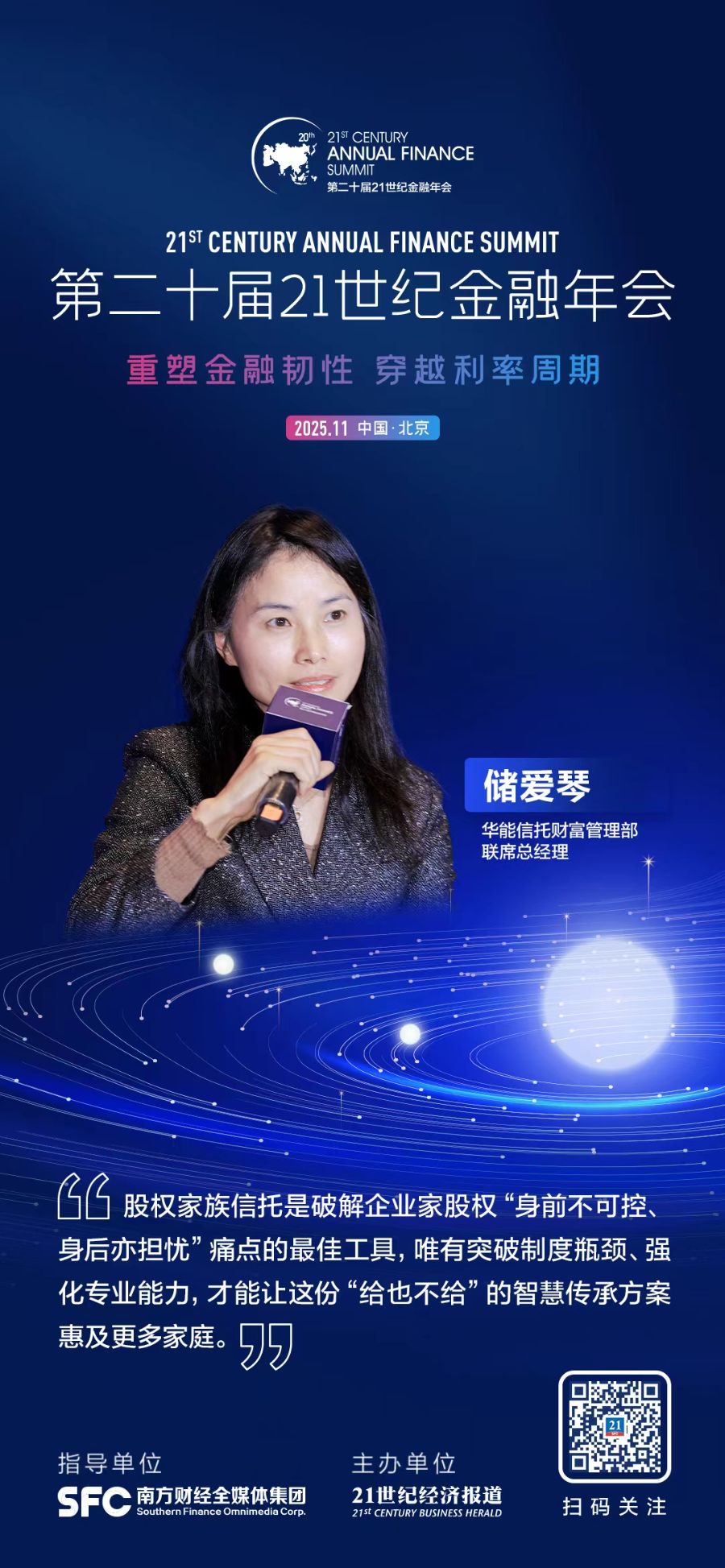
低息时代财富管理破局之路 华能信托解析股权信托新机遇
2 1 Shi Ji Jing Ji Bao Dao· 2025-11-26 13:17
Core Insights - The forum highlighted the significance of wealth management in the current low-interest environment, emphasizing the need for a reevaluation of underlying wealth management logic due to declining savings rates and increased market volatility [3][4] Group 1: Industry Opportunities - The low-interest environment has led to a relative advantage for insurance products, resulting in rapid growth in insurance trusts and family trusts, with family trust development reaching a scale of 300 billion over 10 years and combined family and insurance trusts exceeding 1 trillion [3][4] - The participation of various institutions such as banks, insurance companies, and law firms has created a diversified development ecosystem within the wealth management sector [3] - The introduction of the "three classifications" regulation in 2023 has provided clear policy guidance for the development of wealth management trusts, including pilot programs for real estate and equity trust registrations [3] Group 2: Industry Challenges - Trust companies face a mismatch between business scale and revenue returns in wealth management services, particularly in equity family trusts, which have seen around 300 transactions since their inception in 2019, but are hindered by incomplete registration systems and unclear tax policies [4] - The complexity of equity family trust processes, which can take months or even years to complete, leads to higher service costs and necessitates a fee structure that covers both service costs and risk compensation [4] Group 3: Strategic Directions - To address challenges such as intensified competition and insufficient customer acquisition capabilities, trust companies should focus on enhancing professional service capabilities and building multidisciplinary teams in wealth management, law, tax, investment banking, and family governance [5] - Collaboration with banks remains a primary strategy for customer acquisition, where trust companies can provide professional training to enhance service capabilities in banking channels, fostering a cooperative ecosystem [5] - The market for wealth management service trusts is substantial, and with the removal of related barriers, there is significant business potential for these services to reach more Chinese families [5]
北京通州区区长助理林巍: 建设以财富传承为特色的全球财富管理中心
Zhong Guo Jing Ying Bao· 2025-11-26 11:02
Core Insights - The demand for wealth management in China is growing significantly due to the increasing number of high-net-worth individuals, leading cities like Beijing, Shanghai, and others to compete for the status of wealth management centers [1][2] Group 1: Wealth Management Market Potential - Wealth management is becoming a new growth point for local economies, driven by the accumulation of wealth among Chinese residents over the past few decades [2] - The domestic wealth management market is still in its early stages compared to the mature and large-scale markets abroad, indicating vast development potential [2] Group 2: Resources and Strategies for Development - Successful wealth management requires a local foundation of financial institutions and a concentration of affluent families, which may not be fully present in areas like Tongzhou [3] - Tongzhou aims to differentiate itself by focusing on wealth inheritance and related elder care services, rather than traditional asset management, to build its unique wealth management profile [3][4] Group 3: Wealth Inheritance Market Size - The potential market for wealth inheritance services is estimated to be comparable to the asset management industry, with a potential annual service value of approximately 4.5 trillion yuan [4] - The total social wealth in China is around 600 trillion yuan, suggesting a significant annual demand for inheritance services [4] Group 4: Development of Wealth Management Ecosystem - Wealth inheritance services are seen as resilient to economic cycles, making them an attractive area for development [5] - Trusts are identified as key tools for wealth inheritance, with applications in real estate and equity trusts to ensure effective management and protection of assets [6] Group 5: Building a Global Wealth Management Center - Tongzhou's strategy includes creating replicable experiences in real estate trusts and enhancing the business environment to attract resources and businesses [7] - The "Tongzhou Action" initiative aims to promote trust services within communities, enhancing local trust industry activity and establishing Tongzhou as a significant hub for trust services [7][8]
上调!建设银行,公告!
券商中国· 2025-11-26 08:55
Core Insights - Commercial banks are actively adjusting the risk ratings of mutual funds they sell, with a significant increase in the number of funds affected, indicating a proactive approach to risk management in the current market environment [2][3] - Banks are also offering promotional activities, such as reduced subscription fees for mutual funds, to enhance sales during the year-end peak season, reflecting a competitive strategy to attract investors [5][6] Group 1: Risk Rating Adjustments - On November 25, China Construction Bank announced an increase in the risk ratings of 87 mutual fund products, marking the largest adjustment in two years, with 32 funds upgraded from R2 (medium-low risk) to R3 (medium risk) and 55 funds from R3 to R4 (medium-high risk) [2] - This adjustment is part of a broader trend, as several banks, including Minsheng Bank and CITIC Bank, have also revised the risk ratings of their mutual fund offerings multiple times throughout the year [3] - The reasons for these adjustments include regulatory requirements, market conditions, and changes in target customer profiles, aimed at ensuring accurate risk assessments for investors [3] Group 2: Promotional Activities - Many banks, including Industrial and Commercial Bank of China and Minsheng Bank, have launched promotional activities offering discounts on subscription fees for certain mutual funds, with some fees reduced to as low as 10% of the original rate [5] - These promotional efforts are part of a broader strategy to boost sales during the year-end peak season, with reports indicating that some branches have exceeded their sales targets significantly [6] - The fee discount structure varies among banks, with options including no discount, 50% off, 10% off, and even full waivers, allowing branches to tailor their offerings based on sales needs [5] Group 3: Wealth Management Trends - As deposit rates decline and residents become more aware of wealth management options, banks are intensifying their efforts in selling mutual funds and other asset management products [1][6] - The trend towards increased sales of wealth management products is reflected in the growth of fee and commission income for many banks, with some reporting year-on-year increases exceeding 10% [6] - Analysts suggest that the changing landscape of deposit rates and the aging population will likely lead to a higher allocation of assets towards mid-to-high-risk financial products [7]


低利率下,居民财富如何增长→
Di Yi Cai Jing Zi Xun· 2025-11-26 02:57
Core Insights - The article discusses the shift in wealth management strategies in response to the declining interest rates, with a focus on how financial institutions are adapting to meet changing consumer needs [2][4][8] Group 1: Changes in Wealth Management Demand - The low interest rate environment is reshaping residents' wealth management needs and risk preferences, moving away from reliance on real estate and high-interest deposits to more diversified asset allocation strategies [4] - Three significant changes in client demands for wealth management are identified: a rational adjustment of return expectations, an increased demand for protection products, and a growing awareness of global asset allocation [4][6] - The insurance market reflects the trend of increasing demand for products that balance protection and returns, with a notable 20% year-on-year growth in insurance premiums through bancassurance channels [4][5] Group 2: Investment Strategies and Opportunities - Financial institutions are employing a "dual-track strategy" of "core assets + opportunity assets" to adapt to the low interest rate environment, focusing on dynamic adjustments based on market changes [6][7] - The "fixed income +" product category is highlighted as the fastest-growing fund type, with a net inflow of 460 billion in the third quarter, indicating a gradual increase in risk appetite among investors [5][6] - The article emphasizes the importance of diversified asset allocation, with a focus on technology innovation and undervalued high-dividend assets as key investment directions [7][8] Group 3: The Era of Asset Management - The article posits that China is entering a true asset management era, characterized by a shift towards equity assets as the core vehicle for future wealth growth [8][9] - International investors are increasingly optimistic about Chinese assets, particularly in sectors like artificial intelligence, new energy, and electric vehicles, which are seen as having global competitiveness [8][9] - The article concludes that financial institutions should focus on comprehensive planning that meets clients' risk, return, and liquidity needs, while emphasizing the importance of active management capabilities in fund companies [9]

低利率下,居民财富如何增长→
第一财经· 2025-11-26 02:54
Core Viewpoint - The article discusses the challenges and opportunities presented by the low interest rate environment, emphasizing the need for diversified wealth management strategies among residents to achieve wealth growth despite declining traditional savings options [4][11]. Group 1: Changes in Wealth Management Demand - The low interest rate cycle is reshaping residents' wealth management needs and risk preferences, moving away from reliance on real estate and high-interest deposits to a more diversified asset allocation approach [6]. - Three significant changes in client demands for wealth management have been identified: a rational adjustment of investment return expectations, an increasing demand for protection products, and a growing awareness of global asset allocation [6][9]. - The insurance market reflects this trend, with a 20% year-on-year growth in premium income from insurance channels, particularly in long-term dividend insurance products related to retirement [6][9]. Group 2: Fund Market Trends - The fund market is also showing signs of changing demands, with a recovery in the issuance of equity funds and a notable increase in "fixed income plus" products, which saw a net inflow of 460 billion yuan in the third quarter [7][8]. - The strategy of combining "fixed income" as a base with "opportunistic" assets is being recommended to adapt to the low interest rate environment, with a focus on risk-adjusted returns [9][12]. Group 3: Asset Management Era - The article posits that China is entering a true asset management era, where equity assets are becoming the core vehicle for future wealth growth, driven by technological innovation [11]. - International investment teams are increasingly optimistic about Chinese assets, particularly in sectors like artificial intelligence, new energy, and electric vehicles, which are seen as having global competitiveness [11][12]. Group 4: Multi-Dimensional Asset Allocation - Financial institutions are encouraged to adopt a multi-dimensional asset allocation strategy to optimize domestic and international assets, thereby diversifying risks and capturing opportunities [13]. - Active management capabilities are highlighted as a core competitive advantage for fund companies, emphasizing the importance of long-termism and deep research foundations [13].

十一年“冷板凳”,一朝坐上“火山口”!7000亿微众银行困局,新帅何解?
Sou Hu Cai Jing· 2025-11-25 13:41
Core Viewpoint - WeBank, China's first internet private bank, has achieved significant growth with assets exceeding 700 billion yuan, but it faces challenges including declining revenue and net profit, compliance issues, and a need for new growth drivers [2][3][4]. Group 1: Company Overview - WeBank was established in January 2015 and is recognized for its innovative approach to inclusive finance, having provided its first loan of 35,000 yuan to a truck driver [2]. - As of 2024, WeBank's asset scale has surpassed 700 billion yuan, solidifying its position as a leading private bank in China [3]. Group 2: Financial Performance - For the first time since its inception in 2014, WeBank reported a decline in both revenue and net profit [4]. - In 2024, WeBank's net interest margin has significantly decreased, and it has faced compliance penalties totaling 13.87 million yuan, indicating ongoing regulatory challenges [4][33]. Group 3: Leadership Changes - Huang Liming has been appointed as the third president of WeBank after a long wait of 11 years, taking over during a challenging period for the bank [4][5]. - Huang's background is more aligned with insurance and P2P lending rather than retail banking, which may have contributed to his delayed ascension to the presidency [12]. Group 4: Market Position and Challenges - WeBank's target market primarily consists of underserved segments, including blue-collar workers and individuals with lower educational backgrounds, which presents both opportunities and risks [13][14]. - The bank's reliance on a single product, "Weilidai," has raised concerns about its growth sustainability, especially as economic conditions change [15][16]. Group 5: Asset Quality and Risk Management - WeBank's non-performing loan ratio has shown improvement from 2022 to 2024, but this may be attributed to significant loan write-offs rather than genuine asset quality enhancement [22][25]. - The bank's credit impairment losses have decreased for the first time in five years, contributing to net profit growth, but questions remain about the underlying asset quality [19][22]. Group 6: Future Growth Strategies - WeBank is exploring growth avenues beyond retail lending, including corporate loans, which now account for over 40% of its loan portfolio [35]. - The bank is also focusing on wealth management and intermediary services to diversify its revenue streams, although it still faces challenges in customer retention and product differentiation [37][42][44].
