
多式联运

Search documents
北京平谷国际陆港进口肉类指定监管场地恢复运营
Xin Jing Bao· 2025-06-11 13:08
Core Points - The first batch of approximately 25 tons of imported frozen pork products from the UK has successfully arrived at the Beijing Pinggu International Land Port, marking the resumption of import meat inspection services [1] - The logistics hub has undergone comprehensive upgrades to meet customs and food safety standards, enhancing facilities for inspection and sample pre-treatment, and implementing advanced automated storage and intelligent cold chain management systems [1] - The restoration of meat inspection functions will ensure a stable supply of imported meat for the capital market and facilitate the transformation of the Beijing Pinggu International Land Port from a logistics channel to a trade and industrial hub [1] Group 1 - The logistics hub has established a multi-modal transport network including rail, sea, and air, with regular operations of the China-Europe Railway Express and other intercity trains [2] - The resumption of the designated inspection site for imported meat will serve as an opportunity to strengthen port service functions and build a modern logistics system that serves the capital and radiates to the Beijing-Tianjin-Hebei region and nationwide [2]
“公铁空”多式联运,广东荔枝成交额增长超560%
Nan Fang Du Shi Bao· 2025-06-06 08:00
6月6日上午,乌鲁木齐市沙依巴克区的一家喜事多生活超市里,青红相间的广东荔枝货架前围满了挑选 的顾客。这些荔枝,正是前一日京东从广东湛江联兴荔枝专业合作社现采现摘,通过全程冷链空运,在 凌晨抵疆后直接配送至门店,让新疆消费者第一时间尝到了岭南的"树梢鲜甜"。该超市负责人介绍,这 批荔枝非常受欢迎,短短两小时就售出了上百斤。 作为全球最大的荔枝产区,广东荔枝种植面积常年稳定在400万亩左右,种植面积和产量均超过全国一 半、全球的三分之一。为助力果农增收和当地产业发展,京东今年5月下旬发起行业最大规模助销广东 荔枝专项行动,目前取得积极成效,截至6月5日,广东荔枝在京东成交额同比增长超560%。 据了解,京东超市推出百亿农补-广东荔枝专项,通过产地直采、源头直发模式,与更多当地果农、合 作社直接合作,进一步惠及农户与消费者。以广东茂名根子镇柏桥村为例,京东超市采购量占全村总量 的30%-40%。借助"源头直发",广东荔枝通过京东最快当日即可送上全国用户的餐桌。 6月6日凌晨,京东前一日在湛江直采直发的首批广东荔枝空运抵达新疆,上午便新鲜开售,全程仅用不 到24小时。无独有偶,6月5日清晨,"乘坐"高铁的新鲜荔枝从 ...

研判2025!中国内河水运行业相关政策、市场现状及未来趋势分析:现代化内河水运体系不断优化完善,赋能经济发展[图]
Chan Ye Xin Xi Wang· 2025-06-06 01:20
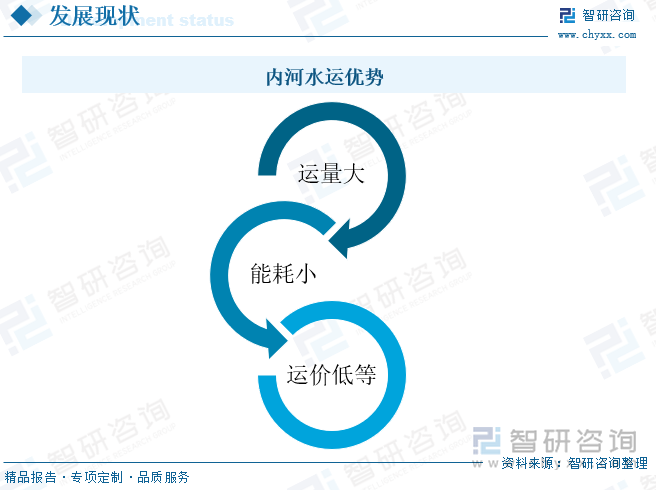
Core Viewpoint - The inland water transport industry in China is experiencing significant growth, driven by government policies and economic recovery, with a focus on enhancing efficiency, reducing costs, and integrating various transportation modes [1][4][9]. Group 1: Industry Overview - Inland water transport refers to the use of vessels to transport goods and passengers through natural or artificial waterways, playing a crucial role in logistics and economic development [2]. - The advantages of inland water transport include large capacity, low energy consumption, and low freight rates, which contribute to cost reduction and efficiency in logistics [2][4]. Group 2: Current Development Status - As of the end of 2022, China's inland waterway mileage exceeded 128,000 kilometers, with continued growth expected in 2023-2024, making it the world's leader in inland waterway navigation [1][11]. - In 2024, the total cargo throughput of inland ports in China is projected to reach 6.377 billion tons, a year-on-year increase of 3.9%, while container throughput is expected to reach 40.4 million TEUs, up 5.2% [1][15]. Group 3: Policy Support - The government has introduced various policies to enhance inland water transport, focusing on waterway construction, vessel standardization, and green shipping initiatives [4][6]. - Key policies include the "Action Plan to Effectively Reduce Logistics Costs" and the "Implementation Plan for Inland Water Transport System Connectivity," aimed at optimizing transportation networks and improving operational efficiency [4][6]. Group 4: Investment Trends - Waterway fixed asset investment reached 201.6 billion yuan in 2023, a 20.1% increase from the previous year, with inland construction accounting for 105.2 billion yuan, up 21.3% [9]. - The investment in waterway infrastructure is expected to continue growing, with a projected 220.8 billion yuan in 2024, reflecting a 9.5% year-on-year increase [9]. Group 5: Future Development Trends - The inland water transport industry is moving towards high-quality development, with increasing market concentration and the integration of green and smart technologies [23]. - The digital transformation of inland ports is accelerating, enhancing operational efficiency and promoting regional economic development through improved multimodal transport networks [24].

山东首条化工品“公路-内河-海运”多式联运通道开通
Da Zhong Ri Bao· 2025-06-04 09:17
Core Insights - The successful launch of the first "road-inland river-sea" multimodal transport corridor for chemical products in Shandong Province marks a significant advancement in port and shipping collaboration [1][2] - This initiative fills a gap in the province's chemical industry by enabling large-scale inland river transportation for chemical exports, establishing a new logistics channel that connects the western Shandong region directly to the Bohai Sea [1][2] Group 1 - The multimodal transport solution has achieved a historic breakthrough by integrating "new customer development, new product expansion, new trade routes, and the establishment of a new logistics channel" [1] - The transport method, which combines road transport, inland river shipping, and sea transport, is projected to reduce logistics costs by 15%-20% annually and decrease carbon emissions by approximately 30% compared to traditional land transport [1] Group 2 - The opening of this multimodal transport corridor not only optimizes logistics channels but also facilitates a dual leap in foreign trade customer development and the expansion of transport categories [2] - Future plans include the cultivation of more innovative "four new" projects and the addition of 3-5 specialized logistics corridors within the year to enhance regional logistics service capabilities [2] - The successful implementation of this multimodal transport for chemical products signifies a breakthrough in Shandong Province's "connecting rivers and seas" strategy, showcasing the potential for further development and cost reduction for inland enterprises [2]
多式联运量质齐升支撑物流降成本
Jing Ji Ri Bao· 2025-06-03 22:16
Core Insights - The report indicates that China's multimodal transport achieved significant growth in both volume and quality in 2024, effectively supporting the reduction of logistics costs across the society [1] - Container multimodal transport volume increased by 15.6% year-on-year, with major ports' container rail-water transport volume rising by 16.5% [1] - The "one document system" reform for multimodal transport has been fully implemented, with approximately 8% of container multimodal transport volume completed through this system [1] Group 1: Infrastructure and Network Development - The optimization of hub functions has provided a crucial foundation for the development of multimodal transport and industrial integration, with 37 hub cities supported and services extended to over 150 national industrial parks [2] - Specialized hub functions, such as rail-water and rail-road transport hubs, are continuously improving, with 49% of logistics parks having a railway logistics base or port within 5 kilometers [2] - The establishment of multimodal transport centers and alliances, along with the release of new standards and policies, has created a favorable environment for multimodal transport development [2] Group 2: Operational Efficiency and Technological Advancements - The multimodal transport network has become more robust, supporting the new development pattern, with 19,000 China-Europe trains and 12,000 Central Asia trains operating in 2024 [3] - The integration of international shipping and rail networks has been enhanced, with 12 container rail-water transport brand routes being developed [3] - The number of automated terminals has reached 52, significantly improving port smart transfer levels and service quality [3] Group 3: Environmental Impact and Structural Optimization - The development of multimodal transport has accelerated the optimization of the transportation structure, contributing to carbon peak and neutrality goals [3] - In 2024, the railway freight volume accounted for 9.1% and waterway freight volume for 17.3%, showing increases of 1.3 and 3.1 percentage points compared to 2017 [3] - Major ports along the coast and Yangtze River have a railway access rate exceeding 90%, indicating effective structural adjustments in transportation [3] Group 4: Market Position and Future Outlook - China's port cargo throughput and container throughput continue to maintain a leading global position, with Ningbo-Zhoushan Port ranking first in cargo throughput for 16 consecutive years [4] - The development of multimodal transport is seen as a core path for deepening transportation structure adjustments and enhancing logistics efficiency [4] - Future efforts will focus on policy implementation and maximizing the role of multimodal transport in supporting the modern circulation system and new development patterns [4]
河南发布规划打造万亿级临港产业集群 三核引领中原出海
He Nan Ri Bao· 2025-06-01 23:42
Core Insights - The article discusses the development of the inland port economy in Henan Province, emphasizing the release of the "Henan Province Port Industry Development Plan (2025-2035)" which aims to enhance the region's economic growth through a structured approach to port industry development [2][3] Group 1: Development Goals - The plan sets dual-phase development goals with key milestones in 2030 and 2035, targeting an industry scale exceeding 1 trillion yuan by 2030 and 2 trillion yuan by 2035, along with the establishment of over 15 major port industry clusters [2][6] - By 2030, the plan aims to create more than 9 port industry clusters each worth over 100 billion yuan and develop 10 or more "shipping enterprises" [2][6] Group 2: Key Port Areas - The plan identifies three core areas for port industry development: Zhoukou, Xinyang, and Zhengzhou, with Zhoukou being the largest inland port in Henan, projected to handle over 87% of the province's cargo throughput by 2024 [4][5] - Xinyang is positioned as a strategic hub for connecting the central plains with the Yangtze River Delta, with a reported cargo throughput of 1.2708 million tons as of April 21 this year, marking a year-on-year increase of 152.49% [4][5] Group 3: Infrastructure and Logistics - The plan emphasizes the need for a robust infrastructure to support the port economy, proposing the implementation of a "2+8" layered port system and a comprehensive waterway network [5][6] - It aims to enhance interconnectivity between Zhoukou and Zhengzhou ports, establishing a multi-modal transport system to facilitate efficient logistics [5][6] Group 4: Industry Focus - The plan outlines a focus on developing five major economic belts along rivers, with a primary emphasis on port logistics, advanced manufacturing, and service industries [6] - It aims to cultivate a diverse industrial ecosystem, including logistics for bulk commodities, container transport, and cold chain logistics, alongside six major manufacturing sectors such as advanced equipment and new materials [6]

四川眉山:打造西南天府国际物流枢纽
Sou Hu Cai Jing· 2025-05-30 06:08
Core Insights - Meishan City is a crucial node in the new western land-sea corridor of Sichuan Province, focusing on the development of the Meishan International Railway Port to enhance logistics capabilities [1] Group 1: Infrastructure Development - The Meishan International Railway Port is located in the Tianfu New Area of Meishan, covering a planned area of over 29,600 acres [1] - The port has launched a total of 443 trains, connecting 34 domestic and international cities, thereby supporting the multi-modal transport system in Sichuan Province [1] Group 2: Logistics Services - The Meishan Bonded Logistics Center (Type B) offers multiple services including bonded warehousing, transshipment trade, and logistics distribution [5][11][14] - The Tianfu New Area Qinglong Rail-Water Logistics Park is actively engaged in cargo handling, showcasing the integration of rail and road transport [3][12] Group 3: Technological Integration - The "Smart Land Port" one-stop service center utilizes digital screens to provide real-time logistics information related to Meishan City [12]
安通控股终止发行股份购买资产 双引擎驱动首季扣非大增925.8%
Chang Jiang Shang Bao· 2025-05-28 23:40
Core Viewpoint - Antong Holdings has decided to terminate its major asset restructuring plan due to disagreements on key terms and changes in market conditions and the actual situation of the target companies [1][2][3] Group 1: Termination of Asset Restructuring - The company planned to acquire 100% of China Foreign Transportation Development Co., Ltd. and 70% of Guangzhou Merchants Roll-on Roll-off Transportation Co., Ltd. through a share issuance [2] - The termination was made to protect the long-term interests of the company and its investors after thorough communication among the parties involved [2][3] Group 2: Strategic Focus on Internal Growth - Post-termination, the company is shifting its strategic focus towards internal growth by optimizing capacity allocation and enhancing multi-modal transport collaboration [3] - The "Three Ports and One Shipping" strategy aims to accelerate logistics network layout and improve logistics efficiency through partnerships with major port groups [3] Group 3: Financial Performance - In Q1 2025, the company reported a revenue of 2.042 billion yuan, a year-on-year increase of 26.35%, and a net profit attributable to shareholders of 241 million yuan, up 371.53% [4] - The net profit excluding non-recurring gains and losses reached 219 million yuan, reflecting a significant year-on-year growth of 925.79% [4] Group 4: Digital Innovation and Collaboration - The company is investing in digital innovation, including the development of an AI-powered customer service assistant to enhance booking processes [5] - A strategic cooperation agreement was signed with Xiamen Guomao Group to focus on domestic container logistics and supply chain finance, aiming to create an efficient logistics service system [6] Group 5: Future Outlook - The company plans to continue focusing on quality improvement, safety, and digital empowerment to drive high-quality development [6] - With the expected release of strategic cooperation resources, the company aims to achieve both qualitative and quantitative growth in the shipping logistics sector [6]

“黄金水道”添活力 杭甬运河启建双百亿级临港产业区
Zhong Guo Xin Wen Wang· 2025-05-28 15:49
中新网绍兴5月28日电(项菁沈嘉玲)5月28日,杭甬运河永和联甬临港产业区启动暨纯甲醇电动智能船全 球首台套项目启动仪式在浙江省绍兴市上虞区永和镇举行,这也意味着杭甬运河沿线将打造双百亿级临 港产业集群,千年"黄金水道"再添新活力。 杭甬运河,古称浙东运河,至今已有2500多年历史,自西向东连接着杭州、绍兴、宁波。其中,沿线的 永和镇因水而兴、航运发达,历史上曾是运河沿岸繁荣的商埠。 如今,永和镇坐拥绍兴"H形千吨级航道网"核心枢纽,向东直连宁波舟山港,向西融入浙北高等级航道 网,向北贯通上海国际航运中心,向南衔接义乌国际陆港,形成"江河海联运、水陆铁衔接"的多式联运 格局。 依托得天独厚的水运优势,杭甬运河永和联甬临港产业区应运而生。 据介绍,该产业区规划占地面积500亩,计划打造覆盖甬绍、辐射华东地区的"水运+公路"多式联运港口 枢纽。建成后,该产业区将形成"前港后市"两期区域,以及集散物流中心、新能源智能船舶制造、绿色 金属加工及交易三大产业区块,并打造成双百亿级临港产业集群,推动传统水运向绿色化、智能化转 型。 作为该产业区的重点项目,纯甲醇电动智能船全球首台套项目也于当日正式启建。该船型采用甲醇清洁 ...
产地直采优质粮源 中亚农产品运贸专列抵汉
Chang Jiang Ri Bao· 2025-05-28 00:31
Core Viewpoint - A special train carrying 1,610 tons of feed wheat flour from Kazakhstan successfully arrived at the China Railway Wuhan Central Station, marking the first Central Asian agricultural product trade train to Hubei province, which will supply local feed processing enterprises [1] Group 1: Agricultural Trade and Logistics - Kazakhstan is a significant wheat producer in Central Asia, providing high-quality wheat, while Hubei, despite being an agricultural province, still relies on some imports for feed grains [1] - The establishment of a "one-stop" logistics model integrating "overseas direct procurement + international trains + rail-water combined transport + local distribution" is expected to exceed an annual import volume of 500,000 tons [2] - The special train's arrival is part of a broader effort to balance the outbound and inbound logistics, with Hubei's textiles, electronics, and vehicles being sent to Central Asia [1][2] Group 2: Transportation and Infrastructure - Wuhan serves as a crucial transportation hub, facilitating rapid distribution of goods across the country through various transport modes, enhancing logistics efficiency and reducing costs [2] - By 2025, the Wujiashan Station of Wuhan Railway has operated 293 China-Europe freight trains, with a year-on-year increase of 6% in outbound trains and 10% in inbound trains [2] - The development of the "train +" new business model aims to improve the quality and efficiency of freight trains and strengthen trade connections between Hubei and Central Asia [2]
