提质增效

Search documents
反内卷情绪发酵,工业硅低位反弹
Tong Guan Jin Yuan Qi Huo· 2025-08-11 02:11
Report Industry Investment Rating No relevant content provided. Core Views of the Report - Last week, industrial silicon rebounded from its low level. The main reasons were the continuous fermentation of anti - involution sentiment in China, the elimination of excess production capacity in the downstream photovoltaic industry chain, and the entry into a stage of quality improvement and efficiency enhancement, which was beneficial to the industry's development prospects. Additionally, China's trade data in July was impressive, with minimal impact from tariffs. The supply side did not show significant expansion, while the demand side faced various challenges. It is expected that the component shipments in August will shrink significantly, and the industrial silicon spot market declined slightly. Technically, the futures price is expected to enter a volatile upward trend in the short term [2][6][10]. Summary by Directory Market Data - From August 1st to August 8th, the industrial silicon主力 contract rose from 8,500 yuan/ton to 8,710 yuan/ton, an increase of 2.47%. The prices of various spot products such as通氧 553,不通氧 553, 421, 3303, and有机硅 DMC decreased, while the price of多晶硅致密料 increased by 6.82%. The industrial silicon social inventory rose to 54.7 tons, an increase of 1.30% [4]. Market Analysis and Outlook - **Macro - aspect**: In July, China's exports increased by 7.2% (in US dollars). In the first seven months, China's total import and export value was 25.7 trillion yuan, a year - on - year increase of 3.5%. High - tech product imports and exports increased by 8.4%, and the "new three" green and low - carbon products increased by 14.9% [7]. - **Supply - demand aspect**: As of August 8th, the weekly output of industrial silicon was 83,400 tons, a month - on - month increase of 6.2% and a year - on - year decrease of 17.9%. The overall furnace - opening rate in the three major producing areas rose slightly to 33.9%. The demand side faced challenges such as limited downstream acceptance of price increases by polysilicon enterprises, difficulty in covering costs in the silicon wafer market, high supply - side pressure in the photovoltaic cell market, and low downstream acceptance in the component market. It is expected that component shipments in August will shrink significantly [8]. - **Inventory aspect**: As of August 8th, the national social inventory of industrial silicon rose to 547,000 tons. The exchange's registered warehouse receipts continued to increase, and the inventory pressure of warehouse receipts decreased due to the continuous decline in domestic production [9]. Industry News - On August 1st, 2025, the US Department of Commerce launched a second anti - dumping and counter - subsidy sunset review investigation on crystalline silicon photovoltaic products imported from China and a second anti - dumping sunset review investigation on products imported from Taiwan, China. The China Photovoltaic Industry Association called on relevant units to provide opinions on the "Price Law Amendment Draft (Exposure Draft)". Guosheng Securities believes that in the context of anti - involution, the price of polysilicon is expected to return above the industry cost price, and attention should be paid to the price repair opportunities in the downstream industrial chain [11][12]. Related Charts - The report provides multiple charts showing data such as industrial silicon production, exports, social inventory, and prices of related products over different time periods [14][17][19].
从“追数量”向“求质量”转变 证券业一流金融人才队伍建设取得新进展
Zhong Guo Zheng Quan Bao· 2025-08-09 00:44
Core Insights - The Chinese securities industry is undergoing a transformation in its human resources strategy, shifting from a focus on quantity to quality, aiming for high-quality development and enhancing the effectiveness of professional talent and middle-back office personnel [1][2] Workforce Evolution - As of the end of 2024, the number of securities professionals is projected to be 335,700, a decrease of 2.04% from 2021. The top five securities firms now account for 17.56% of the total workforce, indicating a concentration of personnel in larger firms [2] - The number of securities brokers has decreased by 27,000, a decline of 48.85%, while investment advisors have increased by 12,000, a rise of 17.46%. The number of securities analysts and sponsors has also increased, reflecting a shift towards wealth management and increased investment in research and investment banking personnel [2] Experience and Efficiency - By 2024, over 50% of industry professionals will be over 36 years old, with the 36-45 age group making up 35.26%, indicating a trend towards a more experienced workforce. The proportion of employees with 11-19 years of experience is 29.58% [3] - There is a significant disparity in human resource efficiency, with top firms maintaining a human resource cost ratio of 32%-38%, which is 10-15 percentage points lower than the industry average. Their revenue and net profit per employee are 2-3 times the industry average [3] Structural Adjustments - The number of brokerage personnel has decreased from 178,500 at the end of 2021 to 146,100 by the end of 2024, a decline of 18.13%. This shift has led to an increase in average revenue per employee, which is expected to stabilize and exceed 2021 levels at 875,500 [4] - In proprietary trading, equity investment personnel have decreased by 14.68%, while bond investment personnel have increased by 25.06%, indicating a shift in focus towards bond investments and new areas like quantitative and derivative investments [5] Research and Sales Dynamics - The number of research and institutional sales personnel has increased from 5,813 to 8,562, improving the sales personnel to researcher ratio from 1:7.1 to 1:4.4. However, the average revenue per research report has declined by 30.10% to 123,300 [6] - The industry has made significant adjustments to personnel structures across various business lines, achieving the goal of improving quality and efficiency while maintaining a dynamic balance between business and management teams [6] Future Talent Development - The industry can enhance talent development by focusing on four key areas: strengthening professional talent capabilities, increasing information technology and international talent reserves, exploring differentiated operations, and promoting professional ethics [7][8] - In 2024, the average revenue per employee in the industry is projected to be 1,344,000, only 38% of that of top firms, indicating lower efficiency among smaller firms [8]
从“追数量”向“求质量”转变 证券业一流金融人才队伍建设 取得新进展
Zhong Guo Zheng Quan Bao· 2025-08-08 21:12
Core Viewpoint - The Chinese securities industry is undergoing a significant transformation in its human resources structure, focusing on quality over quantity to enhance overall industry development and adapt to external changes [1][2]. Group 1: Overall Personnel Changes - As of the end of 2024, the number of securities personnel is 335,700, a decrease of 2.04% from 2021 [2]. - The proportion of personnel in leading securities firms has increased to 17.56%, indicating a concentration of talent in larger firms [2]. - The number of securities brokers has decreased by 27,000, a decline of 48.85%, while investment advisors have increased by 12,000, a rise of 17.46% [2]. Group 2: Professional Quality and Experience - The proportion of personnel aged 36 and above has surpassed 50% for the first time, reflecting a shift towards a more experienced workforce [3]. - The share of employees with 11 to 19 years of experience is 29.58%, indicating a trend of internal talent development [3]. - The human resource efficiency is notably differentiated, with leading firms maintaining lower labor costs and higher revenue per employee compared to the industry average [3]. Group 3: Structural Adjustments in Business Lines - The number of brokerage personnel has decreased from 178,500 at the end of 2021 to 146,100 by the end of 2024, a decline of 18.13% [4]. - The industry has successfully optimized personnel structure, leading to a recovery in average operating income per employee to 875,500 yuan [4]. - In proprietary trading, equity investment personnel have decreased by 14.68%, while bond investment personnel have increased by 25.06% [5]. Group 4: Research and Sales Personnel - The number of research and institutional sales personnel has increased from 5,813 to 8,562, improving the sales personnel to researcher ratio from 1:7.1 to 1:4.4 [6]. - Despite the increase in research personnel, the average operating income per researcher has declined by 30.10% to 123,300 yuan [6]. - The industry has made significant adjustments to personnel structure across various business lines, achieving quality and efficiency improvements [6]. Group 5: Future Talent Development Strategies - The industry should focus on enhancing the capabilities of professional talent, particularly in core business areas, to close the revenue gap with leading global firms [7]. - There is a need to increase the reserve of information technology and international talent to support high-quality development [7]. - The industry should explore differentiated operations and continue to promote professional ethics to strengthen compliance and operational integrity [8].
广钢气体: 关于公司2025年度“提质增效重回报”行动方案的半年度评估报告
Zheng Quan Zhi Xing· 2025-08-08 16:11
Core Viewpoint - The report evaluates the implementation of the "Quality Improvement and Efficiency Enhancement" action plan for 2025 by Guangzhou Guanggang Gas Energy Co., Ltd, highlighting the company's commitment to high-quality development and investor-centric principles [1][2]. Execution Assessment - Core Business Development: The company has aligned with national semiconductor development strategies, successfully securing multiple electronic gas projects in cities like Shenzhen and Nantong, contributing positively to operational performance [2][3]. - Helium Supply Chain Enhancement: The company has signed long-term helium procurement agreements with overseas energy firms, strengthening its supply chain management and expanding its market influence in both domestic and international helium markets [2][3]. - Product Category Expansion: The company is advancing the establishment of electronic specialty gas R&D and production bases in various locations, aiming to enhance domestic production levels of high-end electronic specialty gases [3][4]. Technological Innovation - The company has focused on self-research of core technologies, addressing critical technical challenges in the industrial gas sector, and has made significant advancements in gas production technologies [3][4]. - The company has applied for 12 patents and received 6 patent grants during the reporting period, with a total of 149 patents granted as of June 2025, reflecting a 15.50% year-on-year increase [4]. Risk Management and Internal Control - The company has established a comprehensive risk management and internal control system, enhancing employee awareness of risk management and creating a long-term mechanism for risk prevention and resolution [5][6]. Financial Performance and Dividend Distribution - The company distributed cash dividends totaling 60,675,256.54 yuan (including tax) on June 19, 2025, with a total of 116,087,594.09 yuan (including tax) distributed for the entire year of 2024, representing 46.82% of the net profit attributable to shareholders [5][6]. - For the first half of 2025, the company plans to distribute 0.37 yuan (including tax) per 10 shares, amounting to 48,804,010.69 yuan (including tax), which is 41.53% of the net profit for the period [6]. Future Work Plans - The company aims to ensure the steady construction of existing projects and actively develop new projects in key regions and for important clients in the electronic gas market [7][8]. - The company will enhance internal management processes, strengthen cost control, and improve risk management to ensure operational stability and sustainability [8][9]. - The company plans to increase R&D investment, focusing on core technology development and innovation in electronic specialty gases and equipment manufacturing [8][9].

红旗连锁上半年实现归属于上市公司股东的净利润同比增长5.33% 优化门店结构和提质增效取得成效
Zheng Quan Ri Bao Wang· 2025-08-07 11:45
Core Insights - Chengdu Hongqi Chain Co., Ltd. reported a revenue of 4.808 billion yuan and a net profit of 281 million yuan for the first half of 2025, reflecting a year-on-year growth of 5.33% [1] Financial Performance - The company achieved a net profit growth due to optimizing store structure and enhancing quality and efficiency, which, while slightly impacting revenue scale in the short term, led to effective cost savings [1] - The net cash flow from operating activities was 414 million yuan, which is 1.47 times the net profit, indicating strong cash flow and profit quality [1] Strategic Management - The management team, under the board's leadership, maintained strategic focus and effectively responded to external challenges, resulting in stable overall operations and value creation for shareholders [1] - Internal management was strengthened, resource allocation was optimized, and operational efficiency was improved, significantly reducing operating costs and achieving the goal of offsetting gross profit pressure through cost savings [1]

光伏发电量5591亿千瓦时!同比增42.9%,设备厂商订单回暖显积极信号
Jin Rong Jie· 2025-08-05 02:48
Core Insights - The photovoltaic industry is undergoing significant transformation, shifting from a focus on scale expansion to quality enhancement, with technological innovation becoming the key to overcoming homogenized competition [1][2] Group 1: Industry Performance - In the first half of the year, China's cumulative photovoltaic power generation reached 559.1 billion kilowatt-hours, representing a year-on-year increase of 42.9% [1] - The average utilization rate of photovoltaic power generation in China remains high at 94% [1] - The China Photovoltaic Industry Association has raised its global photovoltaic new installed capacity forecast for 2025 to between 570 GW and 630 GW, while domestic new installed capacity predictions have been adjusted from 215 GW-255 GW to 270 GW-300 GW [1] Group 2: Technological Innovation - The main theme of photovoltaic industry development is shifting from cost reduction and efficiency enhancement to quality improvement and efficiency enhancement [2] - Current high-efficiency photovoltaic module efficiency can reach 23.5%, with an expected annual increase of 0.5 percentage points over the next decade [2] - The theoretical conversion efficiency limit for crystalline silicon solar cells is 29.4%, while perovskite tandem technology is expected to break the 30% efficiency barrier, potentially reaching 43% to 45% [2] - The rise of domestic photovoltaic equipment manufacturers has strengthened the global competitiveness of the industry, with significant advancements in technology leading to a competitive edge [2] Group 3: Market Dynamics - Recent market signals indicate positive trends, with prices for polysilicon, silicon wafers, and solar cells showing signs of recovery since July [3] - Major photovoltaic equipment manufacturers are experiencing a good momentum in new orders, with an ongoing optimization of order structure [3] - New photovoltaic equipment orders are primarily aligned with the TOPCon new process technology, with an increasing proportion of orders for new BC process technology [3] - The demand for new equipment is driven by downstream customers seeking upgrades to improve quality and efficiency [3] - The rapid development of technologies such as HJT and xBC is expected to lead to a new wave of technological transformation, generating significant demand for new equipment [3]
以创新破内卷、以提质求生存 光伏行业重塑竞争新规则
Shang Hai Zheng Quan Bao· 2025-08-05 01:45
Core Viewpoint - The photovoltaic industry is experiencing a recovery with positive signals since July, driven by collaborative efforts from national departments and industry enterprises, leading to a rebound in prices of silicon materials, silicon wafers, and solar cells [1][5]. Group 1: Market Trends - The main theme of the photovoltaic industry is shifting from cost reduction to quality and efficiency enhancement [2]. - The average utilization rate of photovoltaic power generation in China reached 94% in the first half of the year, with a cumulative generation of 559.1 billion kilowatt-hours, marking a year-on-year increase of 42.9% [5]. - The demand for photovoltaic equipment is increasingly focused on improving conversion efficiency, reducing costs, and enhancing system reliability and intelligence [7]. Group 2: Technological Innovation - Technological innovation is essential for quality and efficiency improvement, with a focus on materials, processes, and equipment working in synergy [2]. - The theoretical maximum conversion efficiency for crystalline silicon solar cells is 29.4%, and with perovskite tandem technology, it is expected to exceed 30%, potentially reaching 43% to 45% [2]. - Domestic photovoltaic equipment manufacturers have gained a competitive edge in the global market due to rapid technological advancements and the localization of key components [3][4]. Group 3: Industry Outlook - Experts express optimism about the industry's future, citing the government's commitment to addressing "involution" and the potential for significant growth driven by the dual carbon goals and technological innovation [8][10]. - The China Photovoltaic Industry Association has revised its forecast for global photovoltaic installations in 2025 from 531-583 GW to 570-630 GW, and for China, from 215-255 GW to 270-300 GW [8]. - The industry is expected to gradually emerge from its current low point and enter a new development cycle as it addresses structural supply-demand imbalances [10][12].
以创新破内卷 以提质求生存 光伏行业重塑竞争新规则
Shang Hai Zheng Quan Bao· 2025-08-04 18:51
Core Insights - The photovoltaic (PV) industry in China is experiencing a positive turnaround, with a significant increase in cumulative power generation and an optimistic outlook for future installations [1][10] - The focus of the industry is shifting from cost reduction to quality enhancement and efficiency improvement, driven by technological innovation [2][10] - Domestic PV equipment manufacturers are gaining a competitive edge globally due to advancements in technology and reduced reliance on imports [4][10] Industry Performance - In the first half of the year, China's cumulative PV power generation reached 559.1 billion kilowatt-hours, marking a year-on-year increase of 42.9%, with an average utilization rate of 94% [1][6] - The China Photovoltaic Industry Association has revised its forecast for global PV installations in 2025 from 531-583 GW to 570-630 GW, and for China specifically from 215-255 GW to 270-300 GW [1][10] Technological Advancements - The main theme in the PV industry is transitioning from cost-cutting to quality and efficiency improvements, with high-efficiency PV modules currently achieving efficiencies of 23.5% [2] - Innovations in materials, processes, and equipment are essential for achieving these improvements, with a theoretical efficiency limit for crystalline silicon solar cells at 29.4% and potential breakthroughs with perovskite tandem cells [2] Equipment and Orders - The market for PV equipment is showing signs of recovery, with prices for polysilicon, wafers, and cells rebounding, and a positive order intake for leading equipment manufacturers [6][10] - Companies like Jiangsu Jiangsong Technology are seeing demand for new equipment that aligns with advanced technologies such as TOPCon and BC processes, as well as upgrades for existing equipment [6][10] Industry Outlook - Experts express optimism about the industry's future, citing government efforts to address "involution" and the potential for significant growth driven by the dual carbon goals and technological advancements [10][11] - The industry is expected to overcome current challenges, with a focus on enhancing value and establishing new competitive rules [12]


中国神华(601088):大规模资产收购启动,外延并购行稳致远,龙头风范尽显
GOLDEN SUN SECURITIES· 2025-08-04 11:56
Investment Rating - The report maintains a "Buy" rating for China Shenhua [5] Core Views - The asset injection is seen as a significant strategy for optimizing resource allocation, enhancing coal resource reserves, and improving integrated operational capabilities [2][3] - The company has demonstrated strong historical performance in protecting shareholder rights and enhancing investor returns [2] - The first half of 2025 performance forecast indicates a net profit of 23.6 billion to 25.6 billion yuan, reflecting a year-on-year decline of 8.6% to 15.7% [2] Financial Performance Summary - The company plans to produce 334.8 million tons of commodity coal and generate 227.1 billion kWh of electricity in 2025, with capital expenditures of 41.793 billion yuan [3] - Revenue for 2025 is projected at 326.226 billion yuan, a decrease of 3.6% year-on-year, while net profit is expected to be 50.282 billion yuan, down 14.3% year-on-year [4] - The report forecasts net profits for 2025-2027 to be 50.3 billion, 53.2 billion, and 55.9 billion yuan respectively, with corresponding P/E ratios of 14.8, 14.0, and 13.4 [3][4] Asset Acquisition Details - The company is planning to acquire assets from the State Energy Group, including coal, coal power, and coal chemical assets, involving up to 13 subsidiaries [11] - The total assets of the targeted companies amount to 285.88 billion yuan, with a net asset value of 125.03 billion yuan [11]

小贷机构持续“瘦身”:10年锐减近4000家,11万从业大军缩至4万
Di Yi Cai Jing· 2025-08-03 12:10
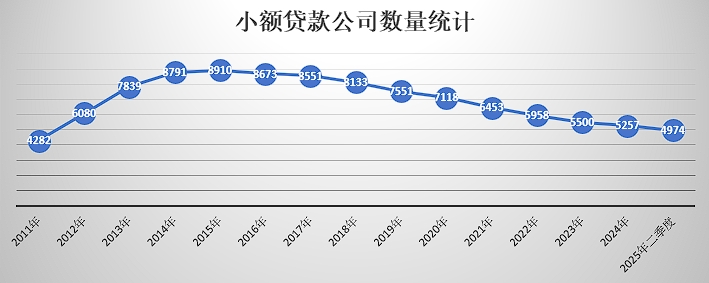
Core Viewpoint - The number of small loan companies in China has significantly decreased in the first half of 2025, surpassing the total reduction for the entire year of 2024, driven by regulatory measures aimed at cleaning up the industry and enhancing quality and efficiency [1][3][5]. Group 1: Industry Statistics - As of June 2025, there are 4,974 small loan companies in China, with a total loan balance of 736.1 billion yuan, reflecting a decrease of 18.7 billion yuan in the first half of the year [1]. - The number of small loan companies decreased by 283 in the first half of 2025, exceeding the total reduction of 243 companies for the entire year of 2024 [3][5]. - Over the past decade, from Q2 2015 to Q2 2025, the number of small loan companies has decreased by 3,977, a decline of 44.4%, while the loan balance has dropped by 223.3 billion yuan, a decrease of 23.3% [5]. Group 2: Regulatory Actions - The People's Bank of China has implemented measures to clear out non-compliant small loan companies, with various provinces actively identifying and shutting down "lost contact" and "shell" companies [2][3]. - In Chongqing, 19 companies were identified as "lost contact" or "shell" and are facing regulatory actions to revoke their pilot qualifications [2]. - The Beijing and Shenzhen local financial management bureaus have also published lists of companies required to exit the industry, with specific deadlines for compliance [3]. Group 3: Industry Trends and Future Outlook - The industry is expected to continue shrinking, with estimates suggesting a further reduction of around 20%, stabilizing the number of small loan companies at approximately 4,000 to ensure effective service in inclusive finance while promoting high-quality development [6]. - The industry has faced challenges such as weak risk control and high borrowing thresholds, which have led to regulatory scrutiny and penalties for non-compliance [6].