稀土出口管制

Search documents
我国稀土管制升级,卡住14nm芯片咽喉
Sou Hu Cai Jing· 2025-10-10 08:30
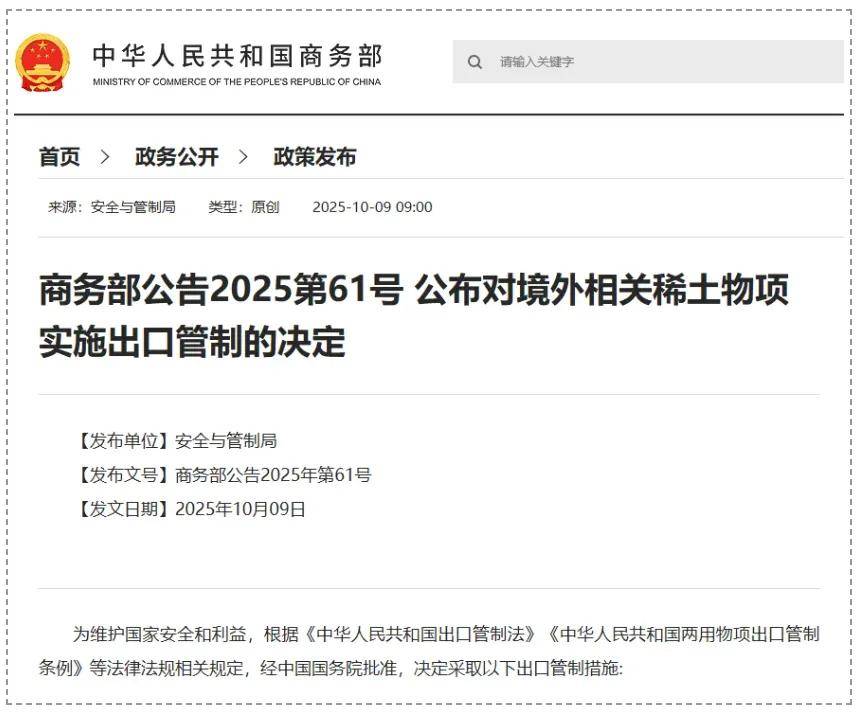
Group 1 - The core point of the article is that China's Ministry of Commerce has implemented new export control policies on rare earth elements, specifically targeting the manufacturing of chips below 14 nanometers and storage chips with over 256 layers, shifting the global focus from materials to key technological applications [1][4][8] - The new regulations require case-by-case approval for exports of rare earth items intended for the research and production of advanced chips, marking a significant expansion of control to include foreign entities [4][7] - The announcement highlights the strategic importance of rare earth elements in high-tech industries, particularly in semiconductor manufacturing and military applications, emphasizing their role as "industrial vitamins" [2][10][16] Group 2 - The new export control measures include a broad definition of "export," covering not only traditional trade but also technology transfer through various means, thereby tightening the control over the entire rare earth supply chain [12][14] - The regulations specifically prohibit Chinese citizens and organizations from providing substantial assistance to foreign rare earth activities without permission, reinforcing the technical blockade [14] - The strategic value of rare earth elements is underscored by their critical applications in semiconductors, renewable energy, and military technologies, with China holding a dominant position in the global rare earth supply chain [16][18][22] Group 3 - The timing of the new export controls reflects China's response to global supply chain restructuring and increasing technological competition, particularly from the US and Europe [18][20] - The measures may lead to bottlenecks in advanced chip manufacturing due to restricted access to essential materials, while also accelerating efforts by other countries to diversify their rare earth supply sources [20][22] - The implementation of these controls is part of China's broader strategy to enhance resource sustainability and upgrade its rare earth industry, moving towards a more regulated and high-end development model [22][23]

谁帮中国堵了稀土走私后门?答案超意外——是美国公司!
Sou Hu Cai Jing· 2025-10-10 06:52
Core Insights - In April 2025, China implemented export controls on seven categories of medium and heavy rare earths, which initially raised concerns about the U.S. supply chain for rare earths, as 90% of refined rare earths in the U.S. come from China. However, three months later, U.S. companies like Lockheed Martin continued production of F-35s and Tesla maintained operations, indicating that smuggling may be occurring despite a 72% drop in Chinese exports [1][3]. Group 1 - The initial customs inspections of large containers yielded no results, but irregularities were discovered in cross-border express shipments labeled as "ceramic parts," which contained epoxy-encapsulated rare earth particles. This led to the uncovering of a smuggling network spanning China, Vietnam, and Mexico [3]. - The smuggling operations involved shipping "protein powder" to Vietnam, where it was mixed with clay and pressed into "ceramic tiles" for transport to Mexico. The extracted materials were then sent to U.S. military contractors as "scrap metal" [3]. - An anonymous tip from a U.S. molybdenum mining company revealed detailed information about the smuggling operations, including warehouses, contacts, and the flow of goods. The company reported that the smuggling of rare earths was undercutting its orders by 40% and causing issues with the purity of materials used in missile tests, prompting the report to protect the industry [3]. Group 2 - In August 2025, a joint law enforcement operation between China, Vietnam, and Mexico dismantled the smuggling network and intercepted shipments, revealing vulnerabilities in the U.S. "diversified supply chain." High-purity dysprosium and samarium are now primarily produced by China, leading to production cuts at Raytheon and Tesla [5]. - The molybdenum mining company that reported the smuggling has since signed long-term contracts with compliant companies, highlighting the importance of adhering to regulations for business sustainability [5]. - The situation illustrates a paradox where U.S. companies, in an effort to protect their interests, inadvertently assisted in closing off smuggling routes, reinforcing the notion that compliance with regulations is essential for survival in the industry [5].



大行评级丨花旗:维持金力永磁“买入”评级 目标价25.3港元
Ge Long Hui· 2025-10-10 05:27
Group 1 - The core viewpoint of the article is that the recent export control measures on rare earth products and technologies by the Ministry of Commerce and the General Administration of Customs are expected to benefit leading companies holding quotas while increasing compliance complexity for downstream magnet manufacturers like Jinli Permanent Magnet [1] - The policy aims to strengthen domestic market protection, which may lead to long-term benefits for companies like Jinli Permanent Magnet through enhanced domestic demand predictability, offsetting short-term export friction [1] - Jinli Permanent Magnet reported preliminary results for the first nine months, with net profit ranging from 505 million to 550 million yuan, representing a year-on-year increase of 157% to 179%, which aligns with Citigroup's estimates for the year [1] Group 2 - Citigroup maintains a "Buy" rating on Jinli Permanent Magnet with a target price of 25.3 Hong Kong dollars [1]
连发两条公告,稀土相关技术出口管制升级
仪器信息网· 2025-10-10 03:58
摘要 :商务部发布2025年61号和62号公告,对稀土相关物项及技术实施出口管制,涵盖开采、冶炼、金属冶炼、磁材制造及回收利用等环节。 特别提示 微信机制调整,点击顶部"仪器信息网" → 右上方"…" → 设为 ★ 星标,否则很可能无法看到我们的推送。 1 0月9日,商务部连发两条公告(2 0 2 5第6 1号和第6 2号公告公告),公布对境外相关稀土物项以及稀土相关技术实施出口管制的决定。此举是 继2 0 2 5年第1 8号公告发布后的又一重要举措。 商务部公告2 0 2 5第6 2号 公布对稀土相关技术实施出口管制,规定以下物项未经许可不得出口: (一)稀土开采、冶炼分离、金属冶炼、磁材制造、稀土二次资源回收利用相关技术及其载体; (二)稀土开采、冶炼分离、金属冶炼、磁材制造、稀土二次资源回收利用相关生产线装配、调试、维护、维修、升级等技术。 商务部公告2 0 2 5第6 1号 公布对境外相关稀土物项实施出口管制,以下物项未经许可不得出口: (一)稀土开采、冶炼分离、金属冶炼、磁材制造、稀土二次资源回收利用相关技术及其载体; (二)稀土开采、冶炼分离、金属冶炼、磁材制造、稀土二次资源回收利用相关生产线装配 ...

特朗普政府入股关键金属公司!有色龙头ETF(159876)下挫...
Xin Lang Cai Jing· 2025-10-10 03:31
Core Viewpoint - The performance of the non-ferrous metals sector remains mixed, with significant movements in stock prices and ongoing policy changes affecting supply dynamics in the industry [1][2]. Group 1: Market Performance - The non-ferrous metals ETF showed weak performance, with a decline of 3.1% and a trading volume of 1.21 billion yuan, while the fund's latest scale is 4.83 billion yuan [1]. - Silver stocks performed exceptionally well, with a notable increase, while companies like Western Gold, Huaxi Nonferrous, and Huayou Cobalt experienced declines of 8.27%, 6.98%, and 6.66% respectively [1]. Group 2: Policy and Supply Dynamics - The Trump administration is discussing investments in critical metals companies, particularly concerning Greenland's largest rare earth project [1]. - The Ministry of Commerce has implemented export controls on rare earth-related technologies, tightening supply policies and maintaining strong price trends in the rare earth sector [2]. - Western Securities predicts that the supply of secondary resource recycling will reach 27% by 2025, indicating a fully controlled supply side with limited potential for sudden increases [1]. Group 3: Industry Outlook - The non-ferrous metals industry maintains a high level of prosperity, with supply constraints from major copper producers due to safety incidents in Indonesia, contributing to rising prices for copper and aluminum [2]. - The top ten weighted stocks in the non-ferrous metals index include major players such as Zijin Mining, Northern Rare Earth, and Luoyang Molybdenum [2].




紫金矿业港股上市+国际标准立项!有色龙头ETF(159876)...
Xin Lang Cai Jing· 2025-10-10 03:31
Core Insights - The performance of the non-ferrous metal sector remains strong, with significant price movements in precious and industrial metals driven by various factors including geopolitical tensions and supply constraints [2] Group 1: Market Performance - As of October 10, the non-ferrous metal ETF showed stable performance with a 0.1% increase in price and a transaction volume of 8.7391 million yuan, bringing the fund's total size to 488 million yuan [1] - Silver has led the gains among constituent stocks with a 6.06% increase, followed by Lichung Group and Northern Rare Earth with increases of 3.64% and 2.96% respectively [1] - Conversely, Chifeng Gold and Western Gold experienced declines of 4.64% and 4.23%, while Huayou Cobalt fell by 3.26% [1] Group 2: Industry Developments - Zijin Mining International officially listed on the Hong Kong Stock Exchange on September 30, marking a significant step in Zijin Mining's global strategy [1] - The establishment of the international standard for "Mining Filling Pipeline Design and Operation" by China at the ISO/TC 82 annual meeting signifies an enhancement in China's international influence in mining technology [1] - An industry growth plan for non-ferrous metals was released on September 28, targeting an average annual growth of 5% in industry value added from 2025 to 2026 [1] Group 3: Price Trends and Projections - The non-ferrous metal industry is experiencing high levels of profitability, with both volume and price increasing across the mining and smelting sectors [2] - Precious metals are influenced by the Federal Reserve's interest rate cuts, geopolitical conflicts, and tariff policies, with international gold prices surpassing 4,000 USD [2] - The tightening of export controls on rare earths is expected to maintain strong pricing, with projections indicating that by 2025, the supply from secondary recycling will account for 27% of total supply [1][2]
新一轮稀土出口管制政策发布,稀土ETF嘉实(516150)近2周新增规模同类居首,成分股安泰科技10cm涨停
Sou Hu Cai Jing· 2025-10-10 03:23
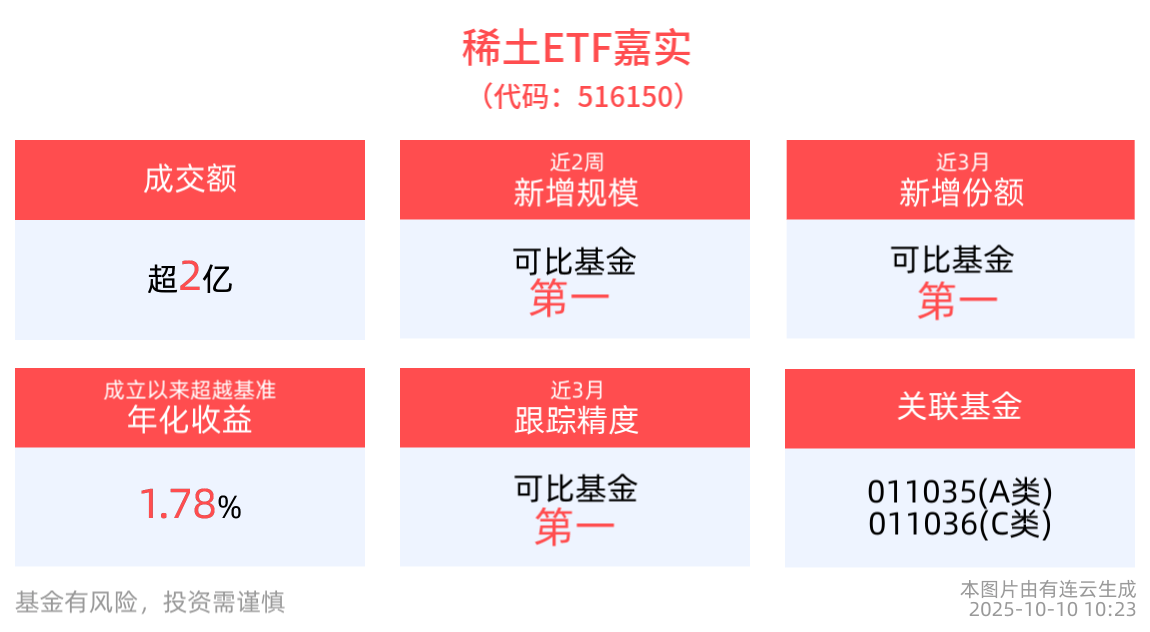
Group 1: Liquidity and Performance of Rare Earth ETF - The liquidity of the Rare Earth ETF managed by Jiashi has a turnover rate of 3.15% with a transaction volume of 251 million yuan [3] - Over the past week, as of October 9, the average daily transaction volume of the Rare Earth ETF reached 783 million yuan, ranking first among comparable funds [3] - The fund's scale increased by 386 million yuan in the past two weeks, also ranking first among comparable funds [3] - The number of shares increased by 2.131 billion in the past three months, marking significant growth and ranking first among comparable funds [3] - As of October 9, the net value of the Rare Earth ETF has risen by 93.31% over the past year, placing it in the top 0.16% of index equity funds [3] - The highest monthly return since inception was 41.25%, with the longest consecutive monthly increase being four months and a maximum increase of 83.89% [3] Group 2: Rare Earth Industry Policy and Supply Chain - The Ministry of Commerce has introduced a new round of export control policies for rare earths, aimed at strengthening management of the rare earth industry chain [4] - These policies include regulations on the recycling and utilization of secondary resources, with expectations that by 2025, secondary recovery will account for 27% of the rare earth supply chain [4] - The new regulations will strictly control the incremental supply of rare earths, making it difficult for the market to experience sudden increases in supply [4] - The focus of these controls is primarily on medium and heavy rare earths, including metals such as samarium, dysprosium, and terbium [4] - The tightening of policies may lead to frequent fluctuations in rare earth supply, potentially improving the overall supply-demand dynamics in the industry [4] Group 3: Top Weighted Stocks in Rare Earth Industry - The top ten weighted stocks in the Zhongzheng Rare Earth Industry Index account for a total of 61.96% of the index [3] - The leading stocks include Northern Rare Earth, Wolong Electric Drive, Lingyi Zhi Zao, China Rare Earth, Shenghe Resources, Greeenmei, Goldwind Technology, Baotou Steel, Xiamen Tungsten, and China Aluminum [3] - The performance of these stocks varies, with Northern Rare Earth showing a decline of 0.81% and China Rare Earth declining by 2.51% [6]





我国稀土出口管制政策加码,稀土价格中枢有望持续上移
Jin Rong Jie· 2025-10-10 02:30
Core Viewpoint - The Chinese government has announced stricter export controls on certain medium and heavy rare earth items, effective from November 8, 2025, which is expected to strengthen China's dominance in the global rare earth market and enhance its pricing power [1] Group 1: Export Control Measures - The Ministry of Commerce and the General Administration of Customs have implemented export controls on specific rare earth equipment and raw materials, as well as rare earth technologies [1] - The new export control policy expands to cover overseas transshipment and technology transfer, complicating access for foreign companies even if they obtain ore [1] Group 2: Market Impact - In 2024, China's rare earth production is projected to account for 68.57% of global output, with reserves representing 39.21%, indicating a significant supply dominance [1] - Following the previous export controls in April, overseas medium and heavy rare earth prices surged, leading to a rapid widening of the price gap between domestic and international markets [1] Group 3: Competitive Advantage - The enhanced export controls are expected to solidify China's competitive advantage across the entire rare earth industry chain, thereby reinforcing its global pricing authority [1]
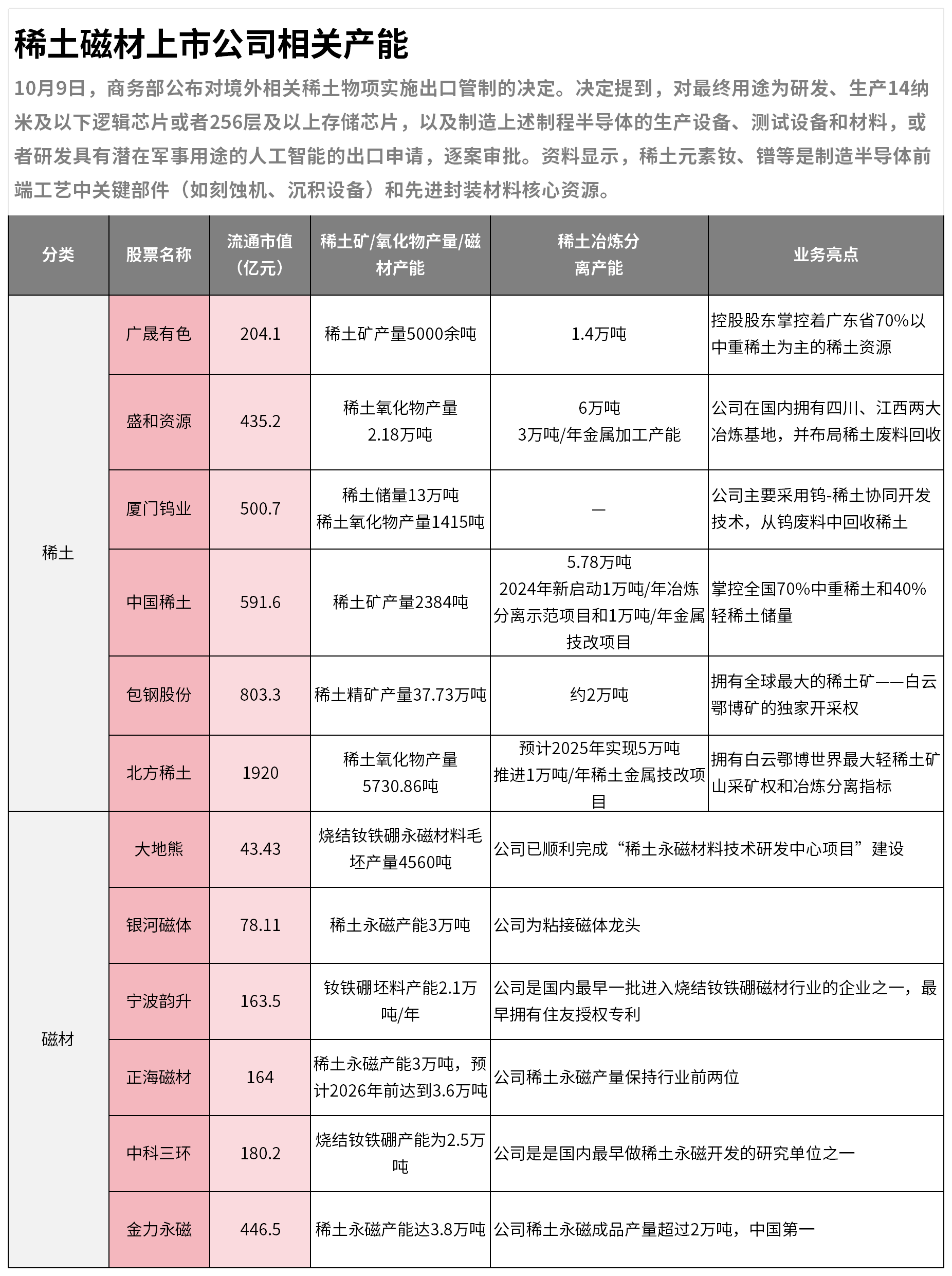
一图了解稀土磁材上市公司相关产能
Xuan Gu Bao· 2025-10-10 01:28
Group 1 - The Ministry of Commerce announced export controls on certain rare earth items, including logic chips and storage chips with potential military applications, requiring case-by-case approval for export applications [1] - The table lists various companies involved in rare earth production, detailing their market capitalization, production capacity, and output figures [1] Group 2 - Guangxi Rare Earth has a market capitalization of 20.41 billion yuan and produces over 5,000 tons of rare earth minerals [1] - Shenghe Resources has a market capitalization of 43.52 billion yuan with a rare earth oxide output of 21,800 tons and a production capacity of 30,000 tons [1] - Xiamen Tungsten has a market capitalization of 50.07 billion yuan, with rare earth reserves of 130,000 tons and an oxide output of 1,415 tons [1] - China Rare Earth has a market capitalization of 59.16 billion yuan, producing 2,384 tons of rare earth minerals and planning a new separation demonstration in 2024 [1] - Baotou Steel has a market capitalization of 80.33 billion yuan, with a rare earth concentrate output of 377,300 tons [1] - Northern Rare Earth has a market capitalization of 192 billion yuan, producing 5,730.86 tons of rare earth oxides and expected to advance production by 10,000 tons [1] Group 3 - Dadi Xiong has a market capitalization of 4.343 billion yuan, with a sintered neodymium-iron-boron permanent magnet output of 4,560 tons [2] - Galaxy Magnet has a market capitalization of 7.811 billion yuan, with a rare earth permanent magnet capacity of 30,000 tons [2] - Ningbo Yunsheng has a market capitalization of 16.35 billion yuan, with an ammonium iron boron blank capacity of 21,000 tons per year [2] - Zhenghai Magnetic Materials has a market capitalization of 16.4 billion yuan, with a rare earth permanent magnet capacity of 30,000 tons, expected to reach 36,000 tons by 2026 [2] - Zhongke Sanhuan has a market capitalization of 18.02 billion yuan, with a sintered platinum-iron-boron capacity of 25,000 tons [2] - Jinli Permanent Magnet has a market capitalization of 44.65 billion yuan, with a rare earth permanent magnet capacity of 38,000 tons [2]
华尔街见闻早餐FM-Radio|2025年10月10日
Sou Hu Cai Jing· 2025-10-09 23:53
Market Overview - US macroeconomic data remains uncertain, raising concerns about bubble risks and increasing profit-taking demand, leading to a decline in US stocks. However, a late rally was triggered by Microsoft's forecast of a data center supply shortage lasting until 2026, although major indices still closed lower [1] - The performance of the seven major US tech stocks was mixed, with Meta rising over 2% and Nvidia hitting a new high, while Apple fell over 1.5%. Investors shifted from cyclical sectors to defensive sectors, with Chinese concept stocks dropping over 2% [1] Bond and Currency Markets - US Treasury bonds faced selling pressure, with yields on major maturities rising by 1-2 basis points. The US dollar increased by 0.72%, surpassing 99 and reaching a two-month high [2] - Bitcoin experienced a drop of approximately 3.3% from its daily high, while Ethereum fell by 3.7%. Strong dollar dynamics, coupled with ongoing negotiations between Israel and Hamas, led to declines in precious metals, with gold dropping by 1.70% below $4000 and silver retreating over 5.6% after a historic peak [2] Oil Market - US oil prices fell by over 1.3% during the day [3] Asian Market - The Shanghai Composite Index opened positively for the fourth quarter, breaking the 3900-point mark for the first time in ten years, with significant gains in gold and copper, while the semiconductor sector retreated in the afternoon [4] Key Developments - The Chinese Ministry of Commerce issued four announcements regarding export controls on rare earths, lithium batteries, and superhard materials, set to take effect on November 8 [4] - The US government faces difficulties in resolving a shutdown, with the Senate rejecting funding bills multiple times, and Trump threatening to cut Democratic projects [5] Federal Reserve Insights - The US Labor Statistics Bureau is preparing to release the September CPI data during the government shutdown, which is crucial for determining future Social Security payments [6] - Federal Reserve officials expressed differing views on inflation risks and interest rate cuts, with some supporting further cuts this year while others urged caution [20] Company Developments - Microsoft predicts a data center supply shortage will last until mid-2026, exceeding previous expectations of late 2025, despite significant capacity increases [22] - Intel showcased its new 18A process AI PC chip, marking a significant advancement in US manufacturing capabilities [23] - TSMC reported Q3 revenue exceeding expectations, with a year-on-year growth of 30%, driven by strong AI demand [11] Mergers and Acquisitions - HSBC plans to privatize Hang Seng Bank for $13.6 billion, offering a premium of over 30% [24] - Novo Nordisk announced a $5.2 billion acquisition of Akero Therapeutics to enhance its liver disease treatment portfolio [32] Industry Trends - The semiconductor industry is expected to recover by 2025, driven by AI demand and significant investments from major tech companies [35] - The rare earth sector is facing tighter export controls from China, which may strengthen its global pricing power [37]