
稀土磁材

Search documents
稀土磁材行业周报:本周板块反弹,产业链价格有望逐步企稳-20260329
Xiangcai Securities· 2026-03-29 13:08
Investment Rating - The industry investment rating is maintained at "Overweight" [3][41] Core Views - The rare earth magnetic materials industry rebounded by 1.42% this week, outperforming the benchmark (CSI 300) by 2.84 percentage points [5][12] - The industry valuation (TTM P/E) slightly decreased by 0.37x to 73.56x, currently at 85.6% of its historical percentile [5][12] - The prices of rare earth concentrates remained stable overall, with praseodymium and neodymium prices stabilizing after a decline, while dysprosium and terbium prices continued to show weakness [6][9] - The supply side of rare earths is experiencing a downward trend in operating rates among mineral separation enterprises, with expectations of increased waste supply to partially offset the reduction in raw ore supply [10][40] Summary by Sections Industry Performance - Over the past month, the industry has shown a relative return of -20%, a 4% return over three months, and a 48% return over the past year [4] - Absolute returns are -24% for one month, 1% for three months, and 63% for twelve months [4] Market Trends - The rare earth magnetic materials industry is expected to stabilize as downstream inventory gradually decreases, with potential support for market prices [10][40] - The demand side is experiencing a temporary decline in orders, primarily due to previous price drops causing delays in downstream purchases, but overall demand remains stable with potential for concentrated release in the future [10][40] Investment Recommendations - The report suggests focusing on upstream rare earth resource companies that may benefit from valuation premiums and stable profits due to policy support and strategic value positioning [10][44] - It also recommends paying attention to downstream magnetic material companies with good customer structures and full capacity utilization, such as Jinli Permanent Magnet, as rare earth prices are expected to continue their upward trend [10][44]
湘财证券晨会纪要-20260327
Xiangcai Securities· 2026-03-27 01:00
Industry Overview - The rare earth magnetic materials industry experienced a decline of 10.25% this week, underperforming the benchmark by 8.06 percentage points [4] - The industry valuation (TTM P/E ratio) decreased to 73.94x, which is at 86% of its historical percentile [4] Price Movements - Prices for rare earth concentrates and praseodymium-neodymium saw significant declines, with mixed carbonate rare earth ore prices dropping by 8.7%, 10%, and 11.43% for different regions [5] - The average price of praseodymium-neodymium oxide fell by 11.88%, while the metal price decreased by 10.1% [5] - Dysprosium and terbium prices also continued to decline, with dysprosium oxide down by 4.47% and terbium oxide down by 2.33% [5] - The price of sintered neodymium-iron-boron (N35) decreased by 5.57%, and H35 by 4.01% [5] Supply and Demand Dynamics - The supply side remains stable with limited capacity increases, while demand is relatively stable with normal production levels in neodymium-iron-boron enterprises [6][7] - Short-term price adjustments are expected as downstream inventory reduction is prioritized, with limited room for further price declines anticipated [7] Investment Recommendations - The industry maintains an "overweight" rating, with expectations of continued support from policy and strategic value positioning despite short-term valuation pressures [8] - Focus on upstream rare earth resource companies is recommended due to policy support and stable profitability, while downstream magnetic material companies with strong customer structures and growth potential should also be monitored [8]
MP-Materials
2026-03-19 02:39
MP Materials Conference Call Summary Company Overview - MP Materials is a leading player in the U.S. rare earth magnet sector, with a fully integrated business model encompassing rare earth mining, refining, and manufacturing of metal alloys and magnets in Texas [3][4] - The company has established a significant partnership with the U.S. Department of Defense, which has become its largest investor and customer, providing a price floor for its downstream and refining businesses [2][3] Key Points and Arguments - **Defense Partnership**: The agreement with the U.S. Department of Defense ensures a minimum profitability level for the company, with the DoD being the sole customer for the new 10X magnet facility [2][3] - **EBITDA Guidance**: The company anticipates a normalized EBITDA floor exceeding $650 million post the 10X facility's launch, based on NDPR prices of $110 per ton and a capacity of 6,000 tons [2][4] - **Market Demand**: There is a surge in demand for rare earth magnets driven by physical AI applications (robots, drones) and hybrid vehicles, offsetting the slowdown in pure electric vehicle growth [2][4] - **Vertical Integration**: The company has achieved a closed-loop vertical integration by recycling old magnets, which provides a cost advantage of 20%-50% against Chinese competitors [2][8] - **Technological Advancements**: Significant breakthroughs have been made in reducing the heavy rare earth content required for automotive-grade magnets by approximately 60% [2][7] - **Independence Facility**: The Independence facility is set to supply General Motors by late 2026, having completed the challenging automotive-grade PPAP certification [2][6] Industry Dynamics - **Supply Constraints**: The tightening supply of NDPR due to export restrictions from China is expected to drive prices higher, with the market showing significant concern over securing NDPR sources [4][10] - **Competitor Landscape**: Other Western competitors are struggling with raw material shortages, which positions MP Materials favorably due to its integrated supply chain [6][10] - **Future Growth**: The company is well-positioned to capitalize on the expected growth in physical AI applications over the next decade, with NDPR supply shortages anticipated [9][10] Additional Insights - **Recycling Strategy**: The recycling business is crucial for the company's vertical integration strategy, allowing it to recover 20%-50% of raw materials lost during production [8][9] - **Capital Expenditure**: The company plans to focus on executing its projects, particularly the 10X project, before considering capital allocation strategies such as mergers, stock buybacks, or dividends [10] - **Market Sentiment**: The overall market sentiment is optimistic regarding the demand for rare earth magnets, especially in defense and AI applications, indicating a robust future outlook for MP Materials [9][10]
湘财证券晨会纪要-20260312
Xiangcai Securities· 2026-03-12 00:29
Industry Overview - The rare earth magnetic materials industry experienced a significant decline of 11.35% this week, underperforming the benchmark by 10.28 percentage points [2] - The industry valuation (TTM P/E ratio) decreased to 87.01x, which is at the 93.2% historical percentile [2] - Prices for rare earth concentrates have generally retreated, with praseodymium and neodymium prices also declining, while neodymium-iron-boron (NIB) sintered block prices remained stable [2][3] Price Movements - The average price of praseodymium-neodymium oxide fell by 3.69%, and the average price of praseodymium-neodymium metal decreased by 2.8% this week [3] - Dysprosium and terbium prices also saw reductions, with dysprosium oxide down by 6.83% and dysprosium metal down by 5.7% [3] - The average price of neodymium-iron-boron N35 remained stable, indicating a lack of upward pressure from the upstream rare earth raw material market [3] Supply and Demand Dynamics - The supply side remains tight, with stable operations in separation enterprises but limited production capacity, leading to insufficient overall output [4] - Demand from neodymium-iron-boron enterprises is stable, with decent order volumes, although short-term procurement is limited [4] - The overall demand outlook is positive, with expectations for stable growth in the end market, particularly in the context of new energy vehicle production [4] Investment Recommendations - The industry maintains an "overweight" rating, with expectations of short-term valuation pressure but a long-term recovery potential due to stable demand and limited supply growth [5] - Continued focus on upstream rare earth resource companies is advised, as they are expected to benefit from valuation premiums and stable profitability [5] - Downstream magnetic material companies, particularly those with strong customer structures and new growth opportunities, are also recommended for attention [5]
稀土磁材行业周报:本周板块走势大幅回落,产业链价格整体回调-20260308
Xiangcai Securities· 2026-03-08 14:36
Investment Rating - The industry investment rating is maintained at "Overweight" [3][10] Core Views - The rare earth magnetic materials industry experienced a significant decline of 11.35% this week, underperforming the benchmark by 10.28 percentage points [5][12] - The industry valuation (TTM P/E) decreased to 87.01x, which is at the 93.2% historical percentile [5][12] - The prices of rare earth concentrates have generally retreated, with specific declines noted in praseodymium and neodymium prices, while the price of neodymium-iron-boron blanks remained stable [6][9] - Supply remains tight in the rare earth sector, with stable operations in separation enterprises, but overall production growth is insufficient due to capacity constraints [10][37] - Demand is stable, with decent orders from neodymium-iron-boron enterprises, and expectations for overall demand in the end market are positive [10][37] - The industry faces short-term valuation pressure due to declining market risk appetite, but medium to long-term supply constraints and stable demand growth are expected to support prices [10][38] Summary by Sections Industry Performance - Over the past month, the industry has shown a relative return of 8%, a 3-month return of 16%, and a 12-month return of 73% [4] - Absolute returns for the same periods are 9%, 17%, and 91% respectively [4] Price Trends - The average price of domestic mixed rare earth carbonate decreased by 1.96%, while prices for specific rare earth minerals also saw declines [9][15] - The average price of praseodymium oxide fell by 3.69%, and the average price of praseodymium metal decreased by 2.8% [18][21] - Dysprosium and terbium prices also saw significant reductions, with dysprosium oxide down 6.83% and terbium oxide down 3.08% [21][25] Investment Recommendations - The report suggests continued focus on upstream rare earth resource companies due to policy support and strategic value positioning [10][38] - It also recommends attention to downstream magnetic material companies with strong customer structures and potential growth points, such as Jinli Permanent Magnet [10][41]
稀土磁材行业周报:本周行业市场表现强势,产业链价格整体强势-20260301
Xiangcai Securities· 2026-03-01 14:27
Investment Rating - The industry rating is maintained at "Overweight" [3][10] Core Views - The rare earth magnetic materials industry experienced a significant increase of 12.72% this week, outperforming the benchmark (CSI 300) by 11.64 percentage points. The industry valuation (TTM P/E) rose to 96.91x, which is at 96.4% of its historical percentile [5][12] - The prices of rare earth concentrates have generally increased, with praseodymium and neodymium prices rising significantly. Dysprosium and terbium prices also showed strong performance, while the price of sintered neodymium-iron-boron blanks continued to rise [6][9][40] - The supply of rare earths remains tight, with stable operations in separation enterprises, but some production is constrained by environmental assessments. Demand is gradually increasing as downstream neodymium-iron-boron enterprises resume operations, leading to a potential release of orders [44][45] Summary by Sections Market Performance - The rare earth magnetic materials industry saw a 12.72% increase this week, outperforming the CSI 300 by 11.64 percentage points. The industry valuation increased to 96.91x, reflecting a strong market position [5][12] Price Trends - Rare earth concentrate prices have generally risen, with domestic mixed carbonate rare earth ore prices increasing by 4.08%, and praseodymium-neodymium prices rising by 3.53% and 5.94% respectively. Dysprosium and terbium prices also saw significant increases [9][18][22] Investment Recommendations - The report maintains an "Overweight" rating for the industry, highlighting the strategic importance of rare earth metals in the current international context. The supply side is expected to remain constrained, while demand continues to show stable growth. Investors are advised to focus on upstream rare earth resource companies and downstream magnetic material enterprises with strong customer structures and growth potential [10][46]
另类视角看行业Ⅱ:CJSC 人形机器人系列指数:“具身”启新程,“人形”创未来
Changjiang Securities· 2026-02-28 06:42
Investment Rating - The report emphasizes the strategic significance of the humanoid robot industry, indicating a strong investment outlook as the industry transitions from the "0-1" stage to the "1-10" stage of development [3][6]. Core Insights - The 2026 Spring Festival Gala marked a historic milestone for the humanoid robot industry, showcasing advanced technologies and commercial opportunities, which have significantly increased consumer interest and market potential [17][20]. - The report outlines the evolution of the humanoid robot industry through four key stages, highlighting the transition from academic exploration to commercial mass production [27]. - The establishment of a specialized humanoid robot index is crucial for guiding capital towards core segments of the industry and aligning with national strategic directives [27][28]. Summary by Sections Industry Overview - The humanoid robot industry is experiencing rapid growth, driven by advancements in AI and robotics, with significant public interest generated by high-profile events like the Spring Festival Gala [20][24]. - The report identifies key technological advancements in humanoid robots, including dynamic control, AI integration, and physical interaction capabilities [20][24]. Key Sectors and Companies - **Rare Earth Materials**: Essential for high-performance motors used in humanoid robots, providing stability and efficiency [7]. - **Chemicals**: The development of AI and related hardware is expected to increase demand for semiconductor materials and cooling solutions [7]. - **New Energy**: Focus on core components like reducers and screws, with companies developing batteries specifically for humanoid robots [7]. - **Automotive**: The automotive industry is heavily involved in the production of humanoid robots, leveraging existing manufacturing capabilities [8]. - **Home Appliances**: Companies like Midea are exploring humanoid robots for both B2B and consumer applications [8]. - **Electronics**: The report highlights the importance of machine vision in humanoid robots, distinguishing them from other types of robots [8]. - **Computing**: The integration of large AI models is seen as critical for enhancing the capabilities of humanoid robots [9]. Investment Opportunities - The report suggests that investors should focus on companies with strong technological barriers and high-profit margins in core components, as these will likely yield the best returns as the industry scales [38]. - The humanoid robot index will help investors identify key players and trends within the rapidly evolving market [27][39]. Index Performance - The humanoid robot indices have outperformed broader market benchmarks, particularly in 2023 and 2025, indicating strong investor interest and market confidence in this sector [40][41].

2月27日主题复盘 | 有色金属、稀土涨势不停,华为产业链大涨
Xuan Gu Bao· 2026-02-27 09:13
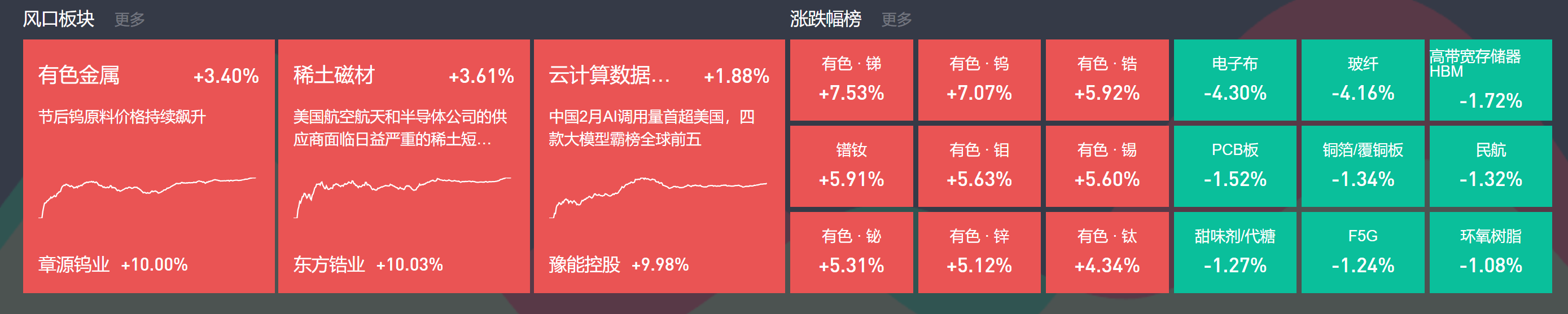
Market Overview - The market experienced fluctuations with mixed performance across the three major indices, as the non-ferrous metal sector saw significant gains, with stocks like Zhangyuan Tungsten and Xianglu Tungsten hitting the daily limit [1] - The trading volume reached 2.51 trillion yuan, with approximately 3,300 stocks in the Shanghai and Shenzhen markets showing gains [1] Non-Ferrous Metals - The non-ferrous metal sector continued to rise, with multiple stocks such as Zhangyuan Tungsten, Jiangxi Tungsten Equipment, and Huaxi Nonferrous Metals hitting the daily limit [3][5] - Zhangyuan Tungsten announced a price adjustment for its welding machine clamping blades due to rising raw material costs, effective from February 26, 2026 [3] - Shanghai tin futures surged by 8.38% on the same day [3] Supply and Demand Dynamics - Supply-side constraints are evident due to stricter safety and environmental regulations, leading to a noticeable tightening in tungsten supply [6] - Domestic demand remains stable, primarily driven by essential procurement and PCB tool requirements, with some companies increasing long-term prices [6] - For tin, the long-term outlook is positive, supported by the recovery in semiconductors driven by AI and automotive technology [6] Huawei Supply Chain - The Huawei supply chain showed strong performance, with stocks like Geer Software and New Jue Network hitting the daily limit following the public release of Huawei Cloud's coding solution [7][8] - The AI coding tools market is projected to grow from $6.1 billion in 2024 to $26 billion by 2030, indicating a significant opportunity for companies in this sector [10] Rare Earth Materials - The rare earth materials sector saw substantial gains, with companies like Dongfang Zirconium and Zhongcai Nonferrous Metals reaching the daily limit [11] - Reports indicate a severe shortage of rare earth elements like yttrium and scandium, impacting suppliers in the aerospace and semiconductor industries [11] - Yttrium prices have surged by 60% since the first report of shortages in November 2025, with a staggering increase of approximately 69 times compared to a year ago [11] Future Projections - Citic Securities forecasts a growing supply-demand gap in the global rare earth market starting in 2026, with significant demand driven by sectors like electric vehicles and humanoid robots [12] - The price index for rare earths is expected to rise between 200-250 points from 2025 to 2026, with neodymium prices projected to rebound to 600,000-800,000 yuan per ton [12]


指数方向有变化,机构蠢蠢欲动!题材分化,还有哪些投资机会?
Sou Hu Cai Jing· 2026-02-27 08:29
Economic Outlook - In February, high-performing sectors included certain resource products, utilities, and information technology, with industrial metals and chemical prices rising [1] - The midstream manufacturing sector saw an increase in the photovoltaic price index, while automotive production and sales slowed down [1] - The consumer services sector experienced improved profitability in pig farming, and the decline in retail sales of major appliances narrowed year-on-year [1] - The financial and real estate sectors continued to face sluggish sales of commercial housing, while gas prices in the utilities sector increased [1] Investment Trends - The top five sectors with net inflows included non-ferrous metals, domestic software, photovoltaics, rare earth magnetic materials, and lithium batteries [1] - The leading five concept sectors with net inflows were artificial intelligence, state-owned enterprise reform, big data, digital economy, and the Belt and Road Initiative [1] - The top ten individual stocks with net inflows included Baogang Co., Yunnan Zhiyuan, Xiamen Tungsten, Yongtai Energy, Cambrian, Haiguang Information, BOE Technology Group, China Tungsten High-Tech, Northern Rare Earth, and Kunlun Wanwei [1] Technology Development - Tsinghua University's research team introduced the FLEXI chip, a flexible AI chip designed for edge intelligence, which fills a gap in flexible electronics technology [3] - The global flexible electronics market is projected to grow from $85 billion to over $173 billion between 2025 and 2030, with China's flexible chip industry expected to rise from 50 billion yuan to 150 billion yuan, reflecting a compound annual growth rate of over 25% [3] Semiconductor Demand - NVIDIA's AI inference context storage platform significantly increased eSSD capacity requirements, with demand for H100 GPUs estimated at 4TB and B100/200 at 8TB, potentially reaching 24TB for Rubin [5] - The NAND capacity demand is expected to grow substantially, with a forecast of approximately 336 exabytes if VR200 shipments reach 14 million units [5] Market Sentiment - The overall market trend is currently strong, with no significant increase in incremental capital entering the market [7] - The Shanghai Composite Index showed signs of weakness, and attention is needed for movements in early March, with expectations of preemptive capital entry [11] - The A-share market has seen strong performance from major indices since last year, driven by a combination of capital inflow and external investment [11]

湘财证券晨会纪要-20260225
Xiangcai Securities· 2026-02-25 00:24
Industry Overview - The rare earth magnetic materials industry saw an increase of 8.84% in the week before the holiday, outperforming the benchmark by 8.48 percentage points [4] - The industry valuation (TTM P/E ratio) rebounded to 86.39x, currently at 93.3% of its historical percentile [4] Price Trends - Rare earth concentrate prices showed a steady increase, with the average price of mixed carbonate rare earth ore remaining stable, while imported monazite prices rose by 6.72% [5] - The price of praseodymium and neodymium saw significant increases, with praseodymium oxide prices up by 12.21% and praseodymium metal prices up by 10.38% [5] - Dysprosium and terbium prices also increased, with dysprosium oxide prices rising by 5.73% and terbium oxide prices by 3.49% [5] - The price of sintered neodymium-iron-boron magnets continued to rise, with N35 and H35 grades increasing by 1.73% and 1.23% respectively [5] Supply and Demand Dynamics - The supply side remains stable with upstream production normal during the holiday, while downstream neodymium-iron-boron enterprises are on break, leading to reduced market consumption [8] - Post-holiday, there is an expectation for increased raw material demand as production resumes in downstream sectors [8] - The demand for new energy vehicles is experiencing a marginal decline, while wind power installations are expected to release some demand [8] Investment Recommendations - The industry maintains an "overweight" rating, supported by high valuation levels and potential policy easing post-holiday [9] - Focus on upstream rare earth resource companies due to policy support and stable pricing trends, which may lead to valuation premiums and stable profits [9] - Downstream magnetic material companies are expected to see profit recovery, particularly those with strong customer structures and new growth opportunities [9]