
国产GPU

Search documents
盘中必读|摩尔线程科创板IPO将上会,概念股表现活跃,和而泰一字涨停
Xin Lang Cai Jing· 2025-09-22 05:36
Group 1 - The core point of the news is that the IPO of Moore Threads, a leading domestic GPU company, is set to be reviewed on September 26, leading to significant stock price movements in related companies [1][2][4] - Related concept stocks, including Heertai, experienced a surge, with Heertai hitting the daily limit at a price of 50.17 yuan per share and a total market capitalization of 464 billion yuan, marking a historical high [1][2] - Moore Threads, founded in 2020 by former NVIDIA global vice president Zhang Jianzhong, focuses on providing autonomous and controllable computing acceleration platforms for AI computing, digital twins, and scientific computing [4] Group 2 - The Shanghai Stock Exchange's listing review committee is scheduled to meet on September 26 to discuss Moore Threads' IPO, indicating that the company is close to entering the capital market [2] - The stock price movements of related companies reflect strong market interest and optimism surrounding Moore Threads' upcoming IPO [1][2][5]



摩尔线程IPO豪赌:实控人“英伟达往事”与百亿亏损的生存悖论
Sou Hu Cai Jing· 2025-09-22 01:30
Core Viewpoint - The analysis focuses on the potential risks and business realities of Moore Threads as it approaches its IPO, highlighting its financial performance, strategic shifts, and market challenges [2][4]. Group 1: Financial Performance - Moore Threads plans to raise 8 billion yuan to support its unprofitable operations, reporting a revenue of 702 million yuan in the first half of 2025, which exceeds the total revenue of the past three years, but still incurred a loss of 271 million yuan, leading to a cumulative loss of 1.478 billion yuan [6]. - The company achieved a remarkable turnaround in gross margin from -70.08% in 2022 to 70.71% in 2024, indicating a fundamental shift in its strategic direction [8][9]. Group 2: Ownership Structure - The ownership structure of Moore Threads is characterized by a unique phenomenon of "high dispersion and high concentration," with no single shareholder holding more than 30% of the shares, while founder Zhang Jianzhong controls 36.36% through various means [6][8]. - The stability of this structure is questioned due to a joint action agreement with other parties that could lead to control instability if disagreements arise [8]. Group 3: Strategic Shifts - Initially targeting both consumer and enterprise GPU markets, the company faced significant challenges and shifted focus to the high-margin B-end market, particularly in AI computing and professional graphics acceleration, where the gross margin for AI computing products reached 73.12% in 2024 [10][12]. - Despite the improvement in gross margins, the company is now heavily reliant on large B-end clients, raising concerns about the stability and sustainability of these customer relationships [12][13]. Group 4: Market Position and Competition - As of June 30, 2025, Moore Threads is negotiating approximately 2 billion yuan in expected orders, but these orders lack legal binding, raising questions about their reliability [13][14]. - The company holds less than 1% market share in its respective segments, which complicates its ability to secure large orders [14]. Group 5: Technological Challenges - Moore Threads has launched four generations of GPU architectures, but faces significant competition from Nvidia, which holds an 88% market share in the global GPU market [17][18]. - The compatibility of its MUSA architecture with existing GPU applications is uncertain due to Nvidia's restrictions on CUDA compatibility, posing a risk to its competitive strategy [18]. Group 6: Profitability and Government Support - Management forecasts profitability by 2027, but this projection relies heavily on government subsidies, indicating weak self-sustaining capabilities [19][20]. - The overall gross margin is expected to decline from 2025 to 2027, contrary to typical trends in technology firms, suggesting concerns about future market competition [21]. Group 7: Human Resources and R&D Efficiency - Moore Threads is a talent-intensive company with 77.81% of its 1,122 employees in R&D roles, but it reported low revenue per employee at 389,400 yuan and a loss per employee of 132,500 yuan, indicating inefficiencies [22][23]. - The company has invested 3.81 billion yuan in R&D, which is 626.03% of its total revenue, raising questions about the sustainability of such high investment levels [23]. Group 8: Risks from Strategic Investors - The presence of strategic investors like Tencent and China Mobile may lead to potential related-party transaction issues, impacting the company's independence in customer acquisition [27][28]. - Maintaining fair and independent business relations with these strategic investors post-IPO will be a focal point for regulators and investors [28][29].


两年亏掉4.7亿却成资本新宠!东芯股份豪掷4亿押注砺算科技,6nm GPU芯片叫板英伟达
Sou Hu Cai Jing· 2025-09-05 09:54
Group 1 - The core narrative revolves around Dongxin Co., a semiconductor company that experienced a dramatic stock price surge of over 200% within a month, despite reporting losses of 1.11 billion yuan in the first half of the year and a total loss of 3.06 billion yuan in 2023 [1][2] - Dongxin Co. made significant investments in a rising domestic GPU company, Lisan Technology, totaling 2 billion yuan in August 2024 and an additional 2.11 billion yuan in August 2023, which contributed to its stock price recovery [2] - Lisan Technology, established only three years ago, launched its first 6nm GPU chip series "7G100" and a new graphics card series, showcasing advanced technology that competes with international leaders like NVIDIA and AMD [2] Group 2 - The situation illustrates that stock market performance is not solely dependent on current financial results but can also be influenced by future potential, particularly in the tech sector [3] - The case of Dongxin Co. serves as a textbook example of risk investment, highlighting the importance of strategic bets on innovative technology [2][3]

国产5nm自研GPU已完成流片验证!
国芯网· 2025-09-04 13:26
Core Viewpoint - The article highlights the rapid development and breakthroughs in the domestic GPU market in China, particularly focusing on the advancements made by the company Xiangdixian with its new "Fuxi" architecture chip [2][4]. Group 1: Domestic GPU Development - Domestic GPU manufacturers are experiencing explosive growth, with new achievements being announced regularly [2]. - Xiangdixian has completed the tape-out verification of its new "Fuxi" architecture chip, which excels in graphics rendering and parallel computing performance [4]. Group 2: Technical Specifications - The new "Fuxi" architecture GPU will utilize a 5nm process technology, achieving a computing power of 160 TFLOPS (FP32) and integrating 12GB of HBM2 memory [4]. - The "Fuxi" architecture will introduce two new products: Fuxi A0, aimed at filling the gap in high-end domestic rendering products, and Fuxi B0, which integrates GPU and NPU, targeting the rapidly growing AIPC market [4]. Group 3: Market Applications - Fuxi B0 will support the deployment of mainstream models such as LLAMA, ChatGLM-6B, Stable-Diffusion, Sora, and DeepSeek R1 1.5B/7B on the edge [4].

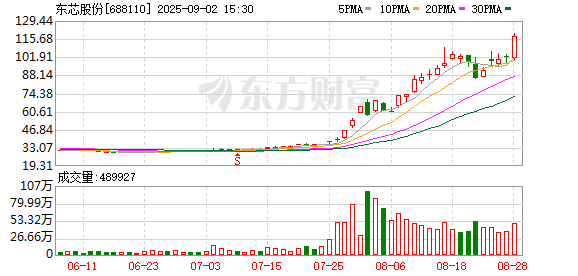
8月股价涨幅超82%的东芯股份复牌 “反路演”引投资者戏称“东伟达”来了 公司半年报现“牛散”赵建平、赵吉
Mei Ri Jing Ji Xin Wen· 2025-09-02 17:06
Core Viewpoint - Dongxin Co., Ltd. (688110.SH) is set to resume trading after a suspension, with significant investor interest driven by its involvement in domestic GPU chip development [2][3]. Group 1: Company Performance and Stock Activity - Dongxin Co., Ltd. experienced a stock price increase of 207.85% from July 29 to August 28, reaching a market capitalization of approximately 52.19 billion yuan [3]. - The stock price surged over 82% in August alone, leading to multiple announcements regarding trading risks due to abnormal fluctuations [3]. - The company has been under close monitoring by the Shanghai Stock Exchange due to these trading activities [3]. Group 2: Investment and Partnerships - Dongxin Co., Ltd. plans to invest approximately 5 billion yuan in Shanghai Lishuan Technology Co., Ltd., acquiring about 35.87% of its equity [3]. - The investment includes a direct capital increase of around 2.1 million yuan from Dongxin to Lishuan [3]. Group 3: Product Development and Market Position - Shanghai Lishuan has launched its first self-developed GPU chip "7G100" and graphics card "Lisuan eXtreme," targeting applications in personal computers, AI PCs, and cloud gaming [4]. - The company has yet to generate revenue from these products, which require certification and customer integration before mass production [4]. - Dongxin Co., Ltd. acknowledges the competitive landscape dominated by NVIDIA and AMD in the global discrete graphics card market, highlighting potential risks if Lishuan's products do not achieve technological breakthroughs [4]. Group 4: Investor Relations and Market Sentiment - Dongxin Co., Ltd. conducted a "reverse roadshow," inviting investors to its facilities for direct engagement, enhancing transparency and trust [6]. - Notable investors, Zhao Jianping and Zhao Ji, have entered the top ten shareholders, holding a combined market value of over 950 million yuan as of August 28 [7][8].
H20再起停产风波:去库存还是谋新篇?
雷峰网· 2025-08-29 14:25
Core Viewpoint - The article discusses the challenges faced by NVIDIA's H20 AI chip in the Chinese market, including production halts and regulatory scrutiny, while highlighting the potential for domestic GPU development in response to these challenges [2][3][4]. Group 1: H20 Chip Production Challenges - NVIDIA announced a halt in the production of the H20 chip for China due to regulatory issues and market demand concerns, despite having prepared a significant inventory [2][3]. - The H20 chip faced a series of regulatory changes from being banned to being allowed for export, only to face another production halt within a month of its initial release [2][3][4]. - The CFO of NVIDIA indicated that the lack of shipments to Chinese customers resulted in a $4 billion reduction in expected sales for the H20 chip [3][5]. Group 2: Market Demand and Regulatory Environment - The Chinese government has raised concerns about the security risks associated with the H20 chip, leading to reduced orders from major tech companies like Alibaba and ByteDance [6][7]. - The demand for H20 chips has diminished significantly, particularly among state-owned enterprises and major tech firms, which are responding to government directives [6][7]. - Despite the current challenges, some industry insiders believe there is still demand for H20 chips, but uncertainty remains regarding when and how much can be procured [6][7]. Group 3: Domestic GPU Development Opportunities - The halt of the H20 chip production has led to increased interest in domestic GPU alternatives, although supply constraints remain a significant issue [10][11]. - Domestic AI chip company Cambricon reported a substantial revenue increase, indicating a growing market for local alternatives [10]. - Industry experts suggest that while domestic GPU manufacturers are gaining traction, they currently cannot meet the high demand for high-performance GPUs in China [11][12]. Group 4: Future of NVIDIA Products in China - NVIDIA is expected to introduce new products in China, including the RTX6000D chip, which is designed for AI inference tasks and priced lower than the H20 [12]. - There are speculations about NVIDIA developing a more powerful chip than the H20, but the approval process from the U.S. government remains uncertain [12]. - Industry insiders maintain a positive outlook on NVIDIA's future products in China, citing the company's technological advantages [12].
0826调研日报
2025-08-27 01:12
Summary of Conference Call Records Companies and Industries Involved - **Ruijie Networks**: Focused on data center products and solutions for internet companies - **Liangxin Electric**: Concentrated on power distribution equipment in data centers - **China National Materials Technology**: Engaged in AI electronic fabrics and low-expansion products Key Points and Arguments Ruijie Networks 1. **Core Clientele**: Domestic internet companies are the core clients, with over 90% of data center product revenue coming from internet clients, primarily from major clients like Alibaba, ByteDance, and Tencent, which account for approximately 90% of revenue [1][2] 2. **Product Deployment**: The company's products supporting large-scale GPU clusters have been successfully deployed, with 400G products making up over 60% of data center switch revenue, amounting to approximately 2.4 billion [2] 3. **Collaboration with GPU Manufacturers**: The company is collaborating with several domestic GPU manufacturers to enhance their network capabilities, although commercial deployment will take time [3] Liangxin Electric 1. **Data Center Focus**: The company's data center strategy is concentrated on power distribution, with a market share primarily in HVDC and UPS systems [4] 2. **Overseas Market Advantage**: Liangxin has a competitive edge in the overseas market due to the demand for technical upgrades and the need for multiple suppliers due to existing capacity constraints of current suppliers [5] China National Materials Technology 1. **Complete Product Line**: The company has a comprehensive product line for AI electronic fabrics, with low-expansion products currently facing a supply-demand gap [8] 2. **Market Demand for Low-Expansion Products**: Low-expansion fabrics are widely used in large chip packaging and are expected to extend into consumer electronics and automotive sectors [9] 3. **Market Responsiveness**: The company plans to quickly respond to market demands and adjust pricing strategies based on market conditions and customer acceptance [10] Other Important Content - **Sector Diversification**: The renewable energy business unit includes solar, storage, and wind energy, with additional investments in nuclear and hydrogen sectors to mitigate cyclical volatility [7] - **Investment Caution**: The content includes a disclaimer emphasizing that the information provided is for reference only and does not constitute investment advice [11]


超讯通信(603322.SH):上半年净利润7208.96万元,同比增长155.26%
Ge Long Hui A P P· 2025-08-22 12:23
Core Viewpoint - The company reported significant growth in revenue and net profit for the first half of 2025, driven by its role as the national distributor of domestic GPU chips and successful project deliveries [1] Financial Performance - The company achieved operating revenue of 1.611 billion yuan, representing a year-on-year increase of 96.37% [1] - The net profit attributable to shareholders reached 72.0896 million yuan, up 155.26% year-on-year [1] - The net profit after deducting non-recurring gains and losses was 71.465 million yuan, reflecting a year-on-year growth of 159.96% [1] - Basic earnings per share were reported at 0.46 yuan [1] Business Drivers - The primary reason for the net profit growth was the company's position as the national distributor for the domestic GPU chip, which allowed for enhanced delivery capabilities and successful bulk deliveries to clients [1] - The company's computing power construction business met acceptance criteria, leading to the recognition of related project revenues and profits [1]

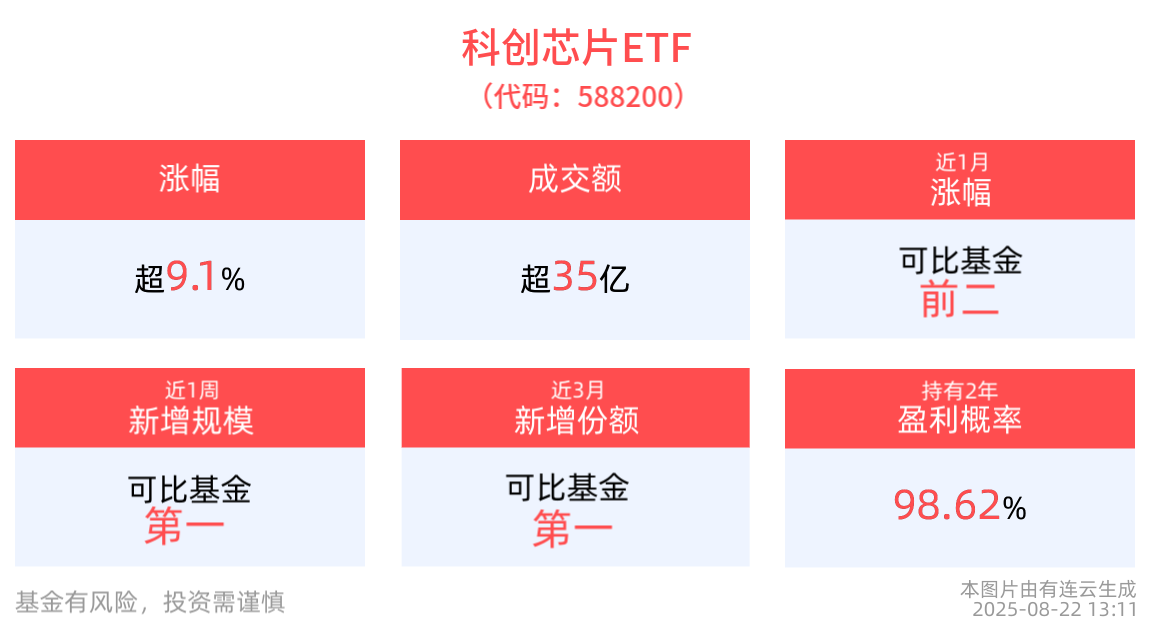
科创芯片ETF(588200)盘中强势上涨10.35%,成分股海光信息、盛美上海20cm涨停,寒武纪涨超19%
Xin Lang Cai Jing· 2025-08-22 05:50
Group 1: ETF Performance - The Sci-Tech Chip ETF has a turnover rate of 10.63% and a trading volume of 3.502 billion yuan, indicating active market trading [3] - Over the past week, the average daily trading volume of the Sci-Tech Chip ETF reached 2.858 billion yuan, ranking first among comparable funds [3] - The ETF's net asset value has increased by 100.39% over the past year, ranking first among comparable funds and placing it in the top 2.22% of index equity funds [3] Group 2: Fund Growth Metrics - The Sci-Tech Chip ETF has seen a scale increase of 583 million yuan over the past week, leading among comparable funds [3] - In terms of shares, the ETF has grown by 46.5 million shares over the past three months, also ranking first among comparable funds [3] - The latest margin buying amount for the ETF reached 230 million yuan, with a margin balance of 1.419 billion yuan [3] Group 3: GPU Market Insights - The development of AI is heavily reliant on GPUs, with the domestic semiconductor industry making significant advancements in GPU manufacturing since 2023 [4] - The market size for domestic GPUs is estimated to be in the hundreds of billions, with production ramping up significantly [4] - Nvidia's revenue in mainland China is projected to be approximately 17.1 billion USD in 2024, exceeding 100 billion yuan [4] Group 4: Top Stocks in Chip Index - The top ten weighted stocks in the Sci-Tech Chip Index account for 57.59% of the index, including companies like Cambricon, SMIC, and Haiguang Information [4] - Notable stock performances include SMIC with a rise of 10.80% and Haiguang Information with a rise of 20.00% [6] Group 5: Investment Opportunities - Investors without stock accounts can access domestic chip investment opportunities through the Sci-Tech Chip ETF linked fund (017470) [7]





港股异动 瑞和数智(03680)涨超8% 近一个月股价实现翻倍 投资收益驱动上半年业绩增长
Jin Rong Jie· 2025-08-18 08:31
Group 1 - The core viewpoint of the article highlights that 瑞和数智 (Rehui Shuzhi) has seen its stock price double in the past month, with a current increase of 6.91% to HKD 2.63, and a trading volume of HKD 14.4166 million [1] - The company plans to hold a board meeting on August 22 to consider and approve its interim performance, with a positive earnings forecast indicating a turnaround in revenue for the first half of 2025, estimated at approximately RMB 43 million to 44 million [1] - The anticipated revenue growth is attributed to substantial returns from forward-looking investments, significant improvements in management efficiency, and ongoing cost reduction and efficiency enhancement initiatives [1] Group 2 - In July, the company announced plans to invest HKD 80 million in the cryptocurrency and Web 3.0 sectors, aligning with the Hong Kong government's push for virtual asset industry development [1] - The investment strategy includes focusing on digital assets and cultivating on-chain financial resources to accelerate the transformation of traditional financial services to on-chain models, particularly in the Greater China region [1] - Additionally, the company is collaborating with Shanghai Yuanlu Jiajia Information Technology Co., Ltd. to develop an integrated solution centered around domestic GPUs, combining hardware, software, and industry capabilities [1]