
首发经济

Search documents
汽车大奖+首店经济+票根密码,系列举措持续带火消费,长沙今年社零增长明显
Chang Sha Wan Bao· 2025-11-25 12:25
Core Insights - Changsha's consumer market is experiencing significant growth due to targeted promotional measures, with a retail sales total of 4,775.98 billion yuan from January to October, reflecting a year-on-year increase of 5.1% [1][3] Group 1: Automotive Sector - The automotive consumption market in Changsha saw a surge in activity, with 3,870 consumers winning cash prizes in a promotional lottery for purchasing new vehicles [1] - Major car manufacturers launched new models, contributing to a vibrant market environment, with significant sales reported during the October auto consumption promotion [3] - The Mango International Auto Show generated over 20 billion yuan in transaction value and more than 10,000 vehicle orders within just five days [3] Group 2: Retail and Commercial Developments - The "first store economy" is a notable highlight, with over 130 new stores opening, enhancing consumer experiences and driving sales [4][9] - New commercial projects, including flagship stores and duty-free shops, are reshaping the retail landscape in Changsha, providing diverse shopping options [5][7] - The city has implemented a million-yuan "first store consumption coupon" initiative to stimulate spending in new retail locations [9] Group 3: Event-Driven Consumption - The "ticket root economy" is emerging as a new consumption driver, linking sports events and concerts to retail opportunities, enhancing consumer engagement [10][11] - The "Xiangchao" league and popular concerts have created a vibrant atmosphere, with ticket stubs offering discounts across various services, boosting local commerce [11] - Changsha's promotional activities have effectively integrated policy support, innovative scenarios, and digital enhancements to foster sustainable consumption growth [11]

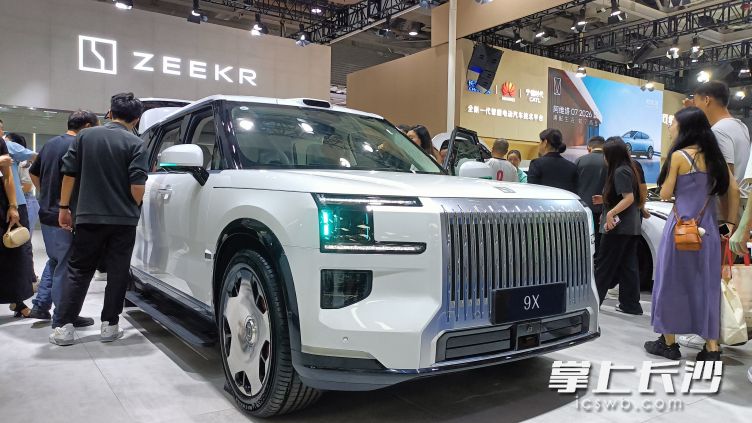
一展双城,首发首秀,全球智能机械与电子产品博览会即将开幕
2 1 Shi Ji Jing Ji Bao Dao· 2025-11-25 11:08
Group 1 - The AIE Expo will be held from December 4 to 6 in Macau and Zhuhai, featuring a theme of "Bay Area Intelligence Manufacturing, Global Sharing" [1][2] - The expo will cover a total exhibition area of 70,000 square meters, with over 1,000 participating companies and 346 registered buyers from more than 20 countries and regions [1][2] - The event will showcase multiple globally or nationally significant product launches and technologies, emphasizing practical cooperation with several buyers planning to negotiate multi-million dollar orders [1][2][3] Group 2 - The Macau venue will feature three thematic pavilions focusing on smart communication, audio-visual technology, and venture capital concepts, with exhibitors including Lenovo, OPPO, and others [1][2] - The Zhuhai venue will focus on manufacturing, transportation, and lifestyle, showcasing products like robots, electric vehicles, and smart home technologies from companies such as Epson and Toshiba [2] - The expo aims to create a "1+1+6+N" multi-dimensional activity system, including a main forum, industry white paper release, six thematic pavilions, and various supporting activities [2] Group 3 - The AIE Expo will serve as a platform for industry promotion and cross-sector integration, facilitating deep exchanges of innovative ideas and practical cooperation [3] - The event will highlight the "first-release economy," showcasing new products and technologies, with the Guangdong-Hong Kong-Macao Greater Bay Area recognized as a leading global innovation cluster [4] - Notable product launches include GAC Aion's new smart connected vehicle and Vivo's next-generation 5G/6G communication terminal [4][5] Group 4 - Guangdong Zhongshifa Intelligent Technology Co., Ltd. will present its RFID inventory robot, which enhances inventory efficiency by over 80% and achieves a 99.9% accuracy rate [6]

改革图强,玄武激荡转型的力量
Xin Hua Ri Bao· 2025-11-24 02:53
Group 1: Economic Growth and Innovation - The GDP of Xuanwu is expected to exceed 140 billion yuan this year, marking a significant increase and positioning it among the top 100 innovative districts in the country [1] - Xuanwu has established a modern urban industrial system based on innovation, integrating data elements and artificial intelligence to enhance various industries [1][3] - The Jiangsu International Data Port is being developed to facilitate data trading and application, aiming to unlock the multiplier effect of data elements [3][4] Group 2: Consumer Market Development - Xuanwu has become a leading consumer district, contributing 14% of Nanjing's total retail sales with only 1% of the city's area [1] - The district has introduced over 400 first stores, including global and provincial-level brands, enhancing its commercial appeal [7] - The establishment of the first "immediate purchase and refund" tax refund pilot in the province at Deji Plaza has improved the shopping experience for international visitors [8] Group 3: Urban Renewal and Quality of Life - Xuanwu is focusing on urban renewal by addressing space optimization, interface innovation, and functional restructuring to create a "hexagonal urban area" [1][10] - The district has implemented various community improvement projects, enhancing living conditions and public services for residents [12][15] - The integration of green and low-carbon principles in urban renewal efforts is a priority, with projects aimed at creating sustainable living environments [11][12] Group 4: Governance and Community Engagement - Xuanwu has adopted a people-centered governance approach, leveraging party leadership to enhance community services and address residents' needs [2][13] - The district has established a comprehensive community service model, improving property management and increasing resident engagement [15][16] - Collaborative projects between local banks and community organizations have fostered a sense of shared responsibility and enhanced service delivery [16]
“国际化消费环境建设试点”叠加“消费新业态新模式新场景试点”
Nan Jing Ri Bao· 2025-11-24 02:37
Core Viewpoint - Nanjing has been selected as a pilot city for both "International Consumption Environment Construction" and "New Consumption Formats, Models, and Scenarios," highlighting its strong consumer base and innovative development potential [1][2]. Group 1: International Consumption Environment - Nanjing is the only city from Jiangsu province included in the list of 15 cities for the international consumption environment pilot program [1]. - The city aims to enhance its international consumption supply by optimizing international consumption carriers and implementing renovation projects in areas like Mendo and Xinanli [1][2]. - Nanjing plans to create international characteristic consumption clusters and promote inbound consumption capabilities [1][2]. Group 2: International Payment and Services - The city will optimize international payment systems to achieve full coverage of foreign card POS machines and digital payments in major public areas [2]. - Nanjing will enhance its outbound shopping experience by upgrading tax refund services and supporting local brands in duty-free shops [2]. - The city aims to improve multilingual service systems and develop international service talent to better serve foreign visitors [2]. Group 3: International Connectivity - Nanjing will enhance its international transportation network by establishing direct flights to key regions such as Japan, Southeast Asia, Europe, and the Middle East [2]. - The city will strengthen its international communication network and continue hosting events like "China Nanjing Week" to promote global engagement [2]. - Nanjing will leverage national-level exhibitions to boost international economic and trade cooperation [2]. Group 4: New Consumption Formats and Financial Support - The central government will provide financial support to pilot cities, with Nanjing eligible for a total of 4 billion yuan during the implementation period of the "New Consumption Formats" pilot [3]. - The funding will focus on enhancing the first-release economic service system, innovating diverse service consumption scenarios, and supporting collaborations between quality consumption resources and well-known IPs [3]. - Nanjing plans to develop a unique path for the pilot project, emphasizing a three-pronged approach of policy, carriers, and platforms [3]. Group 5: Comprehensive Service Consumption - The city aims to create a five-dimensional integrated service consumption scenario that covers all areas, times, industries, ages, and chains [4]. - Nanjing has been recognized as a national-level pilot city for various service industry standards and modern commercial circulation systems, receiving significant financial support [4]. - The city is seizing opportunities to innovate and advance its status as an international consumption center, contributing to high-quality economic development [4].
和讯投顾许森:跨年行情,下周将开始
Sou Hu Cai Jing· 2025-11-24 00:12
Market Trends - The market is expected to experience a rebound that will last until mid-December, similar to the pattern observed last year [1] - Historical data indicates that from late November to mid-December, the market often shows positive performance, but a turning point typically occurs around December 12 [3][4] Short-term Trading Dynamics - In 2023, the market from September to December was characterized by a short-term bull market, particularly in the North Exchange, which outperformed the main board [2] - The 中证1000 index reflects the overall performance of small and medium-sized stocks, showing a significant decline from 6091 points to 4177 points between December 12, 2023, and February 3, 2024 [2] Historical Patterns - The analysis of December trends from 2021 to 2023 reveals a consistent pattern where the market performs well until mid-December, followed by a downturn after significant meetings [3][4] - Major meetings held in December often lead to market stability before the events, but subsequent reactions can result in pessimism once the events conclude [3] Industry Focus - The focus for the upcoming rebound will be on the sectors mentioned in the upcoming meetings, particularly AI applications and the integration of digital and real economies [4][5] - Consumer spending is increasingly emphasized, with expectations for measures to stimulate consumption in the coming year [4] Conclusion - The market is entering a rebound phase, with the core of the market dynamics centered around the industries likely to be highlighted in the upcoming meetings, especially AI applications [5]
喜报!厦门福州泉州,正在公示!
Sou Hu Cai Jing· 2025-11-23 06:29
Core Points - The Ministry of Finance and the Ministry of Commerce have publicly announced the results of the competitive review for pilot cities in new consumption formats, with three cities from Fujian selected: Fuzhou, Quanzhou, and Xiamen [1] Group 1: Pilot Cities Selection - Three cities in Fujian, namely Fuzhou, Quanzhou, and Xiamen, have been selected as pilot cities for new consumption formats [1] - The initiative aims to support around 50 cities, focusing on large and super-large cities with significant population bases and development potential [5] Group 2: Policy Implementation - The policy implementation period is set for two years, as outlined in the notification from the Ministry of Finance and the Ministry of Commerce [5] Group 3: Support Directions - The support directions include establishing a comprehensive first-release economic service system, promoting innovative service consumption scenarios, and facilitating cross-industry collaborations with well-known IPs [6][7][8] - The initiative encourages the creation of first-release centers and economic clusters in key commercial areas, cultural venues, and creative parks [6] - It also aims to enhance service consumption by integrating digital technologies like AI and the metaverse into various sectors such as entertainment, tourism, and health [7] - The program supports the development of unique consumption spaces that leverage local cultural resources and promote new consumer brands [8]
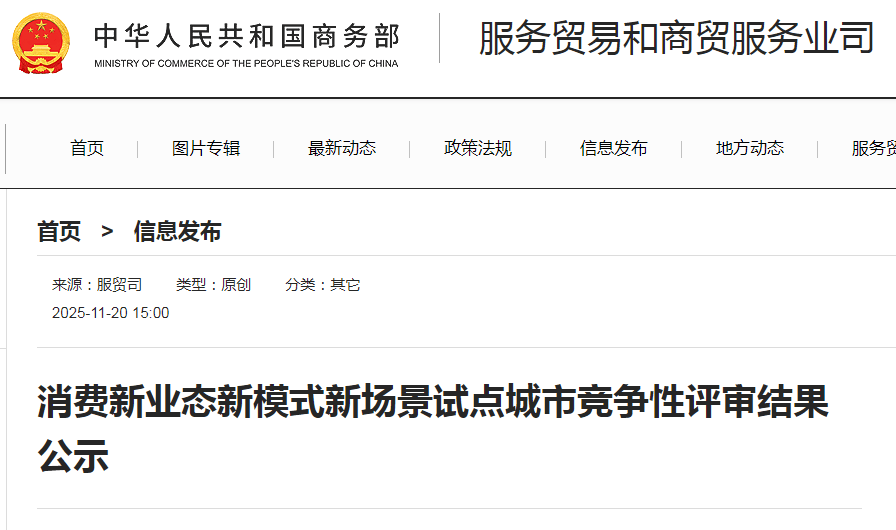
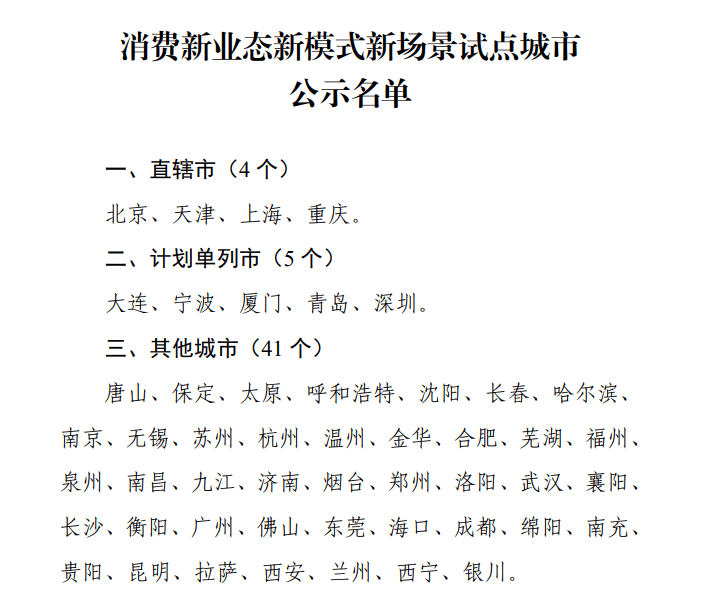
50城入选消费新业态新模式新场景试点城市
Zheng Quan Ri Bao Wang· 2025-11-22 04:05
Core Viewpoint - The Ministry of Commerce and the Ministry of Finance announced the results of the competitive evaluation for pilot cities in new consumption formats, with 50 out of 75 cities selected to promote diverse consumption and stimulate domestic demand [1][8]. Group 1: Pilot City Characteristics - The selected pilot cities are primarily large cities with strong consumption bases, innovation capabilities, and significant regional advantages [2][3]. - The list includes 4 municipalities, 5 separately planned cities, and 41 other cities, ensuring a balanced regional distribution [2]. - Key commonalities among the cities include solid consumption foundations, sufficient innovation momentum, and notable location and service advantages [2][3]. Group 2: Differentiated Consumption Paths - The pilot cities are encouraged to explore differentiated paths based on their unique advantages rather than following a one-size-fits-all model [4]. - The support directions include enhancing the first-release economy service system, innovating diverse service consumption scenarios, and promoting cross-industry collaborations [3][4]. Group 3: Reshaping Domestic Consumption Ecology - The pilot program aims to optimize the consumption supply structure, activate industry innovation, and drive economic and employment growth [5][6]. - The initiative is expected to create "scene-driven" consumption growth, restructure industrial chain divisions, and activate regional consumption potential [6][7]. - The program is seen as a way to transition from "scale expansion" to "quality improvement" in the domestic consumption market, providing new momentum for high-quality economic development [6][8]. Group 4: Local Characteristics and Avoiding Homogeneity - There is a need for cities to focus on local characteristics to avoid issues like "repackaging without content" and "project homogeneity" [7]. - The development of new consumption formats requires enhanced digital capabilities for small and medium enterprises, emphasizing the importance of tailored solutions [7]. - Future efforts should encourage cities to innovate in rules, service models, and digital infrastructure while solidifying effective experiences to prevent a "copycat" approach [7].
超80家首进品牌 新城控股南阳高新吾悦广场解锁城市消费新体验
Sou Hu Cai Jing· 2025-11-21 08:02
11月21日,新城控股(601155.SH)位于河南南阳的高新吾悦广场盛大开业。作为集团在南阳落地的第 二个商业项目,高新吾悦广场深度融合购物、餐饮、娱乐、亲子、文化等多元业态,打造一站式消费体 验新地标。随着该项目正式投入运营,新城控股在南阳成功构建起覆盖核心商圈与新兴板块的"一城双 店"战略布局,不仅进一步激活区域商业活力,更以"五边形经营理念"为核心,持续为南阳城市经济高 质量发展注入强劲动能。 80余家首进品牌 打造差异化竞争优势 据悉,南阳高新吾悦广场地处南阳高新技术产业开发区核心地段,地理位置优越。项目以"秀水南阳"为 主题,深度融入城市人文与历史特色,依托汉城河生态资源打造生态绿廊、立体退台及近万平方米的空 中花园,构建南阳首个亲水商业综合体标杆;同时,通过宛风汉韵市集、卧龙文化街区等十大场景,重 塑城市文化新地标。 在品牌矩阵上,南阳高新吾悦广场汇聚超200个优质品牌,其中80余家为"首进南阳",涵盖9家河南首店 及70余家南阳首店,包括盒马鲜生、会飞的哈林、滏晓、出出出山、见青山等,不仅进一步丰富城市消 费业态,更有效破解区域商业同质化竞争。以盒马鲜生为例,作为豫南首店,其创新模式将满足周边 ...


国家级名单公示!郑州入选→
Sou Hu Cai Jing· 2025-11-21 06:18
Core Viewpoint - Zhengzhou has been selected as one of the 50 pilot cities for new consumption formats, showcasing its potential in consumption innovation and development [1][8]. Group 1: Pilot Program Overview - The policy implementation period is set for two years, focusing on large cities with significant population bases and development potential [4]. - The pilot program will support innovation in three main areas: establishing a first-release economic service system, creating diversified service consumption scenarios, and promoting cross-industry collaborations with quality consumption resources and well-known IPs [4][5][6][7]. Group 2: Financial Support - Central finance will provide funding assistance to pilot cities, with super-large cities receiving a total of 400 million yuan, large cities 300 million yuan, and other cities 200 million yuan during the implementation period [8]. - Zhengzhou's selection as a pilot city marks its second national-level breakthrough in the consumption sector this year, following its inclusion in the first batch of retail innovation enhancement pilot cities [8]. Group 3: Consumption Landscape Transformation - The city is experiencing a comprehensive activation of consumption vitality, with new business formats emerging and new consumption scenarios continuously breaking boundaries [9]. - Zhengzhou is positioning itself as a new highland for consumption upgrades, reflecting its growing appeal in the consumption landscape [9].
大悦城跌2.20%,成交额3760.87万元,主力资金净流入77.24万元
Xin Lang Cai Jing· 2025-11-21 03:01
Core Viewpoint - Daxuecheng's stock price has shown a decline recently, with a 2.20% drop on November 21, 2023, and a total market capitalization of 13.33 billion yuan. The company has experienced fluctuations in stock performance over various time frames, indicating potential volatility in the market [1]. Group 1: Stock Performance - As of November 21, 2023, Daxuecheng's stock price is 3.11 yuan per share, with a trading volume of 37.61 million yuan and a turnover rate of 0.28% [1]. - Year-to-date, the stock price has increased by 2.30%, but it has decreased by 6.61% over the last five trading days, 4.31% over the last 20 days, and 3.72% over the last 60 days [1]. Group 2: Financial Performance - For the period from January to September 2025, Daxuecheng reported a revenue of 20.65 billion yuan, reflecting a year-on-year growth of 0.83%. However, the net profit attributable to shareholders was -533 million yuan, which represents a year-on-year increase of 9.17% [2]. - The company has not distributed any dividends in the last three years, with a total payout of 2.05 billion yuan since its A-share listing [3]. Group 3: Shareholder Information - As of September 30, 2025, the number of Daxuecheng shareholders is 89,700, a decrease of 7.16% from the previous period. The average number of circulating shares per shareholder has increased by 15.33% to 47,810 shares [2]. - Among the top ten circulating shareholders, Hong Kong Central Clearing Limited holds 53.19 million shares, an increase of 28.59 million shares from the previous period. ICBC Value Selection Mixed A is a new shareholder with 22.91 million shares [3].
