
区域协调发展

Search documents
拆掉交界处的“隐形墙”(纵横)
Ren Min Ri Bao· 2025-11-18 23:07
Group 1 - The article discusses the issue of "invisible walls" at administrative boundaries that hinder resource flow and development due to differing financial strengths and priorities of local governments [1][2] - It highlights examples where adjacent regions experience unequal development due to lack of coordination and investment, such as the disparity in infrastructure between two towns [1] - The article suggests that breaking down these barriers requires organizational restructuring, clear mechanisms, and smooth resource flow to achieve cross-regional integration and policy coordination [1][2] Group 2 - To ensure effective operation of newly formed organizations, a clear system of responsibilities and authority is necessary to address governance issues in boundary areas [2] - The article emphasizes the importance of establishing joint approval, enforcement, and emergency response processes across administrative regions to reduce coordination costs and improve information flow [2] - It proposes the creation of cross-regional development funds or special funding pools to address financial concerns and ensure equitable investment in shared projects [2]
携手共绘高质量发展“惠榆新景”
Xin Hua Ri Bao· 2025-11-18 07:19
Group 1 - The core viewpoint of the articles highlights the collaboration between Huishan District of Wuxi and Ganyu District of Lianyungang, focusing on the establishment of the Hu-Yu Emerging Industry Cooperation Park to leverage complementary resources and industrial development stages [1][3] - A joint investment of 100 million yuan has been made to establish Jiangsu Hu-Yu Investment Development Co., which has initiated operations and signed an additional capital increase agreement during the recent joint meeting [1][2] - The Hu-Yu Intelligent Information Industry Park has officially opened with a total investment of 560 million yuan, featuring six signed projects and ongoing construction of additional facilities [2] Group 2 - The cooperation focuses on strategic emerging industries such as new energy, high-end equipment, and new materials, aiming to create a cross-regional industrial chain system [3] - The collaboration has led to the establishment of a joint investment mechanism to attract businesses and promote industrial integration between the north and south regions [3] - The Wuxi-Lianyungang Hu-Lian Metal New Materials Industrial Base, with a total investment of 5 billion yuan, aims to become a model for zero-waste in the recycled aluminum industry and is expected to generate over 10 billion yuan in annual sales revenue [2]
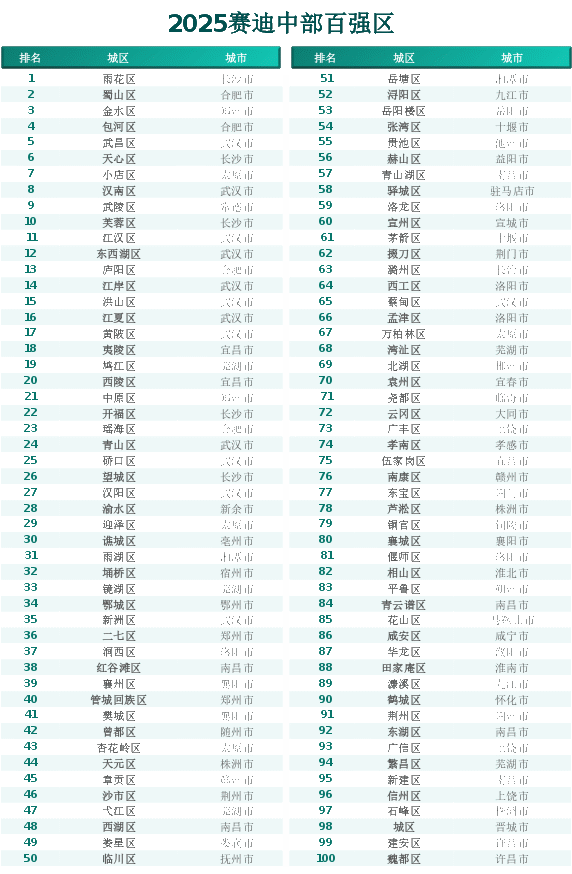
2025赛迪中西部百强区榜单发布 多极联动格局加速成型
Zhong Guo Jing Ji Wang· 2025-11-18 06:06
Core Insights - The report by CCID Consulting presents the latest trends in the economic development of urban areas in Central and Western China, highlighting the evaluation of 463 urban districts through a comprehensive assessment framework [1][2]. Group 1: Regional Characteristics - Central urban economies exhibit uneven spatial distribution and scale gradient, with Hubei leading with 29 districts in the rankings, followed by Anhui (17), Jiangxi (16), and Hunan (16) [2]. - In terms of economic scale, 75 of the top 100 districts in Central China are below 100 billion yuan, with only one district exceeding 400 billion yuan [2]. - Western urban areas are characterized by core leadership, clear gradients, and distinctive drivers, with Sichuan having 29 districts, followed by Shaanxi (15) and Guangxi (12) [2]. Group 2: Development Trends and Recommendations - Three major trends are anticipated for urban development in Central and Western China during the 14th Five-Year Plan: cross-regional collaboration, emergence of "dark horse" cities, and urban renewal leading to a virtuous cycle of spatial restructuring and industrial upgrading [3]. - Four key recommendations to overcome development bottlenecks include: precise industry upgrading through collaboration with Eastern regions, building a regional innovation network, enhancing logistics capabilities under the Belt and Road Initiative, and promoting integration of production, city, and people through urban renewal [3]. Group 3: Rankings and Data - The rankings for the top urban districts in Central and Western China have been published, with the first 22 districts in Central China and the first 19 in Western China making the list for 2025 [6][9].

2026年建筑装饰行业投资策略:投资维稳,布局战略新兴板块
Shenwan Hongyuan Securities· 2025-11-17 09:41
Group 1 - The report emphasizes the need for stable investment and strategic layout in emerging sectors, predicting that investment in the construction and decoration industry will stabilize in 2026 due to the orderly progress of local government debt reduction and the implementation of central "two重" projects [3][4][28] - The report highlights that the construction sector is expected to benefit from national strategies, particularly in areas such as regional coordination, new infrastructure, and green development, with the central and western regions anticipated to enter a fast development track [3][30][34] - The report notes that low-valued state-owned enterprises are likely to see valuation recovery, as the construction industry remains a pillar of the national economy, supported by ongoing investment in the central and western regions, urban renewal, and overseas market expansion [3][4][28] Group 2 - The report indicates that fixed asset investment growth has slowed down, with infrastructure, manufacturing, and real estate facing pressures, as evidenced by a 0.5% year-on-year decline in fixed asset investment from January to September 2025 [5][9][28] - It is projected that broad infrastructure investment will grow by 4.2% and narrow infrastructure investment by 3.3% in 2026, driven by debt reduction policies and the launch of major projects under the "十五五" plan [26][27][28] - The report discusses the importance of urban renewal and the construction of quality housing, emphasizing that the modernization of cities will require both the improvement of existing stock and the development of new quality housing [59][60] Group 3 - The report identifies specific companies to watch in various sectors, including Sichuan Road and Bridge, China Chemical, and Donghua Technology in the central and western region investments, and Shenghui Integration and Yaxiang Integration in new infrastructure [3][4][28] - The report highlights the rapid growth of the Artificial Intelligence Data Center (AIDC) sector, predicting a significant increase in market size and emphasizing the opportunities for construction companies in this emerging field [49][54][58] - The report outlines the strategic importance of Xinjiang's development, with plans to accelerate investment in ten major industrial clusters, leveraging its unique geographical advantages [37][39][40]
擦亮劳务“金名片” 为特色产业提质增效注入“源头活水”
Yang Shi Wang· 2025-11-17 05:30
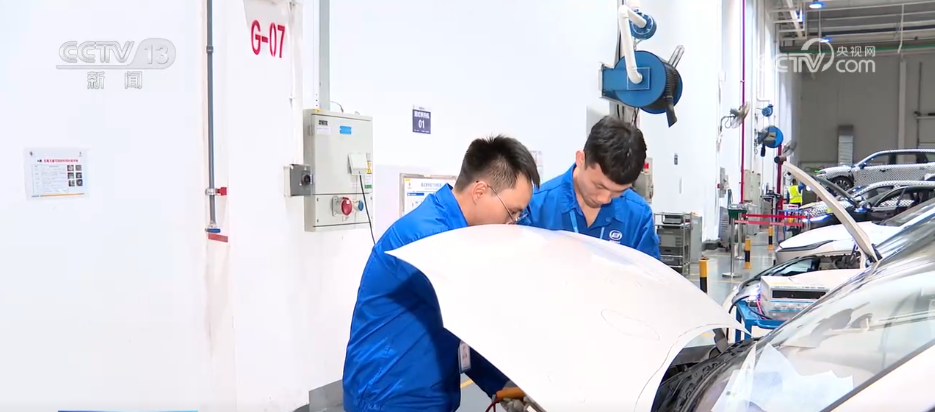
Core Viewpoint - Guangxi is leveraging its regional characteristics to develop labor service brands, which not only broadens the pathways for laborers to enhance skills and increase employment income but also injects "source water" for improving the quality and efficiency of characteristic industries [1]. Group 1 - The "Guangxi New Energy Vehicle Craftsman" labor service brand representative, Li Pingwu, has significantly reduced debugging time from two days to 40 minutes and aims to train 2,000 to 3,000 people annually [3]. - At the SAIC-GM-Wuling Liudong Baojun base, Li Pingwu leads a team that has overcome over 20 technical challenges, saving the company more than 70 million yuan in development costs [4]. - Guangxi has implemented the "Skills Illuminate the Future" three-year action plan, focusing resources on rural workers and college graduates, and has conducted labor service brand training for 104,500 people since 2025 [6]. Group 2 - The Deputy Director of the Laborer Work Department of Guangxi's Human Resources and Social Security Bureau, Li Yuefeng, stated that Guangxi's labor service brand will proactively expand into new occupations, addressing talent "bottlenecks" through deepening industry-education integration and customized training [8].
刘小涛在宿迁淮安调研时强调扎实抓好城乡融合区域联动 推动高质量发展和民生改善
Xin Hua Ri Bao· 2025-11-16 23:29
11月15日至16日,省长刘小涛在宿迁市、淮安市调研。他强调,要深入学习贯彻党的二十届四中全 会和习近平总书记对江苏工作重要讲话精神,完整准确全面贯彻新发展理念,发挥比较优势、坚持各扬 所长,做好区域互补、跨江融合、南北联动大文章,扎实推进乡村全面振兴,促进城乡融合发展、区域 协调发展,让现代化建设成果更多更公平惠及广大群众。 随着宿连航道等项目加快推进,宿迁港临港产业发展迅速。刘小涛实地察看港航产贸一体化建设情 况后说,要发挥水运运能大、成本低、绿色安全的优势,进一步加强企业招引、加快要素导入、加速产 业集聚。刘小涛来到京东智慧城,了解一站式科创商办生态社区智慧管理和高铁片区建设情况后说,新 型产业经济集聚片区科技含量高、综合效益强,要精心谋划开发、完善配套服务,打造联系交通、沟通 产业、促进经济的能量场。在苏宿工业园区,刘小涛对南北挂钩合作工作成效表示肯定。他指出,要树 立大格局、强化大统筹,在产业链、供应链、创新链合作上深挖潜力,形成更多互利共赢的新增长点。 刘小涛先后来到长电科技(宿迁)公司、乔海飞机制造公司、荣芯半导体(淮安)公司和中天精品 钢帘线项目、鹏鼎控股淮安园区,与企业负责人深入交流,感谢企 ...
扎实抓好城乡融合区域联动 推动高质量发展和民生改善
Xin Hua Ri Bao· 2025-11-16 22:10
刘小涛先后来到长电科技(600584)(宿迁)公司、乔海飞机制造公司、荣芯半导体(淮安)公司和中天精 品钢帘线项目、鹏鼎控股(002938)淮安园区,与企业负责人深入交流,感谢企业为当地经济发展作出 的贡献,仔细询问当前实际需求。刘小涛要求有关部门和地方多换位思考、多靠前服务,持续优化营商 环境,推动惠企政策直达快享、兑现落实,及时帮助协调解决问题,更大力度服务企业增资扩产、开拓 市场、做大做强。 省政府秘书长赵建军参加调研。 本报讯(记者王拓李嘉豪)11月15日至16日,省长刘小涛在宿迁市、淮安市调研。他强调,要深入学习贯 彻党的二十届四中全会和习近平总书记对江苏工作重要讲话精神,完整准确全面贯彻新发展理念,发挥 比较优势、坚持各扬所长,做好区域互补、跨江融合、南北联动大文章,扎实推进乡村全面振兴,促进 城乡融合发展、区域协调发展,让现代化建设成果更多更公平惠及广大群众。 在涟水县南集镇码头村,刘小涛察看村卫生室、便民服务站等民生场所,看望慰问低保户,并与基层干 部群众座谈。他要求进一步抓好乡村全面振兴,加强基础设施、基本公共服务和基层组织建设,谋划好 主导产业、保护好主体风貌、挖掘好主题文化,走好科技强农 ...
跑好快递“最后一公里”
Jing Ji Ri Bao· 2025-11-16 21:51
Core Insights - The Chinese express delivery industry is entering a peak season with a significant increase in market scale, achieving an average daily volume of around 600 million packages in October [1] - Major express companies are focusing on improving service quality and reducing internal competition, with a projected 72-hour delivery rate of 85.8% in key areas, up 1.5 percentage points year-on-year [1] Group 1: Industry Growth and Collaboration - The express delivery sector is increasingly integrating with e-commerce, providing robust support for major sales events like "Double 11," resulting in a 100% year-on-year increase in sales for some businesses [2] - JD Logistics has enhanced its service by embedding staff in local businesses to streamline shipping processes, significantly improving delivery efficiency [2] - The introduction of cold chain logistics, such as mobile refrigerated vehicles, has been crucial for maintaining product quality, particularly for seasonal items like hairy crabs [2] Group 2: Infrastructure and Technology Advancements - The application of smart devices, including drones and autonomous vehicles, is rapidly increasing, enhancing operational efficiency in logistics hubs [3] - New logistics centers and upgraded facilities are being established to handle peak season demands, with some centers capable of processing up to 12 million packages daily [3] Group 3: Rural Development and Service Quality - The express delivery network is expanding into rural areas, with a focus on customized logistics solutions to meet local agricultural needs, such as the efficient delivery of fresh produce [4] - The proportion of villages with comprehensive postal service facilities has reached 78%, improving access for rural residents [6] - The government is emphasizing the need for improved rural logistics infrastructure to ensure equitable service quality between urban and rural areas [7]
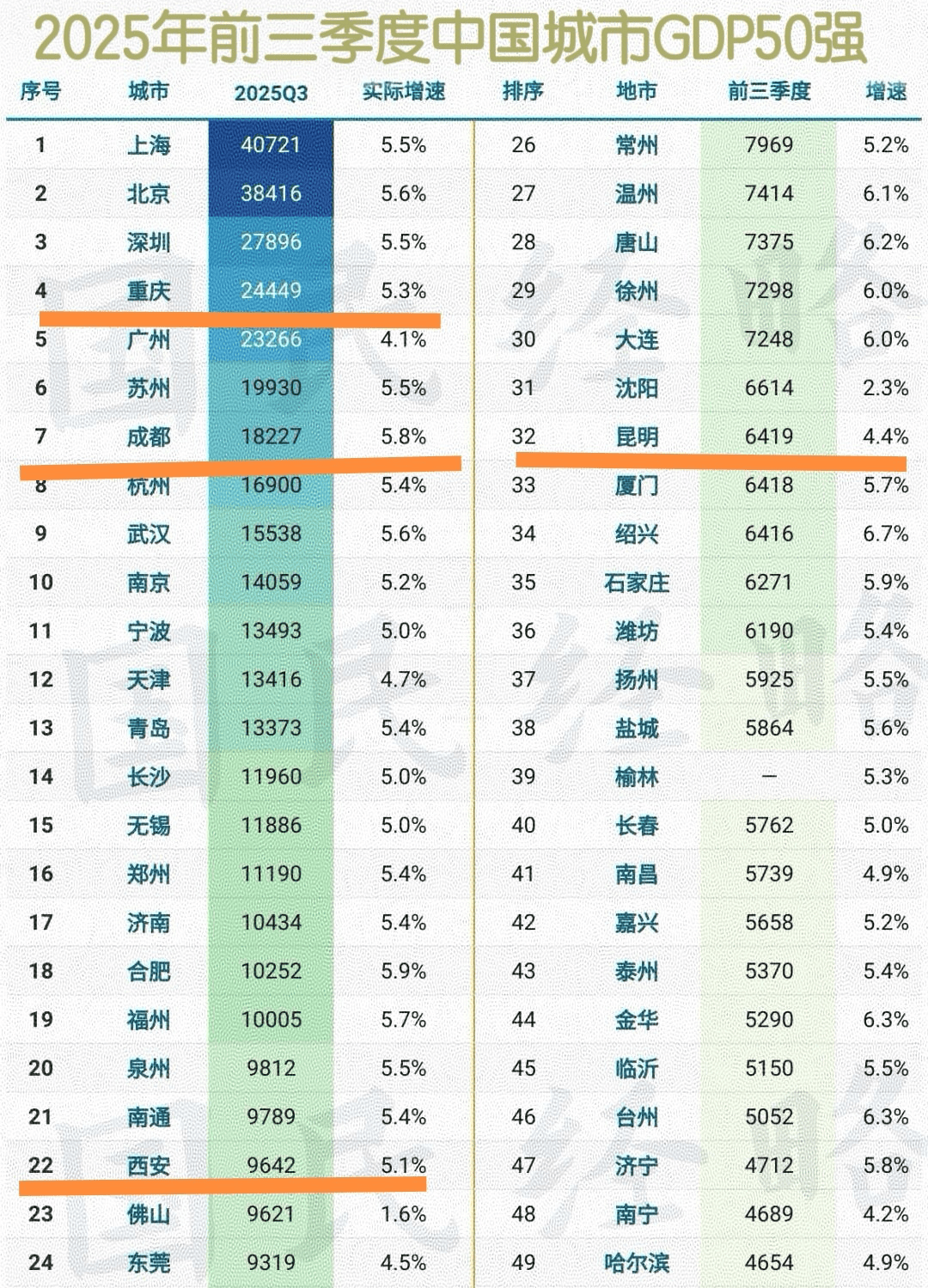
2025前三季度GDP50强揭榜:重庆稳压广州,西部仅4城入围,区域差距何解?
Sou Hu Cai Jing· 2025-11-16 04:01
Core Insights - The GDP rankings of China's top 50 cities for the first three quarters of 2025 reveal a continued economic disparity, with Shanghai, Beijing, and Shenzhen occupying the top three positions, while Chongqing maintains its fourth place, significantly ahead of Guangzhou [1][3] Group 1: Economic Performance - Shanghai leads with a GDP of 40,721 billion, growing at 5.5% [2] - Beijing follows with a GDP of 38,416 billion, showing a growth rate of 5.6% [2] - Shenzhen ranks third with a GDP of 27,896 billion, also growing at 5.5% [2] - Chongqing's GDP stands at 24,449 billion, with a growth rate of 5.3%, while Guangzhou's GDP is 23,266 billion, growing at 4.1% [2][3] Group 2: Regional Disparities - Over 70% of the top 50 cities are located in the eastern and coastal regions, highlighting the economic vitality of these areas [4] - Only four cities from the western region—Chongqing, Chengdu, Xi'an, and Kunming—made it to the top 50, with most rankings in the lower tier [4][5] - The eastern provinces, such as Jiangsu and Guangdong, dominate the list with 9 and 7 cities respectively, showcasing their economic strength [4] Group 3: Challenges in the West - The limited number of western cities in the rankings reflects challenges in industrial structure and population attraction [5] - Many western cities still rely on traditional resource-based industries, leading to insufficient growth momentum [5] - Population outflow is a significant issue, as cities like Xi'an and Kunming struggle to attract talent compared to eastern second-tier cities [5] Group 4: Future Strategies for the West - To narrow the gap with the east, western cities need to focus on three key areas: accelerating industrial upgrades, enhancing open cooperation, and optimizing talent policies [6] - The rise of Chongqing and Chengdu indicates potential for western cities, but innovation and openness are crucial for future competitiveness [6]
1-9月GDP!我国60强城市洗牌:上海增量超2000亿,福州突破万亿,金华逆袭临沂!
Sou Hu Cai Jing· 2025-11-15 06:47
今年以来,在"双循环"新格局和区域协调发展战略的推动下,我国经济韧性凸显,前三季度GDP60强城市榜单迎来新一轮洗牌。上海以超过2000亿元的增量 稳居龙头,福州历史性突破万亿大关,金华则凭借产业转型成功反超临沂——这场城市竞赛背后,是政策红利、产业创新与区位优势的激烈碰撞。究竟哪些 城市在逆势中突围?它们的增长密码又是什么? 作为经济领头羊,上海前三季度GDP达40721.17亿元,增量2005.17亿元,相当于日均创造7.4亿元财富。5.18%的增长率背后,是自贸区临港新片区和科创中 心建设的双重驱动。 值得注意的是,上海第三产业占比已突破75%,金融业与数字经济融合成为新增长极——这种"稳旧育新"的辩证逻辑,使其在复杂外部环境中保持了定力。 | | 地区 | 2025 | 2024 | 撸量 | 名义 | | --- | --- | --- | --- | --- | --- | | | | 前三季度 | 前三季度 | | 增长率 | | 1 | 上海市 | 40721.17 | 38716 | 2005.17 | 5.18% | | 2 | 北京市 | 38415.9 | 36393.2 | 2022 ...
