太空算力

Search documents
“绝不错过2026年大热门”!资本加速卡位商业航天,“太空算力”争夺战一触即发
证券时报· 2026-01-09 00:17
Core Viewpoint - The commercial space sector in China is experiencing significant momentum, with companies like Blue Arrow Aerospace, Tianbing Technology, Xinghe Power, Interstellar Glory, and CAS Space aiming to become the "first commercial rocket stock," all achieving valuations exceeding 10 billion yuan [1] Group 1: Market Dynamics - The U.S. is witnessing SpaceX's IPO plans with a valuation potentially reaching $1.5 trillion, indicating a fierce competition for space resources [1] - Investment institutions, even those previously uninvolved in the sector, are now eager to participate, highlighting the anticipated investment boom in 2026 [3] - There is a noticeable scarcity of shares from existing investors, particularly in companies with valuations around 10 billion yuan, as they are reluctant to sell [3][4] Group 2: Investment Opportunities - The commercial radar satellite segment is showing signs of mergers and acquisitions, which may create opportunities for share transfers [4] - The market for low-orbit satellite launches is projected to intensify, with approximately 51,300 low-orbit satellites planned, although current deployment is less than 1% of this target [8] - The introduction of the "1+6" reform policy for the Sci-Tech Innovation Board has established clearer listing standards for commercial space companies, enhancing investor confidence [8] Group 3: Industry Growth Factors - The competition between China and the U.S. in the space sector is intensifying, with SpaceX achieving profitability and a significant number of satellites in orbit, prompting China to accelerate its efforts [9] - Government policies supporting the commercial space industry, such as the establishment of a dedicated department and funding initiatives, are expected to continue providing benefits [9] - The commercial space sector is transitioning from technical validation to large-scale commercialization, with significant growth potential anticipated as reusable technology matures [11] Group 4: Future Trends - Investment opportunities are emerging in critical supply chain areas such as aerospace chips, specialized batteries, and 3D printing for engine manufacturing [12] - The concept of "space computing" is gaining traction, with major tech companies exploring new avenues for growth in the commercial space sector [12] - The key to reducing costs in the industry lies in the advancement of reusable rocket technology, which requires a mature supply chain and expanded launch capabilities [13]

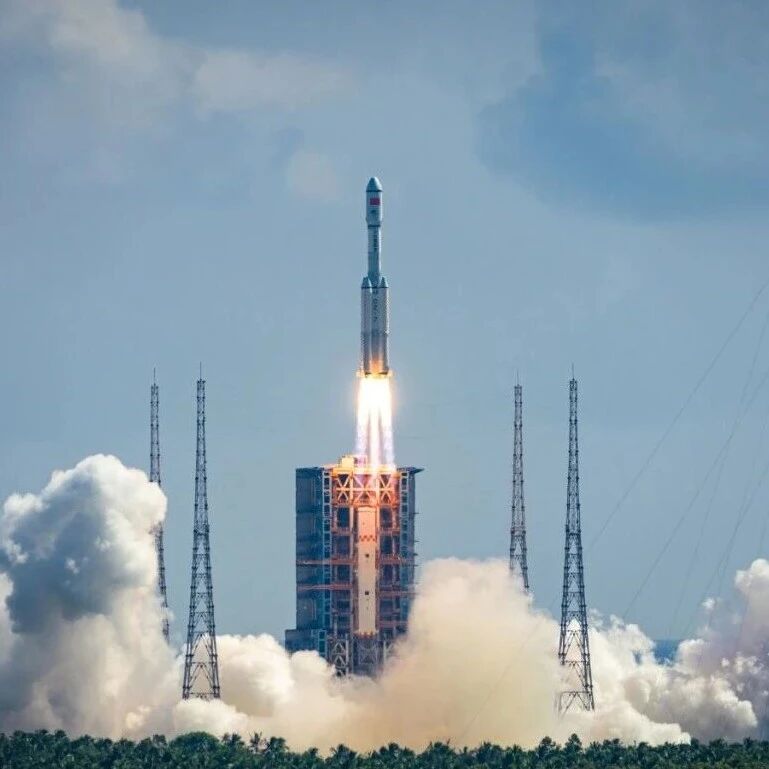
资本狂热卡位商业航天:产业链投资空间广阔,太空算力争夺战一触即发
Zheng Quan Shi Bao· 2026-01-08 23:29
Core Insights - The commercial space industry is experiencing a surge in interest and investment, driven by companies like SpaceX and OpenAI, with valuations potentially reaching $1.5 trillion for SpaceX [1] - The market is witnessing a rush for project shares, leading to increased valuations and a shrinking investment window as competition for quality projects intensifies [1] Investment Trends - Investors are actively seeking to acquire old shares in commercial space projects, indicating a strong demand for established companies in the sector [2] - Many top companies in the space industry are focusing on secondary market listings rather than new financing, making it challenging for investors to acquire stakes [2] - The commercial space sector is characterized by a long investment horizon, with opportunities for share transfers in non-core areas of the industry [2] Market Dynamics - The commercial radar satellite segment is showing signs of mergers and acquisitions, which may create opportunities for investors [3] - The current investment climate contrasts sharply with the pre-2021 period when the commercial space sector was largely overlooked [3] - Recent capital influx from both dollar and RMB funds has reignited interest in the commercial space sector, with local government funds also participating [4] Policy Support - Government policies have played a crucial role in fostering the growth of the commercial space sector, with initiatives encouraging private sector participation [4] - The introduction of new listing standards for commercial space companies has bolstered investor confidence and facilitated capital exit strategies [5] Competitive Landscape - The competition between the U.S. and China in the space sector is intensifying, with SpaceX achieving profitability and planning an IPO, prompting China to accelerate its efforts [6] - The domestic low-orbit satellite launch plans are significant, with approximately 51,300 satellites projected, although current deployment is below 1% of planned numbers [5] Valuation Insights - The valuation of commercial space companies has significantly increased, with leading firms now valued over 10 billion yuan [7] - Despite high valuations, some investors express concerns about the disconnect between valuations and actual revenue growth [7] - The long-term growth potential remains strong as the industry transitions from technology validation to commercialization [7] Future Opportunities - Investment opportunities are expected to arise in key areas of the supply chain, including aerospace chips, specialized batteries, and 3D printing for engine components [8] - The emerging "space computing" sector is seen as a new frontier, with major tech companies vying for dominance, indicating a shift in focus from mere launch capabilities to computational power in space [8] - Cost reduction through reusable rocket technology is critical for the industry's future, with only a few companies currently possessing this capability [9]

资本狂热卡位商业航天:“绝不错过2026年大热门”
Zheng Quan Shi Bao· 2026-01-08 22:33
Core Viewpoint - The commercial space industry in China is experiencing significant momentum, with several companies, referred to as the "Chinese version of SpaceX," aiming to become the first publicly listed commercial rocket company, all achieving valuations exceeding 10 billion yuan [1] Group 1: Market Dynamics - The recent surge in interest from investment institutions, even those previously uninvolved in the space sector, indicates a strong belief in the potential of the commercial space market, particularly looking towards 2026 as a pivotal investment year [2][3] - Existing shareholders are reluctant to sell their stakes, especially in companies valued at over 10 billion yuan, as they anticipate substantial market growth post-IPO [3] - The commercial space sector is characterized by a long and broad market landscape, with opportunities for stake transfers in segments like commercial radar satellites, which have shown signs of mergers and acquisitions [3] Group 2: Investment Trends - The investment landscape for commercial space has evolved since 2014, with a notable increase in capital influx around 2018-2019, although initial enthusiasm waned due to slow commercial progress [6] - Recent years have seen a resurgence in investment interest, driven by the profitability of companies like SpaceX and the increasing demand for low-orbit satellite launches, with projections indicating a significant number of satellites planned for deployment [6][7] - The introduction of favorable policies, such as the new listing standards for commercial space companies, has bolstered investor confidence and created a more favorable exit environment for capital [7] Group 3: Valuation and Growth Potential - Current valuations in the commercial space sector have risen significantly, with leading companies achieving valuations above 10 billion yuan, although there are concerns about the sustainability of these valuations relative to actual revenue growth [8] - The industry is transitioning from technology validation to large-scale commercialization, suggesting substantial future growth potential as reusable rocket technology matures and satellite networks expand [8] - Investment opportunities remain in critical supply chain segments, including aerospace chips, specialized batteries, and satellite control services, as well as in emerging areas like space computing [9][10] Group 4: Technological Advancements - The focus on cost reduction through reusable rocket technology is crucial for the industry's future, with only a few companies currently possessing the necessary capabilities [10] - The competitive landscape is shifting towards the acquisition of space-based computing power, with major tech companies vying for dominance in this new frontier [10]
资本狂热卡位商业航天:“绝不错过2026年大热门” 产业链上下游投资空间广阔 “太空算力”争夺战一触即发
Zheng Quan Shi Bao· 2026-01-08 18:10
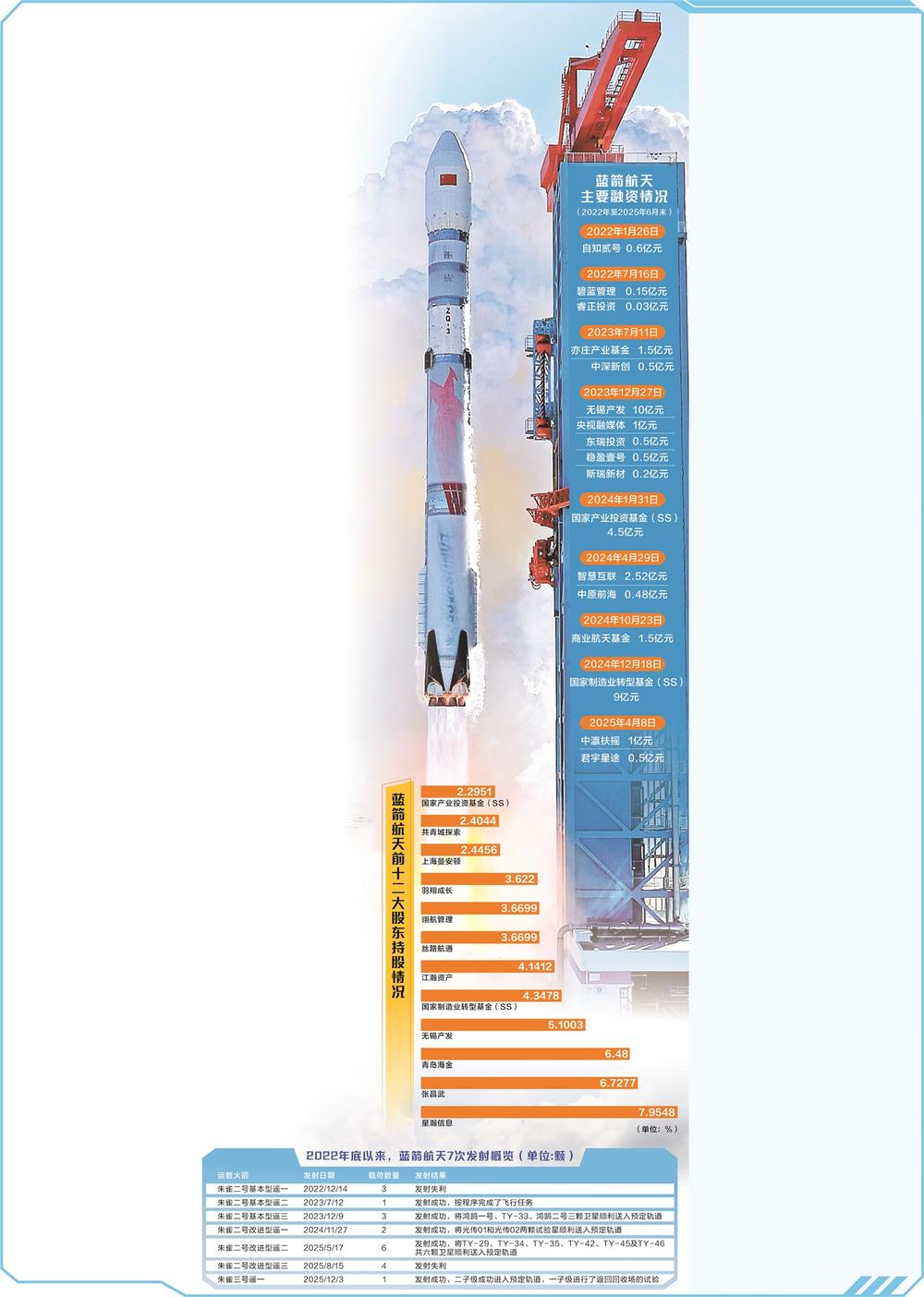
Core Insights - The commercial space sector in China is experiencing significant momentum, with companies like Blue Arrow Aerospace, Tianbing Technology, Xinghe Power, and others aiming to become the "first commercial rocket stock" [2] - The valuation of these companies has surpassed 10 billion yuan, reflecting a broader trend of increasing investment interest in the sector [2] - The competitive landscape is intensifying, driven by policy support and a growing demand for space resources, leading to a rush for capital and project shares [2][3] Financing Overview - Blue Arrow Aerospace has secured multiple rounds of financing from various investors, totaling approximately 27.5 billion yuan from 2022 to mid-2025 [1] - Notable funding rounds include 10 billion yuan from Wuxi Industrial Development and 9 billion yuan from the National Manufacturing Transformation Fund [1] Market Dynamics - There is a growing interest from investors in acquiring shares of established companies in the commercial space sector, with many original shareholders reluctant to sell [3] - The market is witnessing a surge in demand for secondary shares, indicating a strong appetite for investment in this rapidly evolving sector [3] Investment Opportunities - The commercial radar satellite segment is showing signs of mergers and acquisitions, which may provide opportunities for domestic funds to enter the market [4] - The increasing competition in the space sector, particularly with the success of SpaceX, is pushing Chinese companies to accelerate their development and market entry [7] Policy and Regulatory Environment - The Chinese government has implemented supportive policies to encourage private sector participation in the space industry, which has led to the emergence of several startups [5] - Recent reforms in the STAR Market have made it easier for commercial space companies to go public, enhancing investor confidence [6] Future Growth Potential - The commercial space sector is expected to see significant growth as the demand for low Earth orbit satellites increases, with plans for over 51,300 satellite launches in the pipeline [6] - The successful implementation of reusable rocket technology is seen as a critical factor for reducing costs and increasing launch frequency [10] Emerging Trends - The concept of "space computing" is gaining traction, with major tech companies exploring opportunities in this new frontier, indicating a shift from merely launching satellites to leveraging space for data processing [9] - The focus on reducing launch costs through technological advancements and supply chain optimization presents further investment opportunities across the industry [10]
顺灏股份获多家机构调研 跨界太空算力谋第二增长曲线
Zheng Quan Ri Bao Wang· 2026-01-08 14:05
Core Insights - Shunhao Co., Ltd. (002565) is focusing on its core business of specialty eco-friendly paper and printing products, which have maintained stable revenue and profit levels in recent years [1] - The company has established a mature layout in the industrial hemp and new tobacco sectors, with subsidiaries engaged in the extraction and export of CBD and other natural products [1] - Shunhao's recent investment in Beijing Orbit Chen Guang Technology Co., Ltd. aims to explore opportunities in the space computing industry, which is seen as a potential second growth curve for the company [2] Business Overview - The specialty eco-friendly paper business includes vacuum aluminum paper and laser anti-counterfeiting materials, while the printing business relies on a bidding model and personalized services to maintain high customer loyalty [1] - The industrial hemp sector is represented by Yunnan Green New Biological Pharmaceutical Co., Ltd., focusing on CBD and full-spectrum oil processing, while the U.S. subsidiary Shunho Luxin USA LLC offers products containing CBD and other natural ingredients [1] Investment Strategy - The investment in Orbit Chen Guang is a strategic move to transition into the computing industry, with expectations that space data centers will become a key solution for AI computing needs due to their energy efficiency and environmental benefits [2] - Orbit Chen Guang's core services include "space computing" for satellites and "ground computing" for terrestrial data centers, with potential commercial value expected to materialize within the next five years [2] Industry Trends - The space computing sector is viewed as a new frontier for companies seeking growth beyond traditional business limits, with significant implications for both the investing companies and the industry as a whole [3] - The space computing industry is still in its early stages but shows vast market potential, with various countries and companies beginning to position themselves strategically [3] - Continuous technological advancements and cross-industry investments are anticipated to accelerate the application and development of space computing technologies, providing robust computational support for various applications on Earth [3]

太空光伏梦想将照进现实!马斯克发布每年100GW太空光伏计划,光伏龙头ETF(516290)再涨近1%强势四连阳!奔赴星辰大海,太阳光伏万亿空间可期
Sou Hu Cai Jing· 2026-01-08 09:50
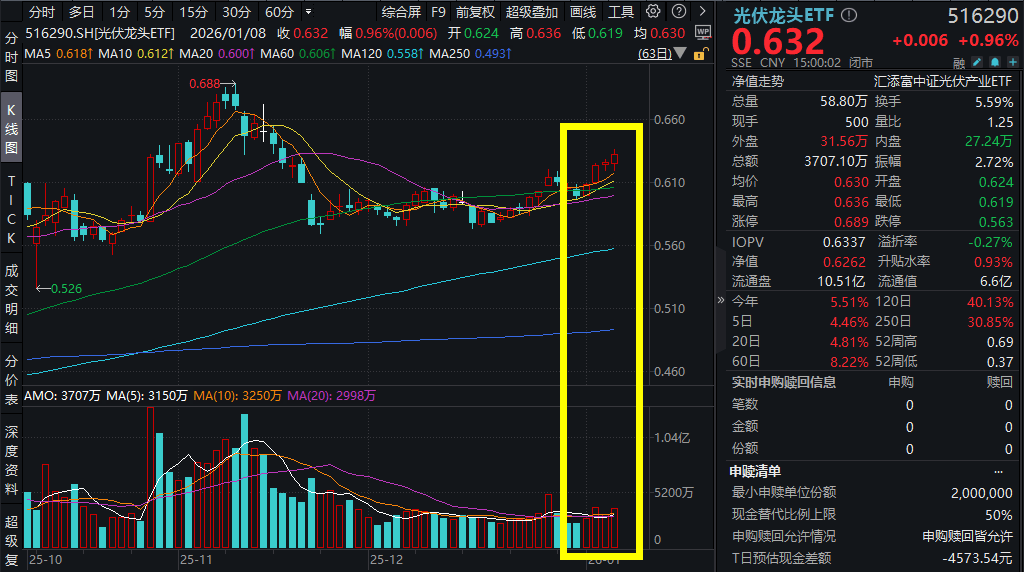
光伏龙头ETF(516290)标的指数成分股多数冲高,迈为股份涨超15%,奥特维涨超11%,钧达股份涨停,东方日升、捷佳伟创涨超6%,正泰电 气、TCL中环等涨超1%,阳光电源、TCL科技等跌超1%,特变电工等回调。 截至15:00,成分股仅做展示使用,不构成投资建议, 消息面上,近期,马斯克抛出每年向太空部署100GW(吉瓦)的计划,并瞬间引爆太空光伏概念。 晶科能源董事长在新年致辞中表示,同样一块板子,在太空的平均发电量比地球上安装的要高出7至10倍,破解了间歇性和衰减性的瓶颈,原则上 它可以一直用,一直发电。 天合光能董事长也在新年致辞中表示,新的一年,天合将加快推进钙钛矿量产化、商业化进程,开启太空光伏、星际算力新纪元。 【成长空间:AI催生太空算力需求,太空光伏有望步入万亿市场空间】 1月8日,A股窄幅整理,沪指微跌仍录得连续15个阳线,太空光伏概念活跃,截至收盘,同类费率最低档的光伏龙头ETF(516290)收涨0.96%, 喜提四连阳! 【光伏龙头ETF(516290)标的指数前十大成分股】 【行业发展:太空光伏迎技术成果商业化加速发展期,钙钛矿产业化进展加速】 中金公司表示,短期内钙钛矿-晶硅 ...
商业航天成最强主线!十大核心ETF·航空航天ETF(159227)开年四个交易日涨近10%
Ge Long Hui A P P· 2026-01-08 09:03
Market Performance - The Shanghai Composite Index experienced slight fluctuations, closing down 0.07%, while the Shenzhen Component Index and the ChiNext Index fell by 0.51% and 0.82% respectively, with total A-share trading volume at 2.83 trillion yuan [1] - The aerospace sector saw a significant surge, with stocks like Galaxy Electronics hitting the limit up for four consecutive days, and the Aerospace ETF (159227) rising by 5.26% today, marking a cumulative increase of 9.96% since the beginning of the year [1] Industry Developments - Star River Dynamics is set to implement the "Vesta I Sea Launch Type (Remote Seven)" commercial rocket launch task, code-named "Wanghai Tide" [2] - The first offshore reusable rocket recovery base in China has commenced construction in Hangzhou, with a total investment of 5.2 billion yuan, expected to achieve an annual production capacity of 25 rockets [2] - SpaceX aims to produce up to 10,000 Starship spacecraft annually, with a $250 million investment in a GigaBay factory to accelerate production [3] Policy and Technological Drivers - The commercial aerospace sector is experiencing a dual drive from policy and technology, with the Fourth Plenary Session in October emphasizing the importance of commercial aerospace as a "new growth engine" [4] - The Ministry of Industry and Information Technology (MIIT) has released 19 measures to promote the satellite communication industry, including easing market access and optimizing approval processes [4] - Key breakthroughs in reusable rocket technology are significantly reducing launch costs, facilitating the large-scale deployment of low-orbit satellite constellations [4] ETF Insights - The Aerospace ETF (159227) closely tracks the National Aerospace Index, boasting a high military industry purity of 98.66%, covering critical sectors such as aerospace equipment and satellite navigation, with a 70.19% weight in commercial aerospace concepts [5]
太空算力,HJT或为能源系统最优解!光伏ETF华夏(515370)上涨1.26%,钧达股份涨停
Mei Ri Jing Ji Xin Wen· 2026-01-08 07:01
Group 1 - The core viewpoint of the article highlights the transition of space photovoltaic technology from experimental to commercial acceleration, addressing the energy supply challenges in various applications such as space computing, deep space exploration, and remote area power supply [1] - The new "space computing" model, which operates in low/mid orbits, offers significant advantages over traditional ground data centers, including higher deployment efficiency, better energy efficiency, and lower cooling costs [1] - The cost of energy systems accounts for 22% of the overall economic viability of satellites, making it a critical factor in the development of space photovoltaic systems [1] Group 2 - The photovoltaic ETF Huaxia (515370) tracks the CSI Photovoltaic Industry Index, which includes upstream, midstream, and downstream companies in the photovoltaic industry, providing a comprehensive reflection of the industry's overall performance [2] - The index has a photovoltaic content of 83.64%, ranking first in the entire market dimension [2]



浙商证券:太空算力和商业航天2026年迎奇点时刻 建议关注太空光伏等四大细分赛道
智通财经网· 2026-01-08 06:04
Core Viewpoint - The space data center industry has transitioned from technology validation to the commercialization phase, represented by Starcloud-1 and China's "Three-Body Computing Constellation," with significant potential for industry growth and value creation [1] Group 1: Commercialization of Space Computing - The construction of space data centers offers a disruptive cost advantage, with a ten-year core cost of approximately $8.2 million compared to $167 million for ground solutions, leveraging efficient solar energy and natural vacuum radiation cooling [1] - The first phase of the computing constellation is expected to generate over tens of billions in industry output by 2027, with long-term potential exceeding one trillion [1] Group 2: Infrastructure Reconstruction - The traditional computing infrastructure paradigm is being redefined due to the unique characteristics of the space environment, necessitating new systems for radiation cooling, solar energy, and inter-satellite communication [2] Group 3: Global Competition Landscape - The low Earth orbit satellite network sector is characterized by intense competition, led by the U.S. with companies like SpaceX and Amazon, while China is rapidly advancing its own satellite internet systems under national strategic guidance [3] Group 4: Satellite Launch Plans - Major satellite constellations, including SpaceX, G60, and GW, are expected to conduct satellite launches over the next five years, with an estimated average of 940 rocket launches annually [4] Group 5: Growth in Launch Activities - The number of Falcon rocket launches has increased from 6 in 2014 to a projected 134 in 2024, while the Long March series has risen from 15 to 49 launches in the same period, indicating a robust growth in global space launch activities [5]

光伏设备行业深度:太空算力中心具备颠覆性优势,HJT或为能源系统最优解
Soochow Securities· 2026-01-08 04:34
Investment Rating - The report recommends a focus on HJT equipment leaders with overseas customer bases, specifically highlighting Maiwei Co., Ltd. and Gaomei Co., Ltd. for their production capabilities of ultra-thin silicon wafers [4]. Core Insights - The space computing paradigm is emerging due to the imbalance in supply and demand for computing power driven by AI advancements, leading to the development of "orbital data centers" [3]. - The energy system's weight significantly impacts the overall cost of satellites, with rollable photovoltaic arrays paired with flexible batteries being crucial for development [4]. - The current mainstream orbital resources are limited, prompting the evolution of computing platforms towards large motherships and multi-satellite clusters [5]. Summary by Sections Space Computing - Space computing represents a new paradigm where modular server nodes with training and inference capabilities are deployed on low or medium orbit satellites, creating "orbital data centers" [9]. - The first batch of AI satellites in the "Trinity Computing Constellation" has been launched, with plans for a total of 1,000 satellites [9]. Energy Systems - The cost of energy systems accounts for 22% of the total satellite cost, making it a critical factor in satellite economics [4]. - Rollable structures are gradually replacing traditional Z-shaped structures, becoming the mainstream solution for LEO orbits, and are compatible with flexible, thin-film batteries [4]. Market Dynamics - The limited availability of orbital resources is driving the development of computing platforms towards larger motherships and multi-satellite clusters, with significant deployment plans outlined by companies like Starcloud and Google [5]. - The report emphasizes the importance of HJT technology as the optimal solution for large-scale applications in space computing, particularly due to its compatibility with new energy systems [7]. Investment Recommendations - The report specifically recommends investing in HJT equipment leaders and companies capable of producing ultra-thin silicon wafers, indicating a strong potential for growth in this sector [4].