
单边主义

Search documents
中方在世贸组织揭批美国“对等关税”措施 呼吁维护全球服务贸易秩序
Yang Shi Xin Wen Ke Hu Duan· 2025-10-03 23:59
Core Points - The World Trade Organization (WTO) held its third annual meeting of the Services Trade Council in Geneva on October 3, where China presented a position paper emphasizing the need for members to strengthen and stabilize global services trade, criticizing the unilateralism and protectionism of the United States [1] - China highlighted that services trade is becoming a crucial engine for global trade growth, providing developing countries with more opportunities to integrate into the global value chain, while the U.S. "reciprocal tariffs" have caused turmoil in global trade, negatively impacting the services trade sector [1] - The U.S. has historically been the largest services trade surplus country, yet it has adopted a misleading narrative focusing solely on losses in goods trade while ignoring gains in services trade, which China labeled as a typical double standard [1] Summary by Sections China's Position - China called for the U.S. to adhere to WTO rules and engage in dialogue and cooperation to maintain the prosperity and stability of global services trade [1] - The country expressed willingness to work with all members to deepen the level of openness in the services trade sector, contributing to the healthy and stable development of global services trade [1] Response from Other Members - Members such as India, Brazil, Egypt, and Pakistan echoed China's statements, emphasizing the importance of a multilateral trade system as a foundational rule for global trade operations [2] - They highlighted that the services sector is a vital component of global supply chains and the future of global trade, advocating for a spirit of consultation and cooperation to ensure the stability and predictability of regulatory policies [2]
为完善全球治理提供合作框架(国际论坛)
Ren Min Ri Bao· 2025-10-03 22:02
Core Viewpoint - The global governance initiative proposed by President Xi Jinping aims to create a fair, mutually beneficial, and sustainable framework for governance cooperation, particularly benefiting developing countries [2][3]. Group 1: Global Governance Initiative - The initiative responds to current global challenges by promoting five core principles: equality of sovereignty, adherence to international law, multilateralism, a people-centered approach, and action-oriented outcomes [2]. - It emphasizes the importance of multilateralism and the role of the United Nations as a core platform for effective global governance [3]. Group 2: Importance for Developing Countries - The initiative enhances the representation and voice of developing countries in the global governance system, countering unilateralism [3]. - China's cooperation initiatives, such as the Belt and Road Initiative, have led to significant progress in infrastructure, energy, and technology for many developing countries [3]. Group 3: Alignment with Cuba's Interests - The global governance initiative aligns with Cuba's long-standing opposition to unilateralism and strongman politics, providing new opportunities for cooperation with China [4]. - Under the Belt and Road framework, Cuba has engaged in collaboration with China in various sectors, including infrastructure and biotechnology [4].


商务部回应墨西哥近日连续对中国发起多起反倾销调查
Zhong Guo Xin Wen Wang· 2025-10-03 13:58
Core Viewpoint - The Chinese Ministry of Commerce firmly opposes Mexico's recent anti-dumping investigations against Chinese products, emphasizing the need to protect legitimate rights and interests of Chinese enterprises and urging compliance with WTO rules [1][1][1] Summary by Relevant Sections Anti-Dumping Investigations - Mexico's Ministry of Economy has initiated four anti-dumping investigations against Chinese products, including float glass and PVC coated cloth, based on applications from domestic companies [1][1] - This year, Mexico has launched a total of 11 anti-dumping investigations against Chinese products, nearly double the total from the previous year [1][1] China's Response - The Chinese government has expressed strong opposition to protectionist actions that harm its legitimate rights and interests, calling for collective resistance against unilateralism and protectionism in the current context of U.S. tariff imposition [1][1] - The Ministry of Commerce has initiated a trade and investment barrier investigation regarding Mexico's proposed increase in import tariffs and other trade restrictions against China, in accordance with relevant laws [1][1] Future Actions - China will take necessary measures across trade and investment sectors based on the results of the investigation and actual circumstances to safeguard the legitimate rights of its enterprises [1][1]
假期重磅!商务部,最新发声!
Zheng Quan Shi Bao· 2025-10-03 10:04
Core Viewpoint - Mexico has initiated multiple anti-dumping investigations against Chinese products, including float glass, self-adhesive tape, PVC coated cloth, and steel bolts, which raises concerns about protectionism and its impact on trade relations [2][3]. Group 1: Anti-Dumping Investigations - Mexico's Ministry of Economy has launched four anti-dumping investigations against Chinese products at the request of domestic companies [2]. - This year, Mexico has conducted 11 anti-dumping investigations against Chinese products, nearly double the total from the previous year [2]. Group 2: China's Response - The Chinese Ministry of Commerce firmly opposes protectionist actions that harm its legitimate rights and interests and will closely monitor the progress of Mexico's investigations [2]. - China has initiated a trade and investment barrier investigation based on its Foreign Trade Law and relevant regulations in response to Mexico's proposed increase in import tariffs and other trade restrictions [2][3]. Group 3: Broader Trade Context - The Chinese side emphasizes the need for countries to collectively oppose unilateralism and protectionism, especially in the context of the U.S. imposing tariffs [3]. - The potential implementation of Mexico's unilateral tax increases could harm not only China but also other trading partners and negatively affect the business environment in Mexico [3].
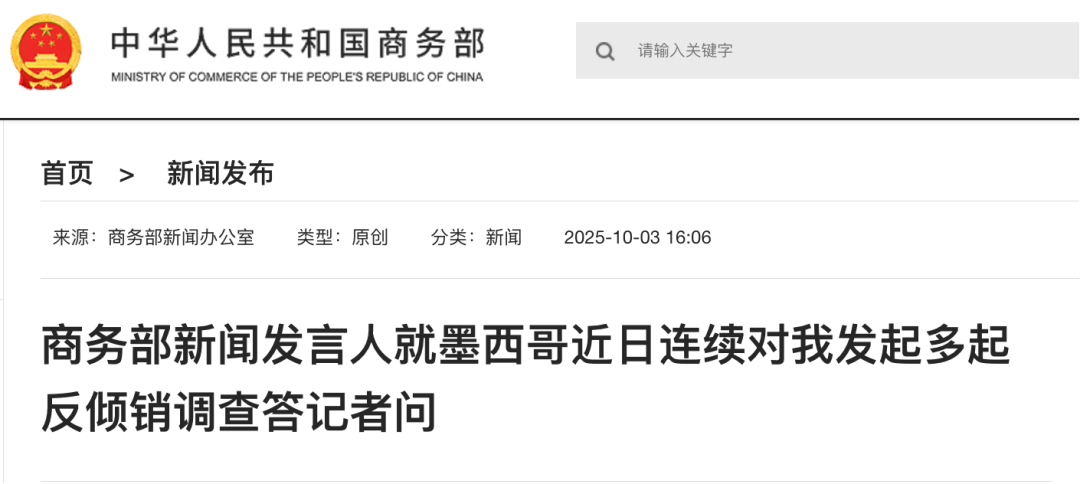
商务部表态
Zhong Guo Ji Jin Bao· 2025-10-03 09:30
Core Viewpoint - Mexico has initiated multiple anti-dumping investigations against Chinese products, which China firmly opposes as protectionist behavior that harms its legitimate rights and interests [2]. Group 1: Anti-Dumping Investigations - Mexico's Ministry of Economy has launched four anti-dumping investigations against Chinese products including float glass and PVC coated cloth, following requests from domestic companies [2]. - In 2023, Mexico has conducted a total of 11 anti-dumping investigations against Chinese products, nearly double the total from the previous year [2]. Group 2: China's Response - China emphasizes the need for countries to collectively oppose unilateralism and not succumb to protectionism, especially in the context of the U.S. imposing tariffs [2]. - The Ministry of Commerce has initiated an investigation into Mexico's proposed increase in import tariffs and other trade restrictions against China, in accordance with relevant laws and regulations [2]. - China will take all necessary measures, including in trade and investment, to protect the legitimate rights of its enterprises based on the investigation results and actual circumstances [2].
中方:坚决反对,将密切关注
中国能源报· 2025-10-03 08:51
Core Viewpoint - The Chinese Ministry of Commerce expresses strong opposition to Mexico's recent anti-dumping investigations against Chinese products, emphasizing the need to adhere to WTO rules and protect the rights of Chinese enterprises [1][3]. Group 1: Anti-Dumping Investigations - Mexico has initiated four anti-dumping investigations against Chinese products including float glass, self-adhesive tape, PVC coated cloth, and steel bolts, following requests from domestic companies [1][3]. - This year, Mexico has launched a total of 11 anti-dumping investigations against Chinese products, nearly double the total from the previous year [1][3]. Group 2: Trade Relations and Responses - The Chinese side has been cautious and restrained in initiating trade remedy investigations, contrasting with the increasing number of investigations from Mexico [1][3]. - In response to Mexico's proposed increase in import tariffs and other trade restrictions, the Chinese Ministry of Commerce has initiated an investigation into trade and investment barriers [1][3]. - The Chinese government will take necessary measures across trade and investment sectors based on the investigation results to protect the legitimate rights of enterprises [1][3].
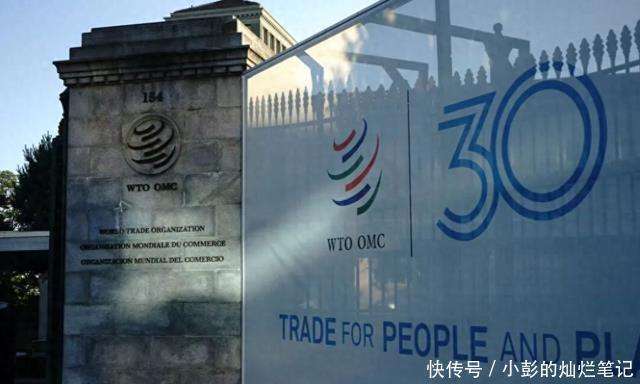
全球贸易体系受到冲击?美国采取单边行动,众国合体抗议提起投诉
Sou Hu Cai Jing· 2025-10-03 06:23
Group 1 - The WTO has become a focal point due to the challenges posed by the unilateral tariff policies of the United States, as emphasized by the newly re-elected Director-General Ngozi Okonjo-Iweala, who noted that "unilateralism has not disappeared" [1] - The Fisheries Subsidies Agreement, which took 21 years to negotiate, is highlighted as a testament to the resilience of multilateralism, marking it as the second new multilateral agreement in 30 years of the WTO [3] - Despite criticisms that the multilateral system is failing, 72% of global trade still adheres to WTO rules, indicating a significant level of compliance amidst challenges [5][7] Group 2 - The WTO's forecast for global goods trade volume in 2023 is expected to grow by 0.9%, a recovery from earlier predictions of negative growth, showcasing the system's resilience [7] - The WTO's appellate body has been non-functional since 2019 due to the U.S. refusal to appoint new judges, which has paralyzed this critical mechanism [8] - In response, Okonjo-Iweala has initiated a temporary arbitration mechanism involving 57 member countries, covering over half of global trade, with 16 disputes currently being resolved through consultations [10] Group 3 - The Investment Facilitation Agreement is currently stalled due to opposition from India, South Africa, and Turkey, with a deadline set for resolution at the 2026 ministerial meeting in Cameroon [10] - Okonjo-Iweala is committed to leading the WTO through these challenging times, emphasizing the necessity of multilateralism for issues like trade fairness and ocean protection, and viewing her re-election as an opportunity to complete unfinished business [10]
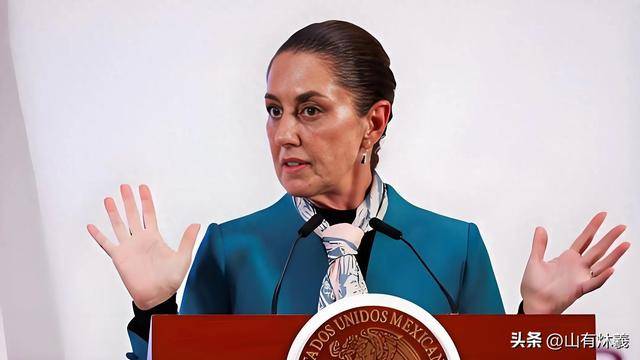
反制不隔夜!墨西哥为讨好美国付代价,中方连发两记重拳警示各国
Sou Hu Cai Jing· 2025-10-02 01:53
Core Points - Mexico has imposed tariffs of up to 50% on 1,400 Chinese goods, marking a significant shift in its trade policy towards China [1][3] - The tariffs are part of a broader strategy to protect domestic industries under the guise of the "Plan Mexico" initiative, but they appear to specifically target Chinese imports [3][5] - The U.S. has exerted pressure on Mexico to reduce trade with China, threatening to increase tariffs on Mexican goods if compliance is not met [7][9] Group 1: Tariff Details - The tariff rates include a 50% increase on automobiles, with parts ranging from 10% to 50%, and a 35% tax on steel products [3][5] - The list of goods affected is notably exclusive to China, as products from countries with free trade agreements with the U.S. and Canada are exempt [5][9] Group 2: China's Response - China reacted swiftly by launching anti-dumping investigations on pecans from Mexico and the U.S., which are significant exports for Mexico [11][13] - Additionally, China is investigating trade barriers imposed by Mexico on various products, including automobiles and textiles, indicating a comprehensive approach to retaliate [11][13] Group 3: Economic Implications - The trade conflict could lead to a 0.3% reduction in Mexico's GDP growth rate, with potential long-term impacts on employment and investment confidence from Chinese firms [23][25] - If the situation escalates, it is projected that trade between China and Mexico could decline by over 30%, severely affecting Mexico's economy [31][34] Group 4: Broader Regional Impact - The situation in Mexico serves as a warning to other Latin American countries, with concerns that similar pressures from the U.S. could lead to a 25% reduction in trade with China across the region [19][21] - Countries like Brazil and Argentina are closely monitoring the developments, fearing they may become targets of U.S. trade pressures as well [19][21] Group 5: International Trade Dynamics - The incident highlights the growing tensions in international trade, with unilateralism and protectionism threatening the foundations of multilateral trade rules [31][34] - The Chinese government emphasizes the importance of fair trade and cooperation, contrasting its approach with the U.S. strategy of coercion [31][34]
谈判陷入僵局,美国制定欠修理名单,先收拾印度,绝口不提中国
Sou Hu Cai Jing· 2025-10-01 13:52
特朗普政府把对外征收高额关税当成了一条"铁律"。只要哪个国家在关税问题上和美国唱反调,特朗普往往会立刻公开嘲讽甚至施压,哪怕对象是美国的盟 友也不例外。今年以来,不少西方国家在这种强压下向美国让步,接受了更多开放市场的条件。但对特朗普来说,这还不够——除了提高关税,美国还要求 这些国家在美境内做实实在在的投资,扶持美国实体经济,而且投资产生的收益要更多流向美方。外界看来,这种要求几乎像"霸王条款"。 为了尽快打破僵局,美国甚至制定了一份"需要优先处理"的国家名单,印度和巴西都在列。有美国官员认为,应当先对付印度,以避免其采取对美不利的举 措。目前美印之间的矛盾不仅是贸易逆差问题,印度继续从俄罗斯进口石油也是一大争议点。 在联合国大会等国际场合,特朗普曾直接敦促印度与俄罗斯在石油贸易上"切割"。印度并未按照美方要求退让,谈判代表直接反击:如果美国不允许印度购 买俄罗斯石油,那么印度可以转而从伊朗或委内瑞拉进口原油——这两国同样受到美国制裁。换言之,印度在石油问题上准备与美国硬碰硬,这使得美印达 成快速贸易协议的可能性非常渺茫。 有人会问:既然美国也指责中国购买俄罗斯石油,为何中国没有出现在那份"欠修理"的名单上 ...
俄中能源合作前景如何?中国计划如何吸引更多俄游客?中国驻俄大使回应
Xin Lang Cai Jing· 2025-09-30 13:28
Group 1: Current State of China-Russia Relations - China-Russia relations are at their historical best, characterized by mutual cooperation and strategic collaboration, unaffected by third-party interference [1][2] - High-level visits between the two countries' leaders have deepened their friendship and set a clear direction for future cooperation [1][2] Group 2: Economic and Energy Cooperation - China and Russia are expanding cooperation in various sectors including trade, investment, energy, agriculture, and technology, aiming to create benchmark projects that enhance resilience and efficiency [2][3] - The energy partnership is crucial for both nations, providing China with diversified energy sources and contributing to global energy market stability [2][3] Group 3: Tourism and Cultural Exchange - A new visa-free policy for Russian passport holders is expected to significantly increase the number of Russian tourists visiting China, with estimates of a 20% to 30% rise in tourist numbers [3][5] - Popular tourist destinations for Russian visitors include major cities like Beijing, Shanghai, and Sanya, with efforts underway to improve services and enhance the travel experience [5] Group 4: Multilateral Cooperation - The BRICS and Shanghai Cooperation Organization (SCO) frameworks are seen as vital platforms for emerging markets to collaborate and counter unilateralism and protectionism [6][7] - The SCO has grown to include 26 member countries, focusing on practical cooperation in various fields, which enhances its global influence [6] Group 5: Trade and Economic Policies - China emphasizes that trade wars and tariff conflicts yield no winners and advocates for open trade to achieve mutual benefits [7] - The country is committed to resisting all forms of protectionism and promoting an open global economy, which aligns with its broader economic strategy [7]