城市更新

Search documents
重庆持续推进超大城市现代化治理 打造一批“AI+”综合场景
Xin Lang Cai Jing· 2026-01-28 12:34
Group 1 - The core viewpoint of the news is that Chongqing aims to advance modernization governance in super-large cities by 2026, focusing on areas such as emergency management and enterprise services through the development of "AI+" integrated scenarios [1] - Chongqing will enhance the capabilities of the Digital Chongqing system, implementing actions to improve data quality and optimize service efficiency, while also strengthening security measures for cloud, network, and data usage [1] - The city plans to improve urban spatial layout by enhancing core functions in the central urban area and promoting coordinated development between the western and eastern regions with the central city [1] Group 2 - Chongqing will implement six major urban renewal actions, including enhancing urban traffic infrastructure and completing key projects like the first phase of Metro Line 15 to improve public transportation [2] - The city will focus on revitalizing idle spaces and expanding innovative and entrepreneurial areas through the "Three Innovations" action plan, while also accelerating the construction of urban comprehensive pipelines [2] - Chongqing aims to innovate its urban governance system by optimizing the governance structure and exploring sustainable investment mechanisms, while also enhancing smart governance through AI integration [2]
克而瑞地产研究:1月土地成交规模迎来季节性回落 供求规模环比显著下降
智通财经网· 2026-01-28 12:33
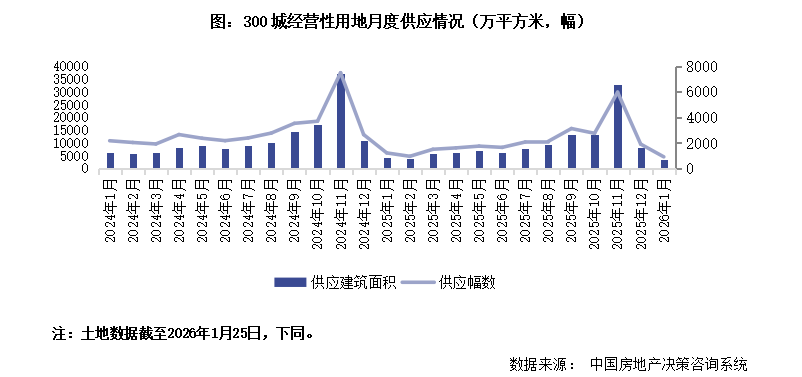
Core Viewpoint - The land transaction scale in January 2026 is experiencing a seasonal decline, with significant month-on-month and year-on-year decreases in both transaction area and value, indicating a continued implementation of the "control increment" policy by local authorities [1][2][9]. Supply and Demand - As of January 25, 2026, the land supply area is 33.6 million square meters, reflecting a 50% month-on-month decrease and an 8% year-on-year decrease, consistent with seasonal trends [2]. - The average land supply floor area ratio in monitored cities is 1.96, with high-quality low-density residential land being the main supply type [2]. Market Activity - The total area of land transactions nationwide is 25.8 million square meters, with a 90% month-on-month decline and a 48% year-on-year decline; the total transaction value is 62.2 billion yuan, also down 90% month-on-month and 59% year-on-year [9]. - The average floor price across all cities is 1,821 yuan per square meter, down 5% month-on-month, influenced by a decrease in high-tier city transactions [9]. Market Heat - The average premium rate for land transactions in January is 1.8%, continuing its low trend, with all high-value land parcels above 1 billion yuan being sold at base prices [12][17]. - The land auction failure rate is 7%, remaining at a low level, with notable failures in cities like Shijiazhuang and Hefei due to uncertain future sales prospects [14]. Key Land Parcels - In first-tier cities, notable land parcels include a high-value site in Guangzhou with a base price of 18.64 billion yuan, featuring strict additional conditions for development [3]. - In second-tier cities, the highest base price is from a site in Hangzhou at 2.134 billion yuan, with a floor price of 30,000 yuan per square meter [4]. - In third-tier cities, a noteworthy low-density residential site in Jinhua has a floor area ratio of only 1.09, with a starting price of 414 million yuan [4]. Policy and Regulation - The Ministry of Natural Resources and the Ministry of Housing and Urban-Rural Development have issued measures to support urban renewal, emphasizing the efficient use of existing land resources and aligning land supply with high-quality urban development [5].

北京两会定调房地产,着力稳市场,建更多“好房子”,三部门:新建住宅项目需按规划标准配建养老设施
Hua Xia Shi Bao· 2026-01-28 12:13
Core Insights - Beijing's government is focusing on stabilizing the real estate market, addressing housing difficulties for young people, and promoting urban renewal in 2023 [2][4] - The relaxation of housing purchase restrictions at the end of December 2025 has led to increased market activity, marking a positive start for the real estate sector in 2026 [8] Real Estate Market Stability - The government aims to enhance the housing rental market, increase the supply of various housing products, and improve living conditions for urban service personnel [4][6] - During the 14th Five-Year Plan period, Beijing constructed over 690,000 affordable housing units, with 450,000 completed, achieving an 85% guarantee rate for public rental housing [4] Affordable Housing Initiatives - Recent years have seen a significant acceleration in the construction of affordable housing, with a new project in Shunyi District providing 989 rental units [5] - The project offers diverse unit sizes and is designed for immediate occupancy, catering to various demographic needs [5] Urban Renewal Focus - Urban renewal remains a key priority, with plans to implement policies that support mixed-use developments and improve existing infrastructure [6][7] - Specific initiatives include the renovation of over 300 old residential communities and the installation of more than 800 elevators in older buildings [6] Market Response to Policy Changes - Following the new policy implementation, there has been an uptick in market activity, particularly in core areas, although disparities remain between different regions and projects [8][9] - The overall market is still in a moderate recovery phase, with structural inventory pressures not fully alleviated, but expectations for gradual improvement in demand are present [9]
广东“未来社区”怎么建?港澳委员建议试点项目纳入城市更新
Nan Fang Du Shi Bao· 2026-01-28 12:08
2026年广东省政府工作报告为今年广东发展描绘新蓝图。报告中提出,广东将加强普惠性、基础性、兜 底性民生建设,扎扎实实办好十件民生实事,切实让人民群众看到变化、见到成效、得到实惠。南都N 视频记者从会上了解到,在2026年广东省两会期间,多位来自港澳地区的政协委员围绕社区建设发展提 出提案。 聚焦未来社区建设 运营思路从单一社区到片区化转变 陈家良指出,广州花都的未来社区等融合粤澳两地服务特色的项目,具备一定的参考意义,可通过研究 两地合作模式和成效,探讨共同促进社区服务、跨境数据交流等重要课题,在机制、政策、资源等方面 进行赋能,探索在社会治理领域形成融合两地特色的大湾区高质量发展模式。 生活垃圾分类的精细做法 为深入实施"百县千镇万村高质量发展工程",落实完整社区建设工作要求,2025年11月,广东省住房和 城乡建设厅发布广东省"百县千镇万村高质量发展工程"指挥部城镇建设专班办公室关于印发《广东省未 来社区(完整社区)建设试点项目名单(2025年)》的通知。提出将重点打造党建引领未来社区全流程 建设及治理、未来公共空间、未来建筑空间、未来社区服务等八大场景,推动社区环境、服务、治理提 质增效,将社区建成服 ...
德才股份:福建奇想无限网络有限公司是公司的控股孙公司
Zheng Quan Ri Bao Zhi Sheng· 2026-01-28 10:41
Core Viewpoint - The company expects significant improvement in its performance by 2025, driven by strategic focus on "urban renewal" and "urban supporting" sectors, as well as participation in national construction projects [1] Group 1: Company Overview - Fujian Qixiang Wuxian Network Co., Ltd. is a controlling subsidiary of the company, with its main business and operational scope defined by final registered information approved by industry and commerce [1] Group 2: Performance Improvement Factors - The main reasons for the expected performance improvement by 2025 include continuous optimization of order structure, steady enhancement of project quality, and improvement in gross profit margin leading to overall gross profit growth [1] - The company faced challenges in the previous year due to industry environment and slow project payments, which led to provisions for impairment on accounts receivable and debt assets [1] Group 3: Financial Management and Efficiency - In 2025, the company plans to enhance its accounts receivable management mechanism, strengthen collection efforts, and accelerate the disposal of debt assets, which will positively impact current profits without significant impairment provisions [1] - The company is committed to refined management practices, implementing cost reduction and efficiency enhancement measures to improve overall operational efficiency and financial stability [1]

原拆原建让老旧危楼焕新
Jing Ji Ri Bao· 2026-01-28 08:57
Core Viewpoint - The article highlights the ongoing urban renewal efforts in China, focusing on the reconstruction of a residential building in Beijing's Xicheng District, which serves as a model for similar projects nationwide [1][4]. Group 1: Urban Renewal and Housing Safety - The original building, constructed in 1978, was deemed a D-level hazardous structure due to aging and safety concerns, prompting its demolition and reconstruction [1]. - The Chinese government is actively promoting urban renewal, emphasizing the need for the renovation of existing buildings, particularly those classified as dangerous [1]. Group 2: Innovative Construction Methods - The project employs a "factory manufacturing + on-site installation" model, significantly reducing construction time and enhancing efficiency, with a 75% increase in building efficiency compared to traditional methods [2]. - The construction process involved breaking down the building into 156 modular units, with over 90% of the work completed in the factory, leading to a completion time of just 45 days for the building's structure [2]. Group 3: Quality Assurance and Financial Innovation - The smart construction approach ensures high-quality housing, with features like improved airtightness, enhanced sound insulation, and integrated safety designs for elderly and children [3]. - The project introduces a financial innovation mechanism called "mortgage-backed renovation," which allows for personal housing renovation loans, easing the financial burden on economically disadvantaged families [3]. Group 4: Collaborative Model for Urban Renewal - The project exemplifies a collaborative model involving government, residents, and enterprises, facilitating a win-win situation through coordinated efforts and tailored solutions [4]. - It emphasizes the importance of urban assessments to identify hazardous housing and advocates for the promotion of smart construction methods to benefit more citizens and provide new opportunities for enterprises [4].
2025年中国新开工改造城镇老旧小区2.71万个
Zhong Guo Xin Wen Wang· 2026-01-28 08:45
当前,中国城市发展形势发生深刻变化,城市更新的重要作用更加凸显。2025年年末召开的全国住房城 乡建设工作会议提出,2026年要高质量开展城市更新,编制实施"十五五"城市更新专项规划,抓好城市 体检、更新试点,实施一批民生工程、发展工程、安全工程。以"绣花"功夫精细化推进城镇老旧小区改 造、完整社区建设、口袋公园建设、绿地开放共享、"温暖工程"建设、城市小微公共空间改造,提升无 障碍适老化环境品质。(完) 2025年,中国计划新开工改造城镇老旧小区2.5万个。住建部透露,根据各地统计上报数据,1-12月 份,全国新开工改造城镇老旧小区2.71万个、499万户,共完成投资1332亿元人民币。 中新社北京1月28日电 (记者庞无忌)中国住房和城乡建设部28日消息,2025年中国新开工改造城镇老旧 小区2.71万个,超额完成年度计划。 (文章来源:中国新闻网) ...
多国青年齐聚北京:在历史与现代中读懂真实中国
Huan Qiu Wang· 2026-01-28 08:18
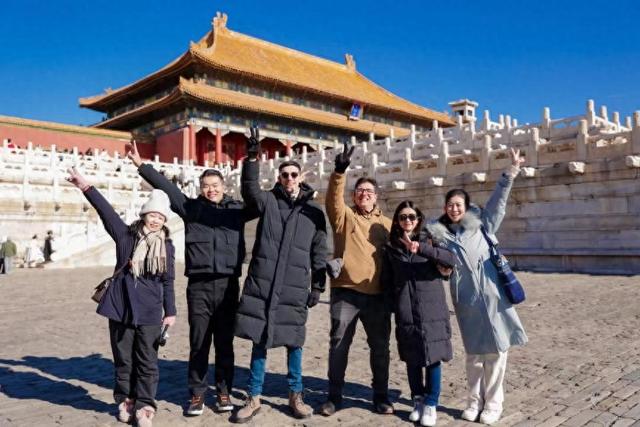
Core Viewpoint - The event highlights the recognition and integration of foreign employees within China Communications Construction Company (CCCC), showcasing their contributions and experiences in China while promoting cultural exchange and understanding [1][5][10]. Group 1: Cultural Experience - Foreign employees from Malaysia, Laos, and Ethiopia participated in a five-day immersive experience in Beijing, exploring historical and modern landmarks such as the Forbidden City and Shougang Park [1][3]. - The visit included a City Walk that connected the historical significance of the Forbidden City with the modern transformation seen in Shougang Park, emphasizing China's sustainable development and urban renewal efforts [3][5]. Group 2: Recognition and Awards - The foreign employees were honored at CCCC's employee representative conference, receiving the "Top Ten Foreign Young Employees" award for their contributions, which reinforced their identity as part of the global CCCC family [5][7]. - The award ceremony was a moment of pride and gratitude for the recipients, who expressed appreciation for the support from their colleagues and leaders [7]. Group 3: Personal Connections and Insights - The interactions among the foreign employees fostered friendships and a deeper understanding of the CCCC culture, encapsulated in the phrase "CCCC, Our Family" [13]. - The participants shared their impressions of Chinese cuisine and digital payment systems, highlighting the convenience and cultural richness of their experiences in Beijing [12][13].

2026:房地产能触底吗?
Sou Hu Cai Jing· 2026-01-28 08:03
Core Insights - The article discusses the potential turning point for the real estate market in 2026, highlighting the need for objective indicators to assess whether the market has reached its bottom [1][4] - It emphasizes the shift from a high-leverage model to a new development model focused on quality and operation, indicating a fundamental restructuring of the industry by 2030 [5][9] Group 1: Market Trends and Indicators - In 2025, real estate development investment in China was 82,788 billion yuan, a decrease of 17.2% from the previous year [1] - The median rental yield in 30 key cities has reached 2.06%, with over 55% of communities yielding more than 2%, indicating a shift towards rental income as a significant factor for investors [2] - The decline in second-hand housing prices has exceeded 39% from peak levels, and new construction starts have dropped by 74% compared to peak levels, suggesting a significant market correction [2] Group 2: Diverging Market Perspectives - Optimists believe 2026 will confirm the bottom of the market, with inventory stabilization and new demand from favorable policies leading to a period of bottoming out [4] - Conversely, cautious analysts predict a further decline in new home prices by 2% to 3% in 2026, with a full recovery in core cities potentially delayed until the second half of 2027 [4] Group 3: New Development Model - The new model emphasizes three dimensions: a shift from "availability" to "quality," focusing on improved living conditions and sustainable housing [6][9] - Real estate companies are transitioning from "development and construction" to "asset operation," with a significant increase in the importance of managing existing properties [6][9] - The article highlights the need for a collaborative approach among policy, financing, and sales systems to support the new model [8][9] Group 4: Capital Management Strategies - The investment logic in real estate is shifting from "holding assets" to "managing liquidity," emphasizing the importance of asset flow in the new market environment [17][29] - A "barbell strategy" is recommended for capital allocation, balancing traditional core assets with new growth sectors [18][19] - The article outlines three asset pools for effective capital management: distressed assets, value-added assets, and standardized REITs, emphasizing the need for efficient asset flow between these pools [22][25][26]

“十四五”时期广西解决800多万民众住房困难
Zhong Guo Xin Wen Wang· 2026-01-28 07:35
Group 1 - The core viewpoint of the article highlights that during the "14th Five-Year Plan" period, Guangxi has constructed and collected a total of 2.95 million units of various types of affordable housing and resettlement housing, addressing housing difficulties for over 8 million people [1][2] - The 2026 Guangxi Housing and Urban-Rural Development Work Conference reviewed the achievements of 2025 and outlined key tasks for 2026, emphasizing the need for continued reform and innovation in the housing sector [2][3] - In 2025, Guangxi achieved a 100% delivery rate in the "guaranteed housing" campaign, with 22 new "good housing" projects recognized by the market, and initiated urban inspections to improve living conditions [2][3] Group 2 - In 2026, Guangxi plans to focus on urban renewal to promote high-quality urban development and support the extension of county infrastructure to surrounding rural areas, while enhancing the historical and cultural preservation system [3] - To stabilize the real estate market, Guangxi aims to reduce inventory of non-residential properties, conduct housing promotion activities, and acquire over 10,000 units of existing properties for affordable housing [3][5] - Guangxi will continue to optimize the market environment for the construction industry, promote digital and intelligent regulation, and enhance support for enterprises, while advancing smart city initiatives and applications of AI in the construction sector [5]