
太空算力

Search documents
商业航天崛起,关注轻量化高效太空光伏技术
Zhong Guo Neng Yuan Wang· 2026-01-08 01:07
Core Insights - The report highlights the rapid development of space computing and solar energy technologies, with significant milestones achieved in 2023, including the launch of China's first space computing constellation and plans for large-scale solar-powered AI satellites [1][3]. Group 1: Space Computing Developments - In May 2023, China launched the world's first space computing constellation, marking a significant advancement in space technology [1][3]. - SpaceX delivered NVIDIA's H100 GPU to space in December 2023, indicating a growing interest in integrating advanced computing capabilities into space applications [1][3]. - Elon Musk announced plans to send 100 gigawatts of solar-powered AI satellites into orbit annually, showcasing a feasible technological pathway for future space energy solutions [1][3]. Group 2: Solar Energy Initiatives - Beijing proposed the construction of a space data center with over 1,000 megawatts of power in the 700-800 km dawn-dusk orbit, outlining a strategic plan from 2025 to 2035 [1][3]. - ResearchandMarkets projects that the global in-orbit data center market will reach $39.09 billion by 2035, with a compound annual growth rate (CAGR) of 67.4% [3]. - The high energy consumption characteristics of space computing create a rigid demand for lightweight and efficient energy solutions, aligning well with the advantages of space photovoltaics [3]. Group 3: Technological Innovations in Solar Cells - The report emphasizes the advantages of P-type ultra-thin HJT (Heterojunction Technology) solar cells, which can reduce launch payloads and save fuel in cost-sensitive applications like low Earth orbit satellites [2][5]. - The collaboration between Aerospace Hongtu and Zhongneng Energy Storage to develop new energy technologies for space computing marks a significant step in the commercialization of flexible perovskite photovoltaics [2][3]. - Perovskite solar cells are breaking traditional limitations in space photovoltaics, with their lightweight and high-efficiency characteristics making them suitable for space computing needs [6][7]. Group 4: Market Opportunities and Recommendations - The increasing number of satellites and demand for in-orbit data create opportunities in the solar energy sector, particularly for P-type ultra-thin HJT and perovskite photovoltaic products [8]. - Companies such as Dongfang Risen, Aerospace Hongtu, and GCL-Poly are recommended for tracking due to their potential growth in new technologies and applications [8]. - The report suggests monitoring the progress of related supply chain companies benefiting from the expansion of space computing and commercial aerospace scenarios [8].

商业航天开启黄金发展期 关注三大投资机遇
Zhong Guo Zheng Quan Bao· 2026-01-07 20:50
Core Viewpoint - The commercial aerospace sector is experiencing a significant surge, with the Wind commercial aerospace theme index showing a cumulative increase of over 60% from November 21, 2025, to January 7, 2026, indicating strong market interest and potential [1] Group 1: Industry Trends and Developments - The commercial aerospace industry is entering a concentrated "breakthrough period" for large-capacity reusable rockets, supported by a comprehensive policy framework [1][2] - The market is witnessing a structural shift towards high-quality economic development, with commercial aerospace emerging as a core representative of new productive forces [2] - The dual support of technological breakthroughs and systematic policy support is driving the current market dynamics, with significant advancements expected in 2025-2026 [3][4] Group 2: Catalysts and Events - Key catalysts for the industry include the successful launch of the Zhuque-3 rocket and upcoming launches of various models like Tianlong-3 and Zhishen-1, which will validate technological advancements [3][5] - The establishment of the National Commercial Aerospace Development Fund and the inclusion of commercial aerospace in the fifth set of listing standards on the Sci-Tech Innovation Board are expected to provide diverse financing channels for industry players [4][5] Group 3: Investment Opportunities - The investment focus should be on three core areas: rocket manufacturing and operation, satellite manufacturing and operation, and ground terminal applications [8] - Companies with strong capabilities in reusable technology and large-capacity launch capabilities are expected to lead the market [8] - The anticipated acceleration of satellite constellation networks will create significant demand for satellite production, benefiting upstream component suppliers [7][8] Group 4: Future Outlook - The commercial aerospace industry is projected to transition from concept speculation to performance realization, with companies possessing substantial technological reserves and order support expected to stand out [8] - The long-term growth logic of the commercial aerospace sector remains intact, driven by continuous technological breakthroughs and supportive policies, indicating a golden period for high-quality development across the entire industry chain [8]

中信建投任宏道: 商业航天开启黄金发展期 关注三大投资机遇
Zhong Guo Zheng Quan Bao· 2026-01-07 20:46
Core Insights - The commercial aerospace sector is a strong focus for investment, with the Wind commercial aerospace theme index showing a cumulative increase of over 60% from November 21, 2025, to January 7, 2026 [1] - Analysts believe that China's large-capacity reusable rockets are entering a critical breakthrough period, supported by a comprehensive policy framework, with significant events such as IPOs and rocket launches expected in 2026 [1][4] - The transition from speculative investment to performance realization in commercial aerospace is anticipated, with a focus on three core areas: rocket manufacturing, satellite networking, and downstream applications [1][8] Market Dynamics - The commercial aerospace sector is seen as a representation of structural market trends during a phase of high-quality economic development, with differentiated growth across various industries [2] - The sector's growth is driven by technological breakthroughs and supportive policies, including the establishment of the National Space Administration's commercial aerospace division and the launch of development funds [3][4] Technological and Policy Support - The sector is experiencing a multi-dimensional driving logic, with technological advancements since 2015, particularly in reusable rocket technology, providing solid support for market performance [3] - A series of policy measures have been implemented to support the industry, including the adjustment of listing standards for the Sci-Tech Innovation Board and the promotion of private investment [4][5] Upcoming Catalysts - Key events in 2026 include the anticipated IPO of Blue Arrow Aerospace, which is expected to set a benchmark for private rocket companies, and multiple rocket launches to validate technological advancements [6][8] - The domestic aerospace industry is rapidly closing the gap with international counterparts, particularly in areas such as rocket recovery and satellite production [6][8] Investment Opportunities - The commercial aerospace industry is transitioning from technology validation to commercial application, presenting investment opportunities across the entire value chain [7] - Key focus areas for investment include rocket manufacturing and operation, satellite production, and ground terminal applications, with an emphasis on companies that possess reusable technology and large-capacity launch capabilities [8][9] Strategic Recommendations - Investors are advised to consider companies' core positions within the industry, competitive stability, and financial health when selecting investment targets [9] - The commercial aerospace sector is expected to shift from speculative hype to tangible performance, with companies demonstrating substantial technological capabilities and order support likely to emerge as leaders [9]

顺灏股份:轨道辰光专注于晨昏轨道巨型算力卫星星座建设
Zheng Quan Ri Bao Zhi Sheng· 2026-01-07 14:09
Core Viewpoint - Shunhao Co., Ltd. is focusing on the development of a giant computing power satellite constellation in the dawn-dusk orbit, which aligns with global trends in space computing power [1] Group 1: Project Overview - The project, named "Tian Guang," is the first incubated industrial project by the Beijing Xingchen Future Space Technology Research Institute [1] - It aims to leverage the unique characteristics of the dawn-dusk orbit to provide continuous solar power supply 24/7 [1] Group 2: Technological Innovations - The project utilizes new gallium arsenide solar cells to significantly enhance the power density of the satellites [1] - Innovative radiative cooling plates and two-phase fluid loop technology have been developed to efficiently dissipate waste heat into the cold environment of space, reducing reliance on ground data centers for cooling [1] Group 3: Achievements and Future Prospects - The team has made progress in key areas such as massive data transmission, space environment protection, and large-scale flat deployment, laying a solid technical foundation for the stable operation of computing satellites [1]

顺灏股份(002565) - 002565顺灏股份投资者关系管理信息20260107
2026-01-07 12:46
Group 1: Company Overview - The company focuses on "environmentally friendly low-carbon new materials + biomedicine" as its dual development strategy, with four main business areas: special environmentally friendly paper, printing products, industrial hemp processing, and new tobacco products [2][3][4]. Group 2: Special Environmentally Friendly Paper - The company is one of the earliest in China to engage in the research, production, and sales of special anti-counterfeit environmentally friendly paper, including vacuum aluminum paper and laser anti-counterfeit materials [3]. - The printing business primarily operates through bidding projects, ensuring high customer retention and the ability to provide customized services [3]. Group 3: Industrial Hemp and New Tobacco - The industrial hemp business focuses on the extraction and processing of CBD and other rare cannabinoids, with a subsidiary in the U.S. offering products like Vitaldiol—R series [4]. - The new tobacco business has developed a certain scale of revenue through subsidiaries engaged in research, production, and branding [4]. Group 4: Investment in Space Computing - In June 2025, the company invested 110 million RMB for a 19.30% stake in Beijing Orbit Chuang Technology Co., which focuses on space data centers [4][6]. - The investment aligns with national policies promoting hard technology and aims to explore the space computing industry, which is seen as a second growth curve for the company [6]. Group 5: Space Data Center Technology - Orbit Chuang's core technology includes deploying computing satellites in the dawn-dusk orbit, providing continuous solar power and addressing cooling challenges for high-performance computing [8][9]. - The company anticipates that the space data center's "sky computing" services may take 5 years to show clear commercial value, while "ground computing" services may take 5-10 years to compete with terrestrial data centers [9]. Group 6: Risks and Challenges - The space data center project faces risks related to macroeconomic conditions, industry policies, and potential delays in commercialization and profitability [9].
华金证券:商业航天产业快速崛起 关注轻量化高效太空光伏技术
智通财经网· 2026-01-07 08:37
Core Insights - The space computing sector is entering a phase of large-scale implementation, with significant growth in demand for photovoltaic technology in space applications [1][2]. Group 1: Market Growth and Demand - The global market for in-orbit data centers is projected to reach $39.09 billion by 2035, with a compound annual growth rate (CAGR) of 67.4% over the next decade [2]. - The high energy consumption characteristics of space applications create a rigid demand for "lightweight and high-efficiency" energy solutions, aligning well with the advantages of space photovoltaic technology [2]. Group 2: Technological Advancements - Gallium arsenide (GaAs) batteries are currently the core support for space photovoltaics, with over 90% of their applications concentrated in the aerospace sector [3]. - The efficiency of GaAs solar cells has achieved breakthroughs, with a six-junction cell reaching a conversion efficiency of 47.1% under concentrated conditions [3]. - P-type ultra-thin heterojunction (HJT) solar cells are particularly advantageous for low Earth orbit satellites, as they reduce launch loads and save fuel [4]. Group 3: Emerging Technologies - Perovskite solar cells are breaking traditional limitations of space photovoltaic technology, offering lightweight and high-efficiency characteristics suitable for space computing needs [5]. - The performance of perovskite solar cells has surpassed 25% efficiency, with minimal degradation under space radiation conditions [5][6]. Group 4: Investment Opportunities - The rapid growth in satellite numbers and demand for in-orbit data highlights opportunities in the photovoltaic sector, particularly for p-type ultra-thin HJT and perovskite products [7]. - Companies such as Dongfang Risheng, Aerospace Hongtu, and GCL-Poly Energy are recommended for tracking due to their potential in new technology applications [7].
海南华铁(603300.SH):公司未开展太空算力相关业务
Ge Long Hui· 2026-01-07 08:04
格隆汇1月7日丨海南华铁(603300.SH)在投资者互动平台表示,公司未开展太空算力相关业务。 ...

电力设备及新能源行业快报:商业航天崛起,关注轻量化高效太空光伏技术
Huajin Securities· 2026-01-07 07:31
Investment Rating - The industry investment rating is maintained as "Outperform the Market" [2] Core Insights - The report highlights the rise of commercial aerospace and emphasizes the importance of lightweight and efficient space photovoltaic technology, particularly gallium arsenide (GaAs) batteries, which dominate the aerospace sector with over 90% market share [1] - The global market for GaAs batteries is projected to reach USD 425 million by 2024 and grow to USD 590 million by 2031, with a compound annual growth rate (CAGR) of 4.3% [1] - In China, the market for GaAs batteries was approximately CNY 5 billion in 2022 and is expected to exceed CNY 12 billion by 2025 [1] - The report discusses the advantages of P-type ultra-thin heterojunction (HJT) cells, which are particularly suitable for cost-sensitive applications like low Earth orbit satellites, as they reduce launch weight and save fuel [1] - The report also notes significant advancements in perovskite solar cells, which are breaking traditional limitations in space photovoltaic technology, offering lightweight and high-efficiency solutions [7] Summary by Sections Market Overview - The GaAs battery market is expected to expand into new fields and applications due to ongoing technological advancements and cost reductions [1] - The report indicates that the efficiency of GaAs solar cells has reached 47.1% under concentrated conditions, showcasing the potential for further improvements [1] Technological Developments - The report mentions that the thickness of P-type ultra-thin HJT cells is around 50-70 micrometers, which allows for further reduction and enhances flexibility for applications in space [6] - Perovskite solar cells have demonstrated efficiencies exceeding 25% and show superior radiation resistance compared to traditional III-V multi-junction cells [7] Investment Recommendations - The report suggests tracking companies involved in the development of P-type ultra-thin HJT and perovskite photovoltaic products, highlighting firms such as Dongfang Risen, Aerospace Hongtu, and GCL-Poly Energy [8] - It also recommends paying attention to the supply chain and related enterprises benefiting from the expansion of space computing and commercial aerospace [8]
太空光伏:地外可靠能源,剑指万亿市场
Hua Er Jie Jian Wen· 2026-01-07 07:22
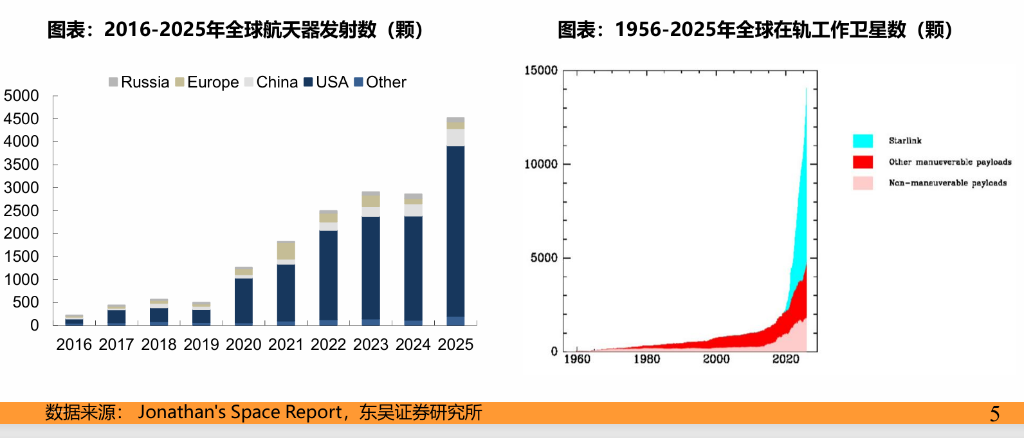
Core Insights - The maturity of reusable rocket technology is driving a significant decrease in launch costs, leading to a "Moore's Law" moment in commercial space, which is creating a massive demand for space photovoltaic systems [1] - By 2025, the number of global satellite launches is expected to exceed 4,300, representing a year-on-year growth of over 50% and a compound annual growth rate of 34% over the past decade [1][5] - The deployment of large satellite constellations will create a rigid demand for high-performance photovoltaic cells, potentially generating a market space of nearly 200 billion yuan for solar wings if 10,000 satellites are launched annually [5] Launch Cost and Frequency - The rapid rise of commercial space is primarily driven by the exponential decrease in launch costs, with SpaceX's Falcon 9 launch cost dropping to approximately $1,400-$1,800 per kilogram, significantly lower than traditional launch costs [6] - Global satellite launches are projected to exceed 300 by 2025, doubling from 2021 levels [6] Strategic Resource Competition - The scarcity of near-Earth orbital frequency bands and positions is accelerating deployment efforts by various countries, as these resources are non-renewable [9] - The U.S. currently leads in launch numbers and in-orbit satellites, while China is rapidly catching up with its "Thousand Sails" and "GW" constellation plans [9] Photovoltaic Systems in Satellites - The power system is crucial in satellite manufacturing, accounting for approximately 20%-30% of total costs, with solar wings representing 60%-80% of the power system's value [10] - As satellite payloads evolve, particularly in communication and computing, power demands are increasing, driving the development of larger and higher-power solar wings [10] Technological Pathways - The current technological landscape for space photovoltaics is characterized by diverse competition, focusing on balancing cost and performance [11] Space Computing and Future Potential - The demand for AI computing is pushing the space economy towards computing and data centers, with space offering ideal conditions for high-performance computing nodes [13] - If a 10 GW space computing system is realized, the solar wing market could reach several trillion yuan [13] Photovoltaic Technologies - Gallium Arsenide (GaAs) is the current mainstream choice in China, known for high efficiency and strong radiation resistance, but its high cost limits scalability [15] - Silicon solar cells are used by SpaceX for their Starlink satellites due to lower costs, despite lower efficiency [15] - Perovskite and tandem technologies are seen as potential disruptors, offering high energy-to-weight ratios and low manufacturing costs, although their stability in extreme space conditions needs further validation [15]

卫星ETF广发(512630)近7天获加仓近4亿元,开源策略首席韦冀星:卫星全产业链有望从“投入孵化期”提前步入“盈利兑现期”
Xin Lang Cai Jing· 2026-01-07 06:18
Group 1 - The commercial aerospace sector is experiencing multiple favorable catalysts, including the IPO of Blue Arrow Aerospace, accelerated low-orbit satellite launches, and the rising interest in space computing, leading to increased market activity and institutional research focus [1] - By 2026, the domestic commercial aerospace industry is expected to witness a "triple resonance" of policy, technology, and capital, with several reusable medium to large launch vehicles planned for their maiden flights [1] - The Chinese government has been actively promoting satellite internet policies, integrating it into the communication network infrastructure, and aiming for over 10 million satellite communication users by 2030 [1] Group 2 - The satellite industry is viewed as a strong strategic investment opportunity due to its large market potential, robust policy support, accelerated technological advancements, and expanded application scenarios [2] - The urgency for satellite launches is heightened by the International Telecommunication Union's "first come, first served" rule, with plans for nearly 30,000 satellites by companies like China Star Network and G60 [2] - 2026 is anticipated to be a pivotal year for reusable commercial rockets, with state and private enterprises collaborating on recovery technologies, which are essential for reducing launch costs [2] Group 3 - As of January 7, 2026, the CSI Satellite Industry Index experienced a slight decline of 0.58%, while the satellite ETF from Guangfa saw active trading with a turnover of 3.39 billion yuan [3] - The Guangfa Satellite ETF reached a new high with a total scale of 1.08 billion yuan and 679 million shares, indicating strong market interest and net inflows of 3.85 billion yuan over the past week [3] - The CSI Satellite Industry Index focuses more on the upstream manufacturing segment of the satellite industry, with over 25% weight in aerospace equipment, providing a sharper and more concentrated exposure to industry acceleration [3][4]