
6G

Search documents
市政府党组(扩大)会议、市政府常务会议召开
Nan Jing Ri Bao· 2026-01-02 01:12
Group 1 - The city government is focusing on the comprehensive governance of chemical and hazardous materials safety, emphasizing the need for higher standards, practical measures, and strict enforcement to prevent and mitigate risks [2] - The meeting highlighted the importance of collaboration among various departments to enhance information sharing, joint inspections, and emergency responses, aiming to create a strong synergy in risk management [2] - The city is advancing the "Artificial Intelligence +" initiative to establish a national AI innovation application pilot zone, aiming to leverage AI for development and improve public welfare [2] Group 2 - The city is planning to implement the "6G City" action plan for 2026-2027, focusing on leveraging advantages in core technology, research transformation, and creating application scenarios to foster a favorable business environment [3] - The meeting underscored the need for continuous improvement in the industrial ecosystem to convert comparative advantages into industrial strengths, aiming to establish a leading demonstration area for 6G industry development [3]
华为/OPPO/小米站台,8亿募资剑指 6G 射频前沿
是说芯语· 2026-01-01 00:40
Core Viewpoint - Chongqing Ruishi Chuangxin Microelectronics Co., Ltd. has officially been accepted for IPO on the Sci-Tech Innovation Board, marking its significant progress in the capital market as a leading domestic RF front-end chip and module enterprise [1] Industry Overview - The RF front-end chip is a core component of wireless communication devices, significantly impacting signal quality and communication performance. The market has long been dominated by international giants such as Broadcom, Skyworks, and Qorvo, particularly in the critical components like filters, where domestic companies have faced supply chain constraints [3] - Among domestic listed companies in the RF front-end chip and module sector, there are established leaders and emerging players, showcasing diverse market positions, technological characteristics, and recent performance trends [3] Company Development - Ruishi Chuangxin's breakthrough began in 2024 with the launch of its high-performance filter wafer manufacturing base, marking a strategic shift from a Fabless to a Fab-lite model. This transition enables the company to achieve independent R&D and mass production of filters, reducing reliance on external supply chains [5] - The company's shareholder structure includes major mobile manufacturers and investment institutions, such as OPPO (5.9431%), Huawei's Hubble Investment (5.7187%), and Lei Jun's Shunwei Capital (5.3964%), indicating strong recognition of its technological capabilities [5] - Ruishi Chuangxin's products have been successfully integrated into major mobile manufacturers like OPPO, Xiaomi, and ZTE, as well as various consumer electronics and IoT companies, demonstrating a diversified application of its products [5] Financial and Market Position - The company plans to raise 809 million yuan through its IPO, focusing on three main areas: the second phase of the MEMS device production base, the establishment of a research and development center, and supplementing working capital [6] - The second phase of the MEMS device production base will enhance the manufacturing capacity of filters and solidify its leading position in the domestic filter market [6] - The R&D center will focus on advanced 5G and 6G technologies, as well as RF module integration technologies, positioning the company for future communication advancements [6] Market Demand and Growth - The global RF front-end market is projected to grow from approximately $22 billion in 2023 to $30 billion by 2028, with a compound annual growth rate of about 6.4% [7] - Domestic companies are poised to benefit from dual opportunities: the significant increase in RF front-end demand due to 5G smartphones (which require about 50% more RF front-end chips than 4G smartphones) and the supply chain restructuring driven by domestic substitution policies [7] - Ruishi Chuangxin's vertical integration from chip design to filter manufacturing and module packaging allows for better cost control, capacity assurance, and rapid response to customer needs [7] - With a registered capital of 434 million yuan and nearly 500 employees, the company has achieved rapid revenue growth in just seven years, positioning itself favorably for resource support and accelerated technological development following its IPO [7]


市场分析:航天软件行业领涨,A股震荡上行
Zhongyuan Securities· 2025-12-31 08:22
Investment Rating - The industry is rated as "stronger than the market," indicating an expected increase of over 10% relative to the CSI 300 index in the next six months [17]. Core Views - The A-share market experienced slight fluctuations with a small upward trend, with notable performance in the aerospace, software development, non-ferrous metals, and internet services sectors, while sectors like pharmaceutical commerce, precious metals, shipbuilding, and batteries underperformed [2][3]. - The average price-to-earnings ratios for the Shanghai Composite Index and the ChiNext Index are 16.28 times and 50.28 times, respectively, which are above the median levels of the past three years, suggesting a favorable environment for medium to long-term investments [3][16]. - The recent Central Economic Work Conference emphasized a shift in macro policy focus from total expansion to a balance of quality and sustainability, highlighting future industries such as artificial intelligence, commercial aerospace, quantum technology, and 6G as key investment directions [3][16]. - The market anticipates a continuation of a "moderately loose" domestic monetary policy, with expectations of the Federal Reserve maintaining a rate-cutting cycle in 2026, contributing to a more favorable global liquidity environment [3][16]. - The strengthening of the RMB is expected to enhance the attractiveness of RMB-denominated assets, facilitating capital inflows [3][16]. Summary by Sections A-share Market Overview - On December 31, the A-share market showed a slight upward trend, with the Shanghai Composite Index closing at 3968.84 points, up 0.09%, while the Shenzhen Component Index fell by 0.58% [7][8]. - The total trading volume for the day was 20,659 billion, which is above the median of the past three years [3][7]. Future Market Outlook and Investment Recommendations - The report suggests that investors should closely monitor macroeconomic data, changes in overseas liquidity, and policy developments, with a short-term focus on investment opportunities in aerospace, software development, non-ferrous metals, and internet services sectors [3][16].

久之洋(300516.SZ):截至目前,公司尚未涉足6G相关的技术和业务领域
Ge Long Hui A P P· 2025-12-31 08:02
Core Viewpoint - The company is currently focused on core business areas including infrared thermal imaging, laser sensors, optical components and film coating, and star trackers, while actively pursuing opportunities in high-end equipment manufacturing, low-altitude economy, and satellite internet [1] Group 1 - The company has not yet ventured into 6G-related technologies and business areas [1]

粤开市场日报-20251231
Yuekai Securities· 2025-12-31 07:45
Market Overview - The A-share market showed mixed performance today, with the Shanghai Composite Index slightly up by 0.09% closing at 3968.84 points, while the Shenzhen Component Index fell by 0.58% to 13525.02 points. The ChiNext Index decreased by 1.23% to 3203.17 points, and the STAR 50 Index dropped by 1.15% to 1344.20 points. Overall, 2470 stocks rose while 2768 stocks fell, with a total trading volume of 204.51 billion yuan, down by 9.72 billion yuan from the previous trading day [1]. Industry Performance - Among the Shenwan first-level industries, sectors such as defense and military, media, real estate, non-ferrous metals, and social services led the gains, with increases of 2.13%, 1.54%, 1.13%, 1.09%, and 1.04% respectively. Conversely, industries like telecommunications, agriculture, forestry, animal husbandry and fishery, electronics, comprehensive, and power equipment experienced declines, with drops of 1.35%, 1.10%, 1.02%, 0.93%, and 0.90% respectively [1]. Concept Sector Performance - The top-performing concept sectors today included satellite navigation, Xiaohongshu platform, commercial aerospace, Pinduoduo partners, satellite internet, Kimi, large aircraft, selected air transport, top ten military industrial groups, Douyin Doubao, virtual humans, military information technology, internet celebrity economy, 6G, and WEB3.0. In contrast, sectors such as cross-strait integration, GPU, high send and transfer, consumer electronics OEM, optical modules (CPO), and copper-clad laminates saw corrections [2].
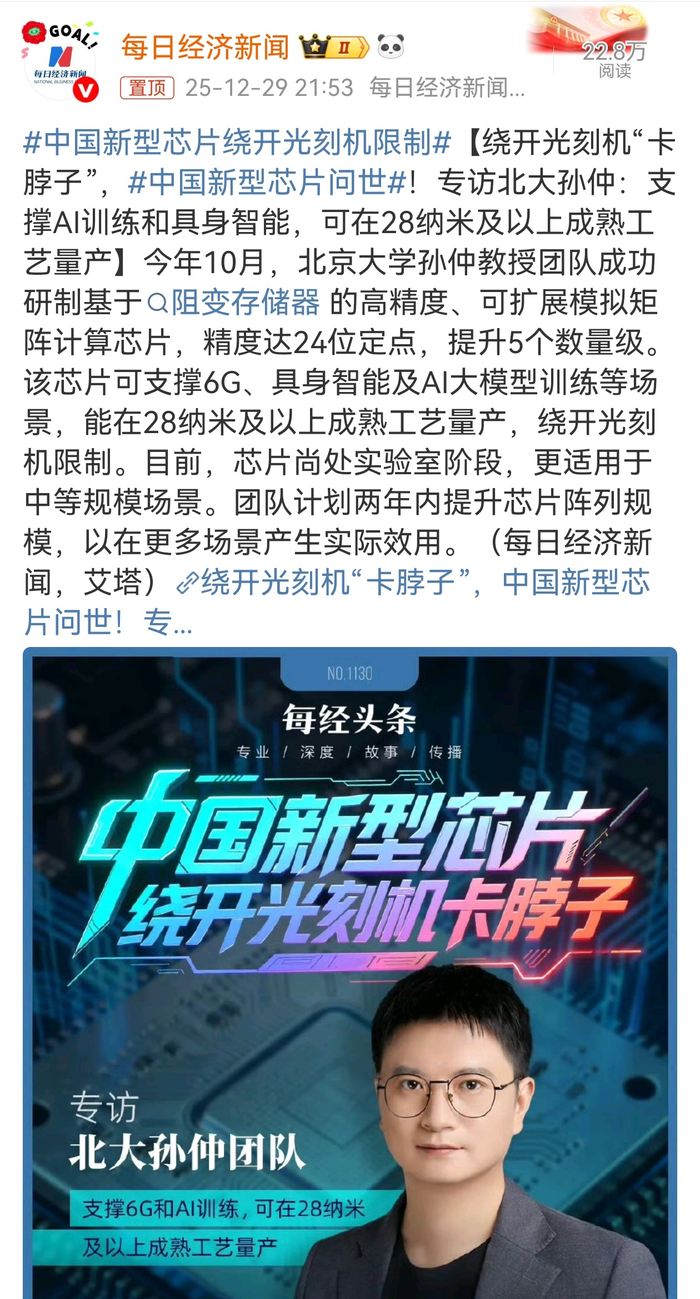
中国新型芯片突破光刻机限制,北大团队研发高精度模拟矩阵计算芯片
Xin Lang Cai Jing· 2025-12-31 02:24
Core Insights - A new type of chip developed by Professor Sun Zhong's team at Peking University utilizes resistive random-access memory (ReRAM) for high-precision, scalable analog matrix computing, effectively bypassing the limitations of photolithography machines [1] - This chip addresses the previous challenges of analog computing, which was deemed inaccurate, by significantly improving speed and energy efficiency while being manufacturable using mature 28-nanometer technology [1] - Currently in the experimental phase, the chip is designed for medium-scale tasks and is expected to be applied in fields such as 6G and robotics, with plans to scale up production within two years [1] - In the long term, this technology serves as a high-efficiency backup solution for AI model training and supercomputing, positioning the industry to meet future demands as they arise [1] Summary by Categories Technology Development - The chip is based on resistive random-access memory, allowing for high-precision and scalable analog matrix calculations [1] - It operates effectively without the need for advanced photolithography, utilizing a 28-nanometer process [1] Applications - Initially suitable for medium-scale tasks, the chip is targeted for use in 6G and robotics [1] - Future applications include AI model training and supercomputing, addressing the needs of high-performance computing [1] Market Positioning - The development of this chip positions the industry to leverage existing technology in response to the anticipated surge in demand for computational power [1]
中国银河证券:1月A股波动可能加大,风格倾向阶段性再平衡
Xin Hua Cai Jing· 2025-12-31 01:11
Group 1 - The A-share market is entering a critical data validation period in January 2026, influenced by policy implementation, macro data, corporate performance, and liquidity changes, leading to increased volatility and a tendency for phase rebalancing [1] - Sectors that led in December, such as defense, 6G, and satellite internet, require performance or order validation to digest their gains, while themes with clear industrial trends like commercial aerospace and AI computing may still present active opportunities [1] - The strategic resource attributes of certain non-ferrous metal sectors, particularly strategic minor metals like antimony, tungsten, and rare earths, are being revalued by the market due to their essential role in technological breakthroughs and their strategic scarcity [1] Group 2 - Three key industry directions are highlighted: first, strategic resources and cyclical recovery sectors, focusing on upstream resource products with strategic scarcity, including industrial metals (copper), strategic minor metals, and energy metals (potash) [2] - Second, the focus is on technological self-reliance and new productivity sectors, emphasizing clear industrial trends and high visibility in performance for leading companies in areas such as AI computing, digital economy, semiconductor domestic substitution, and commercial aerospace [2] - Third, there is an emphasis on domestic demand recovery and structural improvement, with some domestic demand sectors having attractive valuations after prolonged adjustments [2]

焦点访谈|加速演进 我国6G已进入产业落地关键期
Yang Shi Wang· 2025-12-30 13:45
Group 1 - The core viewpoint of the article emphasizes that 6G technology is a key focus in China's "14th Five-Year Plan," with expectations for it to become a new economic growth point through deep integration with AI and smart sensing technologies [1][9] - The development of 6G is currently in a critical phase characterized by accelerated technological innovation and clearer industrial directions, aiming to empower various industries and consumer markets [1][9] - 6G is expected to achieve ultra-low latency and high reliability, enabling applications such as wireless industrial control, which surpass current capabilities of 5G [3][5] Group 2 - The integration of low Earth orbit (LEO) satellites into the 6G network is highlighted as a significant feature, enhancing global communication capabilities and reducing latency compared to high Earth orbit satellites [5][7] - The article discusses the rapid development of China's commercial space industry, which is crucial for establishing the satellite internet constellation necessary for 6G [7][9] - By 2025, 6G is anticipated to reach a pivotal point with the completion of the first phase of technology trials, laying the groundwork for competitive solutions and industry advantages [9][11] Group 3 - Various regions in China are actively establishing 6G ecosystems, with policies promoting integration with fields like autonomous driving and augmented reality [11][12] - The evolution of mobile communication technology in China has transitioned from 1G to 5G, creating new demands and applications, with 5G significantly enhancing user adoption and infrastructure [12][14] - The potential applications of 6G are vast, including immersive holographic interactions, remote medical surgeries, and smart factories, marking a shift from "Internet of Things" to "Intelligent Connectivity" [16]

市场分析:机器人传媒领涨,A股小幅整理
Zhongyuan Securities· 2025-12-30 11:28
Market Overview - On December 30, the A-share market opened lower but experienced a slight upward adjustment, with the Shanghai Composite Index facing resistance around 3979 points[2] - The total trading volume for both markets reached 21,617 billion yuan, above the median of the past three years[3] - The Shanghai Composite Index closed at 3965.12 points, unchanged, while the Shenzhen Component Index rose by 0.49% to 13,604.07 points[7] Sector Performance - Key sectors such as robotics, consumer electronics, cultural media, and energy metals performed well, while commercial retail, photovoltaic equipment, wind power equipment, and jewelry sectors lagged[3] - Over 60% of stocks in the two markets declined, with notable gains in industries like electric machinery and energy metals[7] Valuation Metrics - The average price-to-earnings (P/E) ratios for the Shanghai Composite and ChiNext indices are 16.28 times and 50.13 times, respectively, above the median levels of the past three years, indicating a suitable environment for medium to long-term investments[3] - The report emphasizes the importance of monitoring macroeconomic data, changes in overseas liquidity, and policy developments[3] Future Outlook - The central economic work conference has maintained a positive macro policy tone, shifting focus from total expansion to quality and sustainability[3] - The market anticipates that the Federal Reserve will continue its interest rate cut cycle in 2026, contributing to a more accommodative global liquidity environment[3] - The strengthening of the RMB is expected to enhance the attractiveness of RMB-denominated assets, facilitating capital inflows[3]
美利信持续发力夯实液冷业务 构筑中长期成长主线
Zheng Quan Ri Bao Wang· 2025-12-30 11:25
Core Viewpoint - The company, Meilixin Technology, has established a joint venture with Taiwan's Juyuan Innovation to enhance its liquid cooling business, while also engaging in discussions with Intel for advanced cooling solutions in high-performance computing [1][2]. Group 1: Liquid Cooling Business Development - Meilixin has formed a joint venture named Xinchang Zhileng (Anhui) Precision Technology Co., Ltd. with Juyuan Innovation, completing the registration on December 29 [1]. - The company has received a sample order for AMD's next-generation high-performance CPU water cooling board and aims for mass production by Q1 2026 [2]. - Intel's delegation visited Meilixin to discuss advanced cooling technologies, with plans to develop solutions for high-power AI servers [2]. Group 2: Market Potential and Strategic Positioning - Meilixin's liquid cooling products are expected to expand from communication base stations to computing and energy storage applications, with a focus on extreme cooling scenarios [3]. - The company is positioned to leverage synergies between its communication and liquid cooling sectors, targeting high-power base station cooling solutions [4]. - The domestic telecom operators are projected to invest nearly 20 billion in 5G-A plans by 2025, providing significant growth opportunities for Meilixin's communication and liquid cooling segments [4]. Group 3: Diverse Business Segments - Meilixin's operations span four main sectors: communication, automotive, semiconductor, and liquid cooling, with a concentrated push expected in 2026 [4]. - In the automotive sector, Meilixin has established a decade-long partnership with Tesla and is also supplying components to other major North American manufacturers [5]. - The semiconductor business has seen Meilixin stabilize its position within the supply chains of leading industry players, enhancing its capabilities from individual components to system-level modules [4].