
全国统一大市场

Search documents
湖北电力交易中心董事长詹智民解读《电力中长期市场基本规则》
Zhong Guo Dian Li Bao· 2026-01-08 05:52
Core Viewpoint - The release of the "Basic Rules for the Medium and Long-term Electricity Market" marks a significant step towards a balanced approach to construction and operation in the electricity market, providing essential institutional support for the development of a unified national energy market [2] Group 1: Market Function Enhancement - The "Basic Rules" strengthen the medium and long-term market's role as a stabilizing force in supply assurance, expectation stabilization, risk avoidance, and investment attraction through systematic arrangements in transaction timing, clearing verification, and price linkage [3] - Transaction timing is extended in both directions, balancing stability and flexibility, with regular trading schedules established for multi-year, annual, and monthly transactions to provide stable expectations for power investment and user production planning [3] - A robust transaction verification mechanism is established to ensure the executability of medium and long-term contracts, reinforcing the principle of physical delivery and supporting supply-demand balance [3] - The price linkage mechanism is improved to accurately reflect real-time supply and demand, promoting closer alignment between short-term trading limits and spot price limits [3] Group 2: Market Operation Standardization - The "Basic Rules" promote standardization in the electricity market through unified business processes, data interaction, and technical platforms, aiming to reduce transaction costs and enhance operational efficiency [4] - Unified business processes are mandated for market registration, trading organization, and settlement to eliminate operational discrepancies across provinces, providing transparent and convenient services to market participants [4] - Standardized data interaction is required between electricity trading platforms and grid companies to facilitate efficient data flow and support resource optimization [4] - The introduction of platform norms, including "four unifications" and "dual-active backup," is aimed at ensuring market safety and preparing for more complex, high-frequency trading [4] Group 3: Risk Prevention and Control - The "Basic Rules" establish a comprehensive risk control system, evolving risk prevention to a more systematic approach in response to the complexities of market reforms [5] - Market risks are categorized into five types, including supply-demand imbalance and price anomalies, providing a clear framework for differentiated monitoring and intervention [5] - Proactive risk management measures are emphasized, with daily monitoring and preemptive strategies to enhance the timeliness and foresight of risk responses [5] - The operational authority is clarified for implementing intervention measures, ensuring effective risk management while preventing overreach or neglect in interventions [5] Group 4: Future Outlook - The medium and long-term market in Hubei has achieved continuous operation and integration with spot markets, with market participants exceeding 10,000 and market transactions accounting for nearly 60% of total electricity consumption [6] - Looking ahead, Hubei aims to deepen efforts in multi-market integration, standardized management, and intelligent risk prevention, contributing to the establishment of a leading provincial electricity market system in the context of national market construction [6]
2025年我国邮政行业寄递业务量逾2000亿件 同比增长11.5%
Jing Ji Ri Bao· 2026-01-08 01:35
Core Insights - The core viewpoint of the article highlights the robust growth and expansion of China's postal industry, particularly in the express delivery sector, with significant increases in both volume and revenue projected for 2025 [1] Group 1: Business Volume and Growth - By 2025, the total volume of postal delivery services in China is expected to reach 216.5 billion items, representing a year-on-year growth of 11.5% [1] - The express delivery volume is projected to reach 199 billion items, with a year-on-year increase of 13.7% [1] Group 2: Revenue Growth - The total business revenue of the postal industry in China is anticipated to reach 1.8 trillion yuan by 2025, reflecting a year-on-year growth of 6.4% [1] - Revenue from express delivery services is expected to hit 1.5 trillion yuan, with a year-on-year growth of 6.5% [1] Group 3: Infrastructure Development - During the 14th Five-Year Plan period, China aims to establish the largest and most widely beneficial delivery network globally, with significant expansion into rural areas [1] - The number of postal outlets in rural and border areas has increased by nearly 1.5 times compared to five years ago, ensuring that all border villages have postal services [1] - The international delivery logistics system is being rapidly developed, with a total of 374 overseas warehouses established, including 41 new ones added in 2024, covering an additional area of 1.22 million square meters [1] Group 4: Future Outlook - The head of the State Post Bureau, Zhao Chongjiu, indicated that the industry is expected to maintain a steady upward trend in 2026, focusing on high-quality development and the promotion of new productive forces [1] - The industry aims to support the construction of a unified national market while emphasizing reforms, stable growth, improved services, and risk prevention to ensure effective qualitative and reasonable quantitative growth [1]
用好超大规模市场这张牌
Sou Hu Cai Jing· 2026-01-07 23:20
Group 1 - China has a massive market with over 1.4 billion people, the largest middle-income group globally, and more than 190 million business entities, showcasing its vast market potential [1][2] - The market is characterized by over 500 million express packages, approximately 34 billion yuan in online sales of physical goods, and over 120 billion yuan in international trade daily, indicating strong market activity [1][2] Group 2 - The unique market resources in China provide significant advantages, especially during the complex external environment and internal transformation phase, emphasizing the need to leverage this "trump card" for high-quality development [2][4] - The ice and snow tourism sector is projected to reach 360 million participants and generate 450 billion yuan in revenue during the 2025-2026 winter season, highlighting new market opportunities [3] Group 3 - The expansive market fosters rich scenarios for innovation, allowing new technologies and products to quickly find initial users and achieve continuous innovation through local market effects [4] - The government is focusing on creating new application scenarios across various sectors, aiming to build a comprehensive scene ecosystem that supports technological innovation and market demand [5] Group 4 - The establishment of a normalized electricity trading mechanism across different power grids is expected to enhance energy distribution efficiency, with over 20 billion kilowatt-hours of electricity being transmitted during peak summer periods in 2025 [6][7] - Continuous reforms are necessary to eliminate market barriers and enhance economic circulation, which is crucial for strengthening the market foundation [7][8] Group 5 - China's market is deeply integrated with the global economy, with significant progress in the Belt and Road Initiative and becoming a major trade partner for over 150 countries [9] - High-level openness and multi-field cooperation are essential for transforming the market's advantages into global resource allocation capabilities, making China a vital profit center and innovation partner for international businesses [10]
【二〇二六中国经济展望④】用好超大规模市场这张牌
Jing Ji Ri Bao· 2026-01-07 21:25
Market Size and Opportunities - China has a population of over 1.4 billion, making it the largest middle-income group globally, with more than 190 million business entities, indicating a massive market potential [1] - Daily activities in the Chinese market include over 500 million express packages, approximately 34 billion yuan in online sales of physical goods, and over 120 billion yuan in international trade, showcasing the market's robust dynamics [1] Innovation and Development - The "14th Five-Year Plan" marks a critical phase for China, emphasizing the need to leverage its large market size to support high-quality economic development amidst complex external environments and internal transitions [2] - The ice and snow tourism sector is projected to reach 360 million participants and generate 450 billion yuan in revenue during the 2025-2026 winter season, reflecting the growing potential of innovative market opportunities [3] Technological Advancements - China's vast market allows for rapid validation of new technologies and products, enabling continuous innovation from initial user adoption to broader market penetration [4] - The competitive landscape includes a wide range of enterprises, from industry leaders to small businesses, all leveraging digital platforms to enhance responsiveness to consumer demands [4] Policy Support and Market Integration - The government is focusing on creating new application scenarios across various sectors to foster innovation and meet market demands, with a systematic approach to cultivating 22 key areas [5] - The establishment of a normalized electricity trading mechanism across different grid areas is expected to enhance energy distribution efficiency, demonstrating practical outcomes of market integration efforts [6][7] Reform and Market Strengthening - Continuous reforms are necessary to eliminate market barriers and enhance economic circulation, transitioning China's market from large to strong [7][8] - The government plans to address hidden barriers in regulations and local policies to facilitate the construction of a unified national market, with a focus on creating favorable rules and eliminating obstacles [8] Global Integration and Cooperation - China's market is deeply integrated with the global economy, having made significant progress in initiatives like the Belt and Road, and becoming a key trade partner for over 150 countries [9] - The country aims to enhance its global resource allocation capabilities through high-level openness and cooperation, transforming its market advantages into competitive industrial strengths [10] Future Prospects - The Hainan Free Trade Port is expected to facilitate the entry of foreign enterprises into the Chinese market and support Chinese companies in expanding globally, marking a new chapter in cooperative development [11]
促进行业高质量发展高效能治理
Xin Lang Cai Jing· 2026-01-07 19:17
转自:法治日报 本报北京1月7日讯 记者蒋起东 1月7日,2026年全国邮政工作会议在京召开。会议总结2025年和"十四 五"时期邮政工作,分析形势,研究"十五五"时期邮政工作思路,部署2026年重点任务。 会议指出, 2025年,邮政行业业务收入和行业寄递业务量分别完成1.8万亿元和2165亿件,同比分别增长6.4%和 11.5%。其中,快递业务收入和快递业务量分别完成1.5万亿元和1990亿件,同比分别增长6.5%和 13.7%,行业服务质量稳步提升。 会议指出,"十四五"以来,交通强国邮政篇建设取得了历史性成就, 高质量发展实现了突破性进展,寄递领域"物畅其流"美好愿景正在加快实现,行业在经济社会发展中基 础性战略性先导性作用进一步凸显。 会议提出,"十五五"时期是实施交通强国邮政篇战略的关键时 期,服务构建全国统一大市场的任务更为明确,行业发展进入新的发展阶段特征更为明显,打造具有国 际竞争力的经营主体更为重要。全系统全行业要聚焦促进行业高质量发展和促进行业高效能治理,提升 农村寄递服务能力水平、国际寄递服务能力水平、服务产业的能力水平,建设与中国式现代化相适应的 寄递物流体系。 (来源:法治日报) ...
策略深度报告:“十五五”开局,破浪前行
Xinda Securities· 2026-01-07 08:55
Group 1 - The positive factors for stabilizing profits are increasing, including weak endogenous economic recovery, policy support, and potential improvements in PPI and real estate [4][11][18] - The PPI is expected to show marginal improvement due to seasonal demand and supply-demand balance driven by "anti-involution" policies [4][18][22] - The real estate market is experiencing a downtrend, but there are signs of potential stabilization, with some data showing slight improvements [4][28][29] Group 2 - The core factors influencing the height of the liquidity bull market are policies and stock market funds, with smaller bull markets focusing on profits while larger bull markets are driven by macro liquidity [4][11][18] - The capital market's institutional dividends can easily drive large-scale bull markets, and the "asset shortage" logic is expected to enhance the willingness to allocate funds to the stock market [4][18][22] - The regulatory policy adjustment rhythm will be crucial in the mid-term of the bull market, with significant changes in investor behavior expected as the market progresses [4][11][18] Group 3 - The style judgment indicates that small-cap growth stocks remain a trend, but there will be volatility in the mid-term of the bull market [4][29][31] - Long-term trends favor small-cap stocks, but there may be significant quarterly fluctuations influenced by new resident funds and growth-value style disturbances [4][31][32] - Growth style is likely to maintain a performance advantage over value style [4][31][32] Group 4 - Industry allocation suggests a foundation in finance, with technology as the main line and themes rotating actively [4][33][39] - Non-bank financials are gaining elasticity and have certain allocation value, while technology is expected to see a second wave of growth in the later stages of the bull market [4][33][39] - Key sectors to watch include power equipment, certain cyclical industries, and new consumption, focusing on improvements in ROE [4][39][42][44]
稳中求进、提质增效 实现“十五五”良好开局丨坚持改革攻坚,增强高质量发展动力活力
Ren Min Ri Bao· 2026-01-07 02:12
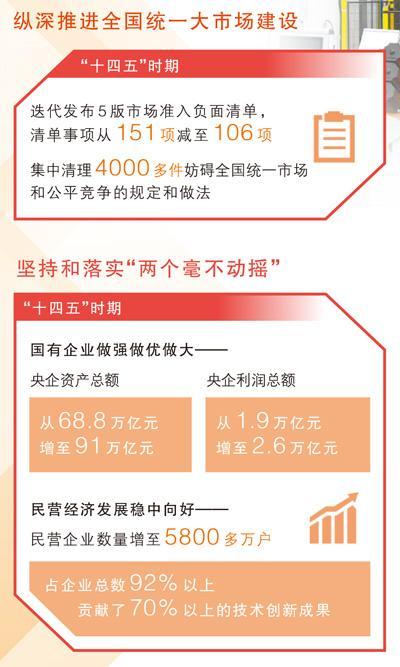
Group 1: Economic Reform and Development - The core objective of the "14th Five-Year Plan" is to further deepen reforms and achieve breakthroughs in economic and social development [4] - The Central Economic Work Conference emphasizes policies to enhance high-quality development through reforms in various sectors, including the establishment of a unified national market and the deepening of state-owned enterprise reforms [4][8] - The construction of a unified national market is essential for creating a new development pattern and enhancing international competitiveness [7] Group 2: Industry-Specific Developments - The automotive industry, along with sectors like photovoltaics and logistics, is witnessing a collaborative effort to reduce internal competition and improve market conditions [5] - The price decline in photovoltaic equipment, lithium-ion batteries, and new energy vehicles indicates a narrowing of the year-on-year decrease, reflecting the effectiveness of measures against "involution" competition [7] - The establishment of a unified market framework aims to enhance market access, fair competition, and quality standards, thereby improving the overall economic cycle [8] Group 3: State-Owned Enterprises and Capital - The integration of state-owned enterprises in the cruise industry has led to the establishment of Asia's largest cruise operation platform, showcasing the benefits of professional integration [9] - By the end of 2025, state-owned enterprise reforms are expected to focus on enhancing quality and efficiency, with significant investments directed towards core business areas [10] - The management structure of central enterprises is being streamlined, with a focus on reducing management levels and improving governance [10][11] Group 4: Private Sector Growth - The implementation of the "Private Economy Promotion Law" marks a significant step in legally protecting the rights of private enterprises, with a focus on equal treatment [13] - In 2025, private enterprises accounted for over 92% of total enterprises, contributing significantly to exports, tax revenue, and urban employment [13] - Future initiatives will focus on expanding market access, enhancing support for private investment projects, and strengthening legal protections for private enterprises [14]

坚持改革攻坚,增强高质量发展动力活力(稳中求进、提质增效 实现“十五五”良好开局)
Ren Min Ri Bao· 2026-01-07 00:37
Group 1: Economic Reform and Development - The core objective of the "14th Five-Year Plan" is to further deepen reforms to drive economic and social development [6] - The Central Economic Work Conference emphasizes enhancing high-quality development through reforms, including the establishment of a unified national market and the deepening of state-owned enterprise reforms [6][8] - The construction of a unified national market is essential for promoting high-quality development and gaining an advantage in international competition [8] Group 2: Industry-Specific Developments - The automotive and photovoltaic industries have seen a collaborative effort to reduce "involution" competition, with significant price reductions in manufacturing [7] - The central enterprise cruise operation platform, China International Cruise Co., has become the largest in Asia, showcasing the results of professional integration among state-owned enterprises [9] - The central enterprises' main business investment ratio reached 98% by November 2025, indicating a focus on core business areas [9] Group 3: Support for Private Enterprises - The implementation of the "Promotion Law for Private Economy" in 2025 marks a significant legal framework for the protection and development of private enterprises [12] - Private enterprises account for over 92% of all companies, contributing more than 50% to imports and exports and 80% to urban employment [12] - The government plans to enhance market access, strengthen support for private enterprises, and protect their legal rights [13]

河南省推动2026年第一季度经济发展实现良好开局若干政策措施新闻发布会丨开局就是奋斗 起步就要奋进
He Nan Ri Bao· 2026-01-06 23:30
Core Viewpoint - The government is focusing on enhancing market efficiency and promoting investment, consumption, and production to ensure economic growth in 2026, with specific initiatives outlined for infrastructure, consumer support, and industrial development [2][4][9]. Market Development - The government aims to eliminate barriers to a unified national market by conducting market access evaluations and implementing a comprehensive administrative enforcement mechanism [2]. - Plans include building "four hubs" and creating "three support points" to facilitate resource flow and economic activity [3]. Investment Initiatives - A total of 28 major transportation projects are set to commence in the first quarter of 2026, with an estimated total investment of approximately 800 billion [4][5]. - The government is focusing on enhancing the inland water transport system and developing green low-carbon transportation [4][5]. Consumer Support - The province will issue 2 billion in consumption vouchers to stimulate consumer spending, particularly in key sectors like dining and tourism [6][10]. - A new round of consumer product trade-in programs will be launched, including subsidies for various categories such as automobiles and electronics [6][10]. Industrial Production - The government plans to allocate 5 billion to reward industrial enterprises that operate at full capacity, with additional incentives for those achieving significant revenue growth [8][9]. - A focus on digital transformation and the implementation of over 1,600 industrial technology improvement projects is expected to drive industrial growth [8]. Financial Support - The financial system will support the economy by organizing over 1,000 government-enterprise financial matchmaking events to facilitate funding [11]. - Emphasis will be placed on technology finance and agricultural financial support to enhance productivity and competitiveness [11][12].
坚持改革攻坚,增强高质量发展动力活力(稳中求进、提质增效 实现“十五五”良好开局) ——着力推进全年经济工作八大重点任务③
Ren Min Ri Bao· 2026-01-06 23:28
Group 1: Reform and Economic Development - The core viewpoint emphasizes that reform is the fundamental driving force for national development, with the "14th Five-Year Plan" aiming for breakthroughs in comprehensive deepening of reforms [2] - The central economic work conference proposed a series of policy measures to enhance high-quality development through reforms, focusing on building a unified national market, deepening state-owned enterprise reforms, and promoting the growth of the private economy [2][4] Group 2: Unified National Market - The construction of a unified national market is essential for creating a new development pattern and enhancing international competitiveness, with a focus on "five unifications and one openness" [3][5] - The State Statistics Bureau reported that the ratio of social logistics costs to GDP was 14% in the first three quarters of 2025, maintaining the lowest level since records began [4] Group 3: State-Owned Enterprises and Capital - The integration of state-owned enterprises (SOEs) has led to the establishment of Asia's largest cruise operation platform, showcasing the results of professional integration among SOEs [6] - By the end of 2025, the central enterprises' main business investment accounted for 98%, indicating a strong focus on quality and progress in SOE reforms [6] Group 4: Private Economy Development - The year 2025 is marked by significant legal and policy advancements for the private economy, including the implementation of the "Private Economy Promotion Law" and a series of judicial cases aimed at protecting private enterprises [10][12] - Private enterprises account for over 92% of the total number of enterprises, contributing more than 50% to imports and exports and 80% to urban employment [10] Group 5: Future Directions for Private Economy - Future efforts will focus on expanding market access, enhancing support for private enterprises, and strengthening the legal framework to protect the rights of private businesses [11][12]