智能家居

Search documents
松霖科技涨2.08%,成交额2832.10万元,主力资金净流入47.07万元
Xin Lang Cai Jing· 2025-11-07 05:48
Company Overview - Xiamen Songlin Technology Co., Ltd. was established on May 11, 2004, and listed on August 26, 2019. The company is located at 298 Yangguang West Road, Haicang District, Xiamen, Fujian Province. Its main business involves the research, production, and sales of bathroom accessories such as showers, shower systems, faucets, hoses, lifting rods, and components [1]. Financial Performance - For the period from January to September 2025, Songlin Technology achieved operating revenue of 1.852 billion yuan, a year-on-year decrease of 15.49%. The net profit attributable to the parent company was 159 million yuan, down 50.53% year-on-year [2]. - Since its A-share listing, the company has distributed a total of 709 million yuan in dividends, with 526 million yuan distributed over the past three years [3]. Stock Performance - As of November 7, Songlin Technology's stock price increased by 2.08%, reaching 29.97 yuan per share, with a trading volume of 28.32 million yuan and a turnover rate of 0.23%. The total market capitalization is 12.974 billion yuan [1]. - Year-to-date, the stock price has risen by 65.58%, with a 3.45% increase over the last five trading days, a 2.69% decrease over the last 20 days, and a 3.56% increase over the last 60 days [1]. - The company has appeared on the "Dragon and Tiger List" once this year, with the most recent appearance on September 10, where it recorded a net buy of -40.51 million yuan [1]. Shareholder Information - As of September 30, the number of shareholders for Songlin Technology was 9,084, an increase of 35.32% compared to the previous period. The average circulating shares per person decreased by 26.10% to 46,758 shares [2]. Business Segments - The company's main business revenue composition includes: smart kitchen and bathroom business at 83.99%, health business at 11.90%, and other segments at 4.10% [1]. - The company operates within the light industry manufacturing sector, specifically in home goods and bathroom products, and is associated with concepts such as robotics, smart home, medical beauty, mid-cap, and C2M [2].

法狮龙跌2.03%,成交额1.05亿元,主力资金净流出2125.42万元
Xin Lang Cai Jing· 2025-11-07 05:30
Group 1 - The core viewpoint of the news is that the stock of Fashilong has experienced significant fluctuations, with a year-to-date increase of 206.55% but a recent decline of 5.06% over the past five trading days [1] - As of November 7, Fashilong's stock price is 62.23 yuan per share, with a total market capitalization of 7.824 billion yuan [1] - The company has seen a net outflow of 21.25 million yuan in principal funds, with large orders showing a buy of 16.73 million yuan and a sell of 32.65 million yuan [1] Group 2 - Fashilong's main business includes the research, production, and sales of integrated ceilings and walls, with revenue composition being 71.52% from integrated ceilings, 14.39% from integrated walls, and 14.09% from other products [1] - As of September 30, the number of shareholders increased by 31.78% to 4,491, while the average circulating shares per person decreased by 24.11% to 27,995 shares [2] - For the period from January to September 2025, Fashilong reported a revenue of 375 million yuan, a year-on-year decrease of 7.28%, while the net profit attributable to the parent company was -1.44 million yuan, showing an increase of 88.24% year-on-year [2] Group 3 - Since its A-share listing, Fashilong has distributed a total of 193 million yuan in dividends, with 115 million yuan distributed over the past three years [3]

家居行业线上线下争相圈地,各有烦忧
3 6 Ke· 2025-11-07 03:18
Core Viewpoint - The recent surge in offline stores by e-commerce giants like Tmall and JD is reshaping the home furnishing retail landscape, emphasizing smart home solutions and immersive shopping experiences [1][2][12]. Group 1: E-commerce Expansion - Tmall Genie opened eight stores in Sichuan, marking a significant offline expansion that contrasts with the relative calm of traditional retail [1][2]. - JD MALL has surpassed 26 stores nationwide, focusing on a one-stop shopping experience that includes a wide range of products [1][2]. - The competition between Tmall and JD in offline retail is intensifying, with both companies adopting innovative strategies to attract consumers [2][3]. Group 2: New Retail Models - The shift from traditional retail to integrated smart home solutions is evident, with Tmall Genie implementing a "space as a service" strategy that enhances user experience through automation [2][4]. - Tmall Genie collaborates with local traditional retailers like Fusenmei to create immersive AI home experiences, showcasing advanced smart home technologies [4][5]. - JD MALL is pursuing a heavy asset model with large self-operated stores, while also forming partnerships with traditional retailers like Juran Home to enhance its market presence [4][5]. Group 3: Traditional Retail Response - Traditional home furnishing retailers are not passive; they are actively transforming into smart home experience centers to compete with e-commerce [6][7]. - Juran Home aims to establish over 30 smart home experience centers, focusing on personalized consumer trends and integrated smart home solutions [7]. - Red Star Macalline is undergoing a comprehensive transformation to appeal to younger consumers through digital channels and innovative service models [8]. Group 4: Market Dynamics - The competition is not just between e-commerce and traditional retail; both sides face unique challenges in adapting to changing consumer demands [10][11]. - E-commerce platforms are expanding into lower-tier cities, which may disrupt the existing traditional retail landscape [10][11]. - The effectiveness of e-commerce's offline expansion in converting foot traffic into long-term sales remains uncertain, as the home furnishing sector involves complex customer interactions [11][12]. Group 5: Future Outlook - The future of home retail will blur the lines between online and offline, with a focus on experiential shopping and emotional connections with consumers [12]. - Both e-commerce giants and traditional retailers must adapt to the evolving landscape to maintain competitiveness in the home furnishing market [12].


这场交流会共商智能家居发展新趋势
Mei Ri Shang Bao· 2025-11-06 22:20
Core Insights - The smart home market is experiencing rapid growth, with increasing consumer demand for intelligent and convenient products [1][2] - Despite the growth, there is a rise in consumer complaints regarding slow after-sales service, high repair costs, and poor compatibility between different brands [1] - The event facilitated direct communication between consumers and companies, allowing for immediate feedback on issues such as battery life and cross-brand connectivity [2] Industry Trends - Smart home products are becoming essential for improving quality of life, with features like automated temperature control and motion-sensing lights gaining popularity [1] - The industry is urged to address consumer pain points to ensure long-term healthy development [1][2] Consumer Engagement - The event served as a platform for consumers to express their needs and for companies to understand user expectations better [2] - An initiative was launched by the Hangzhou Consumer Protection Committee to promote legal operations among smart home companies, focusing on quality control and service system development [2] Future Outlook - The Hangzhou Consumer Protection Committee aims to enhance consumer satisfaction and safety by promoting collaboration between technological innovation and consumer protection [2]


从“设备智能”到“场景智能” 浙江“科学咖啡馆”共话下一代家居体验
Zhong Guo Xin Wen Wang· 2025-11-06 13:53
Core Insights - The smart home industry is transitioning from "device intelligence" to "scene intelligence," focusing on high-quality development centered around user needs and experience [1][3] - Key players like Huawei, Xiaomi, and Siemens are enhancing their market competitiveness through continuous product innovation [1][2] Group 1: Industry Trends - The integration of smart home products with AI and design aesthetics is becoming crucial, with companies like Huawei and Xiaomi emphasizing the importance of core life elements such as "light," "air," and "water" [2] - The concept of "scene intelligence" aims to create seamless experiences by breaking down device silos and addressing real-life scenarios [3] Group 2: Company Strategies - Huawei's smart home products are designed to merge technology with home aesthetics, focusing on user-centric solutions [2] - Xiaomi's ecosystem approach covers various aspects of smart living, including lighting, security, and health management, to meet diverse user needs [2] - Siemens is analyzing consumer groups to identify trends in embedded smart appliances, emphasizing AI-driven intelligence and emotional value [2][3] Group 3: Future Directions - The future of smart homes will likely see the mainstream adoption of full-house intelligent solutions, with a focus on data security and privacy protection [3] - The development of standards for smart home products is essential to address new demands in safety, electromagnetic compatibility, reliability, performance, and energy efficiency [3]


现在年轻人能被智能家居惯成什么样
Xin Lang Cai Jing· 2025-11-06 08:23
Core Viewpoint - The article presents a detailed analysis of recent market trends and their implications for investment strategies, highlighting the importance of adapting to changing economic conditions [1] Group 1: Market Trends - Recent data indicates a significant shift in consumer behavior, with a 15% increase in online shopping compared to last year [1] - The technology sector has shown resilience, with a 10% growth in revenue for major companies in Q3 [1] - Inflation rates have stabilized at around 3%, impacting purchasing power and investment decisions [1] Group 2: Investment Opportunities - Emerging markets are becoming increasingly attractive, with projected GDP growth of 5% in the next fiscal year [1] - Renewable energy investments are expected to rise, driven by a 20% increase in government incentives [1] - The healthcare sector is poised for growth, with a 12% increase in demand for telehealth services [1] Group 3: Risks and Challenges - Supply chain disruptions continue to pose risks, with a reported 25% increase in shipping costs [1] - Regulatory changes in the financial sector may impact investment strategies, particularly with new compliance requirements [1] - Market volatility remains a concern, with a 30% increase in trading fluctuations observed in recent months [1]
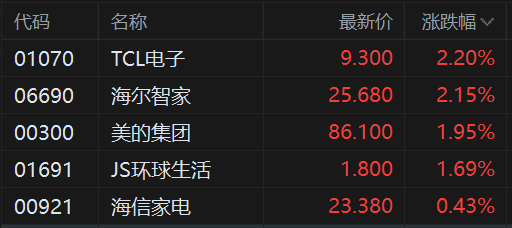
港股异动丨家电股普涨 TCL电子涨超2% AI+5G催生千亿级智能家居市场
Ge Long Hui· 2025-11-06 03:12
Group 1 - The core viewpoint of the article highlights the significant rise in Hong Kong's home appliance stocks, driven by government initiatives to stimulate consumer spending in Guangdong province [1] - TCL Electronics, Haier Smart Home, Midea Group, JS Global Lifestyle, and Hisense Home Appliances all experienced notable stock increases, with TCL Electronics rising by 2.2% and Midea Group by 2% [1] - The Guangdong government has launched a consumption season activity, distributing "Guangdong Quality Purchase" vouchers for consumers purchasing various home appliances and vehicles, which is expected to boost sales in the sector [1] Group 2 - The integration of AI, 5G, and IoT technologies, along with policy support and upgraded consumer demand, indicates that the smart home industry is entering a phase of scaled development [1] - According to authoritative research institutions, the global smart home market is valued at hundreds of billions of dollars, reflecting strong growth potential in the industry [1]

良信股份涨2.02%,成交额2.51亿元,主力资金净流入416.96万元
Xin Lang Cai Jing· 2025-11-06 02:46
Core Viewpoint - The stock of Liangxin Co., Ltd. has shown significant growth this year, with a 55.33% increase in share price, indicating strong market performance and investor interest [1][2]. Financial Performance - For the period from January to September 2025, Liangxin Co., Ltd. achieved a revenue of 3.507 billion yuan, representing a year-on-year growth of 12.23% [2]. - The net profit attributable to shareholders for the same period was 304 million yuan, which reflects a decrease of 2.08% compared to the previous year [2]. Stock Market Activity - As of November 6, the stock price reached 11.60 yuan per share, with a trading volume of 251 million yuan and a turnover rate of 2.40% [1]. - The company experienced a net inflow of main funds amounting to 4.1696 million yuan, with significant buying activity from large orders [1]. Shareholder Information - As of September 30, the number of shareholders increased by 21.36% to 39,400, while the average number of circulating shares per person decreased by 17.60% to 23,245 shares [2][3]. - The largest circulating shareholder is Hong Kong Central Clearing Limited, holding 37.5577 million shares, an increase of 19.467 million shares from the previous period [3]. Dividend Distribution - Since its A-share listing, Liangxin Co., Ltd. has distributed a total of 1.986 billion yuan in dividends, with 744 million yuan distributed over the last three years [3]. Business Overview - Liangxin Co., Ltd. specializes in the research, production, and sales of low-voltage electrical products, with its main revenue sources being distribution equipment (63.82%), terminal equipment (20.57%), control equipment (12.55%), and smart electrical products (2.42%) [1]. - The company is categorized under the power equipment industry, specifically in distribution equipment [1].

Resideo(REZI) - 2025 Q3 - Earnings Call Transcript
2025-11-05 23:02
Financial Data and Key Metrics Changes - Adjusted EBITDA reached a record high, with net revenue of $1.86 billion, up 2% year over year, including a 1% favorable impact from currency [18][19] - Gross margin increased to 29.8%, up 110 basis points year over year, driven by margin-accretive activities at ADI and operational efficiencies at P&S [18][19] - Adjusted earnings per share was $0.89, exceeding the high end of the outlook range and up from $0.59 in the prior period [19] Business Line Data and Key Metrics Changes - Products and Solutions (P&S) segment net revenue grew 2% year over year, with a 1% favorable impact from currency, marking the 10th consecutive quarter of gross margin expansion [8][12] - ADI reported 2% net revenue growth and average daily sales growth of 3%, with most product categories growing low single digits year over year [13][18] - The HVAC channel experienced a low double-digit percentage decline year over year due to a softer residential HVAC market [10][12] Market Data and Key Metrics Changes - Demand for new products, such as the First Alert combined smoke and CO connected detectors, remains strong, contributing to growth across various sales channels [5][8] - The OEM channel posted low double-digit percentage revenue growth year over year, while the retail channel experienced strong point-of-sales volumes [9][10] - The residential housing market remains soft, impacting the HVAC channel, but conditions are expected to normalize in the near future [10][11] Company Strategy and Development Direction - The company is focused on introducing differentiated new products across its connected home product portfolio, anticipating profitable growth opportunities [12] - Ongoing separation activities are on track to be completed in the second half of 2026, with leadership roles defined for the separate companies [7] - The integration of Snap One continues to progress well, with expectations to exceed the $75 million run rate synergies [16] Management's Comments on Operating Environment and Future Outlook - Management expressed confidence in the company's ability to navigate macroeconomic challenges, including inflation and tariff volatility, with no material impacts from recent events like the U.S. government shutdown [6][7] - The company anticipates a rebound in cash provided from operations in the fourth quarter, following the completion of the ERP implementation [19][20] - The outlook for 2026 is positive, with expectations for year-over-year growth in organic revenue and adjusted EBITDA above current analyst estimates [22] Other Important Information - Total reported cash used by operating activities was $1.571 billion, primarily due to the termination payment made to Honeywell [19] - The company is raising its outlook for total cash from operations, excluding the Honeywell termination payment, to $410 million-$450 million [21] Q&A Session Summary Question: Can you quantify the impact of the HVAC regulatory change? - Management indicated that both HVAC and ERP headwinds were transitory and caught them by surprise, but they expect to see improvements moving forward [24][25] Question: Will these headwinds bleed into 2026? - Management believes the ERP issues will be resolved by the end of the year, while HVAC impacts may slightly extend into 2026 but are expected to be minimal [26][27] Question: What growth would P&S have seen without HVAC headwinds? - Management refrained from providing specific growth figures but emphasized strong performance in other areas such as retail and OEM [28][30] Question: Why are HVAC headwinds considered transitory? - Management explained that excess inventory in the market due to regulatory changes is causing temporary disruptions, but demand for HVAC systems will remain strong in the long term [36][37] Question: What are the expectations for operating margins in the future? - Management targets double-digit operating margins for ADI and anticipates 300-500 basis points of operating margin expansion for P&S over the next three to five years [44][46] Question: What factors should be considered for the 2026 outlook? - Management highlighted the $70 million step up in EBITDA from the Honeywell indemnity and ongoing product launches as key factors for the 2026 outlook [60][61]

【机构调研】上市公司TOP5评估 | 11月第1期
Tai Mei Ti A P P· 2025-11-05 09:05
Group 1: Company Highlights - Liandong Technology focuses on semiconductor packaging and testing equipment, with strong technical capabilities in power semiconductor testing and third-generation semiconductor packaging [1] - The company has received attention from over 40 institutions, indicating a strong interest in its technological advancements and market expansion potential [1] - Liandong Technology's capital structure is rated AAA, ranking 45th among 5,164 A-share listed companies, reflecting its robust financial stability [1] Group 2: SWOT Analysis of Liandong Technology - Strengths include a capital structure exceeding industry benchmarks by 63.01%, providing a solid financial foundation for long-term operations [2] - Weaknesses are evident in its scale strength, which is 67.86% below industry benchmarks, indicating limited capacity for economies of scale [2] - Opportunities for growth exist, with significant potential to improve scale strength and operational efficiency compared to industry leaders [2] Group 3: Financial Performance - As of October 31, 2025, Liandong Technology's stock price was 86.08 CNY per share, slightly undervalued compared to a fair value estimate of 87.74 CNY [5] - The company has room for improvement in cash flow, operational efficiency, and asset quality, which could support upward price movement [5] Group 4: TianKang Bio Overview - TianKang Bio specializes in animal vaccines, feed production, and pig farming, with a focus on expanding its market share in the agricultural supply chain [6] - The company has received interest from multiple institutions, reflecting market confidence in its growth potential amid the recovery of the livestock industry [6] - TianKang Bio's cash flow and operational efficiency are rated AA, significantly above market averages, indicating strong financial health [6] Group 5: SWOT Analysis of TianKang Bio - Strengths include cash flow exceeding industry benchmarks by 29.36%, showcasing its strong financial management [7] - Weaknesses are present in its capital structure, which is 30.5% below industry benchmarks, indicating potential financial vulnerabilities [7] - Opportunities for improvement exist, particularly in capital structure and growth capabilities, which could enhance its competitive position [7] Group 6: Financial Performance of TianKang Bio - As of October 31, 2025, TianKang Bio's stock price was 7.38 CNY per share, significantly undervalued compared to a fair value estimate of 12.81 CNY [9] - The company could benefit from cost reductions and improvements in its capital structure to enhance its valuation [9] Group 7: Shunluo Electronics Overview - Shunluo Electronics is a leading provider of passive electronic components, focusing on the electronics and new energy sectors [10] - The company has established stable partnerships with numerous top-tier electronic device manufacturers, indicating strong market positioning [10] - Its profitability is rated AA, reflecting high efficiency and quality in its core business operations [11] Group 8: SWOT Analysis of Shunluo Electronics - Strengths include profitability exceeding industry benchmarks by 42.18%, indicating a competitive edge in the market [12] - Weaknesses are evident in its capital structure, which is 60.77% below industry benchmarks, suggesting financial stability concerns [12] - Opportunities for growth exist, particularly in improving its capital structure and operational efficiency to close the gap with industry leaders [12] Group 9: Financial Performance of Shunluo Electronics - As of October 31, 2025, Shunluo Electronics' stock price was 38.17 CNY per share, undervalued compared to a fair value estimate of 49.71 CNY [13] - The company has potential for price recovery if it can optimize its financial structure and enhance its growth capabilities [13] Group 10: Desay SV Overview - Desay SV specializes in smart cockpit, autonomous driving, and vehicle networking products, with a strong focus on technological innovation [15] - The company has received attention from various institutions, reflecting market interest in its growth prospects amid the automotive industry's shift towards smart technologies [15] - Its operational efficiency and development capabilities are rated AA, indicating strong performance in resource utilization and business growth [16] Group 11: SWOT Analysis of Desay SV - Strengths include development capabilities exceeding industry benchmarks by 43.21%, showcasing strong growth potential [16] - Weaknesses are present in its capital structure, which is 19.89% below industry benchmarks, indicating financial stability issues [16] - Opportunities for growth exist, particularly in improving its capital structure and benefiting from the increasing penetration of smart vehicles [16] Group 12: Financial Performance of Desay SV - As of October 31, 2025, Desay SV's stock price was 118.48 CNY per share, slightly below the fair value estimate of 129.53 CNY [17] - The company could further align its stock price with fair value by improving its asset quality and capital structure [17] Group 13: Arrow Home Overview - Arrow Home focuses on smart home and bathroom products, with a growing presence in the home renovation and real estate sectors [18] - The company has garnered interest from multiple institutions, indicating market confidence in its innovative product offerings [18] - Its cash flow and scale strength are rated BB, suggesting a solid foundation for growth [19] Group 14: SWOT Analysis of Arrow Home - Strengths are lacking compared to industry benchmarks, indicating significant room for improvement [20] - Weaknesses include development capabilities and asset quality significantly below industry standards, highlighting financial vulnerabilities [20] - Opportunities for growth exist, particularly in capital structure and profitability, which could enhance its competitive position [20] Group 15: Financial Performance of Arrow Home - As of October 31, 2025, Arrow Home's stock price was 8.11 CNY per share, undervalued compared to a fair value estimate of 10.86 CNY [21] - The company has potential for price recovery if it can leverage industry trends to improve its financial performance [21]