
世贸组织改革

Search documents
商务部:中国始终是“全球南方”的一员,永远和发展中国家站在一起
Yang Shi Wang· 2025-09-24 05:34
Core Points - China remains the largest developing country in the world, and its status and identity as a developing country have not changed [1] - China will continue to align with the goals of Chinese-style modernization, deepen reforms, and expand high-level opening-up to promote high-quality development [1] - China is committed to maintaining the multilateral trading system and will actively participate in WTO reforms and adjustments to international economic and trade rules [1] - China aims to place development at the center of the WTO reform process and work towards achieving more development-oriented outcomes [1] - The country seeks to promote a more just and reasonable global economic governance system [1]
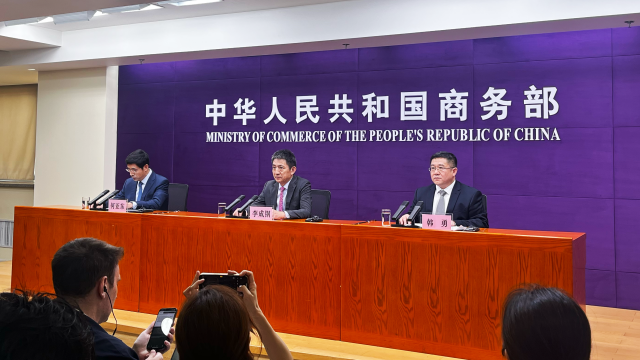
商务部召开中国关于世贸组织特殊和差别待遇问题新闻吹风会
Shang Wu Bu Wang Zhan· 2025-09-24 03:28
Core Viewpoint - China, as a responsible developing country, will not seek new special and differential treatment in current and future WTO negotiations, emphasizing its commitment to multilateral trade and global governance initiatives [2][4][5] Group 1: China's Position in WTO - China joined the WTO in 2001 as a developing member and has enjoyed special and differential treatment, which includes lower levels of commitments and longer transition periods [4] - The announcement reflects China's proactive stance in supporting the multilateral trading system amid rising unilateralism and protectionism [5][7] Group 2: Implications for Global Trade - The decision is expected to inject confidence and direction into global economic cooperation, supporting WTO reforms and promoting a cooperative environment [7][8] - China's commitment to not seeking new special treatment sends a strong signal of responsibility and collaboration among major economies, enhancing stability in the global economy [8][9] Group 3: Future Actions and Goals - China will continue to uphold its status as a developing member and advocate for the rights of developing countries while pushing for the liberalization and facilitation of global trade and investment [9] - Future efforts will focus on opposing unilateralism, updating WTO rules, and achieving development-oriented outcomes at the upcoming WTO Ministerial Conference in March 2026 [9]
中国在WTO谈判中将不寻求新的特殊和差别待遇,商务部详解
Di Yi Cai Jing· 2025-09-24 03:25
Core Viewpoint - China maintains its status as the largest developing country, emphasizing its commitment to multilateral trade systems and global development initiatives [1][5][6] Group 1: China's Position in WTO - China joined the WTO as a developing member in 2001, entitled to special and differential treatment, which includes lower commitments and longer transition periods [3][4] - The WTO has 157 special and differential treatment clauses, with 9 applicable only to the least developed countries, indicating that not all developing members receive the same benefits [3] - China has historically received fewer special and differential treatments compared to other developing members, actively participating in negotiations and contributing to global trade liberalization [4][6] Group 2: Commitment to Multilateral Trade - In light of challenges to the multilateral trade system, China announced it will not seek new special and differential treatments in current and future WTO negotiations, reinforcing its support for multilateralism [5][6] - This decision is seen as a significant step towards promoting global trade cooperation and reforming the WTO to better address international economic challenges [6][7] - China's actions are intended to boost confidence in the multilateral trade system and signal its commitment to working collaboratively with other members [6][7] Group 3: Future Directions - China aims to deepen reforms and expand high-level openness while focusing on high-quality development, positioning itself as a leader in global trade discussions [1][6] - The country emphasizes the importance of addressing development issues within the WTO framework, aiming to bridge the gap between developed and developing nations [7][8] - Future efforts will include advocating for the inclusion of investment facilitation and e-commerce agreements in WTO regulations, as well as achieving development-oriented outcomes in upcoming ministerial meetings [8]

X @外汇交易员
外汇交易员· 2025-09-23 23:51
WTO Reform & China's Role - China will no longer seek special and differential treatment (SDT) in new WTO agreements [1] - This announcement is considered a major step towards WTO reform [1] - The WTO Director-General praised China's leadership on this issue [1] - The US believes that WTO reform is impossible unless major economies like China relinquish SDT [1]
世贸组织总干事伊维拉:多边主义受到打击,但还活着
Sou Hu Cai Jing· 2025-09-19 11:46
Core Points - The global trade system has been impacted by unilateral tariff actions from the United States, yet it retains a resilient multilateral core [3][7][8] - Ngozi Okonjo-Iweala, the first female and African Director-General of the WTO, emphasizes the need for reform and addressing key issues within the organization [5][9] - The WTO's Fisheries Subsidies Agreement, which took 21 years to negotiate, has recently come into effect, marking a significant achievement for multilateral trade [7][8] Group 1: Current Trade Environment - The WTO predicts a 0.9% growth in global merchandise trade for the year, a decrease from the pre-tariff forecast of 2.7% [8] - Despite challenges, approximately 72% of global trade is still conducted under WTO rules, down from 80% before the tariffs [7][8] Group 2: Reform and Challenges - Reform is identified as a critical task for the WTO, with a focus on addressing member concerns regarding fairness, transparency, and inclusivity in the trade system [9][10] - The decision-making process within the WTO, which requires consensus among all 166 members, is a significant point of contention, often hindering timely decisions [10] Group 3: Dispute Resolution Mechanism - The WTO's dispute resolution mechanism remains operational despite the suspension of the appellate body since 2019, with ongoing consultations for 16 cases [11][12] - A temporary multilateral appeal arrangement (MPIA) has been established by several members to address the lack of functioning appellate judges, covering 57.6% of global trade [12]

商务部:推动世贸组织改革朝着正确方向发展
Zhong Guo Zheng Quan Bao· 2025-09-02 22:35
Core Viewpoint - The importance of reforming the World Trade Organization (WTO) is reiterated, emphasizing the need for the dispute resolution mechanism to return to normal operations and the significance of open, inclusive, resilient, and stable supply chains [1] Group 1: WTO Reform and Development - The statement highlights the necessity of supporting developing members and least developed countries to better integrate into the multilateral trading system [1] - There is a call for Belarus, Iran, and Uzbekistan to join the WTO as soon as possible, indicating a push for broader participation in global trade [1] - The upcoming 14th Ministerial Conference (MC14) in 2026 is anticipated to yield practical results [1] Group 2: Characteristics of the Statement - The statement is characterized by its high-level nature, being the first time that heads of state from the Shanghai Cooperation Organization (SCO) have issued a joint declaration specifically supporting the multilateral trading system [1] - The timing of the statement is noted as appropriate, coinciding with recent agreements among some WTO members regarding "reciprocal tariffs" [1] - The emphasis on development is clear, with a commitment to assist developing members in achieving industrialization and supporting least developed countries in better integrating into the multilateral trading system [1]
商务部解读上合组织成员国元首理事会关于支持多边贸易体制的声明 中方将积极践行真正的多边主义
Zheng Quan Shi Bao· 2025-09-02 18:15
Group 1 - The Shanghai Cooperation Organization (SCO) summit recently held in Tianjin issued a statement supporting the multilateral trading system, marking the first time SCO member states have collectively expressed this support [1] - The statement emphasizes the importance of a rules-based multilateral trading system, opposing trade restrictions that violate World Trade Organization (WTO) rules, and calls for dialogue and cooperation among all parties [1][2] - The statement reaffirms the significance of WTO reform, the restoration of the dispute resolution mechanism, and the importance of open, inclusive, resilient, and stable supply chains [1][2] Group 2 - The statement highlights the need for developing members and least developed countries to better integrate into the multilateral trading system, supporting Belarus, Iran, and Uzbekistan in their efforts to join the WTO [1][2] - The timing of the statement is noted as particularly relevant, coinciding with recent agreements among some WTO members regarding "reciprocal tariffs," reinforcing basic principles such as most-favored-nation treatment and non-discrimination [2] - The Chinese side plans to enhance communication and cooperation with other SCO member states to promote genuine multilateralism and support the legitimate interests of developing members [3]
直通部委|外交部:中国对俄罗斯试行免签 国资委:打造生物医药领域国家队
Xin Lang Cai Jing· 2025-09-02 10:12
Group 1: International Relations and Trade - China will implement a visa-free policy for Russian citizens holding ordinary passports from September 15, 2025, to September 14, 2026, allowing stays of up to 30 days for business, tourism, family visits, and transit [1] - The Shanghai Cooperation Organization (SCO) leaders have issued a statement supporting the multilateral trading system, emphasizing the importance of development and the integration of least developed countries into the trade system [1] - China aims to strengthen communication and cooperation with SCO member states to promote genuine multilateralism and push for reforms in the World Trade Organization (WTO) [1] Group 2: Social Security and Tax Policies - The Ministry of Finance and the State Taxation Administration have announced tax policies regarding the transfer of state-owned equity and cash income to bolster the social security fund, including exemptions from VAT and corporate income tax for certain transactions [2] - The policy aims to facilitate the management of state-owned assets and enhance the financial sustainability of the social security fund [2] Group 3: Software Industry Performance - In the first seven months of 2025, China's software industry generated revenue of 83,246 billion yuan, reflecting a year-on-year growth of 12.3% [3] - The total profit of the software industry reached 10,890 billion yuan, with software product revenue accounting for 21.6% of the total industry revenue [3] - Information technology services contributed 57,246 billion yuan, representing 68.8% of the overall revenue, indicating a strong performance in this sector [3] Group 4: Biopharmaceutical Industry Development - The State-owned Assets Supervision and Administration Commission (SASAC) is focusing on accelerating the development of the biopharmaceutical industry, aiming to create a national team in this field [4] - The initiative emphasizes innovation-driven development and collaboration with the Chinese Academy of Sciences to enhance the quality and competitiveness of China's biopharmaceutical sector [4]
上合组织天津峰会丨上海合作组织成员国元首理事会关于支持多边贸易体制的声明
Xin Hua Wang· 2025-09-02 09:08
Group 1 - The leaders of the Shanghai Cooperation Organization (SCO) recognize the rising uncertainty in the global economy and the spread of restrictive trade measures, emphasizing the importance of a multilateral trade system for promoting inclusive economic growth and sustainable development [2] - The SCO supports a multilateral trade system based on World Trade Organization (WTO) rules, highlighting the need for special and differential treatment for developing countries, including the least developed countries [2][3] - There is a call for dialogue and cooperation among parties to adhere to international trade laws, including WTO rules, to eliminate restrictive measures that violate these rules [2][3] Group 2 - The SCO emphasizes the significance of development issues within the WTO's work, advocating for the improvement of special and differential treatment provisions for developing countries and supporting the integration of least developed countries into the multilateral trade system [3] - Concerns are raised regarding global food security challenges, with a focus on expanding agricultural production and ensuring diverse and smooth food supply chains to protect the interests of developing and least developed countries [3] - The SCO supports the acceleration of discussions on the WTO's e-commerce work program, aiming to develop resolutions that address digital inequality and enhance consumer and business confidence in e-commerce [3] Group 3 - The importance of open, inclusive, stable, resilient, and diversified supply chains for achieving sustainable development goals is emphasized [5] - The SCO expresses concern over measures that undermine the stability of global supply chains and encourages continued efforts to strengthen international cooperation in this area [6] - There is a call to enhance the inclusivity of the multilateral trade system by increasing membership, improving regional representation, and attracting more developing countries, including least developed countries, to join the WTO [6]
商务部有关负责人解读《上海合作组织成员国元首理事会关于支持多边贸易体制的声明》
Shang Wu Bu Wang Zhan· 2025-09-02 07:03
Group 1 - The background of the statement highlights the challenges faced by the multilateral trading system, emphasizing the importance of the WTO in global economic governance and the need for cooperation among SCO member states to address global trade turbulence [2] - The statement reflects a consensus among SCO member states to support a rules-based multilateral trading system, oppose trade restrictions that violate WTO rules, and emphasize the importance of open, inclusive, resilient, and stable supply chains [3] - The statement is characterized by its high-level endorsement from SCO leaders, timely response to recent developments in the WTO, and a strong focus on supporting the integration of developing and least developed countries into the multilateral trading system [4] Group 2 - The statement calls for the restoration of the dispute resolution mechanism within the WTO and encourages ongoing efforts to ensure the effective functioning of the multilateral trading system [3] - It expresses support for Belarus, Iran, and Uzbekistan in their efforts to join the WTO and looks forward to practical outcomes from the upcoming 14th Ministerial Conference in 2026 [3][4] - The Chinese government plans to enhance communication and cooperation with other SCO member states to promote genuine multilateralism and contribute to the development of an open world economy [4]