
中小盘股

Search documents
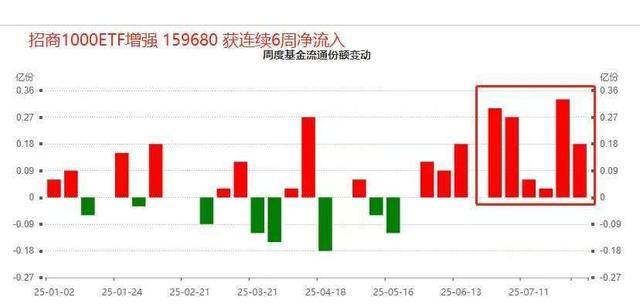
又一只“翻倍基”,又是中小盘!最大的1000ETF增强(159680)周度净流入6连阳
Sou Hu Cai Jing· 2025-08-04 02:16
分析指出,近期市场关注中小盘股后续空间。分析认为,支撑其配置价值的理由包括:一是当前处于牛 市中期,具备成长弹性的中小盘股增强仍为市场焦点;二是其整体估值尚未达历史高位,相对价值及成 长溢价逻辑仍存空间;三是量化增强策略能有效应对波动、持续创造超额收益,如招商中证2000增强 ETF(159552)及中证1000增强ETF(159680)成立以来季季跑赢基准,年内超额显著;四是相关ETF 资金持续净流入,规模领先,流动性充裕。不过短期涨幅后的波动风险值得关注。 中小盘是今年当吃无愧的急先锋。数据显示,今年以来1000ETF增强(159680)累计涨20.79%,较基准指 数接近翻倍。资金热度不减,截至8月1日,该基年初以来累计净流入约2.1亿,年内规模增长104.15%, 创阶段新高。 ...

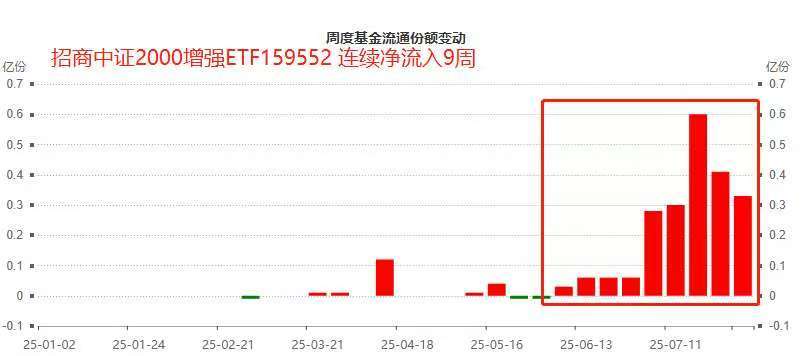
加仓中小盘,增强是方向!规模最大的中证2000增强ETF(159552)周度净流入9连阳
Sou Hu Cai Jing· 2025-08-04 01:34
Group 1 - The core viewpoint of the article highlights the resilience of small and mid-cap stocks in the market despite recent adjustments, with the largest CSI 2000 Enhanced ETF (159552) achieving a cumulative increase of 40.29% year-to-date, marking it as the first broad index ETF to exceed a 40% rise this year [1] - The analysis suggests that the continued interest in small and mid-cap stocks is supported by several factors: the current mid-cycle bull market, the growth potential of small and mid-cap stocks, and their overall valuations not reaching historical highs, indicating room for relative value and growth premium [1] - Quantitative enhancement strategies are noted for their effectiveness in managing volatility and consistently generating excess returns, as evidenced by the performance of the CSI 2000 Enhanced ETF (159552) and the CSI 1000 Enhanced ETF (159680), which have outperformed their benchmarks since inception [1] - There is a continuous net inflow of funds into related ETFs, indicating strong liquidity and leading scale in the market [1] Group 2 - It is important to note that institutions have cautioned about the potential volatility risks following short-term price increases [1]
早盘直击 | 今日行情关注
申万宏源证券上海北京西路营业部· 2025-06-09 02:09
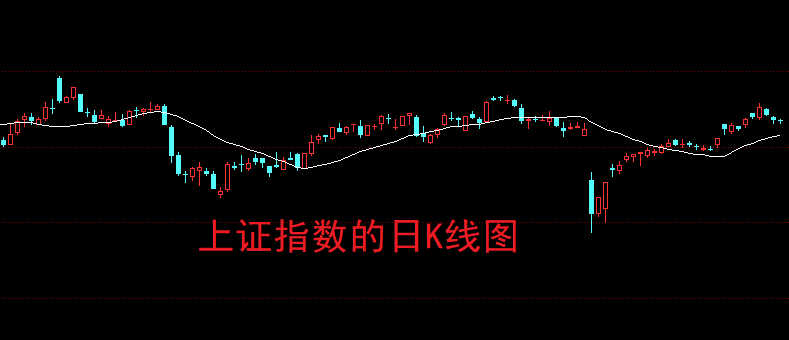
Core Viewpoint - The market sentiment has improved following a phone call between the leaders of China and the United States, with expectations for further discussions and outcomes from upcoming meetings [1] Market Performance - The stock markets experienced a rebound this week, with the Shanghai Composite Index surpassing all moving average resistances and approaching the mid-May high [1] - The Shenzhen Component Index also rebounded but remains under pressure from the 60-day moving average [1] - Average daily trading volume in both markets increased to approximately 11.8 billion, a significant rise compared to the previous week [1] Sector Focus - Market hotspots this week were primarily in the TMT (Technology, Media, and Telecommunications) sector and upstream non-ferrous metals industry [1] - The investment style leaned towards technology and small-cap stocks, which led the gains [1] Market Dynamics - The Shanghai Composite Index is attempting to challenge the mid-May high after a period of downward adjustment [1] - The index had shown a pattern of simultaneous lower highs and lows but found support at the 60-day moving average, leading to a new wave of rebound [1] - There are still strong technical resistances near last year's fourth-quarter trading volume concentration and this year's first-quarter market peak, warranting ongoing observation [1]

中小盘股“风头无两” 主题基金“闭门谢客”
Zheng Quan Shi Bao· 2025-06-08 22:01
Group 1 - The core viewpoint of the articles highlights the strong performance of small and mid-cap stocks, driven by favorable fundamentals and liquidity easing, leading to significant net value increases in various thematic funds [1][2][3] - The CSI 2000 and National CSI 2000 indices have risen by 18.55% and 15.28% respectively since April 7, significantly outperforming major indices [2] - The recent regulatory changes by the China Securities Regulatory Commission (CSRC) encourage companies to optimize and integrate, providing additional funding sources for micro-cap stocks and stimulating market interest in quality small enterprises [2][3] Group 2 - The strong performance of small-cap stocks is attributed to their faster earnings growth during the early stages of economic recovery, with sectors like renewable energy and innovative pharmaceuticals showing significant revenue growth [2] - The liquidity environment remains supportive, with the central bank emphasizing the use of moderately loose monetary policy, which is expected to continue throughout the year [3] - Several thematic funds have experienced substantial inflows, leading to some funds limiting new subscriptions due to capacity constraints, such as the Noan Multi-Strategy Fund and CITIC Prudential Multi-Strategy Fund [4][5] Group 3 - The CSRC's recent action plan strengthens the constraints of performance benchmarks on public funds, which may lead to a shift in investment strategies towards larger indices like CSI 800 or CSI 1000, potentially impacting small-cap stock allocations [6] - Fund managers are increasingly cautious about maintaining optimal strategies in the face of rapid inflows, which could affect existing investors and fund performance [5][6] - There is a possibility of a liquidity shock for certain small-cap stocks if active equity funds adjust their portfolios in response to performance benchmarks, which may favor value and dividend stocks [6]
这一指数创新高!主题基金却“闭门谢客”,什么情况?
券商中国· 2025-06-08 12:45
Core Viewpoint - The recent performance of small and micro-cap stocks has been strong, driven by favorable fundamentals and liquidity easing, leading to significant gains in related indices [1][3]. Group 1: Market Performance - Small and micro-cap stocks have outperformed larger indices, with the CSI 2000 and Guozheng 2000 indices rising by 18.55% and 15.28% respectively since April 7, significantly exceeding the gains of the Shanghai and Shenzhen indices [3]. - The North Star 50 index, which focuses on "specialized, refined, unique, and innovative" companies, has surged over 36% during the same period, while the Wind micro-cap index has reached a historical high [3]. Group 2: Fund Dynamics - Several thematic funds have seen rapid increases in net asset value, leading to limited capacity for new investments, prompting some funds to restrict new subscriptions [2][5]. - The China Securities Regulatory Commission (CSRC) has issued a plan to enhance the performance benchmarks for public funds, which may influence fund managers to favor indices like CSI 800 or CSI 1000 over the CSI 2000, impacting small-cap stock allocations [2][7]. Group 3: Investment Strategies - Fund managers are increasingly focusing on small-cap stocks, identifying opportunities in sectors such as new energy and innovative pharmaceuticals, which are expected to outperform larger companies during economic recovery [4]. - The current market environment, characterized by liquidity easing and a rebound in risk appetite, is seen as favorable for small-cap stocks, with expectations of continued support from monetary policy [4][6]. Group 4: Fund Management Challenges - The rapid inflow of funds into small-cap focused strategies has led to some funds reducing their positions due to capacity constraints, as seen with the reduction of subscription limits for certain funds [5][6]. - Fund managers are cautious about maintaining optimal strategies amidst rising stock prices, which may lead to a decrease in portfolio allocations even with new inflows [6][8].
国泰海通|金工:量化择时和拥挤度预警周报:市场或将出现由中小盘股引领的震荡上行
国泰海通证券研究· 2025-06-02 12:31
Core Viewpoint - The market is expected to experience a volatile upward trend led by small and mid-cap stocks after the holiday [1][2]. Market Indicators - The liquidity shock indicator for the CSI 300 index was 0.13, lower than the previous week (1.13), indicating current market liquidity is 0.13 standard deviations above the average level over the past year [2]. - The PUT-CALL ratio for the SSE 50 ETF options increased to 1.15, up from 0.94 the previous week, reflecting rising caution among investors regarding the short-term performance of the SSE 50 ETF [2]. - The five-day average turnover rates for the SSE Composite Index and Wind All A were 0.76% and 1.30%, respectively, indicating a decrease in trading activity, positioned at the 50.17% and 63.97% percentile since 2005 [2]. Macro Factors - The RMB exchange rate fluctuated last week, with onshore and offshore rates showing weekly declines of -0.08% and -0.48%, respectively [2]. - The US stock market showed a volatile upward trend, with the Dow Jones, S&P 500, and Nasdaq indices posting weekly returns of 1.6%, 1.88%, and 2.01% respectively [2]. - The US core PCE price index rose by 2.5% year-on-year, the lowest since March 2021, with a month-on-month increase of 0.1% [2]. Real Estate Sector - The total land acquisition amount for the top 100 enterprises from January to May 2025 reached 405.19 billion, a year-on-year increase of 28.8%, with the growth rate expanding by 2.2 percentage points compared to the previous month [2]. Technical Analysis - The Wind All A index broke below the SAR reversal indicator on May 23, indicating a bearish trend [2]. - The current market score based on the moving average strength index is 160, positioned at the 64.8% percentile since 2021 [2]. - The market has not yet formed a bottom, as the moving average strength index has not shown a significant decline [2]. Performance Overview - For the week of May 26 to May 30, the SSE 50 index fell by 1.22%, the CSI 300 index decreased by 1.08%, while the CSI 500 index rose by 0.32% and the ChiNext index dropped by 1.4% [3]. - The overall market PE (TTM) stands at 18.9 times, positioned at the 50.5% percentile since 2005 [3]. Factor and Industry Observations - Factor crowding remains stable, with small-cap factor crowding at 0.98, low valuation factor crowding at 0.11, high profitability factor crowding at -0.28, and high growth factor crowding at -0.04 [3]. - The industry crowding is relatively high in machinery, comprehensive, retail, environmental protection, and non-ferrous metals sectors, with transportation and non-ferrous metals showing significant increases in crowding [3].


A股低开低走,涨不上去也让人着急!
Sou Hu Cai Jing· 2025-05-19 04:37
Market Overview - The market opened lower on Monday, but the decline was limited, and the index managed to stabilize as market sentiment gradually improved [1][3] - Small-cap stocks showed remarkable performance, with more stocks rising than falling, indicating a potential recovery in the market [3] Sector Performance - The port and shipping sector led the gains, with stocks such as Lianyungang Port, Ningbo Shipping, and Zhuhai Port hitting the daily limit [5] - Real estate stocks also saw increases, with companies like Konggang Co., Shahe Co., and Rongsheng Development reaching their daily limits [5] Market Sentiment - The current market is experiencing a "five poor" period, characterized by low trading volumes and pessimistic sentiment, which may present opportunities for institutional investors to accumulate positions [7] - The market is still below the 4000-point mark, suggesting a strategy of patience and value investing may be prudent during this uncertain period [7] Declining Stocks - PEEK material concept stocks led the decline, with companies like Shuanglin Co. and Weike Technology dropping over 5% [8] - Robotics stocks also fell, with Longxi Co. hitting the limit down and others like Riying Electronics and Yian Technology dropping over 8% [8]
25Q1持仓配置环比小幅提升,持仓重心向中小盘股倾斜
Tianfeng Securities· 2025-05-09 03:46
Investment Rating - The industry investment rating is Neutral (maintained rating) [5] Core Viewpoints - In Q1 2025, the proportion of public fund holdings in the basic chemical sector slightly increased quarter-on-quarter but decreased year-on-year, with a market value proportion of 3.32% [2][13] - The basic chemical stocks accounted for 3.53% of the A-share market, showing a year-on-year decrease of 0.11 percentage points [2][13] - The number of stocks held by public funds in the basic chemical sector reached 146, an increase of 4 stocks year-on-year and 21 stocks quarter-on-quarter [3][20] Summary by Sections 1. Event - Public funds are required to disclose their top ten heavy stocks within 15 days after the end of each quarter, and the report analyzes the top heavy stocks in the basic chemical industry for Q1 2025 [1][12] 2. Holdings Change - The heavy stock holding ratio in the basic chemical sector increased slightly by 0.05 percentage points quarter-on-quarter but decreased by 0.49 percentage points year-on-year [2][13] - The basic chemical industry is underweighted by 0.2%, with a quarter-on-quarter decrease of 0.04 percentage points [2][13] - The oil and chemical sector saw a significant increase in public fund holdings since Q3 2020, but the proportion dropped to 0.4% in Q1 2025, a decrease of 0.74 percentage points year-on-year [2][18] 3. Individual Stock Analysis - The top five heavy stocks in Q1 2025 are Wanhua Chemical, Juhua Co., Sailun Tire, Hualu Hengsheng, and Satellite Chemical, with Satellite Chemical replacing China National Petroleum in the top five [4][29] - The number of companies in the agricultural chemical sector remains the highest among the top 50 heavy stocks, with 9 companies, accounting for 18% [4][29] 4. Market Preference Analysis - The proportion of holdings in industry leaders has decreased, with a shift towards small and mid-cap stocks [5] - Stocks with a market capitalization of over 500 billion accounted for 33.7% of the total market value of the top 50 chemical stocks, a decrease of 7.49 percentage points [5]



