
交易策略

Search documents
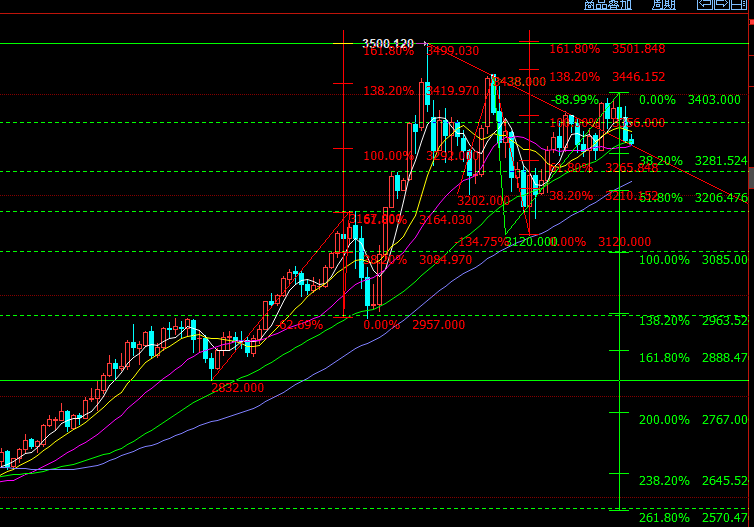
重磅,美国CPI数据来袭,黄金会打破扫荡吗?
Sou Hu Cai Jing· 2025-06-11 12:51
Group 1 - The core viewpoint emphasizes the importance of stop-loss strategies in trading, suggesting that holding onto losing positions is always a mistake [1] - The gold market is currently experiencing fluctuations, with a support level identified at 3316 and a resistance level at 3350, indicating potential trading strategies based on these levels [2][4] - The analysis of silver suggests maintaining a bearish strategy, with key resistance levels identified at 37, 37.6, and 38.1, while also noting the potential for extreme bullish movements [4] Group 2 - The upcoming US CPI data is expected to maintain the current market volatility, with significant attention on the 3365 resistance level, which is crucial for potential market movements [2] - A downward movement in gold prices is anticipated, with critical support levels identified between 3320-16, and a potential breakdown below 3300 could indicate further bearish sentiment [4] - The analysis of futures for gold and silver indicates a bearish outlook, with specific price levels for short positions highlighted, suggesting a cautious approach to trading in the current market environment [4]

澳元兑美元横盘博弈,多空角力下突破方向何在?
Sou Hu Cai Jing· 2025-06-06 05:38
Core Viewpoint - The Australian dollar (AUD) is experiencing a narrow trading range against the US dollar (USD), reflecting underlying economic weakness, monetary policy expectations, and external risk factors [1][3]. Economic Fundamentals - Australia's Q1 GDP growth was only 0.2% quarter-on-quarter, a significant slowdown from 0.6% in Q4 of the previous year, with year-on-year growth dropping to 1.3% [3]. - Per capita GDP has declined for five consecutive quarters, indicating a lack of internal growth momentum [3]. - Household consumption has seen slight growth due to essential spending, but public sector spending has reached a new high since 2017, highlighting the narrowing fiscal policy space [3]. - The Reserve Bank of Australia (RBA) has signaled strong easing measures, discussing a potential 50 basis point rate cut and indicating a quick response to the impacts of US tariff policies [3]. External Risks - Uncertainty surrounding US trade policies poses a significant risk, as Australia relies heavily on exports, which account for 25% of its GDP [3]. - The volatility of commodity export prices to the US has increased by 40% since the beginning of the year due to tariff disputes [3]. - Hawkish statements from the Federal Reserve regarding tariff policies could lead to delayed rate cuts or even a resumption of rate hikes, indirectly pressuring the AUD [3]. Technical Analysis - The AUD/USD pair is in a critical consolidation phase, forming a converging triangle pattern between 0.6450 and 0.6500 [4]. - The RSI indicator shows a bullish divergence in the oversold region, while the MACD momentum remains below the zero line, indicating a delicate balance between bulls and bears [4]. - The psychological level of 0.6500 is a battleground, with three recent tests resulting in pullbacks, while strong buying interest at 0.6400 provides short-term support [4]. Trading Strategy - The market is at a critical point for directional choice, with short-term traders advised to watch for breakout signals [4]. - A drop below 0.6400 could open up further downside towards 0.6300, while a sustained move above 0.6500 could target the yearly high of 0.6540 [4]. - Mid-term investors should be cautious of policy expectation adjustments, considering short positions above 0.6500 with a stop loss at 0.6600 and a target at 0.6350 [4]. Future Outlook - The RBA's meeting minutes on June 18 and the US non-farm payroll data on June 21 will be critical catalysts for the AUD [5]. - A clearer indication of rate cuts from the RBA or stronger-than-expected US employment data could significantly increase downward pressure on the AUD [5]. - Conversely, if iron ore prices exceed $120 per ton, it may provide temporary support for the AUD [5]. - The current predicament of the AUD is a result of weak economic fundamentals, expectations of policy easing, and external uncertainties, with a true breakout requiring a convergence of internal and external momentum [5].

帮主郑重:交易如航海 少即是多的生存法则
Sou Hu Cai Jing· 2025-06-03 18:05
Core Viewpoint - The article emphasizes the importance of simplifying trading strategies by focusing on a few reliable indicators rather than overwhelming oneself with numerous signals and tools [1][3][4] Group 1: Trading Strategies - Many retail investors tend to collect various trading indicators, leading to confusion and ineffective decision-making [3][4] - Successful trading requires a focus on a limited number of reliable signals, akin to a hunter tracking prey with a few well-practiced traps [4] - The article suggests that traders should eliminate unnecessary indicators and simplify their trading plans to enhance effectiveness [4] Group 2: Market Behavior - The chaotic nature of trading can be likened to a novice sailor overwhelmed by too many tools, which ultimately leads to disorientation [3] - The experience of seasoned traders shows that relying on a few key indicators can lead to significant gains, as demonstrated by an old trader who successfully used only a 60-day moving average and volume [4] - The article advocates for a disciplined approach to trading, where clarity and focus on essential signals can lead to better outcomes [4]

知名空头吉姆·查诺斯对比特币和Strategy采取反向押注
news flash· 2025-05-17 06:26
Core Viewpoint - Notable short-seller Jim Chanos has revealed a new trading strategy of shorting MicroStrategy stock while buying Bitcoin, highlighting a significant price mismatch between the two assets [1] Group 1: Trading Strategy - Chanos is selling MicroStrategy stock and buying Bitcoin, describing this as buying something for $1 and selling another for $2.50, indicating a perceived mispricing [1] - The strategy is seen as an important indicator of both arbitrage opportunities and retail investor speculation behavior [1] Group 2: Market Dynamics - Chanos criticizes the trend of companies promoting the idea of purchasing Bitcoin through corporate structures, which has led to other firms attempting to replicate this for market premiums [1] - He labels this phenomenon as "extremely absurd," reflecting concerns about the sustainability of such market practices [1]
国际黄金交易指南:如何在全球波动中稳健获利?
Sou Hu Cai Jing· 2025-03-25 10:56
Core Insights - The article emphasizes the increasing significance of gold as a traditional safe-haven asset amid rising global economic uncertainties, geopolitical conflicts, and persistent inflation pressures. It aims to provide a comprehensive practical guide for international gold traders to achieve stable profits in a volatile market environment. Group 1: Market Analysis - Gold prices are closely linked to global economic conditions, with key indicators such as U.S. non-farm payroll data, CPI (Consumer Price Index), and Federal Reserve interest rate decisions being crucial. Weak non-farm data or unexpected CPI increases may raise recession fears, driving gold prices up, while Fed rate hikes could enhance the dollar's appeal, suppressing gold prices [4]. - Geopolitical risks, including wars, trade disputes, and sanctions, heighten market risk aversion. For instance, during the escalation of the Russia-Ukraine conflict, gold prices briefly surpassed $2000 per ounce. Investors should monitor news and analyses from professional institutions to capture short-term impacts of geopolitical risks on the gold market [4]. - Central bank monetary policies directly affect gold's monetary attributes. When real interest rates (nominal rates minus inflation) decline, the holding cost of gold decreases, enhancing its attractiveness. For example, during the global monetary easing in 2020, gold prices reached historical highs [4]. - Technical analysis tools, such as candlestick charts, moving averages (MA), and relative strength index (RSI), can help identify price trends and trading signals. For instance, if gold prices break through key resistance levels while the RSI is not overbought, it may indicate a continuation of upward momentum [4]. Group 2: Strategy Formulation - Trend-following strategies are essential in a unidirectional market. For example, when gold prices consistently break important moving averages (like the 200-day MA) with increased trading volume, gradual position building and setting trailing stop-loss orders are recommended. Avoiding "counter-trend bottom fishing" is crucial, especially during extreme market sentiments [5]. - In a range-bound market, profits can be made through buying low and selling high. For instance, within a $1900-$2000 per ounce range, buying near support levels and selling near resistance levels while implementing strict stop-loss measures (3%-5% of the range width) is advisable [5]. - Arbitrage trading strategies can exploit price differences between gold spot and futures markets or between different exchanges (e.g., COMEX and Shanghai Gold Exchange). For example, if COMEX gold prices exceed reasonable premiums over Shanghai gold, buying Shanghai gold and selling COMEX gold can lock in profit from the price difference [5]. - Event-driven strategies involve positioning ahead of key events like Federal Reserve meetings or U.S. CPI data releases. For instance, if market expectations are high before a Fed rate hike, shorting gold in advance may be prudent; conversely, if data exceeds expectations, rapid position adjustments are necessary [5]. Group 3: Risk Management - Position control is vital, with a single trade risk not exceeding 2%-5% of total capital to prevent significant losses from single errors. For example, with an account balance of $100,000 and a stop-loss of $50 per ounce, a maximum of 4 contracts (1 contract = 100 ounces) can be traded [7]. - Setting clear stop-loss points (e.g., 3% below support levels) and profit targets (e.g., 5% above resistance levels) is essential. For instance, if gold is bought at $1950 per ounce, a stop-loss at $1900 and a take-profit at $2050 can help secure a favorable risk-reward ratio [7]. - Diversification is crucial to avoid over-concentration in holdings. Allocating funds across different assets such as gold ETFs, gold mining stocks, and physical gold can mitigate the impact of volatility in a single asset. For example, 60% in gold futures, 30% in gold ETFs, and 10% in physical gold is a balanced approach [7]. - Liquidity management involves trading during active hours (e.g., when London and New York markets overlap) to avoid slippage due to insufficient liquidity. Additionally, maintaining sufficient margin to meet potential margin calls is important [7]. Group 4: Mindset Adjustment - Avoiding emotional trading is critical, as fear and greed can lead to irrational decisions during market volatility. For instance, panicking during price drops or excessively chasing prices during surges should be avoided. Establishing and adhering to a trading plan can minimize impulsive adjustments [8]. - Combining a long-term perspective with short-term flexibility is beneficial. While long-term trends in gold are supported by inflation and currency depreciation, short-term fluctuations are unpredictable. Setting a core position (e.g., 50%) to hold until target levels while using remaining capital for swing trading is advisable [8]. - Continuous learning and reviewing trading records to analyze profit and loss reasons are essential. For example, if frequent losses occur due to wide stop-losses, adjusting the stop-loss strategy may be necessary; if trend opportunities are missed, optimizing entry signals is recommended [8]. - Monitoring market sentiment indicators, such as the CBOE Volatility Index (VIX) and speculative net long positions in gold, can help gauge market optimism or pessimism. For instance, a spike in VIX alongside historically high net long positions in gold may signal potential correction risks [8].

评《债务周期与交易策略》
半夏投资· 2024-03-10 07:42
认识明明博士多年,去年 3季度受他的邀请,为其新书 《债务周期与交易策略》作书评 。 受邀后恰逢市场比 较极端的阶段,作为一名基金经理,我的精力都放在研究思考市场和基金交易 上, 直到去年年底才认真读完全书 完成书评,晚交了作业,错过了出版社付印的时间。对此,我 很是抱愧。 感谢 明 明博士依然将这篇迟到的没能印到书中的书评 放在其公众号上, 供大家参考。 并向大家一并推荐明明博士的公众号。 明明博士早年在央行货政司工作,又曾作为首席固定收益分析师长期深入研究债券市场,现在是中 信证券的首席经济学家。是市场上少有的既有监管视角,又深度了解微观市场结构,有实战视角的 经学家。我一直关注明明博士的研究,总是能得到很多启发。例如 本书对于财政货币结合和 地方 债务的讨论,是非常深刻的。 《债务周期与交易策略》获选 长安街读书会第20240108期干部学习新书书单 长安街读书会是在中央老同志的鼓励支持下发起成立,践行全民阅读。为中华之崛起而读书、 学习、养才、报国。现有千余位成员主要来自长安街附近中央和国家机关各部委中青年干部、 中共中央党校(国家行政学院)学员、全国党代表、全国两会代表委员等喜文好书之士以及党 中央 ...