供应链稳定

Search documents
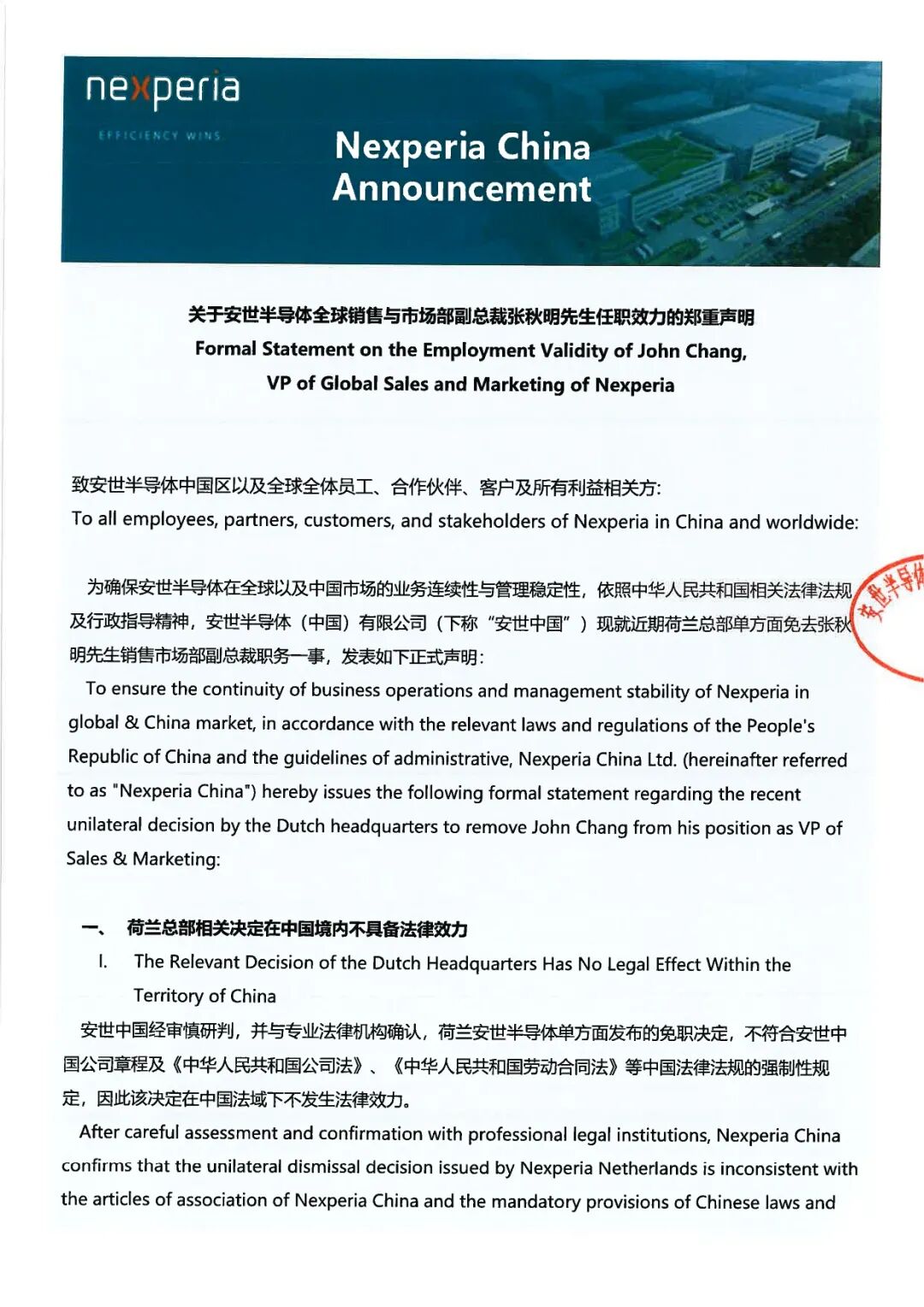
安世中国最新声明!
Zheng Quan Shi Bao· 2025-10-23 13:40
Core Viewpoint - Nexperia China asserts that the recent unilateral decision by its Dutch headquarters to dismiss John Chang from his position as VP of Global Sales and Marketing has no legal effect within China, emphasizing the company's commitment to business continuity and stability in the Chinese market [1][2][3]. Group 1: Legal Validity of the Decision - The decision made by the Dutch headquarters is deemed legally ineffective in China, as it contradicts Nexperia China's articles of association and Chinese laws, including the Company Law and Labor Contract Law [3][4][5]. - Nexperia China has confirmed through legal assessment that John Chang's employment contract remains intact, and his position as VP is still valid [6][7]. Group 2: Authority and Representation - All business activities conducted by John Chang or his authorized representatives are considered formal acts of Nexperia China, carrying full legal effect and responsibility [8][9]. Group 3: Business Operations - Nexperia China's business operations are reported to be normal and orderly, unaffected by external unilateral decisions, with a strong capability to ensure continuity and stability [10][11]. - The company emphasizes its commitment to customer interests and the stability of the supply chain, asserting that all products manufactured in China comply with local laws and quality standards [15][19][20]. Group 4: Response to External Interference - Nexperia China expresses strong opposition to the actions of certain individuals in foreign governments and the Dutch headquarters, which are seen as attempts to disrupt normal operations and undermine the company's interests [11][12][18]. - The company reserves the right to pursue legal action against any unauthorized attempts to interfere with its business operations [13].


安世中国致客户:各项生产经营正有序推进 保障客户生产连续性是现阶段最高追求
Mei Ri Jing Ji Xin Wen· 2025-10-23 06:23
Core Viewpoint - Anshi Semiconductor China is committed to ensuring supply chain stability for its customers and prioritizes customer interests during its ongoing production and operations [1] Group 1 - The company states that all products produced and delivered in China comply with local laws and regulations, as well as the company's technical standards and quality requirements [1] - Anshi Semiconductor China emphasizes that it will communicate with customers in advance regarding any changes or adjustments to product supply, production processes, or technical standards [1] - The board, management, and all employees are making maximum efforts to maintain production continuity for customers [1]
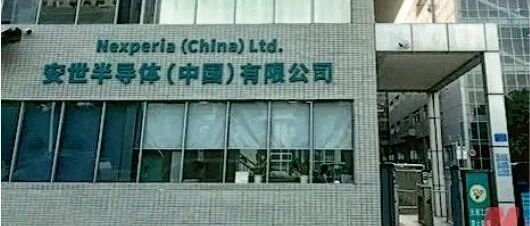
刚刚,安世发布致客户信
半导体行业观察· 2025-10-23 05:09
Core Viewpoint - Nexperia China entities emphasize their commitment to customer interests and the stability of the supply chain amidst external challenges, while opposing the actions of Nexperia Netherlands management that undermine their operations and customer trust [2][3][4]. Group 1: Company Operations and Compliance - Nexperia China operates legally and independently, adhering to Chinese laws and regulations, and prioritizes customer interests [3][4]. - The company assures that all products manufactured in China meet local legal requirements and internal quality standards, ensuring compliance with customer agreements [4][5]. - Any changes to product supply, production processes, or technical standards will be communicated to customers in advance [5][6]. Group 2: Customer Relations and Communication - Nexperia China aims to maintain close and transparent communication with customers to minimize uncertainties and foster trust [6][7]. - The company expresses a commitment to work collaboratively with customers to ensure the long-term stability and resilience of the supply chain [6][7].
大行评级丨瑞银:iPhone 17系列交货期缩短显示供应链正趋于稳定 维持苹果“中性”评级
Ge Long Hui· 2025-10-17 07:17
Core Insights - The delivery times for the iPhone 17 series are stabilizing or decreasing week-over-week, indicating an improvement in supply chain conditions [1] - In the U.S. market, the wait time for the iPhone 17 Pro has decreased by approximately 9 days compared to the previous week, reflecting supply improvements [1] - The iPhone 17 Pro Max has a current wait time of about 21 days, down from 24 days for the previous generation, while the iPhone 17 Pro's wait time is around 10 days, significantly shorter than the previous 18 days [1] - The basic model of the iPhone 17 still shows a high wait time of about 18 days, compared to just 1 day for the previous generation, indicating strong demand for entry-level products [1] - UBS maintains a "Neutral" rating on Apple with a target price of $220, based on an average earnings per share forecast of $7.91 for 2026 and 2027 [1] - The stabilization of wait times reflects a normalization of supply but also suggests that initial market demand for the new models is relatively moderate [1]

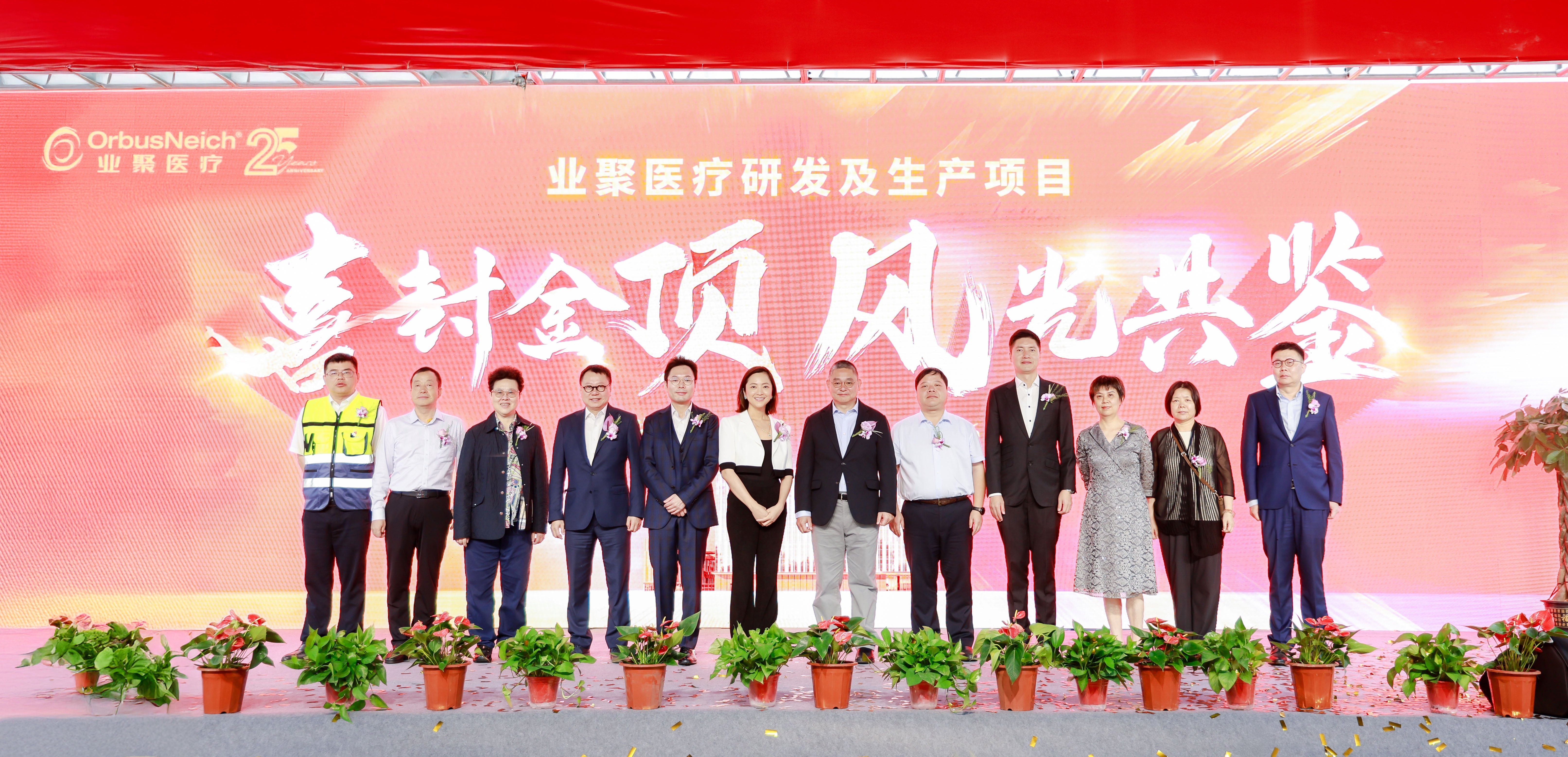
业聚医疗(6929.HK)位于杭州最大研发及生产基地举行封顶仪式
Ge Long Hui· 2025-10-17 01:17
Group 1 - The core point of the article is that Yejv Medical (6929.HK) has completed the structural topping of its R&D and production facility in Fuyang, Hangzhou, which is set to be the largest integrated facility globally, with full production expected by 2027 [1] - The new facility will add approximately 2.4 million units of production capacity annually, increasing the total annual output from the current 2.1 million units of balloons and stents [1] - The company currently operates R&D centers, production bases, and logistics hubs in China, Germany, Japan, and the Netherlands, and has a sales network covering over 70 countries and regions [1][1] Group 2 - Yejv Medical holds over 250 authorized patents and has announced patent applications, with more than 55 approved products sold in major global markets [1][1] - The completion of the Hangzhou facility is expected to significantly enhance the company's high-quality production capacity, accelerate the incubation and application of new technologies, and improve the stability of the global supply chain and overall competitiveness [1] - The company aims to capitalize on the continuous growth opportunities in the global PCI and PTA device markets [1]
让粮食供应链更有韧性更安全
Ren Min Ri Bao· 2025-10-15 22:22
Group 1 - Food security is a national priority, and stable supply chains are essential for ensuring food security. COFCO Group is accelerating the construction of a modern food logistics supply chain system to enhance the resilience and safety of food supply chains [1] - The grain terminal at Nansha Port in Guangzhou, designed by COFCO Technology, is the largest grain port logistics facility in South China, achieving a single silo unloading capacity of 2,000 tons per hour and a berth unloading capacity of 8,000 tons per hour, with an annual throughput capacity of nearly 16 million tons [1] - COFCO Technology has developed advanced equipment such as a non-destructive multi-point grain unloading device and a self-cleaning low-damage elevator, which reduce transportation losses and improve grain circulation efficiency. The automated control system enhances unloading efficiency by 20% and enables real-time information linkage with rail and road transport [1] Group 2 - Grain depots are critical nodes in the grain transportation chain. A new grain storage project in Huangpu District, Guangzhou, designed by COFCO Technology, utilizes next-generation tubular chain technology to address issues of low capacity and high material loss in traditional systems, filling a domestic technology gap [2] - The new tubular chain system has increased grain unloading efficiency from 50 tons per hour to 300 tons per hour, allowing for flexible layout and rapid transportation of grain to designated locations, thus improving the efficiency of the entire grain transportation network [2] - The project transforms traditional grain depots from static nodes into dynamic circulation hubs, facilitating seamless connections for subsequent transportation and creating a high-efficiency, clean, and coherent logistics loop [2] Group 3 - COFCO Group is driving the transformation of traditional industries towards high-end, green, and intelligent development. Innovations in storage include the development of six-sided active temperature control and autonomous temperature control smart storage technologies for precise and eco-friendly grain storage [3] - In processing, COFCO has developed an intelligent milling machine that overcomes key industry challenges such as automatic gap adjustment and online data monitoring [3] - The company is also exploring new growth avenues, including the launch of a new generation of healthy sugar substitute D-allohexose, which supports the Healthy China strategy, and is engaging in cutting-edge research in synthetic biology for future health industry applications [3]
中美都出了王牌,中国升级对稀土管控,美国威胁限制飞机零件出口
Sou Hu Cai Jing· 2025-10-13 10:49
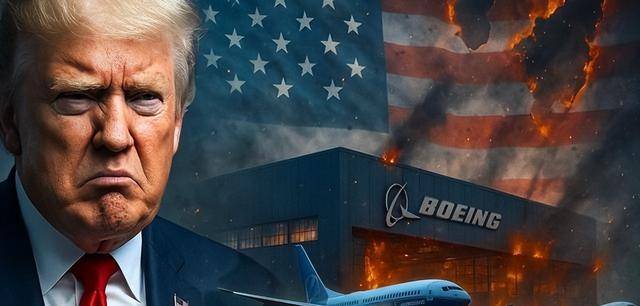
Group 1: Trade Tensions and Responses - The trade friction between China and the U.S. has escalated, with China imposing stricter export controls on rare earth elements, including lanthanum, cerium, praseodymium, neodymium, and samarium, effective October 9, 2025 [1][3] - The U.S. responded swiftly, with Trump threatening to restrict the export of Boeing aircraft parts to China, highlighting the reliance of Chinese airlines on Boeing models, which account for a significant portion of Boeing's global market [1][3][5] Group 2: Impact on Companies - The announcement of China's export controls led to immediate market reactions, with Boeing's stock dropping by 2.4% and General Electric's by 2.6% on October 11, 2025 [5] - Analysts noted that while the impact on Boeing may be limited in the short term due to China's development of its domestic C919 aircraft, the potential for supply chain disruptions remains significant [5][8] - The export controls affect a wide range of products, from jet engines to smartphones, requiring foreign companies to obtain approval for exports containing rare earth elements [7][8] Group 3: Global Supply Chain Reactions - European manufacturers and Japan's electronics sector quickly convened to discuss stockpiling rare earth materials in response to China's announcement [3][8] - Australian mining companies saw stock price increases as they are viewed as alternative sources for rare earth materials [3][8] - The situation highlights the vulnerabilities in the global supply chain, with potential risks for various industries reliant on rare earth elements [7][8]


商务部新闻发言人就加强稀土相关物项出口管制应询答记者问
券商中国· 2025-10-09 03:43
Core Viewpoint - The Chinese government has implemented export controls on certain rare earth-related items and technologies to safeguard national security and fulfill international non-proliferation obligations, reflecting a commitment to global peace and stability [2][3][4]. Group 1: Export Control Announcements - On October 9, the Ministry of Commerce announced two export control measures regarding rare earth-related items and technologies, approved by the State Council [2]. - The 2025 No. 61 announcement imposes export controls on certain overseas rare earth-related items containing Chinese components, citing their dual-use nature and potential threats to national security [2][4]. - The 2025 No. 62 announcement similarly applies export controls to rare earth-related technologies, reinforcing the existing legal framework established in 2001 [3][4]. Group 2: Rationale and Implementation - The export controls aim to prevent sensitive technologies from being misappropriated for military purposes, which poses significant risks to China's national interests and international stability [2][4]. - The Chinese government emphasizes a limited scope for the controlled items and plans to implement various licensing facilitation measures, including exemptions for humanitarian aid [3][4]. - A reasonable transition period has been established to accommodate existing commercial contracts and compliance needs for all stakeholders involved [3]. Group 3: Ongoing Efforts and Future Actions - The government has been actively combating illegal exports of strategic minerals and has identified foreign entities unlawfully acquiring rare earth technologies for military applications [4]. - The export control measures are part of a broader strategy to maintain the security and stability of the global rare earth supply chain while fulfilling international obligations [4].

新消费派|柠檬减产价格上涨 年销超10亿杯柠檬水的蜜雪冰城利润承压
Xin Hua Cai Jing· 2025-09-25 10:07
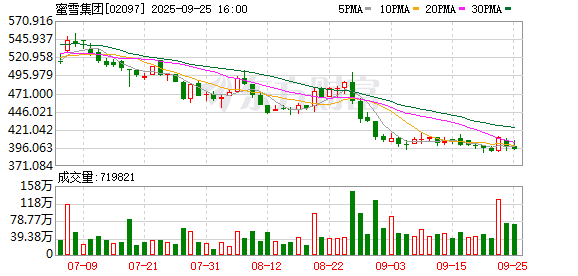
Core Viewpoint - The recent shortage of lemons affecting multiple locations of Mixue Ice City is attributed to delays in imported lemons due to weather conditions and the initial harvesting phase of local lemons in the Sichuan-Chongqing region, leading to temporary supply tightness [2][10]. Group 1: Supply Chain and Pricing - Mixue Ice City has begun large-scale purchases of lemons from Anyue County, which is expected to alleviate future supply pressures, although the procurement prices for lemons have increased compared to previous years [2][6]. - The average wholesale price of lemons in China has risen to 14.91 yuan per kilogram in September 2025, nearly double the price of 7.87 yuan per kilogram from the previous year [9]. - The lemon production in Anyue County, a major supplier for Mixue Ice City, is projected to decline by approximately 20% due to adverse weather conditions, including high temperatures and late spring frost [8][9]. Group 2: Impact on Mixue Ice City - Mixue Ice City sold approximately 11 billion cups of its signature lemon water from January to September 2024, generating over 4 billion yuan in sales from this single product [10]. - The rising lemon prices pose a risk to Mixue Ice City's profit margins, as the company has historically focused on cost control and competitive pricing [11]. - If the current lemon prices are maintained and costs cannot be passed on to consumers, Mixue Ice City may face potential losses, challenging its high-value positioning in the market [11].
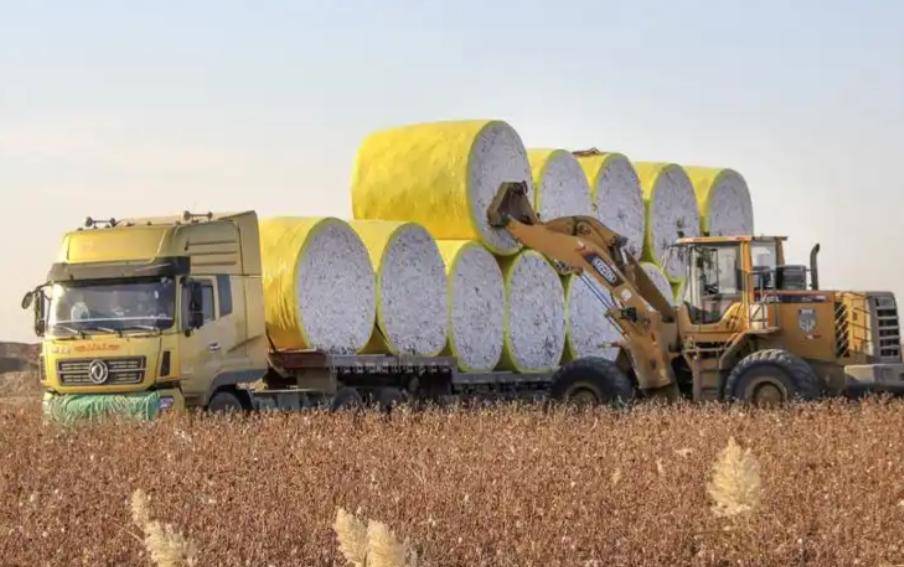
三年前欧盟曾制裁新疆棉,如今军工囤中国棉短绒,俄购棉稳火力
Sou Hu Cai Jing· 2025-09-19 18:41
Core Viewpoint - The article highlights the dramatic shift in the European military industry's reliance on Chinese nitrocellulose, revealing the consequences of previous sanctions against Xinjiang cotton and the current urgent need for high-quality raw materials [1][5][6]. Group 1: European Military Industry Challenges - European military giants, once vocal against Xinjiang cotton, are now scrambling to secure Chinese cotton short fibers, which have been nearly depleted [1][3]. - The EU's defense meeting revealed that only 70% of the planned 1 million artillery shells for Ukraine were delivered, primarily due to a shortage of high-quality nitrocellulose [5][6]. - The reliance on Chinese nitrocellulose has become critical, as over 90% of the supply comes from China, leading to production constraints for European defense contractors [6][21]. Group 2: Shift in Trade Dynamics - Russia's import of nitrocellulose from China surged from virtually zero to 1,365 tons in 2023, indicating a significant shift in trade dynamics [3][8]. - The transportation of nitrocellulose to Russia is facilitated through intermediaries in Central Asia and Turkey, highlighting a complex supply chain [8][10]. - China's production of nitrocellulose, which accounts for nearly half of the global output, is supported by a robust supply of Xinjiang cotton, ensuring a stable production process [16][19]. Group 3: Global Supply Chain Implications - The article emphasizes the strategic importance of raw materials like nitrocellulose in modern warfare, as they directly affect artillery output frequency [24][26]. - European countries are struggling to establish a comparable supply chain to China's, despite efforts to revive local production [21][22]. - The ongoing competition for nitrocellulose illustrates a broader trend in geopolitical dynamics, where supply chain stability becomes a critical factor in military readiness [23][26].