可持续能源

Search documents
创业集团控股(02221)附属拟2400万元收购广西融合生物能源科技12%股权
智通财经网· 2025-11-26 14:36
Group 1 - The company, Chuangye Group Holdings, announced the acquisition of a 12% stake in Guangxi Ronghe Bioenergy Technology Co., Ltd. for a total consideration of RMB 24 million, with the transaction expected to be completed by November 26, 2025 [1] - Guangxi Ronghe primarily engages in the processing and sales of industrial oils, biodiesel, and bio-plasticizers, with key products including first-generation biodiesel (UCOM) and marine biodiesel (B24) [1] - The target company is investing in a biodiesel production facility in Nanning, China, which will have an annual production capacity of approximately 200,000 tons, with the first phase of construction scheduled for completion by November 2025 [1] Group 2 - The board believes that the acquisition aligns with the company's development strategy and is expected to enhance its market share, competitiveness, and brand image in China [2] - This move represents an opportunity to expand the company's biodiesel business portfolio and is anticipated to positively contribute to the prospects of both the target company and the biodiesel industry [2] - Global demand for biodiesel and sustainable aviation fuel (SAF) is expected to rise due to supportive global policy frameworks, including the EU's target to reduce transport-related greenhouse gas emissions by 90% by 2050 [1][2]
Woodward(WWD) - 2025 Q4 - Earnings Call Transcript
2025-11-24 23:02
Financial Data and Key Metrics Changes - Annual revenue exceeded $3.5 billion for the first time, marking a record performance [5] - Adjusted earnings per share increased nearly 13% compared to the prior year [6] - Net sales for Q4 2025 totaled $995 million, a 16% increase, while net sales for the full year reached $3.6 billion, a 7% increase [17] - Earnings per share for Q4 2025 were $2.23 compared to $1.36, and adjusted earnings per share were $2.09 compared to $1.41 [17] Business Line Data and Key Metrics Changes - Aerospace sales increased 14% to record levels, with margin expansion of 290 basis points [6] - Industrial segment sales for Q4 were $334 million, up 11%, with core industrial sales growing 15% [20] - Commercial services sales in the aerospace segment increased 40%, while defense OEM sales rose 27% [18] - Industrial segment earnings for Q4 were $49 million, or 14.6% of segment sales, compared to $38 million, or 12.6% of segment sales [21] Market Data and Key Metrics Changes - Aerospace segment sales for the full year were $2.3 billion, up 14%, driven by strong demand in commercial services and defense OEM [18] - Industrial sales anticipated to grow across all primary markets, with power generation growth expected to be muted in the first half of 2026 due to divestiture impacts [26][27] - China on-highway sales in 2026 expected to be approximately $60 million, in line with 2025 [27] Company Strategy and Development Direction - Company focuses on strong execution, capturing growth in markets, and driving operational excellence [15] - Strategic investments in automation and new facilities to support long-term growth [11][24] - Continued emphasis on innovation and partnerships to enhance technology solutions [14] Management's Comments on Operating Environment and Future Outlook - Management expects sustained demand across core markets, with a modest adjustment to cumulative free cash flow target due to increased capital allocation towards growth investments [16] - Anticipated strong repair growth for LEAP and GTF engines, with expectations for LEAP and GTF repair revenue to surpass legacy repair revenue by late 2026 or early 2027 [8][15] - Management remains confident in the growth trajectory across segments, with guidance for 2026 reflecting continued operational discipline [16][26] Other Important Information - Capital expenditures for 2025 were $131 million, driven by investments in automation and new facility construction [24] - New three-year share repurchase program authorized for up to $1.8 billion, reflecting confidence in the company's strategy and growth outlook [25] Q&A Session Summary Question: What growth is expected for legacy narrowbody engine aftermarket in 2026? - Management expects single-digit growth rates for legacy narrowbody engines in 2026, with some price increases anticipated [42][44] Question: How much of the current power generation revenue is tied to Caterpillar? - Management indicated healthy growth from power generation customers, including Caterpillar, but did not specify exact revenue figures [47][49] Question: What are the assumptions for OE de-stocking? - Management anticipates de-stocking could occur by the second quarter of fiscal year 2026 if airframe and engine customers meet forecasted rates [81][82] Question: Will capital expenditures normalize after the A350 build-out? - Management indicated that the Spartanburg investment is causing a peak in capital expenditures, with future investments being evaluated [90] Question: How should shareholders expect the return of capital to be distributed? - Management plans to spread the return of capital evenly throughout the year [111]

美股异动 | 太阳能股爆发 阿特斯太阳能(CSIQ.US)涨超15% 9个交易日已翻倍
智通财经网· 2025-11-10 15:47
Core Viewpoint - The U.S. solar stocks experienced a significant surge, with notable gains from companies like Canadian Solar, Sunrun, Array Technologies, and SolarEdge Technologies, driven by strong performance in energy storage and increasing global energy demand due to AI infrastructure expansion [1] Company Performance - Canadian Solar (CSIQ.US) saw its stock price increase by over 15%, reaching a new high not seen in over two years, and has doubled in value over the past nine trading days [1] - Sunrun (RUN.US) and Array Technologies (ARRY.US) reported stock price increases of over 9% and 8% respectively, while SolarEdge Technologies (SEDG.US) rose by over 7% [1] Industry Trends - Canadian Solar reported a 50% year-over-year increase in energy storage product shipments, totaling 2.7 GWh for Q3 2025 [1] - The company anticipates global energy storage shipments to be between 7-9 GWh for the current year, with expectations for significant growth in the following year [1] - The expansion of AI infrastructure is driving up global energy demand, positioning solar energy as a key sustainable energy solution [1]


特斯拉未来十年技术路线全曝光
汽车商业评论· 2025-11-07 23:08
Core Insights - The article discusses Tesla's ambitious plans for the future, particularly focusing on the development of humanoid robots (Optimus), full self-driving (FSD) technology, and sustainable energy solutions. The core mission is to achieve "sustainable abundance" through technological advancements and innovative products [4][5]. Group 1: Optimus and Robotics - Tesla aims to produce humanoid robots at a massive scale, with projections of potentially hundreds of billions of units in the market [13][15]. - The company plans to establish production lines capable of manufacturing millions of units annually, with a long-term goal of reaching a production capacity of one billion units [14][26]. - Optimus is envisioned to revolutionize various sectors, including healthcare, by providing superior medical services and potentially eliminating poverty [15][16]. Group 2: Full Self-Driving Technology - Tesla's vehicles are designed for full self-driving capabilities, with ongoing improvements in the FSD software, now at version 14.2, aiming for a user experience that allows for minimal driver intervention [36][40]. - The company emphasizes the importance of educating customers about FSD features, as many users have not fully utilized the technology despite purchasing it [34][37]. - Tesla is working towards regulatory approvals in Europe and China to expand the deployment of FSD technology [37][38]. Group 3: AI Chip Development - Tesla is developing its own AI chips, which are expected to be more energy-efficient and cost-effective compared to competitors like NVIDIA [42][44]. - The AI5 chip is designed specifically for Tesla's AI software, aiming to enhance performance while reducing power consumption [42][43]. - The company is considering building a large-scale chip factory to meet the growing demand for its AI chips [45]. Group 4: Product Line Updates - Tesla is set to launch several new products, including the Cybercab, a fully autonomous taxi designed without traditional driving controls, and the Tesla Semi truck [48][55]. - The manufacturing process for the Cybercab is expected to be highly efficient, potentially achieving production cycles of under ten seconds per unit [51]. - The company is also focusing on the production of the next-generation Optimus robots, with plans for multiple iterations over the coming years [27][28]. Group 5: Sustainable Energy Vision - Tesla is committed to advancing sustainable energy solutions, with a focus on solar energy and battery technology [56][58]. - The company is expanding its battery production capabilities, including the development of the MegaPack for utility-scale energy storage [66][70]. - Tesla's efforts in building a comprehensive charging network are aimed at making electric vehicle charging accessible globally [70][72]. Group 6: Supply Chain and Raw Materials - Tesla is investing in raw material production, including a lithium refining facility in Texas, to secure the supply chain for battery manufacturing [73][74]. - The company is also producing its own 4680 batteries, which are expected to be used in upcoming vehicle models [77][78]. - Ensuring a stable supply of materials is crucial for Tesla's growth and production capabilities in the face of geopolitical challenges [76].



马斯克万亿美元薪酬案过关!十年业绩对赌能否兑现?
Bei Ke Cai Jing· 2025-11-07 06:56
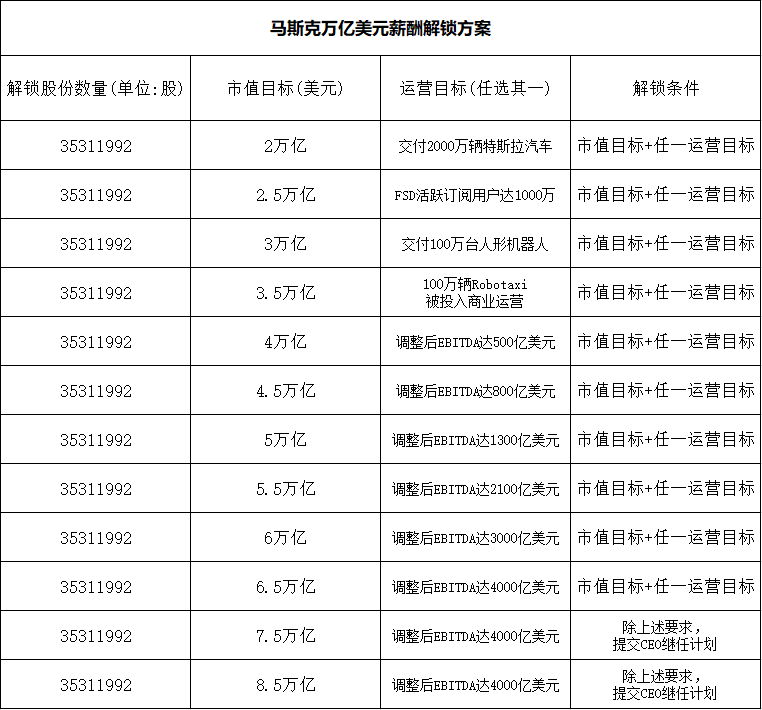
Core Points - The Tesla 2025 Annual Shareholder Meeting took place on November 6, where over 75% of shareholders approved Elon Musk's compensation plan, which includes stock options amounting to approximately 12% of the current total shares [1][2] - Musk emphasized the integration of sustainable energy and AI technology as a key focus for Tesla's future development [1] - Tesla's stock price closed at $235.2, reflecting a 1.69% increase in after-hours trading, but market reactions were generally lukewarm due to concerns over the company's performance [1][8] Compensation Plan Details - Musk's compensation plan involves unlocking 423.7 million shares of restricted stock over 10 years, with a potential value of around $1 trillion based on current stock prices [2][4] - The plan includes market capitalization targets ranging from $2 trillion to $8.5 trillion, alongside operational metrics such as delivering 20 million vehicles and achieving specific EBITDA targets [2][4] Shareholder Reactions - Some shareholders, including Norway's sovereign wealth fund, expressed concerns over the high dilution of shares and the lack of short-term verifiable performance metrics [5] - Proxy advisory firms ISS and GlassLewis recommended opposing the plan, citing insufficient rigor in the performance-linked compensation structure [5] - Support for the plan came from Tesla's board, which argued that Musk's leadership is crucial for the company's strategic direction and technological advancements [5] Financial Performance - Tesla's Q3 financial results showed a net profit of $1.373 billion, a 37% year-over-year decline, marking the third consecutive quarterly drop [1][8] - The company's total revenue for Q3 was $28.095 billion, a 12% increase year-over-year, but the automotive business faced challenges with a gross margin of 15.4% when excluding regulatory credits [8] - Vehicle deliveries for the first three quarters of 2025 totaled 1.217 million, reflecting only a 3.26% year-over-year growth [8] Technological Developments - Musk indicated that the mass production of the third-generation Optimus robot will not commence until the end of 2026, raising questions about Tesla's technological leadership [9] - The rollout of Tesla's Full Self-Driving (FSD) technology remains delayed, with ongoing discussions with regulatory bodies in various markets [9] - Concerns have been raised by investors regarding the long-term performance of Tesla in relation to the ambitious compensation plan [9]
天基太阳能开启清洁能源新赛道
Ke Ji Ri Bao· 2025-11-03 23:55
Core Viewpoint - The increasing electrification of human life and advancements in big data and AI are driving unprecedented global energy demand, positioning space-based solar power (SBSP) as a potential pathway to a clean and abundant energy future [1][2]. Group 1: Advantages of Space-Based Solar Power - SBSP can provide stable and reliable baseload power, which has traditionally relied on fossil fuels or nuclear energy [3]. - The intensity of sunlight in space is 5-10 times greater than on Earth, allowing for higher energy generation efficiency and significant land resource savings [2][3]. - A NASA study predicts that a model of SBSP could generate power 99% of the time in a year [3]. Group 2: Global Developments and Investments - A global "space race" for sustainable energy is underway, with countries and private enterprises increasing investments in SBSP [4]. - In August 2023, the California Institute of Technology successfully demonstrated a prototype for space-based solar energy transmission [4]. - China aims to achieve breakthroughs in SBSP by 2028, with ongoing projects in Chongqing and Xi'an [4]. - The European Space Agency has initiated the SOLARIS pre-research program with a budget of €60 million to develop core technologies for SBSP [4]. Group 3: Technological Challenges - Key challenges include high launch costs, as building a large SBSP system will require numerous launches despite decreasing satellite launch costs [7]. - Efficiently transmitting gigawatt-level power back to Earth remains a significant technical hurdle [7]. - The need for autonomous robots to assemble and maintain large space structures in orbit is another critical challenge [7].

中丹清洁能源联合工作组第二次会议联合公报
国家能源局· 2025-10-25 07:03
Core Viewpoint - The second meeting of the China-Denmark Joint Clean Energy Working Group emphasizes the importance of bilateral cooperation in advancing sustainable energy systems and achieving mutual goals in renewable energy, energy efficiency, and low-carbon solutions [3][4][7]. Group 1: Achievements and Progress - Over the past two decades, the partnership has provided a valuable platform for dialogue and knowledge exchange, yielding tangible results for both countries [5][6]. - Joint efforts have led to significant advancements in enhancing the flexibility and efficiency of existing coal-fired power plants, promoting renewable energy integration, and advancing district heating and energy efficiency solutions [10][11]. Group 2: Future Vision - Denmark and China reaffirm their commitment to deepen collaboration in the next phase (2026-2029), focusing on energy transition while ensuring economic growth and energy security [9][14]. - The new phase will emphasize areas such as power market design, hydrogen and green energy storage, and the integration of power and heating systems [11][12]. Group 3: International Significance - The partnership is recognized as having significance beyond bilateral relations, showcasing that economic growth and carbon emission reduction can be achieved simultaneously [12][13]. - Through their cooperation, Denmark and China aim to set an example of how pragmatic collaboration can accelerate global progress toward a sustainable energy future [13][14].

阿布扎比港口集团与烟台港签署初步战略合作协议
Shang Wu Bu Wang Zhan· 2025-10-13 17:01
Core Insights - Abu Dhabi Ports Group and Yantai Port signed a preliminary strategic cooperation agreement to establish a green automotive industrial park aimed at enhancing automotive trade between Asia, the Middle East, and North Africa while utilizing sustainable energy [1] Group 1: Strategic Cooperation - The agreement focuses on exploring the feasibility of establishing and operating an integrated bilateral terminal and automotive hub network [1] - The collaboration aims to connect the Asia-Pacific green automotive circular economy industrial park in Yantai with Abu Dhabi Ports Group's automotive terminals and hubs in the UAE and other key countries [1] Group 2: Technological and Operational Enhancements - Both parties will consider exploring the use of artificial intelligence technology to improve operational efficiency [1] - The agreement includes discussions on sustainable energy initiatives [1]
《时代》周刊公布年度最佳发明榜单:联想、宇树科技、DeepSeek等公司产品上榜
Ge Long Hui· 2025-10-10 07:26
Core Viewpoint - The inclusion of Lenovo's Yoga Solar PC in TIME magazine's list of the best inventions signifies a milestone in the application of solar technology in consumer electronics, highlighting the potential for sustainable energy solutions in the PC industry [1][6]. Group 1: Product Innovation - Lenovo's Yoga Solar PC features a back-contact photovoltaic battery embedded in the lid, allowing efficient light collection for charging both indoors and outdoors [3]. - The device has a thickness of 15mm and combines a 24% photovoltaic conversion efficiency with a "solar priority" algorithm, enabling real-time power supply while storing excess energy [3]. - The laptop can charge for 20 minutes in sunlight to support 1 hour of video playback, showcasing its practical utility [3]. Group 2: Industry Context - The trend towards green and low-carbon lifestyles is increasingly influencing consumer electronics, with Lenovo's solar laptop serving as a practical case for the PC industry's shift towards sustainable energy [6]. - Lenovo has previously had multiple products recognized in TIME's best inventions list, indicating a consistent commitment to innovation in technology [6]. - The company has diversified its technological focus, including developments in foldable screens, dual screens, transparent screens, 5G, AR, and solar energy, addressing user needs through iterative technological advancements [6].



美国工程师:摸不透中国人,明知水电站危害,还大力兴建水力发电
Sou Hu Cai Jing· 2025-10-06 09:22
Core Viewpoint - Hydropower is an essential and sustainable energy source that plays a significant role in social development, despite facing some environmental concerns and criticisms [1][3][18] Historical Development - Hydropower has a long history, with its origins tracing back to ancient times when water wheels were used to reduce labor intensity [5] - The first application of hydropower for lighting occurred in 1878, and the first hydropower station was established in the U.S. in 1882 [7] Current Achievements - The Three Gorges Dam in China, completed in 2006, is a notable achievement, generating over 100 billion kilowatt-hours of electricity annually, accounting for 14% of the country's total hydropower output [9] Environmental Concerns - There are ongoing debates regarding the environmental impact of hydropower, with some arguing that it disrupts ecosystems and can lead to significant ecological changes [3][14] - The U.S. has seen a trend of dam removals, primarily targeting old and ineffective structures, while many useful dams are being rebuilt [11] Benefits of Hydropower - Hydropower stations provide critical flood control, especially in flood-prone agricultural countries like China, and serve multiple functions such as irrigation and navigation [13] - It is recognized as a clean and renewable energy source, contributing to low-carbon energy production [13] Drawbacks of Hydropower - The construction of hydropower stations can alter natural ecosystems, affecting both aquatic and terrestrial species, and may induce seismic activity [14] Future Outlook - Despite some negative impacts, hydropower remains an irreplaceable green energy source, with potential advancements in technology that may lead to more environmentally friendly and efficient power generation methods in the future [18]