
太空计算

Search documents
中国首个太空计算实验室落户上海交大
Feng Huang Wang· 2025-12-13 12:11
Group 1 - Shanghai Jiao Tong University and Guoxing Aerospace signed an agreement to establish China's first Space Computing Joint Laboratory, focusing on research in autonomous space computing chips, robotic satellites, and in-orbit additive manufacturing [1] - The collaboration aims to leverage Shanghai Jiao Tong University's strengths in artificial intelligence and Guoxing Aerospace's advancements in AI intelligent constellation networking to create a "technologically advanced and independently controllable space computing network" [1] - The initiative is expected to contribute to the formation of a globally influential space computing industry cluster [1] Group 2 - The signing ceremony also marked the establishment of Dongfang Tiancan Technology Co., Ltd. as an industrialization platform for the Space Computing Joint Laboratory, aimed at exploring new models for industry-academia-research integration and accelerating the industrialization of the space computing network [3] - Beijing is also working on building a "Space Data Center," with the first computing constellation supported by the city set to launch its first experimental satellite, "Chenguang-1," which has completed product development and is undergoing assembly tests [3] - Starcloud, a startup supported by NVIDIA, successfully trained and operated an AI model in space for the first time, launching the "Starcloud-1" satellite on November 2, 2025, equipped with NVIDIA's H100 GPU [3]

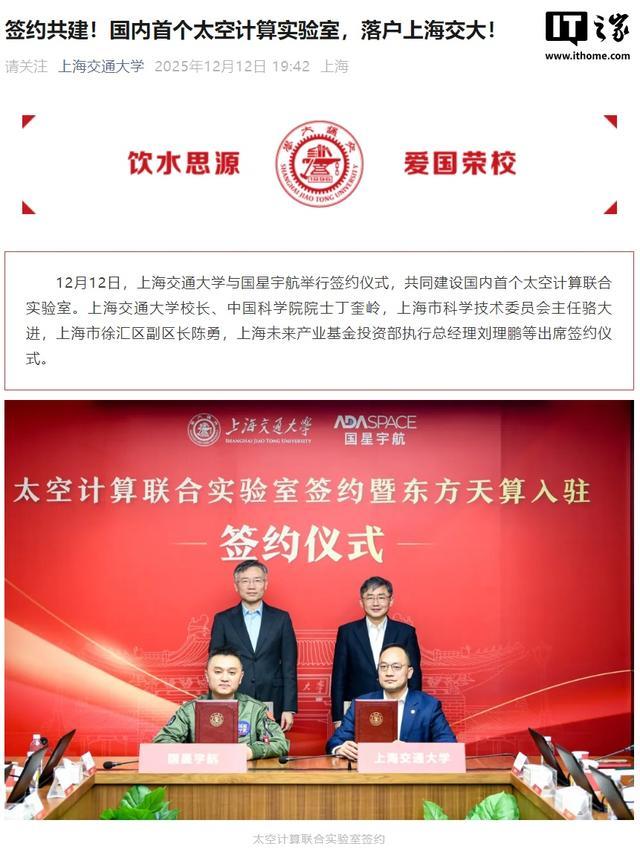
加快太空计算产业化进程 上海交通大学与国星宇航共建国内首个太空计算联合实验室
Zheng Quan Ri Bao Wang· 2025-12-12 14:15
Core Viewpoint - Shanghai Jiao Tong University and Guoxing Aerospace have signed an agreement to establish the first domestic Space Computing Joint Laboratory, focusing on advanced research in space computing technologies [1][2] Group 1: Collaboration Details - The collaboration aims to leverage Shanghai Jiao Tong University's strengths in artificial intelligence and Guoxing Aerospace's expertise in AI satellite constellation networking [1] - The laboratory will focus on the development of autonomous and controllable space computing chips, robotic satellites, and in-orbit additive manufacturing [1] Group 2: Industrialization and Innovation - The signing ceremony also marked the establishment of Dongfang Tiancan Technology Co., Ltd. as an industrialization platform for the Space Computing Joint Laboratory, aimed at exploring new models for industry-academia-research integration [2] - Shanghai Jiao Tong University has a strong foundation in artificial intelligence and is one of the earliest institutions in China to train talent in this field [2] - Guoxing Aerospace is recognized as a national-level key specialized and innovative "little giant" enterprise, focusing on building space computing infrastructure to serve artificial intelligence [2]
上海交通大学与国星宇航签约 共建国内首个太空计算联合实验室
Xin Lang Cai Jing· 2025-12-12 09:55
Core Viewpoint - Shanghai Jiao Tong University and Guoxing Aerospace have signed an agreement to establish the first domestic Space Computing Joint Laboratory, focusing on the development of space computing chips, robotic satellites, and in-orbit additive manufacturing [1] Group 1: Collaboration and Research Focus - The joint laboratory will address the demand for space-based computing networks and will conduct research in cutting-edge areas [1] - The signing ceremony also marked the establishment of Dongfang Tiancan Technology Co., Ltd. as an industrialization platform for the Space Computing Joint Laboratory [1] Group 2: Industrialization and Innovation - The initiative aims to explore new models for the integration and transformation of industry, academia, and research, accelerating the industrialization process of space-based computing networks [1]
“空天经济”闪耀两市!资金重注卫星产业ETF(159218)布局产业未来
Sou Hu Cai Jing· 2025-12-12 01:45
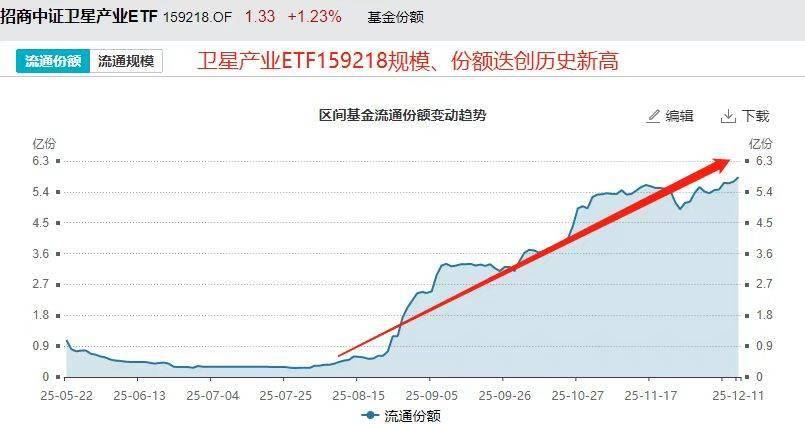
Core Viewpoint - The capital market's enthusiasm for the "space economy" is rising, with the satellite industry ETF (159218) becoming a focal point for investment, reflecting the industry's growth and potential [1][4]. Group 1: ETF Performance - As of December 11, the ETF's scale has reached nearly 800 million yuan, marking a historical high, with a year-to-date share growth of approximately 438.88%, leading among similar ETFs [4]. - The ETF has seen four instances of net inflow in just five trading days, indicating strong interest from institutions and investors in the commercial space sector [4]. Group 2: Industry Catalysts - The excitement in the sector is driven by significant industry catalysts, shifting the narrative from "space networking" to "space computing" [4]. - SpaceX is accelerating its IPO plans, aiming to raise over 30 billion USD with a target valuation of about 1.5 trillion USD, which would reshape the valuation landscape of the space economy [4]. Group 3: Technological Advancements - The "space AI" competition is intensifying, with Starcloud successfully operating an AI model in orbit, showcasing a significant leap in satellite capabilities [5]. - Domestic advancements in launch and manufacturing capabilities are also notable, with the Long March 12A rocket set for its maiden flight, representing a breakthrough in reusable rocket technology [5][7]. Group 4: Supply Chain and Manufacturing - The domestic supply chain is enhancing its capabilities, particularly in satellite energy systems, where a significant portion of satellites globally utilize high-efficiency solar cells, supported by local technological advancements [7]. - The combination of capital investment and technological breakthroughs forms a solid foundation for the current investment boom in the satellite industry [7].
【大佬持仓跟踪】光通信+太空计算,公司为大型星座研制的星载设备已在轨组网成功,率先开展星间激光相干通信技术研发并交付
财联社· 2025-12-11 04:49
Core Viewpoint - The article emphasizes the importance of timely and professional information interpretation in the investment landscape, particularly focusing on significant events, industry chain companies, and key policy insights [1]. Group 1: Company Developments - The company has successfully developed and deployed spaceborne equipment for large satellite constellations, marking a significant achievement in inter-satellite laser coherent communication technology [1]. - A subsidiary of the company has become a partner with Huawei for the Matrix384 super node, indicating a strategic collaboration in advanced communication technologies [1]. Group 2: Industry Advancements - The company has achieved international advanced levels in hollow-core optical fiber with ultra-low attenuation, showcasing its technological leadership in the optical communication sector [1]. - The multi-core optical fiber transmission capacity has set a new domestic record, reflecting the company's commitment to innovation and capacity enhancement in fiber optics [1].

中科星图(688568.SH):已深入论证规划了太空算力星座、太空感知星座等特色商业卫星星座
Ge Long Hui· 2025-12-09 08:13
Core Viewpoint - The company has thoroughly planned and validated the development of specialized commercial satellite constellations, including space computing and sensing constellations, to enhance multi-layer data perception capabilities on Earth [1] Group 1: Company Developments - The company is collaborating with Zhongke Shuguang to build an open and inclusive space computing network [1] - This network aims to create an integrated intelligent computing architecture that covers "user (end) - satellite (edge) - space (cloud) - ground (cloud)" for interconnected resource scheduling and real-time data processing [1] - The company signed a "Cooperation Development Framework Agreement" with Zhongke Shuguang on July 8, 2025, to jointly promote technological innovation and application in advanced computing within the space sector [1] Group 2: Industry Implications - The initiative is expected to connect with national-level computing service platforms, driving innovation and application of "space computing" technologies [1] - The focus on space computing and sensing constellations indicates a strategic move towards enhancing capabilities in data processing and resource management in the aerospace industry [1]


马斯克设想:每年发射1百万吨AI卫星
财联社· 2025-12-08 05:24
Core Viewpoint - The next significant leap in artificial intelligence may occur in space rather than on Earth due to infrastructure and energy supply bottlenecks [1][3]. Group 1: Elon Musk's Vision - Elon Musk proposed that localized AI computing satellites in low-latency sun-synchronous orbits could become the most cost-effective way to transmit AI data within three years [2][3]. - Musk envisions launching 1 million tons of satellites annually, each equipped with 100 kW of power, which could add 100 GW of AI computing capacity each year without operational or maintenance costs [3]. - The concept includes building satellite factories on the Moon and using mass drivers to accelerate AI satellites to escape velocity, potentially achieving over 100 TW of AI computing capacity annually [3][4]. Group 2: Challenges in AI Development - The rapid growth in AI model sizes and demand is putting significant pressure on existing data centers, fiber networks, and power systems [5]. - There is a need for new energy sources to keep pace with the increasing demand, while also considering factors like latency, climate risks, and political obstacles [5]. Group 3: Competing Projects - Google's "Project Suncatcher" aims to create orbiting computing nodes powered by continuous solar energy, which could operate machine learning models more efficiently than ground-based data centers [6]. - Amazon's "LEO" project seeks to establish a global broadband network of low Earth orbit satellites, potentially providing edge computing services for AI tasks in underserved areas [7]. - Musk is also conceptualizing an "orbital computing farm" for xAI and SpaceX, which would not only run AI models but also train them, addressing the challenges of continuous energy supply and resource consumption [7].
开源晨会-20251201
KAIYUAN SECURITIES· 2025-12-01 14:44
Group 1: Macro Economic Overview - Industrial production and demand are showing signs of weakening, with construction activity remaining at historical lows and industrial operating rates declining marginally [6][7][9] - Recent weeks have seen a drop in demand for construction materials and consumer goods, with significant declines in automobile sales and home appliance sales [7][8] - The overall price of domestic industrial products is fluctuating weakly, with some commodities like steel and coal showing slight recoveries while others, such as construction materials, are declining [8] Group 2: Industry Insights - The lithium battery industry is experiencing a supply-demand turning point, with a projected global shipment of 2921.8 GWh in 2026, a year-on-year increase of 35% [32] - The demand for dynamic storage is robust, and the industry is expected to benefit from rising prices in segments with tight capacity [32] - The European electric vehicle market is anticipated to recover strongly in 2025, driven by new model releases and government incentives [33] Group 3: Company-Specific Developments - ByteDance has launched the Doubao mobile assistant, emphasizing investment opportunities in edge AI, with hardware support from ZTE [25][30] - Zhongke Star Map is deeply engaged in the commercial aerospace industry, with a focus on satellite constellation construction and aerospace electronic equipment manufacturing [53][54] - Meitu has introduced an e-commerce design agent, enhancing its product offerings in the fashion sector [43][45] Group 4: Investment Recommendations - Recommended stocks in the lithium battery sector include CATL and Yiwei Lithium Energy, which are expected to benefit from the industry's growth [32] - In the humanoid robot sector, companies like UTree and UBTECH are highlighted as key players as the industry approaches a production milestone [37][40] - For AI applications, companies such as Kuaishou and Bilibili are recommended due to their strategic positioning in the gaming and AI sectors [49][50]

中科星图(688568):前瞻布局商业航天全产业链
KAIYUAN SECURITIES· 2025-12-01 09:43
Investment Rating - The investment rating for the company is "Buy" (maintained) [1][2] Core Views - The company is deeply engaged in the commercial aerospace industry, covering four core areas: constellation construction and operation, aerospace electronic equipment manufacturing, aerospace measurement and control, and satellite application services. The projected net profits for 2025-2027 are estimated at 436 million, 525 million, and 627 million yuan, with corresponding EPS of 0.54, 0.65, and 0.78 yuan per share. The current stock price corresponds to a PE ratio of 82.2, 68.1, and 57.1 for 2025-2027 [2][3] Summary by Sections Business Strategy - The company has planned the construction of specialized commercial satellite constellations, including space computing, space perception, commercial meteorology, and commercial electromagnetic constellations, enhancing multi-layer data perception capabilities on Earth. Additionally, it has developed the "Tianjian" series of rocket electronic systems and the "Tianxing" series of satellite electronic systems to meet the demands of the commercial aerospace electronic equipment market [3] Collaboration and Innovation - The company is collaborating with Zhongke Shuguang to build an open and inclusive space computing network, which will create a "space-ground integrated" collaborative intelligent computing architecture. This aims to achieve interconnection and real-time data processing of computing resources, integrating with national-level computing service platforms to promote innovation and application of "space computing" technology [4] New Initiatives - The subsidiary, Xingtian Measurement and Control, has officially launched the "Xingyan" space perception constellation plan, which aims to provide innovative solutions for space traffic safety management. The plan intends to launch 156 satellites starting in the first half of 2026, forming a global near-Earth orbit detection network to predict collision risks, monitor space debris, and assist in space traffic management [5] Financial Projections - The company's projected revenue for 2025 is 3.992 billion yuan, with a year-on-year growth of 22.6%. The net profit for the same year is expected to be 436 million yuan, reflecting a growth of 23.8%. The gross margin is projected to be 50.7%, and the net margin is expected to be 10.9% [7][9][10]
第七届金麒麟计算机行业最佳分析师第一名国盛证券刘高畅最新研究观点:太空计算有望开启新纪元(附5股)
Xin Lang Zheng Quan· 2025-12-01 06:33
Core Insights - The emergence of space computing and satellite industries is expected to revolutionize data center deployment, with significant advancements in technology and cost efficiency [2][3][5]. Group 1: Space Computing Developments - Nvidia has launched its H100 GPU into space, marking a significant step towards establishing large-scale computing infrastructure in orbit, with Starcloud predicting that most new data centers will be built in space within the next decade [2]. - Elon Musk anticipates that deploying large-scale AI systems in space will be more cost-effective than on Earth due to the availability of free solar energy and efficient cooling methods, estimating future AI computing needs could reach 200 to 300 gigawatts [3]. - Google's Project Suncatcher aims to develop satellites equipped with TPU AI chips to create a scalable computing network in space, with plans to launch test satellites by early 2027 [4]. Group 2: China's Space Computing Initiatives - China successfully launched the world's first space computing satellite constellation, "Body Computing Constellation," which is expected to achieve a total computing power of 1000 Peta Operations Per Second (POPS) [5]. - The constellation features advanced onboard computing capabilities and high-speed inter-satellite communication, enabling significant advancements in space-based data processing [5]. Group 3: Investment Opportunities - Companies such as Potevio Technology, Shunhao Co., China Satellite, Haige Communication, and Shanghai Hantong are identified as potential investment opportunities in the burgeoning space computing sector [6].



