成长

Search documents
从微观出发的风格轮动月度跟踪-20250901
Soochow Securities· 2025-09-01 04:04
- The style rotation model is constructed based on micro-level stock factors, including valuation, market capitalization, volatility, and momentum. It utilizes 80 base factors to generate 640 micro features, replacing absolute proportion division of style factors with common indices as style stock pools. Random forest is employed for rolling training to avoid overfitting, enabling feature selection and style recommendation. The framework integrates style timing, scoring, and investment implementation[3][8][9] - The performance of the style rotation model during the backtesting period (2017/01/01-2025/08/31) shows an annualized return of 17.08%, annualized volatility of 20.07%, IR of 0.85, monthly win rate of 55.77%, and maximum drawdown of -29.89%. When hedging against the market benchmark, the annualized return is 10.42%, annualized volatility is 13.03%, IR is 0.80, monthly win rate is 56.73%, and maximum drawdown is -9.57%[9][10] - The style rotation model's September 2025 timing direction focuses on growth, large-cap, momentum, and high-volatility factors[17] - The latest holdings of the style rotation model for September 2025 include ETFs such as Semiconductor Leaders ETF (159665.SZ), Big Data ETF (159739.SZ), Artificial Intelligence ETF (159819.SZ), Fintech ETF (159851.SZ), and 5G ETF (159994.SZ)[2][20]
宏观:人民币汇率何时破7?
2025-09-01 02:01
Summary of Key Points from Conference Call Industry Overview - The discussion primarily revolves around the **Chinese currency (RMB) exchange rate** and its implications for the **Chinese asset market**. The analysis includes macroeconomic factors, particularly the influence of the **US dollar index** and **Producer Price Index (PPI)** on the RMB's performance. Core Insights and Arguments 1. **RMB Exchange Rate Trends**: The RMB exchange rate exhibits both **trend and cyclical characteristics**. Long-term depreciation is influenced by the US dollar index, while short-term fluctuations align with it. The RMB's actual effective exchange rate is expected to strengthen if the PPI rebounds significantly, which is anticipated in Q2 2026 [1][3][7]. 2. **Impact of PPI on RMB**: A significant rebound in China's PPI is crucial for enhancing market interest in Chinese assets and providing a basis for the RMB's appreciation. The PPI is expected to turn positive in 2026, which will improve the competitive landscape for Chinese enterprises [7][9][10]. 3. **Potential for RMB Appreciation**: The RMB is projected to appreciate significantly against a basket of currencies in 2026, with a potential entry into the "6 era" (6.1 to 6.9 range) depending on the US dollar's performance and PPI trends [11][14][15]. 4. **Foreign Investment and RMB**: The RMB's exchange rate against the USD is a critical observation point, as foreign capital inflows are necessary for the revaluation of Chinese assets. The lack of foreign investment in recent years has hindered this process [2][19]. 5. **Market Style Shift**: The asset style in China is expected to shift from long-duration assets to short-duration assets, focusing more on profitability rather than valuation. Growth sectors such as technology, consumer demand, and cyclical assets are likely to perform well [16][18]. 6. **Federal Reserve's Role**: The anticipated interest rate cuts by the Federal Reserve could catalyze RMB appreciation. The divergence in monetary policies between China and the US may alleviate the interest rate spread, supporting the RMB's strength [12][13][17]. 7. **Current Market Dynamics**: The A-share market has been buoyed by liquidity rather than earnings, with significant support from the central bank. The market is expected to continue its upward trajectory, driven by sectors aligned with the five-year planning cycle, particularly in technology and consumption [19][20][21]. Other Important but Overlooked Content 1. **Liquidity and Market Support**: The central bank's support through increased debt to financial companies has been crucial in stabilizing the market. However, the actual inflow of funds from residents into the stock market remains limited [20][24]. 2. **Investor Behavior**: Historical trends indicate that even in favorable conditions (low interest rates and high returns), significant capital inflows into the stock market have not materialized, suggesting a cautious investor sentiment [27][34]. 3. **Economic Indicators**: The relationship between savings rates and deposit growth is critical. A potential increase in the savings rate could signal a shift in risk appetite among investors, which may influence market dynamics [33][34]. This summary encapsulates the key points discussed in the conference call, focusing on the implications of the RMB exchange rate and the broader economic context affecting Chinese assets.
交易型指数基金资金流向周报-20250828
Great Wall Securities· 2025-08-28 03:37
Report Information - Report Title: Weekly Report on Capital Flows of Exchange-Traded Index Funds [1] - Data Date: August 18 - 22, 2025 [1] - Analyst: Jin Ling [1] - Report Date: August 28, 2025 [1] Core Findings Domestic Passive Equity Funds - Different index funds showed varying performance in terms of fund size, weekly returns, and net weekly capital inflows. For example, the Shanghai - Shenzhen 300 index fund had a size of 983.449 billion yuan, a weekly return of 4.27%, and a net weekly capital outflow of 34.74 billion yuan; while the ChiNext Index fund had a size of 126.448 billion yuan, a weekly return of 5.81%, and a net weekly capital inflow of 22.61 billion yuan [4]. Overseas Index Funds - International index funds also had diverse performance. The Nasdaq 100 index fund had a size of 78.421 billion yuan, a weekly return of -3.08%, and a net weekly capital inflow of 7.78 billion yuan; the S&P 500 index fund had a size of 20.837 billion yuan, a weekly return of -1.63%, and a net weekly capital outflow of 1.44 billion yuan [5]. Bond Funds - Bond funds had different performance based on factors such as maturity and credit rating. The 30 - year bond fund had a size of 8.969 billion yuan, a weekly return of -1.25%, and a net weekly capital inflow of 59.60 billion yuan; the short - term financing bond fund had a size of 29.341 billion yuan, a weekly return of 0.01%, and a net weekly capital outflow of 28.50 billion yuan [6]. Commodity Funds - Commodity funds, including gold, soybean meal, and others, also had distinct performance. The gold fund had a size of 70.887 billion yuan, a weekly return of -0.29%, and a net weekly capital outflow of 0.94 billion yuan; the energy and chemical fund had a size of 2.93 billion yuan, a weekly return of 0.76%, and a net weekly capital inflow of 0.88 billion yuan [6]. Index - Enhanced Funds - Index - enhanced funds based on different indices had different performance. The CSI 500 index - enhanced fund had a size of 1.978 billion yuan, a weekly return of 3.76%, and a net weekly capital inflow of 0.12 billion yuan; the ChiNext Index - enhanced fund had a size of 0.469 billion yuan, a weekly return of 5.46%, and a net weekly capital outflow of 0.04 billion yuan [6].
固投增速放缓,新藏铁路提升基建预期 | 投研报告
Zhong Guo Neng Yuan Wang· 2025-08-20 07:33
Core Viewpoint - The construction industry is experiencing a decline in prosperity, with a slowdown in fixed asset investment growth [2] Group 1: Construction Industry Indicators - In July, the construction industry Purchasing Managers' Index (PMI) was 50.6, a decrease of 2.2 percentage points from the previous month [2][1] - The construction business activity index was also 50.6%, down 2.2 percentage points from last month [2][1] - The new orders index for the construction industry was 42.7%, reflecting a decline of 2.2 percentage points from the previous month [2][1] - The input price index for the construction industry rose to 54.5%, an increase of 6.2 percentage points from last month [2][1] - The sales price index for the construction industry was 49.2%, up 0.9 percentage points from the previous month [2][1] - The employment index in the construction industry was 40.9%, an increase of 1.0 percentage point from last month [2][1] - The business activity expectation index was 51.6%, down 2.3 percentage points from the previous month [2][1] Group 2: Fixed Asset Investment - From January to July, national fixed asset investment (excluding rural households) reached 288,229 billion yuan, with a year-on-year growth of 1.6%, a decrease of 1.2 percentage points compared to January to June [2] - The broad infrastructure investment growth rate was 6.67%, down 2.31 percentage points from the previous value, while the narrow infrastructure investment growth rate was 2.89%, down 1.57 percentage points [3] - In the first seven months, investment in electricity, heat, gas, and water production and supply increased by 21.5%, while investment in transportation, warehousing, and postal services grew by 3.9% [3] Group 3: Real Estate Sector - From January to July, national real estate development investment was 53,580 billion yuan, a year-on-year decrease of 12.0%, with the decline expanding by 0.8 percentage points compared to January to June [4] - The sales area of commercial housing was 51,560 million square meters, down 4% year-on-year, with the decline expanding by 0.5 percentage points [4] - The area of new housing starts was 35,206 million square meters, down 19.4% year-on-year, with the decline narrowing by 0.6 percentage points [4] - The area of completed housing was 25,034 million square meters, down 16.5% year-on-year, with the decline expanding by 1.7 percentage points [4] Group 4: Infrastructure Projects - The establishment of the New Tibet Railway Company with a registered capital of 95 billion yuan is expected to boost infrastructure investment [5] - The total investment for the New Tibet Railway is estimated at approximately 175.4 billion yuan per year over a 10-year construction period [5] - The approval of the Yaxia Hydropower Project, with an investment of 1.2 trillion yuan, is expected to further enhance long-term infrastructure investment expectations [5] Group 5: Investment Recommendations - Recommendations include companies involved in stable growth, construction, and regional development such as China Power Construction, China Energy Construction, and Shanghai Construction [5] - Focus on companies benefiting from infrastructure investment and those with high dividends, including Anhui Construction, China National Materials, and China Railway Construction [5] - Attention is also drawn to growth sectors such as low-altitude economy and welding robots, with suggestions to monitor design and engineering firms [5]
被看见之前,要先看见自己 | Wanlin Chen | TEDxYuehai St Salon
TEDx Talks· 2025-08-19 15:25
Personal Growth & Development - The speaker emphasizes the importance of taking the first step and embracing new experiences [1] - The speaker encourages listeners to break out of their comfort zones and believe in themselves to expand their possibilities [1] - The speaker's story of pursuing her passion despite doubts can inspire those seeking direction [1] Industry Relevance (Media & Entertainment) - The speaker's background in stage performance and film directing highlights the challenges and opportunities in the entertainment industry [1] - The mention of TEDx event indicates a platform for sharing innovative ideas and personal stories within a community [1] Key Takeaway - Overcoming fear and self-doubt is crucial for personal and professional growth [1]


从“向上”转向“守住”,年轻人的成长变成伪命题了吗?
3 6 Ke· 2025-08-11 04:10
Group 1 - The concept of "growth" has become distorted, with many young people feeling it is merely an illusion rather than a path to improvement [2][3] - The traditional linear path of effort leading to rewards and upward mobility has been disrupted by various factors, including economic stagnation and resource concentration [3][7] - The perception of growth is influenced by a shrinking social mobility channel, where even skill enhancement may not guarantee upward movement in society [7][9] Group 2 - The rapid dissemination of success stories in the internet age creates a false sense of progress, leading to feelings of inadequacy among individuals [5][8] - The speed of information and experience updates results in a delayed sense of achievement, where newly acquired skills may quickly become obsolete [5][10] - The current environment has shifted the focus of growth from upward mobility to merely maintaining one's position in a competitive landscape [7][11] Group 3 - The traditional notion of growth is being replaced by a more symbolic and superficial understanding, where external validation takes precedence over genuine development [10][14] - Individuals are increasingly managing their lives as projects, driven by the need to demonstrate value in a competitive job market [11][16] - This project-based self-management can lead to two types of growth: performative and commercialized, both of which may lack true substance [13][16] Group 4 - The standards for evaluating growth are influenced by social networks, labor markets, and educational systems, creating a complex framework for what constitutes growth [17][19] - As public consensus on growth diminishes, it is becoming a more personal experience, leading to a fragmentation of shared definitions [19][20] - The shift from "possessive growth" to "existential growth" emphasizes the quality of life experiences over material accumulation [20][21] Group 5 - In the AI era, the focus of growth is shifting from self-accumulation to collaborative capabilities, where humans and AI complement each other [23][25] - Key human abilities that should be prioritized include ethical judgment, cross-domain imagination, and deep emotional connections [25][26][28] - The core transformation in growth is moving from accumulating knowledge to asking valuable questions and defining meaningful pursuits [28]

我的暑假有滋味
Ren Min Ri Bao Hai Wai Ban· 2025-08-06 22:47
Group 1 - The article highlights the diverse experiences of students during their summer vacations, emphasizing personal growth and cultural engagement [11][12][13][14][15][17][19][21][22] - Various activities such as sports competitions, cultural performances, and educational initiatives are showcased, reflecting the importance of teamwork and community involvement [13][14][15][19][21] - The significance of cultural heritage and the desire to learn traditional arts, such as the Dai language and music, is emphasized, showcasing the commitment to preserving local traditions [17][18][19] Group 2 - The article discusses the impact of educational outreach programs, such as teaching emotional management and providing support to children in rural areas, highlighting the reciprocal nature of teaching and learning [15][16] - The experiences of students participating in practical training in the electrical engineering field illustrate the importance of hands-on learning and understanding real-world applications of their studies [21][22] - The narrative underscores the value of community events, such as the Naadam festival, in fostering unity and cultural pride among different ethnic groups [19][20]

收盘丨沪指涨0.66%,超3800股飘红,军工板块20余股涨停
Di Yi Cai Jing· 2025-08-04 07:33
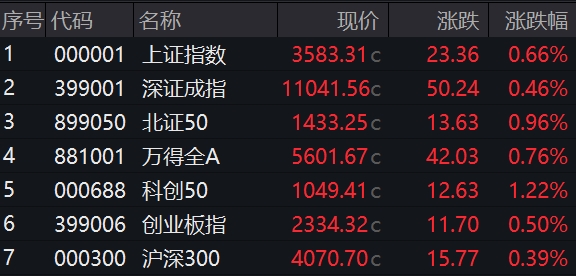
Market Performance - The Shanghai Composite Index rose by 0.66% to close at 3583.31 points, while the Shenzhen Component Index increased by 0.46% to 11041.56 points, and the ChiNext Index gained 0.50% to 2334.32 points [1][2] - The total trading volume in the Shanghai and Shenzhen markets approached 1.5 trillion yuan [3] Sector Performance - The military industry sector showed strong performance, with multiple stocks hitting the daily limit, including North China Longyuan, Aileda, and Kesi Technology [5][6] - The human-robot sector also saw significant gains, with stocks like Daying Electronics and Zhejiang Rongtai reaching the daily limit [6] - The medical device sector experienced a rally, with stocks such as Lide Man and Dabo Medical hitting the daily limit [6] Capital Flow - Main capital inflows were observed in the defense, machinery, electronics, and banking sectors, while there were outflows from the oil and petrochemical sectors [7] - Notable net inflows were recorded for stocks like Construction Industry, Changcheng Military Industry, and Hanyu Pharmaceutical, with inflows of 5.91 billion yuan, 5.47 billion yuan, and 4.70 billion yuan respectively [8] - Conversely, stocks such as Zhongji Xuchuang, Tibet Tianlu, and Hikvision faced net outflows of 5.98 billion yuan, 5.95 billion yuan, and 5.42 billion yuan respectively [9] Institutional Insights - Guotai Junan expressed that if the Shanghai Composite Index finds effective support near the 20-day moving average and trading volume increases, it may restart an upward trend, with a positive outlook for financial, growth, and certain cyclical sectors [10] - CITIC Securities noted a cooling of market sentiment, predicting a phase of consolidation that could benefit a steady bull market, with a focus on sectors such as semiconductors, AI applications, human-robot technology, innovative drugs, non-ferrous metals, defense, transportation, and non-bank financials [10]
环保行业跟踪周报:重视价格法修订促ROE、现金流提升,水价市场化+现金流拐点,下一个垃圾焚烧-20250804
Soochow Securities· 2025-08-04 05:11
Investment Rating - The report maintains an "Accumulate" rating for the environmental protection industry [1] Core Views - The report emphasizes the importance of the recent price law revision, which is expected to enhance ROE and cash flow, particularly in the water pricing sector. The marketization of water prices is seen as a potential turning point for cash flow, similar to the previous developments in waste incineration [1][11] - The report identifies a cash flow turning point in water operations, suggesting that companies like Xingrong and Shou Chuang will see significant reductions in capital expenditures starting in 2025, leading to substantial increases in free cash flow [1][22] - The report highlights the strengthening of environmental inspections as a driving force for the industry, indicating a shift from policy-driven to governance-driven demand for environmental services [10] Summary by Sections Industry Trends - The environmental protection industry is transitioning towards a governance-driven model, with a focus on long-term, systematic management rather than temporary fixes [10] - The report notes a significant increase in the sales of new energy sanitation vehicles, with a year-on-year growth of 90.56% in the first half of 2025, indicating a growing market for environmentally friendly equipment [31] Water Operations - The report predicts that the water operations sector will experience a cash flow turning point, with companies like Xingrong and Shou Chuang expected to reduce capital expenditures significantly starting in 2025, leading to increased free cash flow [1][22] - The report recommends companies such as Xingrong Environment, Yuehai Investment, and Hongcheng Environment for their strong dividend potential and market positioning [23][24] Waste Incineration - The report discusses the expected decline in capital expenditures for waste incineration, which will enhance free cash flow and dividend payouts. Companies like Junxin and Green Power are highlighted for their strong dividend performance [18][20] - The report identifies new trends in waste incineration, including partnerships with data centers to enhance profitability and ROE [21] Policy Developments - The report outlines the implications of the price law revision, which aims to enhance market pricing mechanisms and improve cash flow for public utilities, particularly in water and waste management sectors [11][14] - The report emphasizes the importance of environmental inspections in driving industry growth and ensuring compliance with new regulations [9][10] Recommendations - The report recommends a focus on companies with strong operational capabilities and cash flow potential, such as Xingrong Environment, Yuehai Investment, and Hongcheng Environment, while suggesting attention to emerging players in the waste management and renewable energy sectors [23][24][25]





超2900家个股上涨
第一财经· 2025-08-01 04:26
Market Overview - The A-share market experienced a slight decline with the Shanghai Composite Index down 0.19% to 3566.55 points, the Shenzhen Component Index down 0.15% to 10992.87 points, and the ChiNext Index down 0.16% to 2324.50 points [3][4]. Sector Performance - The traditional Chinese medicine sector led the gains, while photovoltaic equipment, animal vaccines, and logistics sectors also showed strong performance. Conversely, the shipbuilding sector, film and television industry, and gaming sector faced declines [7]. Institutional Insights - Liu Kuijun from Shenzhen Dexun Securities noted that the A-share index has shown a strong three-month upward trend, but profit-taking and technical resistance at 3600 points may lead to volatility in August. Investors are advised to look for rotation opportunities in hot sectors [8]. - Qiu Yu from Guojin Securities indicated that the current market adjustment does not signify the end of the rally, as the weekly trend remains upward despite recent daily declines. High trading volumes provide more room for market corrections, and some sectors may emerge as new leaders [8]. - According to CITIC Securities, the domestic liquidity environment is relatively loose, supporting economic stability. The report highlights a continued focus on high-growth sectors such as overseas computing power chains, innovative pharmaceuticals, wind energy, and military industries [9].