
数字支付

Search documents
数字人民币迎来重大调整 | 知识窗
Sou Hu Cai Jing· 2026-01-05 06:28
Core Viewpoint - From January 1, 2026, digital yuan wallet balances will earn interest based on current deposit rates, marking a transition from "digital cash" to "digital deposit currency" in China [2][3] Group 1: Digital Yuan Transition - The People's Bank of China will be the first central bank to pay interest on its digital currency, enhancing user willingness to adopt digital yuan and expanding its usage scenarios [2] - Major state-owned banks, including ICBC, ABC, CCB, BOC, PSBC, and BOCOM, will implement interest payments on digital yuan wallets, aligning with current deposit rates [3] - This shift signifies a move from version 1.0, which functioned as "digital cash," to version 2.0, which will operate as "digital current deposits" with core functions including value measurement, value storage, and cross-border payments [3] Group 2: Characteristics of Digital Yuan - Digital yuan is a legal tender issued by the People's Bank of China, designed to support a broad account system and allow for a loose coupling with bank accounts [6] - It does not pay interest, aligning with its classification as M0, similar to physical cash [10] - Digital yuan offers low operational costs, as there are no fees for exchange or circulation services [12] - Transactions using digital yuan are settled immediately, enhancing efficiency [14] - It incorporates controllable anonymity, protecting personal information while preventing illegal activities [16] - Security features include digital certificates, signatures, and encryption to ensure transaction integrity and prevent fraud [17] - Digital yuan is programmable through smart contracts, allowing for automated transactions under agreed conditions [19] Group 3: Comparison with Third-Party Payment Systems - Digital yuan is a state-backed legal currency that merchants cannot refuse, unlike third-party payment systems [21] - It does not incur any transaction fees and supports offline transactions [21] - Third-party payment systems may charge fees and require internet access, limiting their usability [23] Group 4: Benefits of Digital Yuan - The issuance cost is reduced as there is no need for physical currency production [25] - It aids in combating illegal activities through transaction data tracking [27] - Digital yuan facilitates the internationalization of the renminbi, making cross-border transactions more efficient [29] Group 5: Usage Scenarios - Digital yuan can be used in various sectors, including transportation, shopping, dining, healthcare, cultural tourism, and online platforms [31] - It has established a comprehensive application model across multiple fields, integrating both online and offline payment capabilities [31]



拉卡拉连续七年入选中国互联网企业综合实力百强
Quan Jing Wang· 2026-01-05 01:09
Core Insights - The core viewpoint of the articles highlights the recognition of Lakala as a leading player in the digital payment sector, reaffirming its strong market position and commitment to innovation and compliance in operations [1][2]. Group 1: Company Recognition - Lakala has been ranked 74th in the "Top 100 Chinese Internet Enterprises Comprehensive Strength Index (2025)" released by the China Internet Association, marking its seventh consecutive year in the top 100 [1]. - The evaluation criteria for the top 100 include seven dimensions: scale strength, profitability, innovation capability, growth capability, risk control capability, social responsibility, and corporate credit, reflecting the overall development status of Chinese internet enterprises [1]. Group 2: Business Strategy - In 2025, Lakala aims to promote digital payment, share digital technology, and realize data value, focusing on strengthening its core payment business [2]. - The company is accelerating the integration of payment services with SaaS and AI, systematically promoting AI applications in merchant services, enterprise operations, and risk control [2]. - Lakala is building a digital service system centered on "Payment + SaaS + AI," enhancing merchant service efficiency and resilience, and supporting the digital upgrade of the real economy [2].


数字人民币进入2.0时代:年利率0.05%开始生息,App已同步升级
Xin Lang Cai Jing· 2026-01-05 00:56
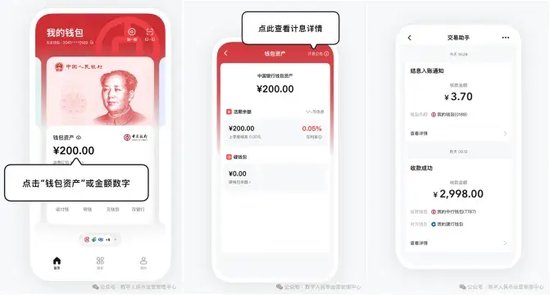
Core Viewpoint - The digital renminbi is officially upgraded to version 2.0 on January 1, 2026, transitioning from "digital cash" to "digital deposits," allowing for interest payments on wallet balances similar to traditional bank deposits [1][7][17]. Group 1: Interest Payment Mechanism - Ten operational institutions, including major banks, will pay interest on the balances of real-name digital renminbi wallets at the current savings account rate of 0.05% [3][4]. - The interest calculation rules will align with those of traditional bank savings accounts, with quarterly interest payments on specific dates [4][10]. - Only real-name wallets will benefit from interest payments, while non-real-name wallets will prompt users to upgrade for earning interest [2][4]. Group 2: Digital Renminbi App Upgrade - The digital renminbi App has been upgraded to version 2.0, enhancing functionality and user experience, including personalized features and better management of deposit-type digital renminbi [3][4]. - Users can check their wallet assets, including interest rates and quarterly interest information, through the app [4][10]. Group 3: Regulatory Framework and Operational Changes - The upgrade is driven by the People's Bank of China's action plan to strengthen the management and service system for digital renminbi [8][9]. - The digital renminbi will now be considered a liability of commercial banks, allowing them to manage it as part of their asset-liability operations, thus providing similar safety guarantees as traditional deposits [10][11]. - The action plan also emphasizes the importance of compliance with anti-money laundering regulations and the establishment of a robust digital currency infrastructure [9][10]. Group 4: Future Prospects and Applications - The digital renminbi is expected to expand its functionality beyond payments to include the purchase of traditional financial products [1][17]. - The transition to digital deposits will enhance the digital renminbi's role in the financial ecosystem, allowing for broader applications and integration with emerging technologies [11][17]. - The digital renminbi supports offline payments, ensuring transaction capabilities without internet access, which distinguishes it from traditional payment methods [16].
平安付跻身2025上海市互联网综合实力企业前50强
Jin Rong Jie· 2026-01-04 04:55
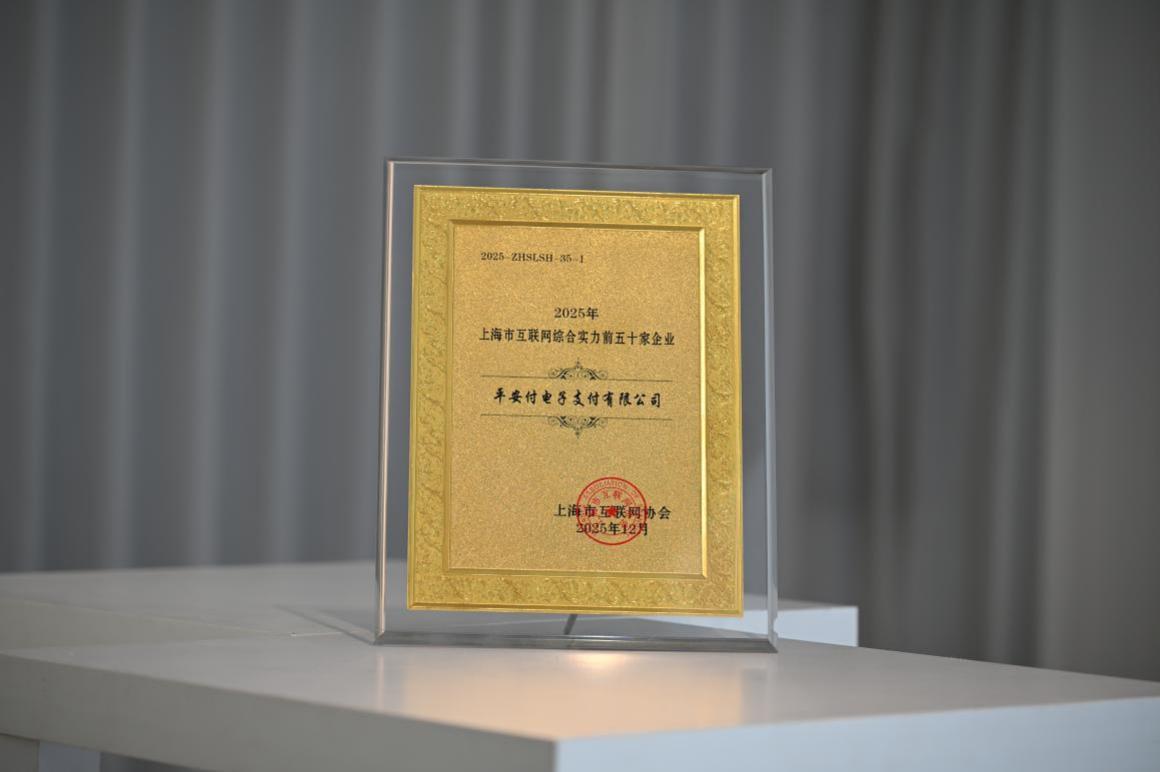
近日,上海市通信管理局指导,上海市互联网协会组织的"数智领航,沪链全球——上海市互联网企业年会暨高质量发展论坛"正式举行,现场发布了2025 《上海市互联网企业综合实力指数报告》,揭晓"2025年上海市互联网综合实力前50强企业和成长型10强企业"榜单。平安壹钱包旗下平安付电子支付有限公 司(下称"平安付")凭借优异的数字支付能力和科技应用水平,成功跻身前50强,同榜企业包括拼多多、携程、叮咚买菜及饿了么等。 截至目前,平安付累计服务的支付账户超4亿,支持平安综合金融及外部金融机构的支付服务领先同业,发行品牌联名预付卡50余种,拥有超220万客户信 赖。同时,平安付依托平安集团与平安壹钱包资源能力,积极践行乡村振兴带动消费帮扶10亿元,展现企业社会责任担当。 2025年上海市互联网综合实力前50强企业榜单的发布,不仅彰显了上海互联网行业的蓬勃发展,也体现了上榜企业在市场竞争中强劲势头。报告显示,上海 市互联网行业发展呈现出六大特征。在业务收入、营业利润、研发投入、财务风险防控、人才建设及业态分布等方面,这些上榜企业各有所长,实力强劲。 2024年榜单前50家企业互联网业务总收入已达7205亿元,且营业利润连续 ...
数字人民币与微信支付宝:支付领域的革新与共存
Sou Hu Cai Jing· 2026-01-04 03:57
在数字化浪潮席卷全球的当下,支付方式正经历着前所未有的变革。数字人民币作为中国央行发行的法定数字货币,与微信、支付宝这两大第三方支付平 台,在支付领域形成了三足鼎立的格局。它们虽同为支付工具,但在本质属性、技术架构、使用场景、政策目标等多个维度上存在着显著差异,共同塑造着 中国支付市场的多元生态。 微信支付和支付宝则更注重场景深耕,尤其是在社交场景和小额转账中具有独特优势。微信支付与社交场景深度绑定,用户可以在聊天过程中直接完成转账 或发送红包,无需切换应用,这种无缝衔接的设计极大提升了在熟人之间进行小额资金往来时的便利性。例如,在群聊中点击"+"号,选择"红包",设定总 金额和数量,发送后群成员可即时领取,整个过程完全嵌入社交流程。支付宝则定位为综合性数字生活平台,提供了更为全面的金融及生活服务功能,适合 对理财、信贷有需求的用户。用户进入支付宝首页,可直接访问"余额宝"进行现金管理,查看收益情况;点击"花呗"入口,可查看当前额度、账单详情,并 设置还款提醒;通过"信用卡还款"功能,添加多张银行卡并设置自动还款计划,避免逾期影响信用记录。 数字人民币的政策目标旨在提升支付系统的效率和安全性,促进普惠金融发展 ...
数字人民币能计利息了!对你的钱包有何影响?
新华网财经· 2026-01-03 04:22
Core Viewpoint - Starting from January 1, 2026, digital yuan wallet balances will earn interest based on current deposit rates, marking a transition from "digital cash" to "digital deposit currency" [2][4]. Group 1: Significance of Digital Yuan Interest - The introduction of interest on digital yuan balances positions China as the first economy to pay interest on central bank digital currency (CBDC), which is expected to enhance user willingness to adopt digital yuan and expand its usage scenarios [2][4]. - Major state-owned banks, including ICBC, ABC, CCB, BOC, PSBC, and BOCOM, will implement this interest policy, aligning with the current deposit interest rates [4]. Group 2: Current Applications and Features - Digital yuan has established a presence in various sectors such as retail, dining, education, public services, and cross-border settlements, showcasing a versatile application model that integrates both online and offline capabilities [5]. - The digital yuan operates on a broad account system, supporting a decoupled banking account function, and is equivalent to physical RMB, possessing value characteristics and legal tender status [9]. Group 3: Payment Methods and User Experience - Users can download the "Digital Yuan" app, register a wallet, and convert bank funds into digital yuan through the app [11]. - Payment methods include QR code payments, NFC "tap-to-pay," and direct transfers using phone numbers or wallet IDs, transitioning from a cash-like 1.0 version to a deposit-like 2.0 version [12]. Group 4: Advantages of Digital Yuan - The issuance cost of digital yuan is lower as it eliminates the need for physical currency production, thus reducing costs associated with printing and maintaining physical money [20]. - Digital yuan transactions are recorded, aiding in the fight against illegal activities [21]. - The digital currency facilitates international transactions, promoting the global use of the RMB [22]. Group 5: Comparison with Other Payment Methods - Unlike WeChat and Alipay, which serve as wallets for various currencies, digital yuan functions as a direct form of money, enhancing the payment experience [16][18]. - Merchants will be required to accept digital yuan, while they can refuse other payment methods like WeChat and Alipay, which may incur service fees [25].

财经观察|今日起,数字人民币开始计息!对你我生活有何影响?
Sou Hu Cai Jing· 2026-01-01 08:59
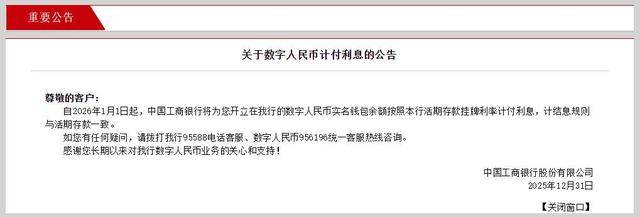
今天,数字人民币正式迈入"计息"时代,用户实名钱包里的余额能"钱生钱"了。 图片截取自工商银行官方网站 六大行集体官宣 图片截取自农业银行官方网站 2025年12月31日,工商银行、农业银行、中国银行、建设银行、交通银行、邮储银行集体发布关于数字 人民币重磅公告。公告称,自2026年1月1日(含)起,将为客户开立在该行的数字人民币实名钱包余 额,按照活期存款挂牌利率计付利息,计结息规则与活期存款一致。 这意味着,存放在这些钱包里的数字人民币,将和传统银行活期存款一样,开始产生收益。目前,几家 大行官网显示的活期存款挂牌利率为0.05%。 图片截取自工商银行官方网站 值得注意的是,并非所有数字人民币钱包都能享受计息。 数字人民币现金型1.0版迈入存款货币型2.0版,一大变化点是由央行对客户负债,变成了商业银行对客 户负债。为何会出现这一变化? 中国人民银行党委委员、副行长陆磊在撰文中指出,数字现金作为中央银行对公众的负债,理论上不需 要商业银行等金融机构参与运营维护。但是在研发试点中,数字现金与流通中纸币的权责关系存在明显 差异。商业银行是数字钱包开立、场景开发和技术维护不可或缺的运营者,其服务伴随数字现金流通 ...



重大调整!数字人民币将从数字现金时代迈入数字存款货币时代
Guo Ji Jin Rong Bao· 2025-12-29 14:17
在总结十年研发试点经验基础上,中国人民银行出台了《关于进一步加强数字人民币管理服务体系 和相关金融基础设施建设的行动方案》(下称《行动方案》)。《行动方案》在DC/EP(数字货币/电 子支付)理论框架下进一步优化了"双层架构"。在顶层中央银行端,数字人民币由中央银行负责业务规 则、技术标准制定,承担相关基础设施的规划、建设和运营。 数字人民币迎来重大调整! 12月29日,记者获悉,新一代数字人民币计量框架、管理体系、运行机制和生态体系将于2026年1 月1日正式启动实施,数字人民币将从数字现金时代迈入数字存款货币时代。未来的数字人民币是中央 银行提供技术支持保障并实施监管、具有商业银行负债属性,以账户为基础、兼容分布式账本技术特 点,在金融体系内发行、流通的现代化数字支付和流通手段,具备货币价值尺度、价值储藏、跨境支付 职能。 《行动方案》还明确了"账户体系+币串+智能合约"的数字化方案,提出升级现有账户体系,在新 型账户(数字人民币钱包)基础上推动新兴技术应用,提升人民币发行、流通、支付等各环节的数字 化、智能化水平,升级数字人民币智能合约生态服务平台,支撑构建智能合约开源生态体系。 此外,《行动方案》明确 ...
数字人民币正式进入2.0版:从数字现金时代迈入数字存款货币时代
Zhong Guo Jing Ying Bao· 2025-12-29 06:52
中经记者 许璐 李晖 北京报道 12月29日,中国人民银行党委委员、副行长陆磊在《金融时报》发表文章《守正创新 稳步发展数字人 民币》。 陆磊在文章中表示,在总结十年研发试点经验基础上,中国人民银行出台《关于进一步加强数字人民币 管理服务体系和相关金融基础设施建设的行动方案》(以下简称"《行动方案》"),新一代数字人民币 计量框架、管理体系、运行机制和生态体系将于2026年1月1日正式启动实施。 陆磊指出,新的制度安排在"双层架构"基础上,明确了客户在商业银行钱包中的数字人民币是以账户为 基础的商业银行负债,标志着数字人民币由现金型1.0版进入存款货币型数字人民币2.0版。 数字人民币处于领跑态势 陆磊指出,当前,境内和跨境数字人民币试验推广取得积极成效,在各国中央银行试验推进的项目中, 数字人民币处于领跑态势。 2016年,中国人民银行提出了具有数字货币特征的电子支付工具(DC/EP)的法定数字货币理论框架构 想,审慎科学稳健试点探索数字人民币(e-CNY)管理体系和运行机理。经反复论证和开放试点,初步 构建了数字人民币的生态体系,走出了一条以中央银行为主导,依托商业性金融机构和现有支付体系, 融合最新技术 ...
马尔代夫银行(BML)、马旅游局与中国银联签署合作协议
Shang Wu Bu Wang Zhan· 2025-12-21 16:43
(原标题:马尔代夫银行(BML)、马旅游局与中国银联签署合作协议) 马尔代夫银行(BML)、马旅游局与中国银联签署合作协议,启动联合营销 计划,提升数字支付体验并加强旅游推广。三方将面向银联持卡人联合推广马 旅游形象,吸引更多游客。根据协议,BML被指定为银联在马本币结算代理 行,为深化合作及未来银联卡发行奠定基础。BML表示,此举将进一步完善数 字支付生态,助力旅游业发展。 ...